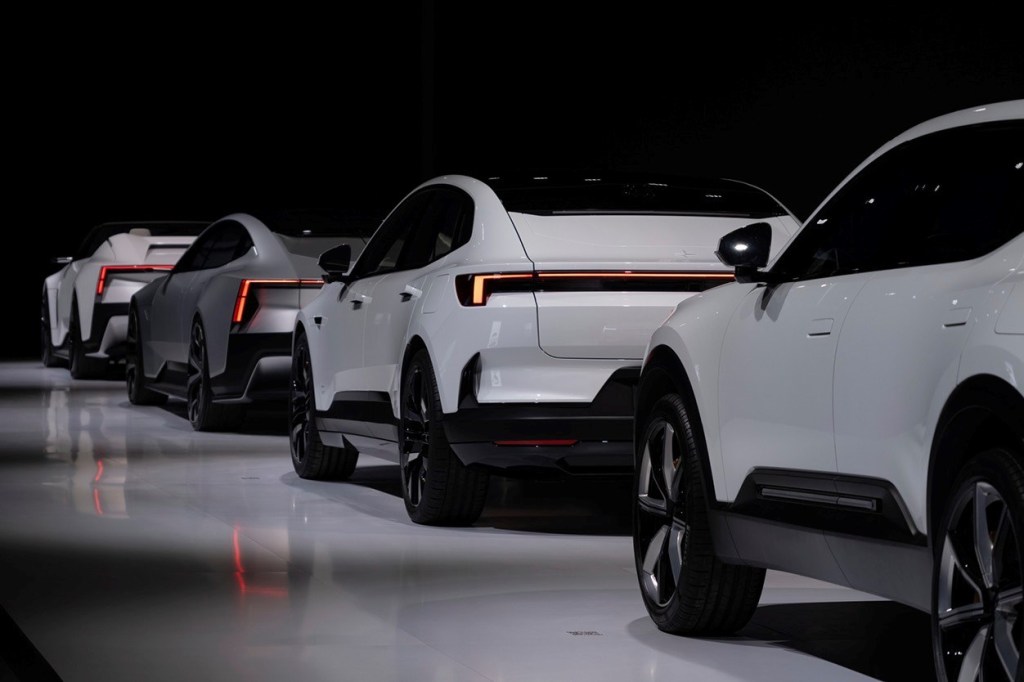
EV (Dis)interest

By Gary S. Vasilash

One of the things that isn’t talked about much is the fact that electric vehicles really aren’t that popular unless they come from Tesla.

Flying in the face of that is a finding of Kelley Blue Book that in Q3 2023 EV sales in the U.S. hit 313,086 units, a 49.8% increase over Q3 2022. Such a jump means interest, right?

Well, the total number of EVs sold in Q3 represents 7.9% of total industry sales.

In other words, 92.1% of the vehicles people bought in Q3 weren’t electric.

And to the point of Tesla’s sway over the market—even though KBB saysTesla’s share of market tumbled to 50%–is that KBB acknowledges“Tesla’s price cuts have moved the market, pushing electric vehicle prices down more than 22% year over year, from $65,295.”

That’s right: a single company moves the entire segment.

(And in case you’re wondering, in October, according to KBB, the average transaction price for an EV was $51,762 while the ATP for a non-lux vehicle was $44,331.)

Drilling down a bit more, it is bracing to discover that in terms of share of the EV segment, the mainstream brands really don’t have much in Q3.

  • Chevrolet, 5.1%
  • Ford, 6.7%
  • GMC, 0.4%
  • Hyundai, 6.3%
  • Kia, 3%
  • Nissan, 1.9%
  • Subaru, 0.9%
  • Toyota, 0.9%
  • VW, 3.4%

And know that the 6.7% for Q3 Ford racked up represents 20,926 vehicles: 14,842 Mach-Es, 3,503 F-150 Lightnings and 2,617 E-Transits.

Ford sold 23,931 Mavericks in Q3, of which 56.5% were hybrids. Somehow that 20,926 EVs sold—encompassing three models, one of which is based on the best-selling pickup Since Time Began—seems more than anemic.

So even before Ford started talking about having to make adjustments as a result of the salary and benefit increases in the proposed agreement with the UAW, the auto company suddenly found things like the F-150 Hybrid more interesting.

When I ask knowledgeable people about the subject, they point out that much of the EV development and promotion is predicated on government regulations, more than organic customer demand. Look at those puny percentages up there, slices of the 313,086 vehicles sold by companies ranging from Audi to Volkswagen.

There’s not much there there.

Yes, there will be more EVs offered. More EVs sold.

But—again, absent Tesla—the market demand isn’t at all what it sounds like it should be.

Another example of this not-big demand is something that some point to as a real success story: the Chevrolet Bolt EV.

Here are the sales figures for the past five years:

  • 2018: 18,019
  • 2019: 16,418
  • 2020: 20,754
  • 2021: 24,828
  • 2022: 38,120

Whoa! you might think. From 2018 to 2022 the sales of the Bolt EV doubled! Remarkable.

But there are a couple of elements that need to be considered.

For one thing, Chevy added a (slightly) different body style, the more ute-like Bolt EUV in 2021, which certainly added some interest to the model(s).

And in June 2022 General Motors cut the price of the Bolt to persuade customers to buy one—sort of like what Elon has been doing.

Had Dodge made a substantial price reduction to the SRT Hellcat Redeye Widebody, the Brotherhood of Muscle would exponentially increase its membership of all genders and municipalities throughout the country would have a sharp uptick in revenues from speeding tickets.

If there is a change in the political situation, those regulations that are driving EV development and sales and those incentives that do the same (what if the government offered $7,500 tax credits for the purchase of a Hellcat?), the question of actual market demand is really going to matter.

Will Minivans Make It Once Again?

By Gary S. Vasilash

One of the things that isn’t often cited with regard to the forthcoming VW ID. Buzz is that it is a minivan. Yes, an electric minivan. But nonetheless the type of vehicle that has more than its share of people who say they’d never be caught driving one.

In the U.S. market, the brand that really brought the minivan to the market back in 1983, Chrysler, is still there with the Pacifica. There is a plug-in hybrid option available for the Pacifica.

Toyota has the Sienna as a hybrid-only minivan.

And there are the Honda Odyssey and the Kia Carnival, although these are ICE-only (for now, anyway).

Which brings us to what they’re calling an “MVP,” or “multi-purpose vehicle,” but which one glance at its configuration says “minivan”: the Volvo EM90.

Volvo EM90: A minivan by any other name is still. . .a minivan. (Image: Volvo)

Volvo describes it as having an interior design that makes it “your living room on the move.”

For years (hard to imagine that the architecture is 40 years on) minivans have always had the most versatile and capacious interiors among light vehicles.

Will electrification make them more appealing to customers such that people will be boastful, not sheepish, about that comparatively boxy three-row vehicle in the driveway?

One thing about the Volvo EM90, however.

It is being launched in China and there has been no announcement it is going to be available elsewhere.

Perhaps if the ID. Buzz becomes a hit in the U.S. market Volvo may offer the EM90 there, as well.

Perhaps.

Polestar Says It Out Loud

By Gary S. Vasilash

Polestar is an electric vehicle company that, in effect, spun out of Volvo, but Volvo is owned by Geely, but is traded on NASDAQ (as PSNY), so let’s not even try to sort out where the Gothenburg, Sweden-headquartered company exists. (It has announced it will build the forthcoming Polestar 3 in a plant in South Carolina next year. . .the Volvo plant in South Carolina.)

Anyway, yesterday as part of its Q3 earnings presentation it announced a “strengthened business plan.”

Which is notable because the company has stated it is going to put margins ahead of volume.

(Image: Polestar)

Thomas Ingenlath, Polestar CEO, stated, “Margin over volume is our way forward, supported by a gorgeous line-up of four exclusive performance cars.”

Meaning that Polestar is going to focus on the premium end of the EV market.

It figures that as of 2025, when it has four models in production, it will have an annual volume of 155,000 to 165,000 cars, which in and of itself is a rather small number and is smaller when you take into account it is selling globally.

Consider This

According to Kelley Blue Book, in September the average transaction price of a luxury vehicle in the U.S. was $62,342, down 6.2% from September 2022.

Here’s the key to that: “Luxury price declines in 2023 are primarily driven by aggressive price cuts at Tesla, the luxury market leader.” The Model 3 price was down 26% compared to the previous year.

And in the EV space, the average transaction price in September was $50,683, or down about 22% from the previous year “led again by market leader Tesla.”

(Tesla, because of its margins, is really the only OEM that can build mass volumes of EVs and afford to cut its prices.)

The point is, the EV market in the U.S. is pretty much a premium market.

And in the U.S., EVs are pretty much a premium proposition.

When Chevy announced the Equinox EV it made much of the fact that it was going to be a $30,000 vehicle, but it covered itself with “about” and announced a starting price of $34,995. While that is below the average price of an EV, what are the odds there will be many $35,000 Equinox EVs available?

When Chevy announced the Silverado EV work truck earlier this year, pricing was to be just below $40,000, but as reality set in, the price is now above $70,000.

EVs are an expensive proposition.

Let’s face it: until there is some massive change in battery technology (batteries are where most of the cost of an EV is found), the EV market is going to be characterized by prices higher than the ICE market—KBB found that the average transaction price for compact cars in September was below $30,000.

Credit to Polestar for saying it is going to put its profit ahead of volume, something other OEM execs don’t seem to want to say out loud.

Serious Concerns About Money

By Gary S. Vasilash

Although it isn’t exactly “buyer’s remorse,” according to a survey conducted in the U.K., 50% of vehicle buyers in the past 12 months express concern about whether or not they’re going to be able to afford the financing.

Specifically, when asked “How concerned are you about whether you can afford the payments under your current finance agreement?”

  • 10% responded “very concerned”
  • 40% responded “somewhat concerned”

Notably, in the “somewhat concerned” cohort, 55% were younger buyers. Perhaps reflecting a certain financial conservatism, only 16% of those 65 or older expressed that.

The survey was sponsored by ALPHERA, a part of BMW Group Financial Services.

While not auto-specific, findings of research conducted in the U.S. by Experian are more concerning.

It found that 68% of U.S. adults have or are suffering from “financial trauma.”

Including “negative thoughts, flashbacks and anxiety.”

And, again, the younger cohorts stand out:

  • 73% of Gen Z adults
  • 77% of Millennials

Seems like greater consideration before hitting the “buy” button might alleviate some concerns, both in the U.S. and the U.K.

The Coming EV Cost Challenge

By Gary S. Vasilash

B-segment cars are not big in the U.S. Of course, these cars, which are under compacts (e.g., Honda Civic, Toyota Corolla, Hyundai Elantra), are physically small, as in things like the Honda Fit, Toyota Yaris and Hyundai Accent, all of which have departed the scene in the U.S.

However, the B-segment has a solid following in Europe probably not because Europeans just like to wedge themselves into smaller vehicles but because of things like high gasoline prices and parking challenges.

The Boston Consulting Group (BCG) recently performed an analysis of the costs of producing B-segment electric vehicles (EVs) for the European market.

This is apparently quite a challenge, as they found:

“the price difference between a B-segment EV and a similar ICE vehicle is greater than the price differential for other EV and ICE vehicle segments. An analysis of recent French price data found that the average retail price premium on a B-segment EV compared to its ICE counterpart is around 75% (€36,800 vs. €20,900). In the C- and D-segments, the premium is 47% and 11%, respectively.”

People who might be inclined to buy a B-segment EV would likely be disinclined once that price delta is seen at a dealership.

BCG finds that material costs are a big driver, with the material costs for an EV being about 65% higher than the materials for an ICE vehicle.

Batteries play a big role in this.

So as the BCG analysts looked at how prices can be managed, they pointed out, of course, that reduction in battery costs through things like using lithium iron phosphate batteries (LFP) instead of nickel-manganese-cobalt are beneficial.

But there needs to be more done, from reducing the number of vehicle variants to sharing parts across models.

And then there is the manufacturing cost input that must be managed.

The BCG analysts note:

“In the manufacturing realm, restructuring assembly lines to focus solely on producing EVs will automatically lower assembly costs. In both greenfield and brownfield EV plants there are 75% fewer engine preparation and 25% fewer mechanical preparation steps per vehicle compared to ICE factories. This, in turn, improves productivity and factory output while decreasing the number of full-time employees.”

Again, this is about B-segment EVs in Europe.

But it makes one wonder about the recent tentative agreements between the UAW, Ford, GM and Stellantis.

In the BCG model, “decreasing the number of full-time employees” is arguably a positive in that it would reduce costs.

In the new model created by the UAW-OEM negotiators, that is something that is not likely to be realized.

Which could prove to be challenging to the OEMs in the U.S., even when producing much larger EVs.

Faced with competitors who can, this could be rather problematic when pricing those new domestic EV models.

Honda Motocompacto: Ridden

By Gary S. Vasilash

The starting price of an iPhone 15 Pro is $999.

Which puts the starting MSRP for the Honda Motocompacto electric scooter–$995—into some context.

Chances are, the kind of people who’d opt for that phone model would be ideal for the personal transportation device—and yes, it is more of a device than a traditional scooter, especially given that the Motocompacto can be folded into an easy-to-lug (it weighs 41 pounds, so while you’re likely able to carry it, it probably won’t be for a great distance, which is where the lugging comes in) rectangular (self-) container measuring 3.7 inches wide, 21.1 inches high, and 29.2 inches long: think of it is a narrow suitcase.

The scooter folds into itself so there is a tidy package ready to be put in the truck of a car (ideally a Honda or Acura, as dealers of those brands are where the scooter is sold) for the next last-mile journey.

You meet the nicest people on a Motocompacto. (Image: Honda)

But the point of the scooter is to provide quick urban transport, not to be transported (although that folding is quite clever).

It has a range of 12 miles, a top speed of 15 mph, and it can accommodate a rider who weighs 265 pounds.

Once the battery is exhausted, it takes 3.5 hours to recharge from a traditional plug in the wall.

The typical electric scooter is designed for the rider to be standing up when riding it.

The Motocompacto is designed so the rider is sitting.

This does a couple of things.

  1. It lowers the center of gravity, which facilitates balance
  2. It allows the rider to be able to use their legs to recover if they feel they’re going out of balance

If you’re standing and the platform under your feet is traveling at speed and something goes awry, it could be the makings of a serious tumble.

If you’re sitting on a Motocompacto that is moving along, it is far easier to maintain one’s physical composure (even though one may be thinking “Holy sh**!”).

Riding Is Easy

It really is. No instructions required.

Need for Speed

While 15 mph might seem snail-slow, when your posterior is comparatively close to the wide open ground, it is quick. The Motocompacto is FWD, and it can get to that top speed in 7.5 seconds.

You’ve Heard of Honda

According to data analysis company Tracxn, there are some 450 electric scooter manufacturers. Odds are you’ve heard of not many of them. And odds are you’ve seen reports of late that indicate some e-scooters are bursting into flames. Seems to me that it would be a better investment—even if that investment is higher—to go with a Honda than something built by a company that started up a few months ago and very well may cease to exist a few months from now.

Hyundai and Hybrids

By Gary S. Vasilash

In reporting its October sales, Hyundai noted that the company that was once thought of mainly in the context of its style-setting Sonata sedan (remember when the 2011 model came out with its “Fluidic Sculpture” styling that made all other sedans seem as though they came from an earlier age?) had 81% of its retail mix in. . . SUVs.

Of course, that has a little something to do with the fact that in the car category there are the Sonata, Elantra and recently introduced IONIQ 6 EV sedan, while in the SUV category there are:

  • IONIQ 5
  • Kona
  • Nexo
  • Pallisade
  • Santa Fe
  • Tucson
  • Venue

(There is also the Santa Cruz pickup, for purposes of providing a look at the entire showroom.)

Hyundai Tucson PHEV (Image: Hyundai)

While there were 9,456 Elantras sold—an 11% increase compared with October 2022 sales—there were 9,700 Santa Fes sold—and that’s a decrease of 10% compared to last year and it still is more than the Elantra sales.

But what is more interesting in some regards is this observation from Randy Parker, Hyundai North America CEO:

“This was the best-ever October for total and retail sales for our segment-leading Tucson HEV, Tucson PHEV, Santa Fe HEV and IONIQ 5 SUVs along with our Elantra HEV.”

Yes, hybrids are doing increasingly well at Hyundai, though there is also that full battery-electric IONIQ 5.

Overall, electrified vehicles represented 21% of Hyundai’s October sales, a 49% year-over-year (YoY) increase.

In terms of the hybrid YoY increases:

  • Elantra HEV:          +15%
  • Santa Fe HEV:        +81%
  • Tucson PHEV:         +170%
  • Tucson HEV:           +14%

Odds are those OEMs that decided to deemphasize hybrids to promote full electric vehicles are giving their portfolio strategy a hard re-think.

Biden and Belvidere

“Congratulations to Stellantis and the UAW for their dedication and focus in coming together to reach a hard-won tentative agreement. The significance of this historic achievement coming just days after the UAW and Ford reached an agreement cannot be overstated.

 “This tentative agreement includes a number of important provisions including a commitment to reopen the Belvidere plant in Illinois, which will bring good, union jobs back that community. The parties are also charting a future of good middle-class jobs in battery manufacturing, consistent with the President’s vision for a just transition where building a clean economy and creating good union jobs go hand-in-hand.

 “Today’s agreement demonstrates what is possible when workers have a voice and a seat at the table. On behalf of the most pro-worker, pro-union administration in history, we applaud the parties on what they have achieved.”—Julie A. Su, U.S. Acting Secretary of Labor

A couple of considerations.

  1. What does it matter that there is the self-proclaimed “pro-worker, pro-union administration in history”? Wasn’t this contract worked out by the UAW and Stellantis? How was the Biden Administration involved? One of the points that the UAW used in bargaining was that the Administration is shoveling money into battery plants and while the OEMs can take advantage of that, there was no certainty that the workers would benefit from it, as that wasn’t written into the language of the Fed’s largess, only geography and material sourcing, not worker representation. Pro-labor?
  2. That plant in northern Illinois had been closed earlier this year because the Jeep Cherokee that was built there wasn’t selling. Obviously, making something that someone doesn’t want to buy is not a good idea. (OK: that only a few people want to buy.) According to UAW vice president Rich Boyer, the plant will build a midsize pickup and there will also be jobs at a battery plant in Belvidere. Should that midsize pickup be an electric pickup, given what’s happening in the market right now, that may put the workers back in the situation that had occurred with the Cherokee. EVs are not selling at the rate that had been anticipated, which is causing Ford to cut a shift from its F-150 Lightning production and GM to push back the construction of an EV assembly plant. Seems like more EVs isn’t what’s required at present. However, UAW president Shawn Fain pointed out: “We not only won the right to strike over plant closure, we won the right to strike over product and investment. That means if the company goes back on their word over any of these plans, we can strike the hell out of them.” Stellantis better hope its product planning is on target for Belvidere as well as its other U.S. plants.

Fisker: Emotional or Updateable?

By Gary S. Vasilash

Henrik Fisker is an automotive designer whose work includes the BMW Z8 and the Aston Martin DB9. And, of course, there was the Fisker Karma, the car that continued long after the Fisker Automotive ceased to exist. In 2016 Fisker Inc. was established.

Fisker Inc. says of itself: “Passionately driven by a vision of a clean future for all, the company is on a mission to create the world’s most sustainable and emotional electric vehicles.”

Fisker Inc.’s first vehicle, the Fisker Ocean, is an electric SUV. (The Karma was part of the way to clean: a hybrid.)

Fisker Ocean (Image: Fisker Inc.)

Henrik Fisker recently said something interesting (well, he’s probably said plenty of interesting things of late, but this one, in particular):

“In the 21st century, our vehicles are more like rolling computers than the cars of the past, so we need to ensure that our customers are seeing frequent improvements and updates to software.”

He was talking about having over-the-air (OTA) update capability for the Ocean.

When one thinks of a computer, the word emotional probably doesn’t come to mind (unless something has just gone seriously awry and there is a thought about throwing it against a wall).

Although Apple once designed computers that had form factors that were far more appealing (or off-putting) than the run-of-the-mill IBM or Dell—think of the colorful iMac G3, iMac G4, PowerMac G4 Cube—today the products are well-designed, but not particularly emotional.

Henrik Fisker is a chairman and a CEO as well as being a designer.

Consequently, he has to be concerned with what sells.

Which seems to be things that are OTA-capable.

Let’s hope the design doesn’t become an occasional afterthought.

EVs and Oil Investments

By Gary S. Vasilash

Although there seems to be a propulsive inevitability of the electric vehicle such that by the time 2030 arrives we’ll all be rolling around in electron-powered machines, there are a few things that are making this seem less. . .inevitable.

Last week ExxonMobil announced it is acquiring Pioneer Natural Resources, an oil and gas exploration and production company, for $59.5-billion.

As ExxonMobil described this: “Together, the companies will have an estimated 16 billion barrels of oil equivalent resource in the Permian. At close, ExxonMobil’s Permian production volume would more than double to 1.3 million barrels of oil equivalent per day (MOEBD), based on 2023 volumes, and is expected to increase to approximately 2 MOEBD in 2027.”

Or simply put: More access to more oil.

Today Chevron announced it is buying Hess Corp. for $53-billion. Hess “is a leading global independent energy company engaged in the exploration and production of crude oil and natural gas with leading positions offshore Guyana, the Bakken shale play in North Dakota, the deepwater Gulf of Mexico and the Gulf of Thailand.”

Chevron “produces crude oil and natural gas; manufactures transportation fuels, lubricants, petrochemicals and additives; and develops technologies that enhance our business and the industry. We aim to grow our traditional oil and gas business, lower the carbon intensity of our operations and grow new lower carbon businesses in renewable fuels, hydrogen, carbon capture, offsets and other emerging technologies.”

With Hess it will most certainly grow its traditional oil and gas business.

McKinsey & Company just released its “Global Energy Perspective,” which looks at the likelihood of the industrialized world meeting the goal of keeping global warming growth below 1.5°C. There are four scenarios about the energy transition, ranging from “Fading momentum” to “Achieved commitments.”

In all cases they predict that oil will peak in 2030.

But then there is a question of what happens next: what is the angle of decline by 2050?

It could be big: as much as a decrease of barrels of oil by 50%

It could be small: as little as a 3% decline.

Odds are ExxonMobil and Chevron are betting on something closer to 3 than 50.

Which leads to a bit of wonder about the rate of adoption of EVs in the U.S.

As of August, J.D. Power had the share of EV sales in the U.S. at 8.6%. That number is a bit opaque because Tesla accounts for 63% of all of those EV sales, so it is not like EVs that aren’t Teslas are growing in ubiquity. (Even Ford has taken a shift out of the production of the F-150 Lightning, and F-150s (well, with combustion engines) are otherwise produced at such a rate that other vehicle manufacturers can only look on with envy.)

So while the number is easily going to be greater than 3% come 2030, perhaps the idea that EVs will be 50% of the market by 2030 is a bit too optimistic.