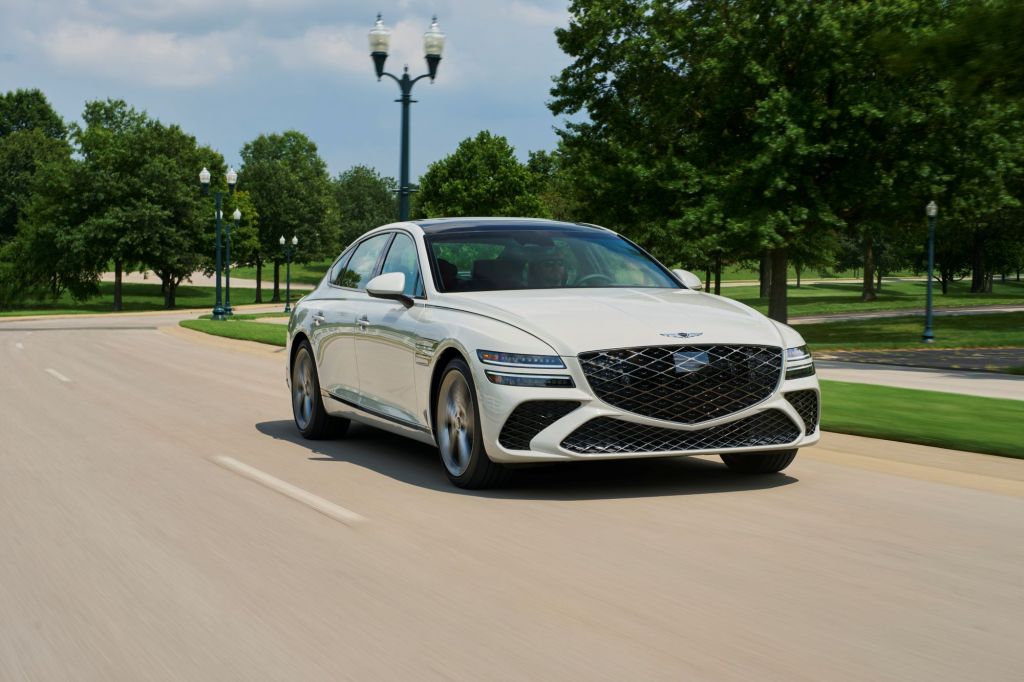
2026 Genesis G90 3.5T E-SC MHEV AWD

This is so cool, it almost seems fictional. . .

By Gary S. Vasilash

If you ever wondered what car Bruce Wayne would but, this is your answer.

According to his backstory, Wayne traveled to the “Orient,” including South Korea, where he trained in martial arts under a master named Kururgi. He also went to Japan, China, Thailand, and Nepal, not for the cuisine, but to pickup fighting skills. Still, you’ve got to believe he picked up some of the local culture, such as that which has given rise to this highly impressive sedan.

(Note: this would be the Clooney Wayne. Not Keaton or Kilmer, certainly. Bale is marginal. Affleck would like to. Pattinson—well, maybe the next movie will make that clear.)

The G90 is long, low, powerful.

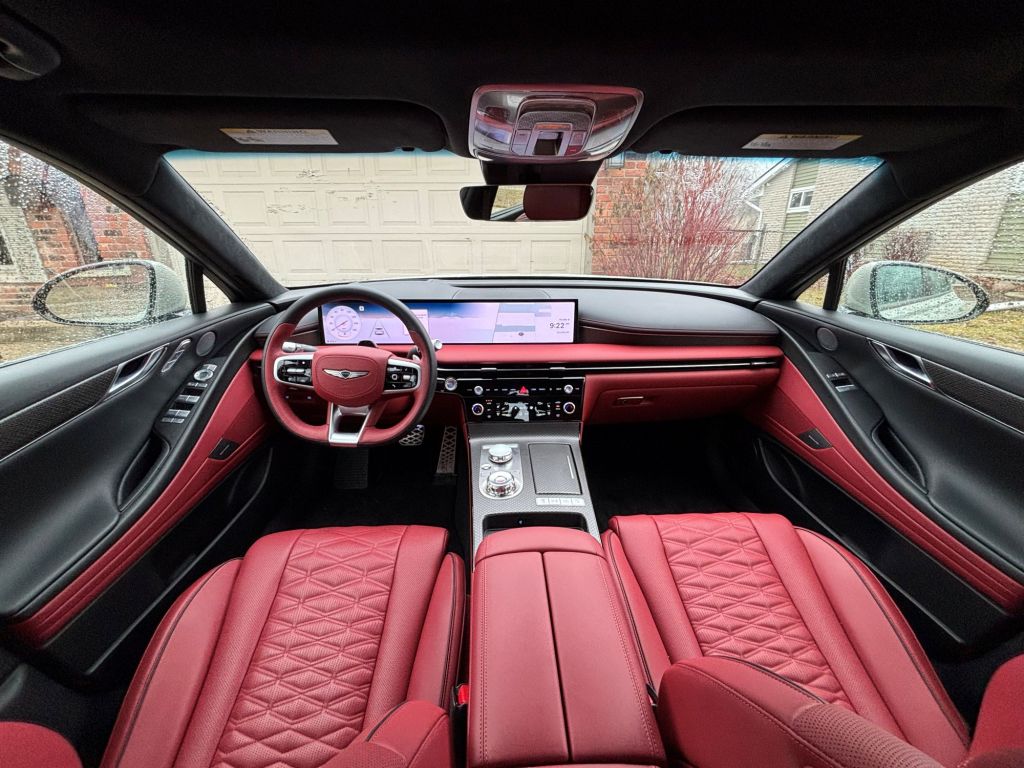
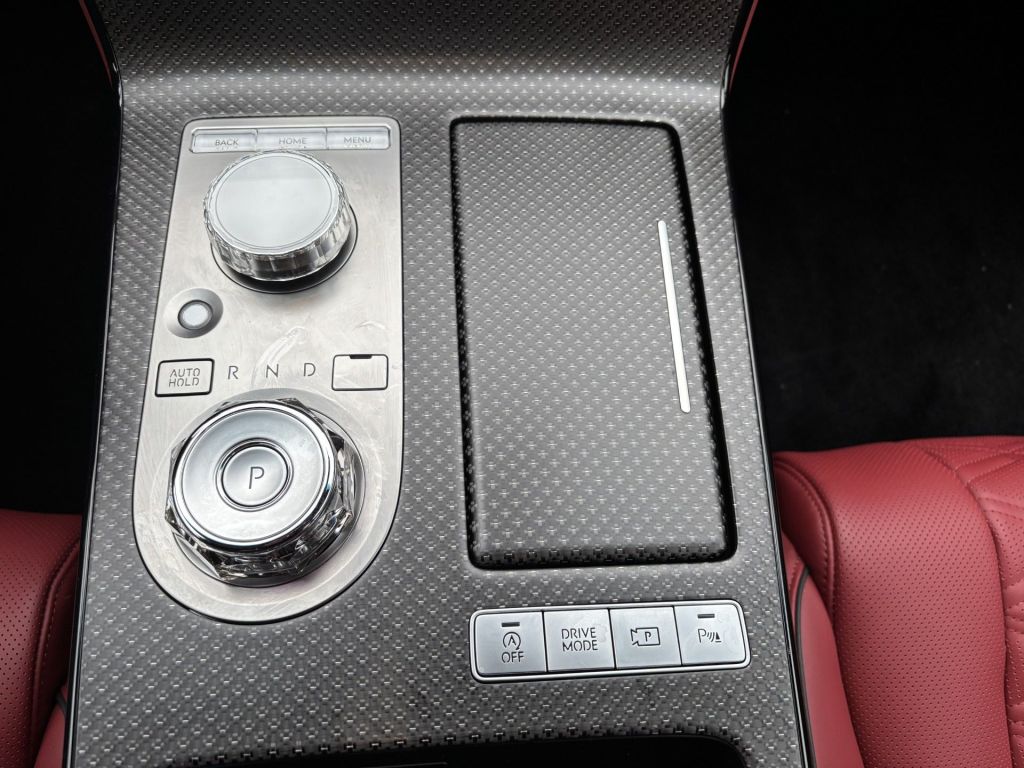
Details make the difference. (Images: Hyundai)

And the Prestige Black trim package makes this sedan something that seems like it would be seen in a movie, not in real life.

Yet there it is.

Impressive.

The exterior is in Vik Black, and black is the color of the 21-inch alloy wheels. The grille is dark chrome, as are accents and trims on the doors, fascias and elsewhere.

Inside, again, it is dark. In this case, Obsidian Black. The quilted semi-aniline leather seating is dark, as is the leatherette-wrapped upper instrument panel. And the microfiber headliner and A-pillars.

There is black ash wood trim on the doors with a “G-Matrix” pattern in brass color, an intricate design that goes to the point that this is something out of the ordinary.

It should go without saying there are screens (e.g., 12.3-inch HD infotainment screens), an impressive sound system (Bang & Olufsen), and wireless Apple CarPlay and Android Auto. But going back to something that is Batmanesque: there is fingerprint authentication, which allows the driver to start the G90 with a touch of a specific surface. (Yes, Alfred has stored the correct digital imprint so not just anyone can touch and go.)

And on the subject of going, the 3.5-liter V6 with an electric supercharger produces 409 hp and 405 lb-ft of torque, so you are moving in style and with alacrity.

An absolute Bruce Wayne feature is the electronically controlled suspension with road preview.

A camera surveys the road ahead and if any potholes or the like are detected, it signals the suspension controller that electronically adjusts the damping force of each wheel. It is always smooth.

Because this is a large vehicle—207.7 inches long, 76 inches wide, 58.7 inches high, and with a 125.2-inch wheelbase—there is rear-wheel steering that assists in maneuverability.

And while I suspect that the glass is thicker and the insulation more abundant, there is active noise control that makes use of the Bang & Olufsen audio system: microphones in the cabin monitor the noise and then the system sends out counteracting sound waves in real time so the unwanted sounds are canceled.

People often tell me reasons for electric vehicles over those with internal combustion engines are power and quietness. The G90 has both of those and when you depress the throttle you get more of a feeling of performance (perhaps the via slight, nearly imperceptible vibrations caused by all of those moving parts in the powertrain) than is the case in an EV.

And it must be admitted there is another reason why this is something of a Bruce Wayne vehicle: the MSRP, including freight, for this model is $107,895.

2026 Toyota Corolla Hybrid SE

It’s got nice looks and the fifth-generation Toyota hybrid system. A competent combo. . .

By Gary S. Vasilash

“What kind of car is that?” my brother-in-law asked as we arrived for Thanksgiving.

“A Toyota Corolla.”

“They sure have come a long way,” he responded, shaking his head with a bit of disbelief. “Corollas didn’t look like that before.”

Yes, that’s true. Previously, Corollas had a design that indifference could be an appropriate response to. Not bad. But not the sort of thing that would cause comment like that which took place in this instance.

Now the Corolla is sporty in its styling, which is remarkable for a vehicle that, in all manifestations, has an MSRP of under $30,000 (from the Hatchback SE at $24,180 to the Hybrid XLE at $28,940).

Some people may be surprised to learn that that’s a Toyota Corolla. The style is notable, as is the fact that this model is fitted with a hybrid system that makes stops at gas stations comparatively infrequent. (Image: Toyota)

///

And that there is a Corolla Hybrid makes the proposition for getting a highly fuel efficient vehicle that is sporty all the more interesting.

How efficient?

Well, here is the lineup and the EPA estimated fuel economy numbers for each:

  • LE/XLE: 53 / 46 / 50 city/highway/combined mpg
  • LE AWD: 51 / 44 / 48
  • SE: 50 / 43 / 47
  • SE AWD: 47 / 41 / 44

The Corolla Hybrid is powered by Toyota’s fifth-generation hybrid system. There is a 1.8-liter four-cylinder engine as the core element. With the attendant electrification the propulsion system produces 130 hp and 105 lb-ft of torque.

While the styling might make it seem as though the Corolla Hybrid is something that goes really, really fast and gets there really, really fast, the acceleration and overall performance is more conventional compact car.

But again, it allows you to quickly go past gas stations for a longer period of time than is the case of some even bigger vehicles from other OEMs who are still working out their hybrid strategies.

And the available all-wheel drive (there is a rear-mounted electric motor that kicks in when needed, not only when the sensors determine slippery conditions, but when starting from a stop and getting on the throttle) is certainly a good feature.

///

The vehicle as driven has the “SE Premium Package,” which means there is a 10.5-inch Toyota Audio Multimedia screen (the standard size is 8 inches), six audio speakers, a 12.3-inch digital gauge cluster, and a wireless charger.

While the steering wheel is wrapped with leather, the seats are “Sport Fabric-trimmed), a.k.a. cloth.

A helpful and useful standard feature is Blind Spot Monitor with Rear Cross-Traffic Alert, with the first part of that being helpful when driving and deciding whether to move from one lane to another and the latter when, say, backing out of a parking space at the grocery store, when you’re likely to have two full-size pickup trucks on either side of you.

After all, the overall height of the Corolla Hybrid is 56.5 inches, so you’re comparatively low.

That’s one of the sacrifices you make for sporty styling.

2026 Hyundai Palisade Hybrid Calligraphy

Some somewhat technical aspects of an immensely impressive three-row SUV. . .

By Gary S. Vasilash

The 2026 Hyundai Palisade Hybrid is the first deployment of the Hyundai next-generation hybrid system. Which is important to know simply from the standpoint that it has been offering hybrids in the U.S. market since 2011. It hasn’t stopped. And as this indicates, it has continued to work on the technology.

The Palisade Hybrid features a 2.5-liter turbocharged four-cylinder engine.  There are two electric motors, one that has the primary function of providing power to the wheels and the other, secondary, motor that supports starting and regenerative braking and power flow. All in, the result is system horsepower of 329 and 339 lb-ft of torque. The motors—know in the technical hybrid community as P1 (the starter motor, 17 hp) and P2 (the drive motor 72 hp) are integrated with the vehicle’s familiar—at least more familiar than Honda’s transmission-free two-motor hybrid system (there is a lock-up clutch deployed when needed) or the Toyota e-CVT—six-speed automatic transmission.

’26 Palisade Hybrid Calligraphy: looks great. Drive far (564 miles FWD; 528 miles AWD). (Image: Hyundai)

There are a couple things to keep in mind about what might seem to be an usual transmission choice.

One is that it provides a more natural driving “feel.” Odds are, even if you don’t think about it, you are used to discerning when a vehicle shifts gears when you accelerate (not so much when you decelerate). And it actually feels odd when you’re driving a vehicle with a CVT (now often with programmed steps to simulate a more natural, mechanical feel). (One reason why people driving an EV become surprised when they take it out for the first few times and look at their speedometer and see a high number is because there is linear acceleration: it just goes.)

Another is that they’re taking advantage of the mechanical advantage provide by the step-gear transmission. Know that the Palisade is a big vehicle. . .

  • 116.9-inch wheelbase
  • 199.2 inches long
  • 78 inches wide
  • 69.5 inches high

. . .that offers plenty of interior space. . .

  • 159.6 cubic feet of passenger volume
  • 19.1 cubic feet of cargo space behind the third row

. . .and provides the ability to tow 4,000 pounds.

As this is sort of techy with that P1 and P2, it is also worth knowing (even if it isn’t wholly understood) that the 2026 Palisade makes extensive use of third-generation steel (average strength 69.2 kgf-mm2). What this means is the structure of the vehicle is remarkably solid, which is helpful when it comes to minimizing any squeaks and rattles from the structure (they take care of things like road noise with an extensive use of sound-absorbing material and thicker glass on the windshield, front doors and tailgate).

Also, by using hot-stamped components (most stamping for vehicles is done at room temperatures, but some of the steels used in the Palisade have to be heated up to make them more ductile so they can be stamped—otherwise they might break the dies), the cage structure adds safety, which is an important thing for a people-mover.

The Palisade comes in a gas-only version. That has a 287-hp V6 and an eight-speed automatic. In the front-drive setup it provides 19/25/21 mpg city/highway/combined and 18/24/20 mpg for the AWD version.

The Palisade Hybrid provides 31/32/31 mpg in the FWD configuration and 29/30/29 mpg in AWD.

A significant difference. And a key reason why the Palisade Hybrid is a notable vehicle for today.

2026 Toyota Corolla Cross XSE

Considering the Corolla. . .

By Gary S. Vasilash

Although people who live in places like southeastern Michigan would probably answer the question “What is the best-selling automotive nameplate of all time?” with “Ford F-150” because there are so many of them evident on the roads and in the driveways (in fact, it almost seems as though the “most people” have one), that is not the right answer.

The right answer is “Toyota Corolla,” the compact car that can.

Even though the F-Series has been available since 1948 and the Corolla since 1966, the Corolla has about 20% more sales (~50 million v. ~40 million), even with the 18-year difference in availability.

That’s largely because whereas there is a huge concentration of F-150s (and yes, Chevy SIlverados and Ram 1500s) in places like southeastern Michigan, the Corolla is available on five continents. (There is yet to be a Toyota dealership in Antarctica.)

Even though many people maintain there is waning interest in cars—especially compact cars—because everyone wants trucks or crossovers, there is still immense interest in cars.

Consider: through Q3 2025 Toyota sold 179,983 Corollas. GM’s Buick Div., which offers only crossovers, had sales of 156,835.

But this is not to say that the folks at Toyota don’t recognize a couple of things, like the value of the Corolla badge and the interest in crossovers.

So it has on offer the Corolla Cross which, too, is doing well in the U.S. market. Through Q3 it outsold the F-150’s little brother, the Ranger: 73,341 to 48,278.

Now there’s another aspect to the Toyota approach to the market, which in its case is a global market. (Yes, the Corolla Cross is available around the world, too.)

Toyota has not only maintained its hybrid offerings, but it has expanded them throughout most of its lineup, including to things like the Corolla Cross. While there have been some people who were critical that the company wasn’t going “all-in” on electric vehicles in a way some of its competitors seemed to be, because Toyota does have more of a global view than some of its competitors, it recognizes that EV charging isn’t as everywhere convenient as gasoline, so hybrids are a sensible alternative.

2026 Corolla Cross Hybrid XSE. Note the available Cavalry Blue body color and Jet Black roof. Also the hexagonal pattern of the upper grille is specific to the hybrid trim. (Image: Toyota)

And the U.S. market is certainly interested in the hybrid powertrain offerings. Of the Corollas Crosses sold through the first quarter 24,594 are hybrids, which is more than the Chevy Blazer EV, at 20,825 or the F-150 Lightning, 23,034 (not that anyone is likely to cross-shop a pickup with a compact crossover).

The Corolla Cross is categorized as a crossover. Presumably that has a lot to do with ground clearance. That is, a Corolla sedan has 5.3 inches of ground clearance and the Corolla Cross 8 inches, which is just 0.1 inch less than that of a RAV4, which is clearly a crossover.

But the Corolla Cross and the Corolla sedan are both built on the same platform, TNGA-C, whereas the RAV4 is based on the TNGA-K, which goes to the point that the Corolla Cross really drives, well, like a car, albeit with a higher seating position for better visibility.

The Corolla Cross Hybrid (it is also offered with no electrification of the 2.0-liter engine) provides a system horsepower of 196 net, which is reasonably peppy for the vehicle. What is more to the point of it vs. the standard is its superior fuel economy: 46/39/42 city/highway/combined miles per gallon for the hybrid and 31/33/32 mpg for the standard engine.

It is also worth noting the Hybrid—available in three trim levels—are all all-wheel drive, using Toyota’s 5th Generation Hybrid System. (The whole Toyota “continuous improvement” approach is something it has been applying to its hybrid systems, which can certainly provide consumers with a sense of confidence.)

The 2026 Corolla Cross Hybrid XSE has a base MSRP of $33,330 and with the $1,450 delivery, processing and handling fee (which gets you out the door), it is up to $34,780.

Exterior-wise, the XSE trim brings things like 18-inch black-finished alloy wheels, and black rocker panels, over-fenders and badging. There is a special grille design that has intimations of electrification.

On the inside there are a 12.3-inch digital gauge cluster and a 10.5-inch infotainment setup. There’s a heated steering wheel and heated front seats (good for those in southeastern Michigan this time of year).

There is Toyota Safety Sense 3.0 (Pre-Collision System with Pedestrian Detection, Proactive Driving Assist, Full-Speed Range Dynamic Radar Cruise Control, Lane Departure Alert with Steering Assist, Automatic High Beams, Lane Tracing Assist, and Road Sign Assist)—again, going to the point of continuous improvement.

All in, it is a competent package that, because in large part of its global footprint, has the kind of build quality and amenities that are a consequence of this massive scale.

Finalists Announced for 2026 NACTOY Awards

A strong slate. And some history, too. . .

By Gary S. Vasilash

Earlier today at the LA Auto Show the finalists for the North American Car, Truck and Utility of the Year (NACTOY) awards were announced.

They are:

  • Car of the Year finalists: Dodge Charger, Honda Prelude, Nissan Sentra
  • Truck of the Year finalists: Ford Maverick Lobo, Ram 1500 Hemi, Ram 2500
  • Utility Vehicle of the Year finalists: Hyundai Palisade, Lucid Gravity, Nissan Leaf

If nothing else, the list is varied.

A few things:

Since the awards have been presented in 1994, this is the first time Dodge has been on it for a car. It has repeatedly been on it for trucks. In fact, it took the first Truck trophy in ’94.

Last year the Honda Civic Hybrid took Car. The Prelude is a hybrid, much of it based on the Honda Civic Hybrid. The non-hybrid Civic was Car in 2022. The Honda Accord in 2018. Honda Ridgeline for Truck in 2017. Honda Civic in 2016. Honda Civic and Honda Ridgeline in 2006. Honda has plenty of practice.

The Sentra was a finalist in 2021. It didn’t win. The Hyundai Elantra did. Nissan has won in Car: the Altima in 2002.

//

The Maverick was the winner of Truck in 2022.

The Ram 1500 won in 2019 and in 2013. And as mentioned above, the first NACTOY Truck in ’94.

The Ram Heavy Duty, which is what a 2500 is, was a finalist in 2020 along with the Ford Ranger and the Jeep Gladiator. The Gladiator won.

///

This is the second appearance of the Hyundai Palisade; the first was in 2020. Hyundai has been a finalist many times—’25 for the Santa Fe; ’24 for the Ioniq 6 and Kona; ’21 for the Elantra (which won); ’22 for the Santa Cruz and the Ioniq 5; ’20 for the Sonata; ’19 for the Kona, which won; ’15 for the Genesis (which was still a Hyundai back then); ’12 for the Elantra (which won); ’11 for the Sonata; and ’09 for the Genesis (which won).

This is the second appearance of Lucid as a finalist. The Lucid Air was a finalist in 2022.

This is the second appearance of the Nissan Leaf as a finalist. It first appeared in 2011.

==

Winners will be announced January 14, 2026, at the Detroit Auto Show.

Disclosure: I am a NACTOY juror

EV Intentions in the UK

A survey of UK drivers finds that 18% of those ages 18 to 34 say they will buy an EV as their next vehicle.

Eleven percent of older drivers—those over 55—say they’ll go EV.

When hybrids are included in the question along with EVs, 42% of the 18-42 cohort say that’s what they’ll go for and 36% of the older group, too.

These findings are from the Kwik Fit annual survey on the subject. Kwik Fit is a leading vehicle service provider in the UK.

Observation

Given that according to the UK’s Society of Motor Manufacturers and Traders (SMMT) the year-to-date (through October) market share of EVs in the UK is 25.4%.

Add in the market share of hybrids and plug-in hybrids and the market share goes up to 50.8%.

All of which indicates there isn’t exactly a burgeoning future demand for electrified vehicles in the UK given the results of the Kwik Fit survey (although that demand would be awfully appealing to US OEMs).

Dan Joyce, operations director at Kwik Fit, said of the findings: “The overall proportion of drivers planning to switch to low emissions for their next car has remained the same since last year.  However, our study shows that younger drivers are much more open to moving to EVs – and new car brands – than many older drivers.”

(Which leads to a question of whether younger or older buyers are actually likely to buy a new vehicle, and my money is on the latter.)

The reference to “new car brands” in the quote goes to Chinese vehicles. According to Kwik Fix BYD had a year-over-year sales increase in September of 880%.

2026 Volkswagen Jetta SEL

A solid offering in a tough category. But let’s not get carried away. . . .

By Gary S. Vasilash

According to the official Volkswagen site for consumers, the 2026 Jetta is “The compact sedan that redefines the standard.”

Well, let’s face it: that’s verbiage that came out of an advertising agency that is tasked with talking big about its clients products.

Arguably, in the compact car segment the definitional products are the Honda Civic and the Toyota Corolla.

Consider: in the first three quarters of 2025 there were 185,225 Civics sold in the U.S. and 179,983 Corollas. Yes, there are hatches among them, but still.

During the same period there were 43,610 Jettas sold.

It would be hard to redefine something with that.

Which is not to say that the Jetta is not a car worth consideration. It is a good-looking, capable compact that is competing in a tough segment (obviously).

In fact, there is something to be said for zigging while everyone else in the market is zagging.

If you go Jetta, you’re likely to be standing out wherever you drive.

VW Jetta: a competitor in a tough category. (Image: VW)

The 2026 Jetta is a seventh-generation vehicle, so there’s experience there, especially with the MQB architecture that the car is based on. All you really need to know about that is that it “feels” like a solid vehicle.

It is 186.5 inches long, 70.8 inches wide and 57.7 inches tall; the wheelbase is 105.7 inches. The Jetta offers 94.7 cubic feet of passenger volume and 14.1 cubic feet of trunk capacity.

It is powered by a 158-hp turbocharged inline four-cylinder engine that is mated to an eight-speed automatic transmission. It is a front-wheel-drive vehicle.

That eight-speed, it must be noted, is a differentiator between the Jetta and the Civic and the Corolla, as those two vehicles have a continuously variable transmission (CVT). Some people like the “feel” of a step-gear transmission more than a CVT, so that is a consideration that should be made.

It has EPA-estimated fuel-economy ratings of 29 mpg city, 40 mpg highway, and 33 mpg combined, which puts it right in the ballpark with the Civic and the Corolla.

The SEL trim driven here has a number of features, including 18-inch alloy wheels, heated and cooled front seats (heated in the rear outboard positions), leather seating surfaces, heated steering wheel, navigation, premium audio, and a sunroof.

One of the features it has that I certainly wish it didn’t is capacitive-touch “buttons.” This is the sort of thing you have on your smartphone: you simply touch a specific area to activate something rather than using a physical button, dial or switch. While this works well on your phone because odds are you are (assuming that you are a good driver, not a scoff-law) standing, sitting or maybe walking while you are doing something with your phone, not traveling at 70 mph as you may be in your Jetta while you are trying to adjust the temperature. (There are buttons and rockers on the steering wheel for a few functions.)

The base MSRP for the 2026 Jetta SEL is $30,450. There is a $1,275 destination charge.

A key consideration, of course, comes down to whether a German marque is more interesting than a Japanese—or Korean: we can’t forget the Hyundai Elantra and the Kia K4, both of which are gamers in the category.

2025 Hyundai IONIQ 5 XRT

An EV that let’s you play in the dirt. But you can’t get too carried away. . .

By Gary S. Vasilash

The stylists who created the Hyundai IONIQ 5 pulled off a feat that is not at all easy to accomplish.

They devised a design that looks absolutely futuristic but—and here’s the tricky bit—doesn’t make one think that it is too advanced to be on the road with other vehicles that, well, don’t have appearances that would make them relevant in, say, 2030.

Realize that the IONIQ 5 was launched as a model year 2022 electric vehicle and is still striking.

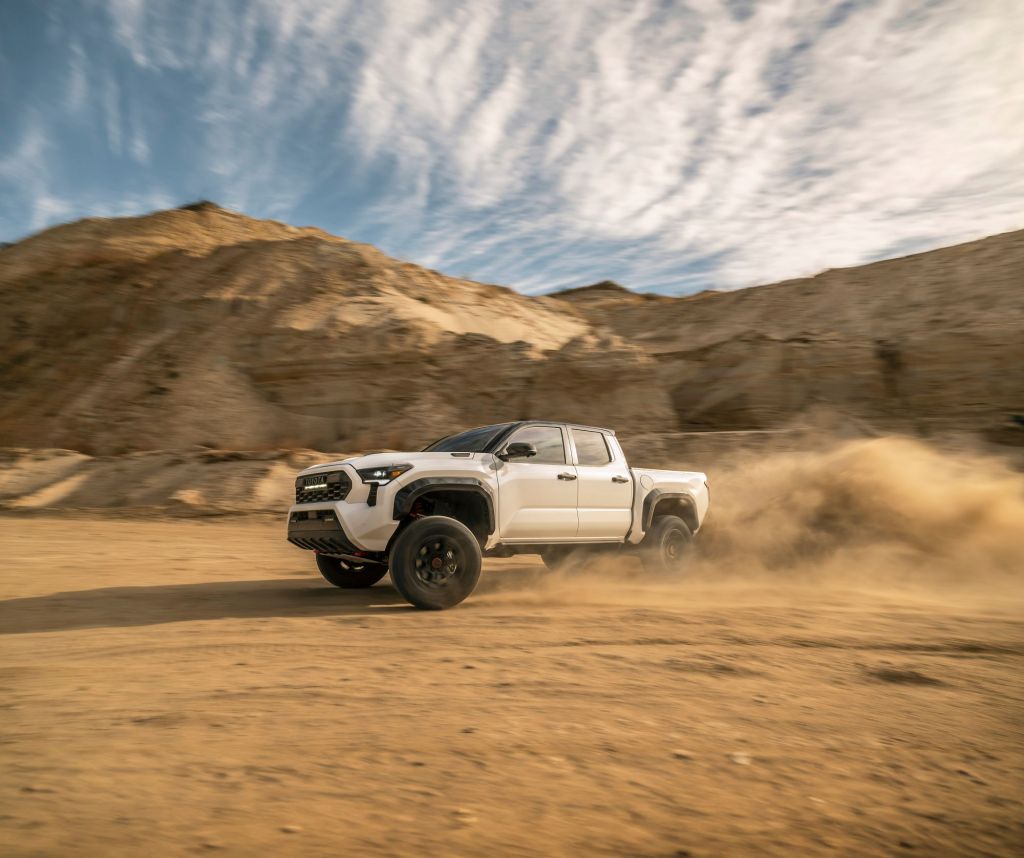
So for MY 2025 they made a bit of a swerve with the IONIQ 5, a swerve that takes the vehicle off road.

Now we’re not talking Jeep Trail Rated terrain here.

Hyundai IONIQ % XRT. Yes, take it to the dirt. (Images: Hyundai)

But the XRT trim is more capable than the SE, SEL or Limited models.

For example, there is modified suspension tuning and the suspension is lifted by 0.9 inches—but lest one gets carried away, realize that this brings it to 7 inches. (The ground clearance for a Jeep Cherokee is 8 inches.)

There are off-the-beaten-path approach and departure angles: 19.8 degrees and 30 degrees, respectively.

There are red-painted recovery hooks on the front fascia that are said to be functional. (Those are something that you’re not likely to utilize in your daily commute unless your commute takes you through some tough territory.)

There is a composite cladding on the fascias, around the wheel arches and on the door panels that has a subtle pixelated camo pattern to provide a more-capable appearance. (The XRT wouldn’t look out of place driving on Mars thanks to this addition.) There are XRT black 18-inch wheels wrapped with 235 / 60 R 18 all-terrain tires.

As mentioned, the IONIQ 5 XRT is an electric vehicle. One of the aspects of this 2025 model (and the other trims) is that it comes equipped with the NACS port, standard, which means it can be used at the Tesla Supercharger network, adapter-free. (Which ought to annoy owners of the Tesla Model Y, given the aforementioned still-fresh design of the Hyundai and the aging Tesla exterior, Juniper update tweaks notwithstanding.)

It is worth noting that for those who aren’t using a Supercharger there is a CCS adapter that comes along for the ride.

And while this doesn’t matter as much as it did before the tax credits for EVs were pulled but is still non-trivial: the 2025 IONIQ 5 is built at the Hyundai Motor Group Metaplant America in Ellabell, Georgia.

Clever pixilation on the cladding.

The vehicle is, of course, all-wheel drive.

There is a 99-hp permanent magnet synchronous AC motor in the front. A 221-hp motor of the same type in the rear.

The system output is 320 hp and 446 lb-ft of torque.

It has a liquid-cooled 84-kWh battery pack. The peak DC fast charge rate is 250 kW, which means that the battery, on a DC fast charger, can be charged from 10 to 80% in 20 minutes. The EPA estimated range is 259 miles.

On the inside there are H-Tex seating surfaces (a synthetic leather that offers easy clean-up, because let’s face it: this trim wants to get dirty) featuring XRT-unique pattern and logo. And there are XRT badged all-weather floor mats (because you’re going to take this out in, well, all types of weather that you’re likely to bring into the vehicle with you when you go out in it).

Hyundai has some of the best screens in the business, with a 12.3-inch screen for the driver’s info and a 12.3-inch screen for infotainment. There are wireless Apple CarPlay and Android Auto and wireless charging. There is BlueLink+, the connected vehicle service that provides capabilities from remote starting to receiving diagnostic alerts to performing automatic collision notification and more.

And the BlueLink+ services are free, not for a trial period, but for as long as you own the vehicle.

While on the subject of costs, the MSRP for the 2025 IONIQ 5 XRT is $55,400. The one I drove had an optional paint color (Atlas White Matte) that added $1,000; carpeted floor mats for $210; and $1,475 for inland freight and handling, to a total sticker of $58,085, which is in keeping with average transaction prices for EVs.

On the 2026 Nissan Sentra

What a concept: a good-looking, well-equipped new car with an affordable price tag. Something important in today’s market

By Gary S. Vasilash

Although when you are buying a new car you are (likely) buying the newest version of that car available. What it currently is and what it currently has is what matters.

Still, there is something to be said for legacy.

The Nissan Sentra has been around since 1982. Nine generations. There have been more than 6.5-million sold in the U.S. during this period.

So for someone who is looking to buy a new, 2026 Sentra, there should be confidence that there’s more than a little something right about the car as it has endured.

///

And on the subject of timing, Nissan is nothing if not timely.

Among the competitors for the compact sedan are the Toyota Corolla and the Honda Civic.

The current-generation Corolla (and credit to it: it is now in its 12th generation) was launched as a sedan in early 2019 (model year 2020).

The current-generation Civic (and points to it, too: 11 generations) was launched in mid-2021 as a 2022 model.

So the Sentra is the freshest of the three.

///

While the conventional wisdom has it that sedans are pretty much dead, Gauthier Bayard, Nissan senior planner, Chief Marketing Manager, said that they have numbers showing that in the next five years there’s going to be some incremental growth in the category.

And things aren’t as sad for sedans as you might think.

Through Q3 Honda sold 185,225 Civics, Toyota 179,983 Corollas, and Nissan 125,741 Sentras.

And while you probably think that crossovers crush those sorts of numbers, that’s not necessarily so.

Again: Sentra 125,741 through Q3 2025.

Ford Bronco Sport: 103,261.

Ford Escape: 114,728.

Bronco: 109,921.

Somehow that compact sedan number doesn’t look too bad.

///

And now the Sentra is better.

There is one thing to know before we look at some of that.

Another thing that everyone knows—and knows far too well if they’ve been actively in the market of late—is that vehicles are breathtakingly expensive.

The Sentra S is the starting trim. It has an MSRP of $22,400.

The SV, $23,170.

The SR, $25,000.

The SL, $27,990.

The sort of prices that regular people can afford without having to take out a loan with a length that would be so long the car would qualify for a driver’s license by the time its paid off. (Slight exaggeration. According to LendingTree.com the average auto loan term is 68.9 months.)

2026 Nissan Sentra SR. Handsome, sporty styling wraps an array of useful tech. Notably the entire package comes in at less than $30,000. (Images: Nissan)

///

The old saw has it that the styling of a vehicle gets people into a car and the interior (if done right) keeps them there.

According to Lihao Yu, design director at the Nissan Global Design Center, the exterior styling is characterized by the Japanese word shun, which means agile, yet effortless.

Through the clever use of colors and execution of the front fascia, there is a sporty appearance for the SR Sentra and a more sophisticated look for the SL.

And they continue to pay that off on the interior, with the SR having red accent stitching on the seats and the SL quilted seating surfaces.

///

And then, of course, there’s the tech, both outside and in.

That is, on the outside there are LED headlamps that have more than 70% greater light dispersion than the previous headlamps. When approaching at night there is a minor light show that commences, welcoming you to the car.

And the outside is seen from the inside with the Intelligent Around View Monitor that makes use of a front camera that provides a wider view than the previous one.

While approaching the vehicle the key fob is detected and the doors unlocked.

Inside there’s a 12.3-inch screen for the gauges and another 12.3-inch screen for infotainment (at least on all trims with the exception of the entry S. It has a 7-inch gauge info display but the 12.3-inch infotainment screen). There’s available Bose premium audio. And there are things including automatic emergency braking with pedestrian detection, intelligent forward collision warning, lane departure prevention, high beam assist, traffic sign recognition, and more.

///

The powertrain is a 149-hp, 146 lb-ft of torque inline four mated to a continuously variable transmission. This is familiar from the last-generation Sentra. The rationale is simple: it works well, so use it. To be sure they’ve tuned it for improved operations.

The SL trim has an upscale look on both the outside and in the cabin.

///

When considering the customer, Bayard said they project it will be gender balanced and aged between 25 and 54. The household income will have a fairly wide range, from $50,000 to $150,000 (this latter figure may be a bit generous: according to the US Bureau of Labor Statistics, median weekly earnings in Q2 2025 were $1,196, which translates to $62,192 per year, so even if there were two wage earners in the household. . .$150K is unattainable.)

What they have developed is what plenty of people need: a well-equipped, affordable, reliable car. And as for that reliability, it is worth noting that in the J.D. Power 2025 US Initial Quality Study, the Senta takes the Compact Car category, besting the Kia K4 and the Hyundai Elantra, two non-trivial competitors.

So if we assume the new one is even better. . .then they really have something special.

Stellantis Advancing Factory Tech

Investigating and installing new technologies to improve production operations

By Gary S. Vasilash

Chances are, when you think of a corporate venture startup fund focused on early and later-stage startup companies, a multi-million fund, you probably don’t think “auto industry.”

Yet they exist. While like those firms you think about they invest in AI, new battery chemistries and other advances, at Stellantis Ventures the team is looking for ways for the parent company’s factories to work more efficiently and effectively.

Realize that in North America alone Stellantis has 31 manufacturing operations, 18 in the U.S., seven in Mexico and six in Canada, so making improvements can have significant effects on the bottom line.

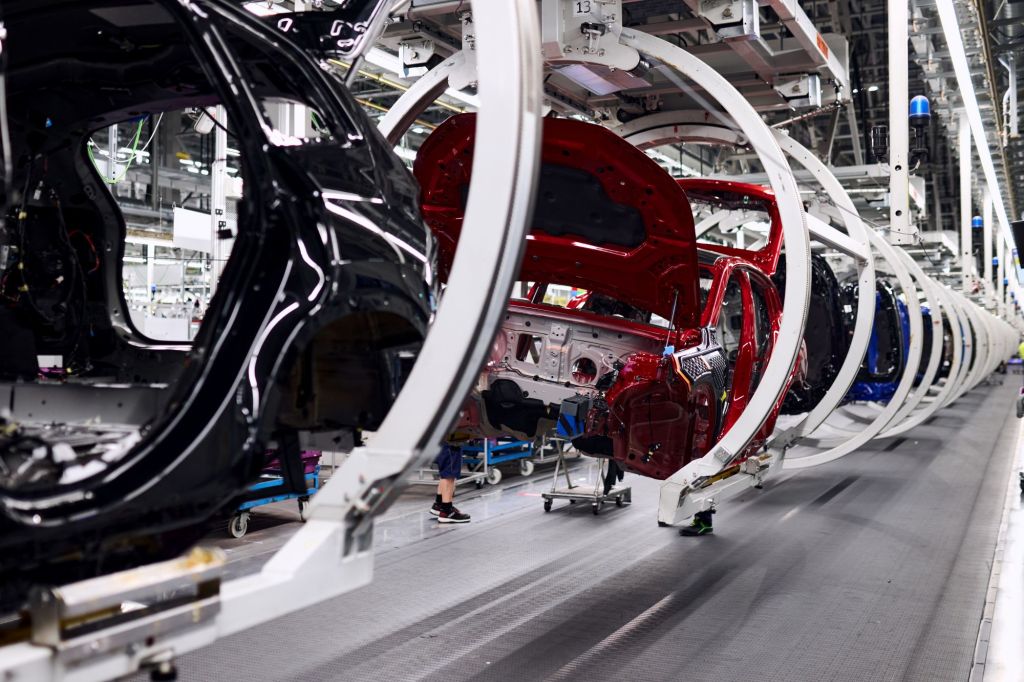
Inside Detroit Assembly Complex–Jefferson. (Image: Stellantis)

To say nothing of the fact that the company also operates plants in France, Italy, Spain, Germany, UK, Poland, Portugal, Serbia, Slovakia, etc.

Tim Fallon, Senior Vice President, Global Head of Stellantis Production Way, said that an objective that he and his team have is to assure that production systems around the world are setup so that benefits realized in one facility can be shared with others so the whole system is continuously improved. Among the areas focused on are quality, efficiency and sustainability.

And one of the ways there is improvement is through the implementation of new technologies. One of the ways this is being achieved is through the discovery of new tech, something that Anna Valeria Anllo, Head of Global Innovation for Vehicle Process Engineering, said Stellantis Ventures helps the manufacturing team discover.

In addition, there is an on-going compilation of a list of potential suppliers that can help advance the manufacturing process.

Stellantis recently held what it calls its “Factory Booster Day,” an annual event that is attended by Stellantis personnel as well as 80 suppliers—traditional suppliers and startups.

The event was held at the company’s Conner Center in Detroit.

Fallon said there were some 700 people on site as well as an additional 1,200 on-line.

While there is an abundance of advanced technology showcased, the objective is to make this tech operational in Stellantis factories.

For example, at the 2024 Factory Booster Day a firm named KCF Technologies worked with Stellantis personnel on an AI-powered predictive maintenance (PM) system that is being used in North American paint shops. The system collects sensor data from various systems within the paint shop (e.g., pumps, fans, exhaust systems) and then makes a determination as to when PM is necessary.

Fallon said that unlike systems identify problems, this AI system learns and, as a result, uptime is maximized in the paint shops, which are a highly critical part of any assembly plant.

Another example is a camera system that uses AI to perform 100 inspections per vehicle at the Detroit Assembly Complex—Jefferson (where the Jeep Grand Cherokee and Dodge Durango are produced). The KEYENCE IV4 camera system—it features built-in lighting, lenses, and AI-powered inspection functions—provides real-time feedback to operators and automated repair alerts.

Supplementing this is a Stellantis-developed AI Agent Tracker that provides daily performance analytics.

Although the Factory Booster Days are annual events, Anllo said they are consistently looking for the ways and means to improve operations: “We believe in the fast and the furious.”