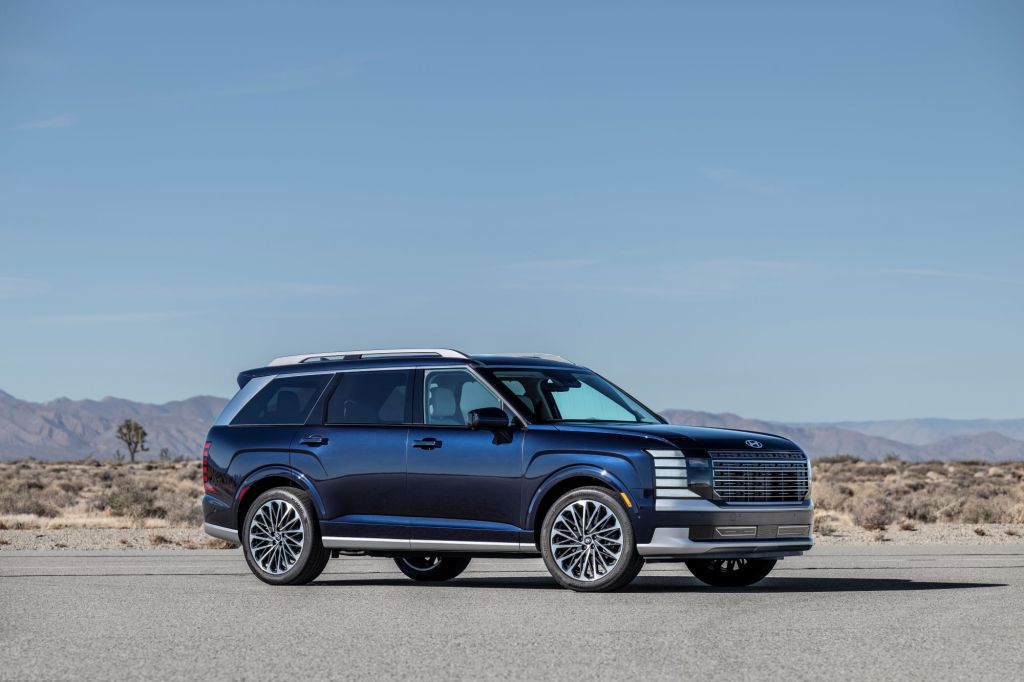
2025 Hyundai Santa Cruz Limited AWD

Don’t be misled by the box on the back. This is far more than just a pickup

By Gary S. Vasilash

The Ford Maverick pickup and the Hyundai Santa Cruz both came out in 2022 and there was an immediate comparison made between the two vehicles because they both have boxes behind the cabin.

But this is a convenient but false comparison.

The Maverick is first and foremost a truck, a truck in more of the classic sense of being utility-first and everything else gravy.

The Santa Cruz is described by its marketers as a “Sport Adventure Vehicle.” And while no one outside of a Hyundai dealership is likely to describe the Santa Cruz as such, in one regard that is more accurate than calling it a compact pickup truck.

You may recall that when BMW launched its X3 SUV it didn’t want to merely call it an “SUV” because it is, after all, a BMW. So it coined the term “Sports Activity Vehicle.” Which, of course, hasn’t had a whole lot of resonance.

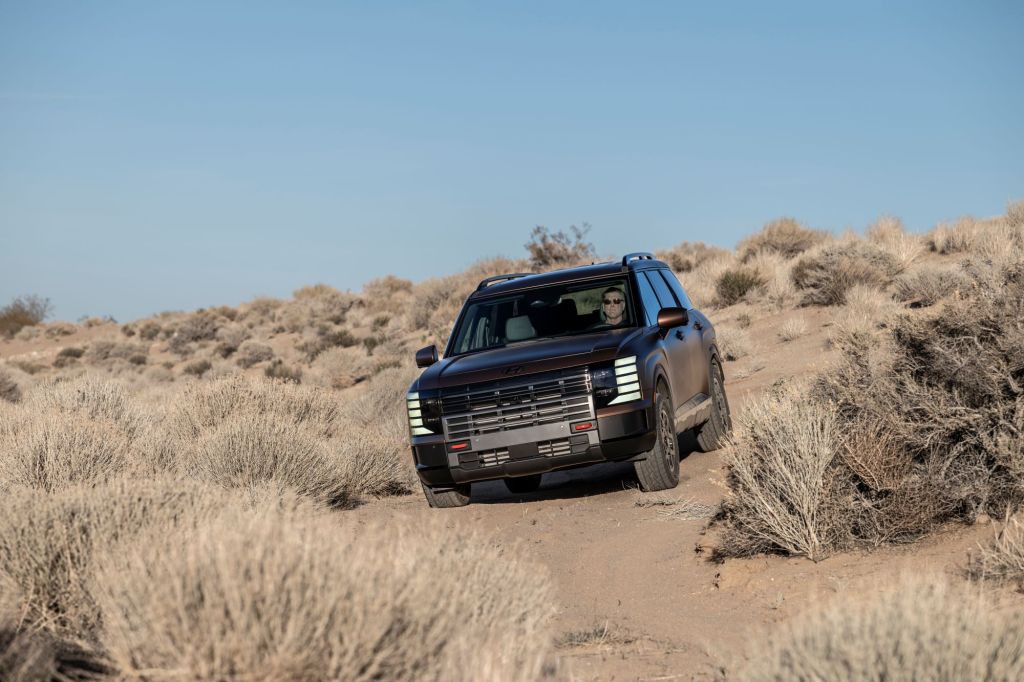
2025 Hyundai Santa Cruz Limited AWD: Style meets substance. (Images: Hyundai)

But the SAV that is the Santa Cruz is in someways closer to the SAV that is the X3 in that the Santa Cruz, certainly, is more like an SUV with a bed on the back than it is like the Maverick, which is like a “Honey, I Shrunk the F-150.”

The level of sophistication in the cabin of the Santa Cruz is simply in a completely different space than the DIY nature of the Maverick.

And while they both have beds, the Maverick’s is not only bigger (54.4 inches long vs. 52.1 inches; 20.3 inches deep versus 19.2 inches; 53.9 inches maximum width versus 53.3 inches; 33.3 cubic feet of volume versus 27 cubic feet), but it simply seems like the sort of thing you’d fill with landscaping material while the Santa Cruz would be more about mountain bikes.

It is a difference between utility and, well, weekend, low-impact adventure.

If there is any product in the Ford lineup that the Santa Cruz resembles, it is the Explorer Sport Trac, which had a run from 2000 to 2010: essentially a four-door Explorer with a box on the back. It was more Explorer than Ranger or F-150.

The Santa Cruz is like a Tucson with a box on the back.

When the refreshed Santa Cruz was revealed last year, José Muñoz, then-president and Global COO of Hyundai Motor Company and president and CEO of Hyundai Motor North America (he has since become president and CEO of Hyundai Motor Company), said, “The development goal for freshening Santa Cruz was to give it an even bolder, stronger design.”

While I agree with the “bolder,” I would quibble with the “stronger,” at least in the context of a vehicle with a box on the back. Usually when “stronger” is used in relation to truck-like vehicles, that means “boxier,” and the style of the front end of the Santa Cruz (or any Hyundai vehicle, for that matter, even the Class 8 Xcient tractor) doesn’t bring a T-square to mind. Rather, with it’s B-LED projector headlamps and LED daytime running lights it looks completely contemporary.

(There are also LED taillights, and LED cargo light on the rear edge of the roof, and LED bed lighting. This vehicle probably has more LEDs than most people have in their houses.)

The Limited is powered by a 281-hp 2.5L direct-injected turbocharged engine. There is an eight-speed wet dual-clutch automatic transmission (DCT). This vehicle can tow up to 5,000 pounds.

Inside there are such things as a powered 8-way driver seat and 6-way for the front passenger; both are heated and ventilated. There are leather surfaces on the seats. There is leather for the steering wheel and the shift knob.

That circle on the black rectagular surface is something you ordinarily don’t see in vehicles. It is a biometric interface: just like on smartphones, it is a fingerprint recognition system that allows the Santa Cruz to be started and it also loads the profile preferences for the person who is identified.

There is a 12.3-inch digital gauge cluster (i.e., what’s in front of the driver, with the speedometer, for example) and a 12.3-inch infotainment touch screen with the now-obligatory wireless Apple CarPlay and Android Auto.

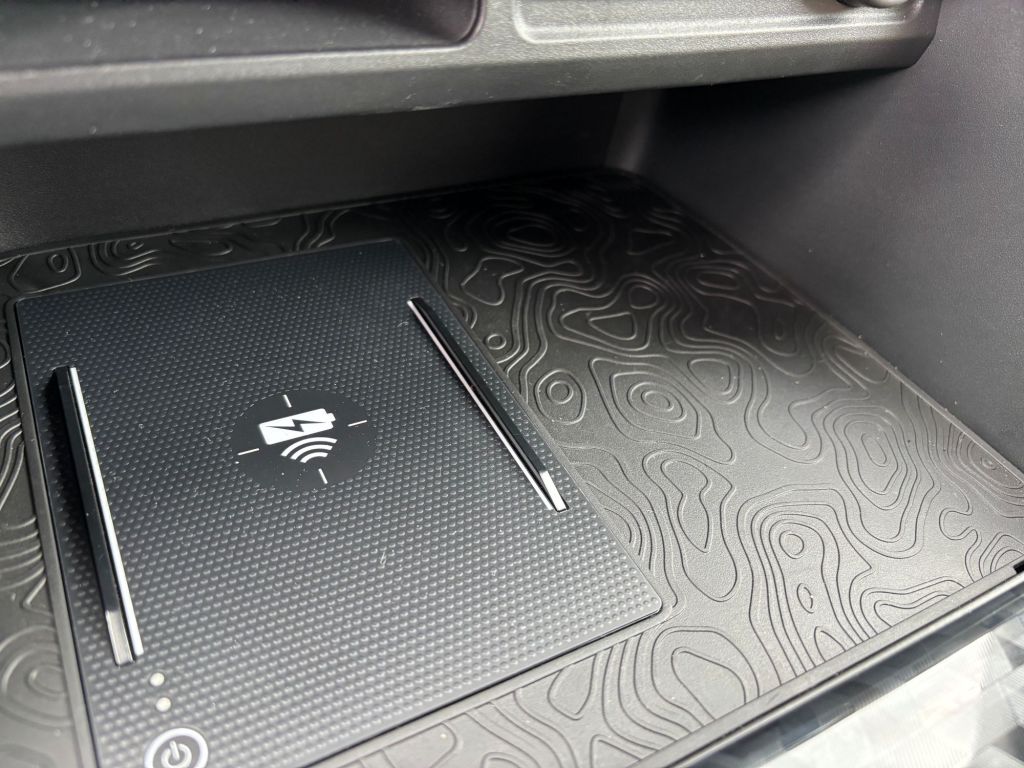
Bose premium audio. Plenty of USB-C ports. Wireless charging.

There is Hyundai Digital Key 2 Touch, which allows a phone to be used in lieu of the fob.

There is even a fingerprint authentication system that allows a fingerprint to unlock the vehicle, start it, and load driver profiles.

There is BlueLink+ a connected vehicle service (remote start; lock-unlock; emergency assistance; etc.) that is. . .subscription free.

The point is, yes, the Santa Cruz may be truck-like because of the bed on the back, but it has contemporaneous amenities and style such that it really might make someone refer to it as a “Sport Adventure Vehicle.”

How Often Do You Think About Your Chassis?

Probably—unless there is something amiss—never. . . .

By Gary S. Vasilash

Odds are, unless there is a problem with your suspension system like one corner of the vehicle sagging to a surprising degree or continued bouncing long after the pothole has been hit, you probably don’t think much about it.

So it is probably a good thing that there are companies like ZF that do. Otherwise there could be serious problems—dare I say?—down the road.

ZF has developed what it calls its “next-generation* Smart Chassis Sensor.”

This unit fits into a ball joint in the control arm.

“Next Generation Smart Chassis Sensor”: seems like a straightforward integration that results in useful information. (Image: ZF)

Consequently, it is able to measure a number of factors related to the vehicle, some to help ensure the ride as is as smooth as it can be, some that are unexpected.

For example, if a tire has been changed and the lug nuts aren’t sufficiently tight, it can detect that and send an alert to the driver.

Or if the vehicle is at the local landscaping supply store and being loaded with those decorative rocks, it can determine whether the vehicle is being overloaded.

(Apparently this load-detection capability is good for electric vehicle drivers in that it can provide more accuracy regarding when it is going to be necessary to get a recharge.)

ZF says the sensor system can even provide an assessment of “Chassis Health,” providing alerts when maintenance or repair is required.

Of course, this is the sort of thing that must be specified in a vehicle during development, not the sort of thing you have your local repair shop integrate into your vehicle.

Here’s hoping some chassis engineers look at the functionality and capabilities of this unit.

==

*A few weeks ago ZF introduced the Smart Chassis Sensor. Already there’s another, this enhanced with the integration of an accelerometer. Certainly not the rate of development more common in automotive, which tends to be measured in months, not weeks.

2025 Toyota Sienna XLE AWD, Woodland Edition

The question is: why wouldn’t you if you transport people and their stuff?

By Gary S. Vasilash

I once owned a Toyota Tercel. A subcompact. A vehicle that was as stylish as a pair of orthopedic shoes.

There were three reasons why I had the Tercel:

  1. I needed a car to get to work
  2. I could afford it
  3. It was available

All of those reasons are fairly pragmatic, more about needs than desires.

On Maslow’s Hierarchy of Needs, the Tercel was at the base level. It was far from the Self-Actualization that many people imagine they achieve when buying a vehicle.

But is that the case? Really?

Sure, we all like to have something that reflects who we think we are, which explains why we buy particular shoes (ideally not orthopedic) or phone. Those objects send a message to those we encounter. But arguably, unless those objects are rather egregious—like wearing clown shoes or using a Jitterbug phone years before AARP membership kicks in—odds are there is less of a message being sent than we would like to imagine.

Which brings me to the Toyota Sienna XLE AWD minivan.

Suddenly the word “minivan” causes in some people a reflexive reaction like what happens when a doctor taps your knee with a little hammer: you can’t stop it.

But unlike that reflex, which physiologically occurs without involving the brain (the reaction goes straight through the spinal cord), the reaction to “minivan” is a social construct.

“I’m not a minivan person” or “I just wouldn’t feel right driving a minivan” or “What would it say about my sexuality if I was behind the wheel of a minivan?”

OK. No one says the last one out loud. But that’s what plenty of people are thinking.

For some reason, when people are buying a crossover or SUV, none of those things arise.

They do have to run some quick calculations like why I needed that Tercel. What’s more, they have to determine whether there is the sort of functionality that they will need. Toyota, for example, has 11 crossovers and SUVs to choose from, each with its own suite of specs. If you have multiple family members a Sequoia will work in a way that a RAV4 doesn’t. If there are just a few of you, the RAV4 works in a way that the Sequoia would be just overkill.

So there are at least a couple of proverbial back-of-the-envelope decisions that need to be made in terms of what the vehicle can do to meet your needs: how many people might you want to bring along with you; how much stuff do you generally carry of a nature that a pickup truck wouldn’t be right for?

So let’s take the stuff part of the equation.

The Toyota Sienna minivan offers 33.5 cubic feet of cargo space behind the third row, 75.2 cubic feet with the third folded, and 101 cubic feet with the second and third rows folded.

While those numbers may not mean a whole lot, know that they translate into Big, Bigger, Biggest.

Toyota Sienna Woodland: yes, you don’t need an SUV to do things like this. (Image: Toyota)

And if that isn’t enough and you need to pack a U-Haul trailer, the Sienna offers 3,500 pounds of towing capacity.

Or what about people?

Depending on the seating configuration selected, it is either seven or eight people.

And the thing to know about that is that these people are all going to feel comfortable, not as though they are occupants of the proverbial sardine can.

The functionality of the configuration of the minivan’s architecture is simply more package-efficient than an SUV (or sedan, for that matter).

“Oh, but a minivan isn’t stylish,” comes the knee-jerk reaction.

It’s not like the people at Toyota’s Calty design studio in Newport Beach aren’t aware of that objection, so they’ve added style to the substance of the vehicle.

One of the notable characteristics of the Sienna is that it is now, in all trim levels and packages, a hybrid. There is a 189-hp four-cylinder engine. There is an electric motor up front. And in the AWD version (yes, AWD—just like in some SUVs!), another in the rear.

All told the propulsion system provides 245 hp.

But the impressive part of this is that on the AWD model, like the one driven here, the combined city/highway fuel economy is 35 mpg.

And the beauty of that is that with the 18-gallon tank you can achieve a theoretical 630 miles before you need a fill up, but even if you use 17 gallons to be on the safe side, it is still 595 miles.

If the average American drives 37 miles per day, then the Sienna can be driven for more than two weeks without visiting a gas station. And once there, only regular gas is required.

I drove the Sienna from Detroit to Traverse City (255 miles) and back, putting on freeway miles as well as slow city miles (Traverse City is increasingly popular). And I got the 35 mpg without a problem and it was in the Normal mode throughout (there are also Eco, Sport and EV modes, with the first eking out all the energy it can, so this is a bit on the slow side; Sport amps things up, but let’s face it: this is a minivan; EV is a short spurt of low-speed all-electric driving: this isn’t a plug-in hybrid).

The Woodland trim driven here includes a smidge more ground clearance (it is 6.9 inches rather than the 6.3 inches of other trims).  There are 18-inch six-spoke dark wheels and black roof rails on the outside. There are themed floor mats and things like a 12-speaker JBL audio system on the inside.

And there is an abundance of the types of things one would expect on a vehicle that you’re going to be spending plenty of time in (from the 12.3-inch screen to wireless Apple CarPlay and Android Auto; four-zone climate control), as well as things that add to the overall utility (e.g., being able to open the sliding doors by putting your foot beneath it is a nice function). Of course, there is an array of safety tech bundled into Toyota Safety Sense 2.0 (pre-collision system with pedestrian detection, lane departure alert with steering assist, lane tracing assist, etc.).

If there is any stigma associated with the Sienna minivan it is one of simply being smart. Which isn’t a bad thing.

The Tercel did the job for me. The Sienna could certainly do it for those who are looking for efficiency, capability, capacity, and, yes, soupçon of style.

Massaging Seat Innovation Announced

Long drives can cause muscle tightness. Even short drives (e.g., to the endodontist) can create knots. This seat can handle them. . .

By Gary S. Vasilash

Adient—which designs, engineers and manufactures automotive seating—has developed a mechanical massage device that’s embedded in automotive seats.

While there are pneumatic systems available on some vehicles, according to Adient the mechanical approach “precisely simulates professional kneading techniques, delivering much stronger effects in relieving occupant fatigue than traditional pneumatic massage solutions.”

Having experienced my share of the pneumatic executions, I imagine this really has to be a robust approach to working out those knots.

However, the system allows for the adjustment of strengths and modes—the actuators are programmed using approaches associated with Western fascia therapy and traditional Chinese medical philosophy to address back and lumbar issues.

Location of the mechanical actuators in the seat that provides massage capabilities. (Image: Adient)

It is, of course, capable of receiving over-the-air (OTA) updates.

The packaging of the 3D massage module is such that seat heating and ventilating systems can be used in the seat, as well.

The mechanical massage seating has been launched in the GAC-Trumpchi M8, a three-row luxury minivan.

Apparently there will be deployments in other mid- to high-end Chinese vehicles.

Adient says the massage seat is “getting attention” in both the Americas and Europe.

Editorial observation:

Given that Adient’s global headquarters is in Plymouth, Michigan, less than an hour’s drive from GM, Ford and Stellantis North America headquarters, one would hope that there is more than “attention” for this interesting innovation.

2025 Lexus LC 500 Convertible

Something special with impressive mechanisms but limited space. . .

By Gary S. Vasilash

There are some cars you get into. There are some cars you put on.

The Lexus LC 500 Convertible is one of the latter. You just don’t get into it, but you essentially wrap yourself in the driver’s seat—which, of course, is a sumptuous, buttery leather surface with heating and ventilation.

The vehicle is undoubtedly designed and engineered for those who like to take weekend road trips on roads that are not freeways but those with curves through forests or along beaches below.

After all, you want that top down so you can smell the pine or the sea breezes. Sitting in traffic going nowhere slowly is not what you want to be doing with the soft-top retracted.

Swish

One thing about the retraction that you might now intuitively know: Its movement is predicated on Japanese calligraphy with a brush: inked brush is applied to paper; the brush stroke is to the right; the ink brush stops. I am not making this up.

Something that is notable about that top, too, is that it can be opened in 15 seconds or closed in 16, and you can do that at speeds up to 31 mph. The quick closing is the more important of the two because who wants to be caught in a sudden cloudburst?

Materials Matter

Another thing notable about the top—something that could provide a bit of bragging rights of a somewhat technical—and therefore cool—nature is that components for it are made with magnesium and aluminum, not your run-of-the-mill ferrous materials. If that doesn’t impress whomever, perhaps the fact that the top consists of four layers—three fabric and one sound-insulating—may do the trick. And I won’t even get into the hydraulic actuation controlled by an electromagnetic valve. All of this is serious stuff.

Speaking of the top down and climatic conditions:  The HVAC system is engineered so that it keeps the cabin occupants comfortable. It has something called the “Lexus Climate Concierge with Upper Body Heating.” So the air conditioner, seat heaters, neck heaters (yes, neck), and steering wheel heater are activated as necessary.

Vroom

Of course, one of the real features that someone who is interested in a sport convertible is probably more interested in than a top-folding mechanism or a neck heater is what is under the hood.

And here the vehicle also has quite an impressive mechanism: an all-aluminum 471-hp V8 that’s mated to a 10-speed automatic. This 5.0-liter engine is naturally aspirated (i.e., no turbo).

According to Lexus, the car goes from 0 to 60 mph in 4.6 seconds and the top speed—on a track, because you don’t want to do this where you’d get a massive moving violation—is an electronically limited 168 mph.

Now some people might look at that 4.6 seconds and think that an electric car like a Hyundai Ioniq 5—and I’m not talking the “N” version, but a standard AWD—and beat it.

But what no electric car can do is provide the audible sound of a V8 engine, which is part of the experience of driving a vehicle like the LC 500. Recognizing that, the Lexus engineers plumbed a pipe that takes the engine intake sounds that have been fed into a diaphragm, then, though the pipe, into the cabin. This is not artificial noise but the real rumble. And because they evidently figured that’s not enough, they include a computer-controlled vale that adjusts exhaust back-pressure, exhaust tone and volume at higher engine speed to, in effect, turn the sound of the engine up to 11.

Tighten Up

According to Lexus, the LC 500 Convertible seats four. Which is something of an exaggeration by two. Sure, there is a rear seat and the front seats fold forward to allow access to the rear. But it is hard to imagine anyone being comfortable in the front seats while there is anyone—even small children—in the back. (The front legroom is 42.6 inches and the rear 28 inches.)

Then there is the aforementioned weekend road trip.

The cargo space is 3.4 cubic feet. You’d need to pack with care as that space can handle two small carry-ons—and you might opt for luggage that isn’t hard-sided to assure that it is going to fit.

Exclusivity

And there is another number that needs to be considered: $115,705. That’s the MSRP for the LC 500 Convertible with the optional Bespoke Build Package, which includes the option to select from nine exterior colors, four interior color schemes, three 21-inch forged wheel styles, and chrome or dark chrome interior accents. There is also badging on the center console that proves you’ve got it.

Add the red soft top, the 10-spoke alloys, Mark Levinson audio, .premium paint, carbon fiber door scuff plates, and a carpeted trunk mat.

Add the $1,350 for delivery, processing and handling, and you’ve reached $117,055.

But you’ve also got something special. Through the first half of 2025 there were 790 LCs sold in the U.S.

You will not see these vehicles—especially the Convertible—going and coming.

Ford Going Zero

Now’s the time to buy. . .

By Gary S. Vasilash

“Many families have seen their savings go toward higher mortgage rates and summer travel costs. They want a new vehicle but also want options that allow them to forgo an upfront down payment,” said, Rob Kaffl is Ford director, U.S. sales and dealer relations.

So the company has decided it will not only continue with its employee pricing for everyone, but has initiated a summer sales event: “0-0-0.”

Which means zero down payment, zero percent interest for 48 months, and zero payments for 90 days.

Since starting its “From America, For America” campaign in April that provides the employee pricing approach, Ford second quarter sales grew well over the rate of the rest of the industry.

Kaffl: “Momentum matters, and in the past few months we have had plenty of it.”

They want to keep it going with this 0-0-0 program.

What’s more—and it is more—Ford is providing a two-year maintenance program that covers things like oil changes and tire rotations. Certainly a nice benefit.

While there is undoubtedly some small print involved in signing those papers at the dealership, there is some you should know about if you have your eye on a 2025 Bronco Sport, Bronco, Expedition, Maverick, Ranger, Transit, Super Duty, or Lincoln Navigator.

They are excluded from the program.

So that leaves Escape, Mustang Mach-E, Explorer, F-Series, E-Series, and Mustang for Ford brand and Corsair, Nautilus, and Aviator for Lincoln.

Clearly Ford wants to continue to move metal before more tariffs kick in and people are faced with more than high mortgage rates and travel costs.

2026 Hyundai Ioniq 9 AWD Performance Calligraphy Design

Although it is big, some of the small details are most impressive

By Gary S. Vasilash

This is the bottom of the front cupholder on the Ioniq 9:

This is not the sort of thing that a review of a three-row electric vehicle that provides—depending on the powertrain setup selected—a range ranging from 311 miles to 335 miles typically opens with. In fact, it is unlikely that the bottom of a cupholder is even an issue.

After all, realize that this is quite a substantial vehicle, measuring 199.2 inches long, 78 inches wide, 70.5 inches high, with a 123.2-inch wheelbase. The top-of-the-line version tips the scales at 6,008 pounds. In the seven-passenger configuration (it can also be configured to seat six) it offers 163.4 cubic feet of passenger volume. With the third row folded it offers 46.7 cubic feet of cargo capacity. Leave it up and there’s 21.9 cubic feet.

But it is to make a point about the level of detail that the designers and engineers at Hyundai have taken in developing this vehicle.

Now the overall theme for the vehicle is one based on “pixelated design.” As in pixels, the individual square elements that make up images on digital screens. So as you can see from the bottom of that cupholder: pixels.

Hyundai designers use squares throughout the vehicle, both inside and out.

As in the front:

(Following images: Hyundai)

And back:

There is a remarkable consistency to this approach.

While it enhances the overall design, it also indicates that there is consistency and care in the creation of the SUV.

As legendary management consultant Tom Peters, the guy who co-wrote In Search of Excellence, put it:

“Small>>Big. Small Stuff Rules!”

Get the small stuff right and you’re likely to get the whole thing well executed.

And that is precisely the sense one gets from the Ioniq 9.

The AWD version driven here is a dual-motor arrangement that provides a total 422 hp, which means that as big as it is, the Ioniq 9 drives smartly. And while there is a RWD model on offer, which is the one that gets the 335-mile range, this model gets a respectable 311 miles.

And if you take it to a Supercharger, you can get from 10% state of charge to 80% in 40 minutes. If you are able to access a 350-kW DC fast charger, with the CCS adapter you can hit that 80% mark in 24 minutes.

But the thing is, when you have range of 300 miles+ the issue of range anxiety isn’t much of a thing—if it is a thing at all. Assuming you’re doing your pre-drive homework, you can take a road trip with several family members or friends in the Ioniq 9. If you’re just doing a daily drive, you probably won’t think much at all about charging.

Inside the vehicle there’s a lot more to it that nicely trimmed cupholders.

The driver and front passenger seats are both power 8-way adjustable, heated and ventilated. The driver gets 4-way power lumbar; the passenger 2-way. In the second row the captain’s chairs offer 4-way power adjustment and are heated and ventilated.

The seats are trimmed in the H-Tex material: a synthetic leather that looks and feels quite authentic.

In terms of technology, there is a 12.3-inch touchscreen. The gauge cluster is also a 12.3-inch screen.

And that is deserving of a word. There are some OEMs that, in vehicles that have a staring MSRP of $76,490 like this one does, figure that the more digital real estate they can throw on the IP, the better.

It isn’t.

While 12.3 inches times two certainly doesn’t go back to Peters’ “Small>>Big,” I would argue that the Hyundai approach to interface is a whole lot better than just adding screens.

It should be noted that the Ioniq 9 is counted among the 2025 Wards 10 Best Interiors & UX (full disclosure: I am one of the judges).

How the Celestiq Can Help Address the Problem of Potholes

Smart sensors can lead to smoother roads. . . .

By Gary S. Vasilash

The Cadillac Celestiq—the hand-built electric vehicle that has a price in the $340,000 vicinity—is a lot of things, but one that’s surprising is, in effect, a test-bed for road maintenance personnel.

That is, the Celestiq is fitted with Smart Chassis Sensor technology developed by ZF.

Sensors—two in the front wishbones and two in the rear—are permanently mounted into the ball joints of the suspension system.

An important part you cant see are the algorithms. (Image: ZF)

These sensors and associated algorithms are used to do a variety of things, like control damping and provide headlight leveling.

Steffen Reichelt, Head of the Chassis Components Product Line at ZF, says, “With the help of evaluation algorithms, our sensor not only replaces conventional height sensors, it also significantly outperforms them in terms of the quantity and reliability of the data collected.”

It is that last bit—the data collected—that is germane to the beyond-Celestiq applications.

Reichelt: “The data collected by the sensor allows additional conclusions to be drawn about the vehicle, its surroundings and the road surface. These findings are particularly attractive for commercial vehicle users and fleet owners, but also for the maintenance of road infrastructure.”

So while most of us will never experience the smooth ride that is undoubtedly offered by the Celestiq, conceivably those who do could benefit the rest of us with the data that their vehicles can collect about the road surfaces.

2025 Volkswagen Atlas Cross Sport SEL Premium R-Line

Who knew this is being built in Tennessee?

By Gary S. Vasilash

“This vehicle will be a real American – large, attractive and with many high-tech features on board. Above all, the midsize SUV will be made by real Americans.

“From 2016, this vehicle will roll off production line at the Chattanooga plant – as second core model in addition to the Passat.

“This major decision was taken by the Board of Directors of Volkswagen Group of America last Friday.

“So: Our midsize SUV will be a car “made in Chattanooga”!

“A car ‘made in the US’!”

While that might sound like something you’d hear someone say nowadays as the tariff situation (there is a 25% tariff on imported vehicles that is based on Section 232 of the Trade Expansion Act of 1962; Section 232 deals with national defense: who knew that things like a midsize SUV would have military implications?), that was actually from July 14, 2014, in a speech by Dr. Martin Winterkorn, who, at the time, was CEO of Volkswagen. (He resigned the following year as a result of the Dieselgate scandal.)

The vehicle he was talking about is the VW Atlas, a seven-seat SUV that went into production late 2016 as a model year 2018 vehicle.

Yes, it was, and is, built in Chattanooga. (The Passat, however, ended production there in 2021.)

The Atlas gave rise to the model year 2020 Atlas Cross Sport. It is a five-passenger vehicle.

And the plant has been cranking out Atlases of both configurations ever since. (In addition to the electric ID.4.)

VW Atlas Cross Sport: A sporty utility vehicle. (Image: VW)

A faster roofline and more generous cargo capacity (40.3 cubic feet in the present version with the rear seat ready to accommodate people; in the standard Atlas, with the rear seatback up the cargo is 20.6 cubic feet*, but it should be noted that the Atlas version of the Atlas has a third row, so that explains the delta in space for stuff) are key differences, as are an overall, well, sportier appearance. Like a diffuser on the rear hatch that isn’t found on the Atlas.

Under the Hood

The vehicle is powered by a turbocharged, direct-injected four-cylinder engine, the “Evo4” TSI EA888, mated to an eight-speed automatic. The engine produces 269 hp and 273 lb-ft of torque, which is good for a vehicle that is 195.5 inches long, 78.3 inches wide, 67.8 inches high, has a wheelbase of 117.3 inches and a curb weight of 4,171 pounds. Merging onto a freeway and then driving on it are no problem with the vehicle.

There are sporty stainless-steel pedal caps—but one need not get too carried away thinking that this is a vehicle that will allow you to crush it on a gymkhana course.

The vehicle is EPA rated at 19 mpg city, 26 mpg highway and 21 mpg combined. Helping that is a feature of the 4Moiton with Active Control all-wheel-drive system (not all Cross Sports have this; there is a front-drive version, too).

Inside

On the inside, as this is the top-of-the-line there is good leather seating surfaces. (Lower trims offer leatherette.) The overall execution provides a sense of substance, as one would hope to get from a German car, even if it is one built some 4,600 miles away from Wolfsburg.

There is a 12-inch infotainment display. The Atlas has VW’s App-Connect system, though which things like CarPlay and Android Auto are accessible.

And there is what VW calls the “Digital Cockpit Pro,” a 10.25-inch screen that stands in for the gauge cluster. One advantage of this is that it provides things that are actually useful, like navigation information so the driver can keep eyes forward.

From the points of view of styling, content and powertrain, this is midsize that can hold its own against others in the category.

While there is a bit of a sacrifice to get that style, unless your needs are all about utility (which would then shift a look to the Atlas version of the Atlas), it is worth it.

///

*It is interesting to note that while the seats-in-position cargo capacity of the Cross Sport is about twice that of the regular Atlas, through Q1 2025 the sales of the regular Atlas were about twice that of the Cross Sport: 16,902 to 8,689. Guess people either have more than five passengers on a regular basis or they anticipate that they will so they give up some sportier style for potential utility.

AV in the UK

This makes more sense than Tesla in Austin

By Gary S. Vasilash

While there is a lot of attention being paid to Tesla’s rollout of some 10 vehicles in Austin that are operating autonomously—with a safety driver on board and apparently people back in Tesla HQ monitoring the fleet, ready to kick in with teleoperation help if needed—there is virtually no attention being paid to what is happening in Cambridge, UK.

This week an autonomous Mellor Orion E electric midi bus—a low-floor transporter that can be configured to accommodate a maximum 16 passengers—equipped with a CAVStar Automated Drive System started rolling through the streets of the university town.

Bus is operating autonomously in the streets of Cambridge, England. (Image: Fusion Processing)

The CAVStar system is engineered by Fusion Processing. It comprises an AI processing unit, radar, LIDAR, optical cameras, and ultrasonic sensors.

The Cambridge vehicle is said to meet the requirements of SAE Level 4 autonomy.

The bus is running as part of the Connector project, which is led by the Greater Cambridge Partnership, which is supported by Innovate UK and the Centre for Connected & Autonomous Vehicles.

The bus initially ran though the areas in Cambridge where it is now operating without passengers to determine fitness for use.

Dan Clarke, head of Innovation and Technology at the Greater Cambridge Partnership:

“People may have already seen the bus going around Eddington and Cambridge West from Madingley Park & Ride recently, as, after the extensive on-track training with the drivers, we’ve been running the bus on the road without passengers to learn more about how other road-users people interact with the technology. We’re now moving gradually to the next stage of this trial by inviting passengers to use Connector.

“As with all new things, our aim is to introduce this new technology in a phased way that balances the trialling of these new systems with safety and the passenger experience. This will ensure we can learn more about this technology and showcase the potential for self-driving vehicles to support sustainable, reliable public transport across Cambridge.”

Somehow this seems more substantial than the reports out of Austin about the performance of some of those Tesla vehicles.

In addition to which: if, as Musk has proclaimed in his various “Master Plans,” his goal is to reduce overall energy use (yes, targeting fossil fuels, but even renewable energy systems are far from being zero-emissions), then doesn’t a mass transit vehicle that can transport plenty of people make more sense than autonomous passenger cars?