
Some EV Numbers

A key reason why used may be more appealing. . .

The fact there are leased EVs coming back and ending up in dealer lots in some number and so being less expensive by far than when they were new is indisputable.

According to the June “EV Market Monitor” from Cox Automotive, used EV sales are up 20.3% compared to what they were a year ago, undoubtedly reflecting the influx of vehicles.

And when it comes to pricing, the average listing price for a used EV in June was $38,342, which is actually up 7% compared to last year but still just $3,382 higher than a vehicle with an internal combustion engine—which listed at $34,960.

But looking at the new market, the average transaction price for an EV in June was $56,238 while the ATP for an ICE+ vehicle (the “+” signifies “hybrid”) was $49,558, or $6,680 less than the new EV.

So in the used space the EV is 9.7% more expensive but in the new space it is 13.5% more expensive than an ICE+ vehicle. And that is likely a price too far.

A data point for that is this: Director of Industry Insights for Cox Automotive Stephanie Valdez Streaty reports that the EV share of the new vehicle market in June was 5.4%.

Ain’t great.
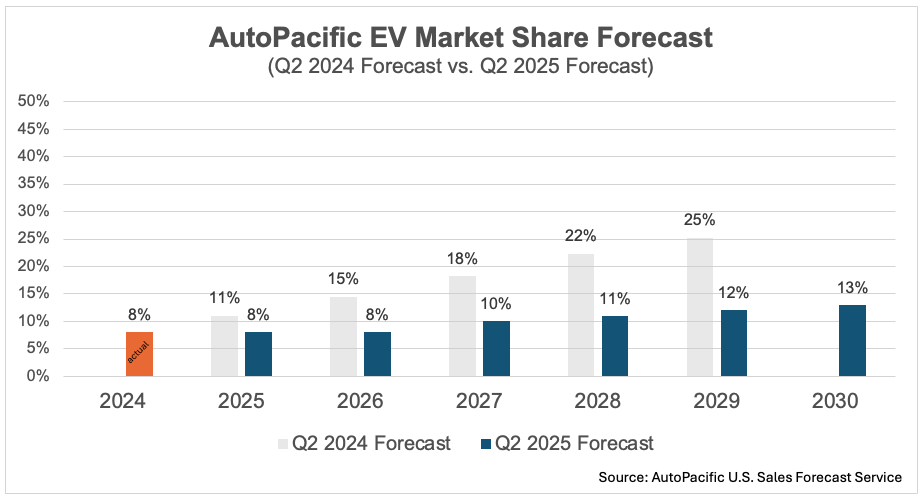
AutoPacific Adjusts EV Forecasts—Downward

To be sure, the future is uncertain, but these numbers should chill some EV product planners. . .

By Gary S. Vasilash

In 2024 in the U.S. Ford delivered 1,793,541 light vehicles powered by internal combustion engines.

In 2024 the total number of light vehicles delivered in the U.S. was some 15.9 million units.

If we take the number of Ford ICE vehicles sold, that’s about 11% of the whole market.

According to AutoPacific, in 2024 the total number of electric vehicles (EVs) delivered in the U.S. represented 8% of the market.

That would be 1,272,000 vehicles.

While that is not a trivial number, it is still about half-a-million shy of the number of vehicles that Ford alone sold with internal combustion engines.

You’d think with the billions invested in the vehicles and attendant technology the numbers would be somewhat larger for EVs now.

They aren’t.

AutoPacific has some new numbers that adjust the number of EVs to be sold in the U.S. market, an adjustment that the Federal tax credit of $7,500 that expires on September 30 plays no small roll in.

Or, as Ed Kim, AutoPacific president and chief analyst puts it:  “The EV market in the U.S. is headed for a rough patch with market share growth stalled due to multiple factors related to lack of affordability.”

And the elimination of the tax credit will make the vehicles less affordable.

Last year AutoPacific made projections of what it anticipated the size of the market would be.

And across the board, they are adjusted in a downward direction. And not a trivial decline:

Even with all of the claims of less-expensive, longer-range and quicker-charging EVs coming within a few years’ time, going forward the AutoPacific forecast shows serious declines.