A Thought About the Design of the Ford Maverick

Does an urban dweller want something that is Built Ford Tough or which smacks of fashion?

By Gary S. Vasilash

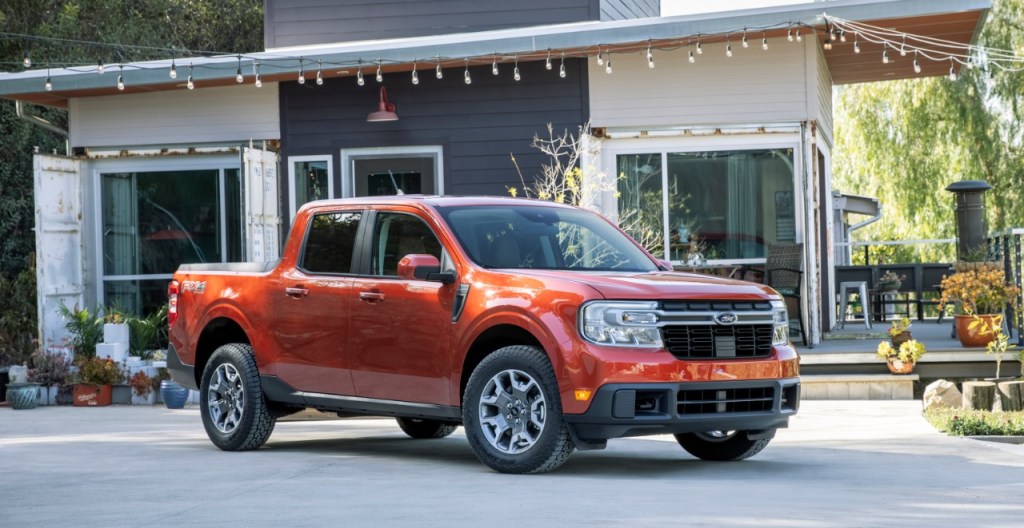
“One thing that’s non-negotiable is that Maverick is Built Ford Tough,” said Chris Mazur, chief engineer for the small pickup.

What seems a bit odd is that Ford says of the truck “The interior design is stylish and spacious, with thoughtful features and the versatility for city driving or escaping the urban life,” which seems to indicate that this is a vehicle for city dwellers.

Looks like a truck. Is a truck. (Image: Ford)

So this “Built Ford Tough” characteristic doesn’t seem to align with what would assume would be style-conscious urbanites—except for those who wear Carhartt.

As it starts under $20K and comes standard as a hybrid, there is a draw there.

But as Hyundai is coming with the Santa Cruz, a vehicle that is certainly more chic, it will be interesting to see which has greater appeal for those who want a “truck” but really don’t want a “truck.”

Lambo and LEGO

A LEGO model that looks (almost) like the real thing

By Gary S. Vasilash

When you were a kid, perhaps you had a model—or more—of a particular vehicle that you hoped to have when you “grew up.”

And maybe you had a LEGO set that allowed you to make something that was a geometric analogue of that vehicle.

For many people, a Lamborghini may have been the desired vehicle.

And Automobili Lamborghini has been working with LEGO on the production of models.

The latest is a life-size replica of the Lamborghini Sián FKP 37.

(Image: Automobili Lamborghini)

Yes, as big as the real car.

To build it they used 154 different types of LEGO elements, including 20 molded for the project. (Which goes to show you that when the OEM and the supplier are working hand-in-hand, special things can happen.)

This was no idle process of putting blocks together and seeing how they worked.

There was a team of 15 people involved. They used 8,660 hours of development and construction.

The companies say that the model is “identical” in size to the real thing: 4,980 mm long, 2,101 mm wide and 1,133 mm high.

The model was painted in the Automobili Lamborghini paint shop.

LEGO offers a 1:8-scale edition of the Sián for those looking to put something on the shelf.

Another Electric Pickup

Not everyone is going to be getting an F-150 Lightning. . .

By Gary S. Vasilash

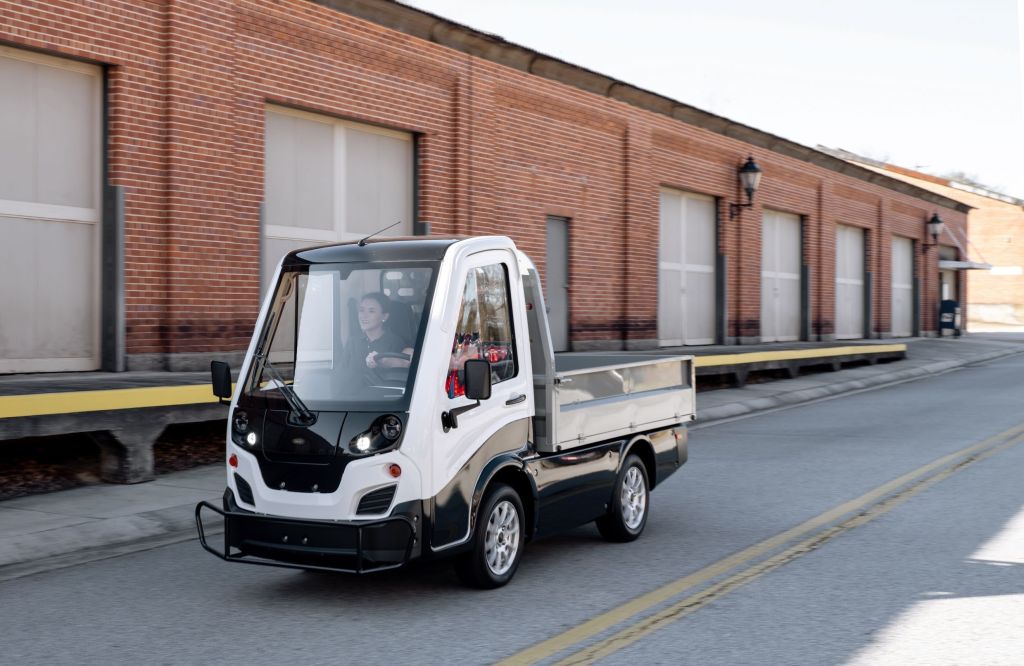
Those who spend time on golf courses are undoubtedly familiar with the golf cars—not carts—from Club Car, the company makes a variety of other vehicles for low-speed operations.

The company, working with AYRO, which produces purpose-built electric vehicles (EVs) for such things as microdistribution, has launched the Club Car Current, an EV that can be configured as a flat bed, pickup or van.

It offers a range of up to 57 miles.

(Image: Club Car)

As a certified low-speed vehicle (LSV), it operates at up to 25 mph.

It is powered by a VRLA (valve regulated lead-acid) gel battery.

It is certified as a Zero Emissions Vehicle by the California Air Resources Board.

And perhaps the most important factor for users: the cup holders are designed to accommodate larger containers.

Will Buying a Car Change?

Does Gen Z really want to kick tires?

By Gary S. Vasilash

On April 14, 2021, an “Open Letter by Academics in Favor of Direct EV Sales and Service” was published, with the signatories being current or emeritus professors at U.S. universities who “specialize in economics, competition policy, market regulation, industrial organization” and other disciplines.

The primary point:

“We write to argue that any state laws still prohibiting car companies from selling their cars directly to consumers, or opening service centers for those vehicles, be amended to permit direct sales and service of electric vehicles (‘EVs’).”

There is an acknowledgement that this has largely been a case of Tesla hitting up against franchise laws. But they go on to note: “it is equally important to a new crop of American EV start-up companies including Rivian, Lordstown, Lucid, Bollinger, and others about to enter the market. It is also important to the legacy automobile companies like General Motors, Ford, and Chrysler, which should be allowed to compete with the start-ups on a level playing field.”

The academics argue the dealer franchise laws generally go back to the mid-20th century when “car dealers were mostly ‘mom and pop’ sole proprietorships. By contrast, the ‘Big Three’ auto companies were hegemonic firms that faced relatively little domestic or foreign competition.”

So, in effect, to protect the little guy, the franchise laws were put in place. This meant that OEMs couldn’t sell (or service) vehicles directly to the consumer, as it was thought that were they able to, they would be able to undercut the small proprietorships that were selling vehicles.

The letter points out that today there are massive dealership groups responsible for moving a whole lot of vehicles, not one’s next-door neighbor who operates a dealership down the street. They write: “there are at least 15-20 major manufacturer groups selling cars in the U.S.”—which account for, they say, billions of dollars in revenue. You can buy a whole lot of jerseys for the local softball team with that kind of money.

The academics put forth a number of reasons why direct sales should be permitted for EVs (one suspects that were it permissible for EVs it would be difficult to stop this happening for vehicles with other propulsion systems). One of the salient points is: “Traditional dealerships earn low profit margins on new car sales, and make it up on service. EVs have a much smaller service component since they don’t have service needs like oil changes or engine tune-ups. Traditional dealerships therefore lack much of an incentive to sell EVs.”

In addition to arguments like that, there is the simple fact that since the franchise laws were enacted there have been an array of developments that allow people to obtain goods and services that were not even imagined back then.

Like the Internet.

Which facilitates things like Amazon.

Which has created a generation of consumers who want to get things on their schedules.

Which has given rise to things like Carvana.

And on it goes.

Dave Zuchowski is the chief strategy officer at Unite Digital. The mission of Unite Digital is “To drive significant growth for our customers by creating seamless customer experiences that Unite and differentiate a manufacturer and their distribution network.” The “customers” in that sentence are “automotive, powersports, automotive groups and other franchised industries.”

Zuchowski, who is a former president and CEO of Hyundai Motor America and senior vice president of Dealer Operations at Mazda North America, has seen the business from several perspectives.

He thinks that what will be the case going forward will be more of a “hybrid” than a case where in order for someone to get a new vehicle—EV or otherwise—they will have to go to a dealership. Rather, it will be a blend of digital and personal interactions, something more seamless than obstreperous.

On this edition of “Autoline After Hours” Zuchowski provides his insights on not only the changing face of automotive retail, but overall changes that are facing various aspects of the industry. He talks with “Autoline’s” John McElroy, automotive writer Steve Findlay, and me.

And you can see it here.

2021 Niro EV Launched

The what?, you, perhaps, wonder

By Gary S. Vasilash

When you think of an electric vehicle (EV), odds are that the first thing that comes to mind is something from Tesla.

Then, given the recent buzz, the forthcoming Ford F-150 Lightning.

Then after that maybe the Chevy Bolt EV.

And then any number of things, be it an Audi e-tron or a Porsche Taycan or something from a startup company that you’ve heard about (e.g., a Lucid Air).

K2021 Niro EV

How about the Niro EV?

(Quick: What is the name of the manufacturer who produces the Niro EV?)

The 2020 Niro EV was the number-one mass-market vehicle in the first J.D. Power Electric Vehicle Experience Ownership Study.

Number one.

The 2021 version is being launched.

The crossover from Kia has a starting MSRP of $39,090 and with its 64 kWh battery provides an estimated range of 239 miles.

It has a whole suite of standard driver assistance tech (from forward collision warning to smart cruise control with stop and go). Its got the goods, and then some.

And it is a functional compact crossover with 18.5 cubic feet behind the second row or 53 cubic feet with the second row folded. Usefulness meets technology at a very reasonable price.

Surprising how a competitive EV gets lost in the noise.

Some Sales Numbers to Consider

All things considered, the auto market in the U.S. is doing remarkably well

By Gary S. Vasilash

According to LMC Automotive, a forecasting and market intelligence firm, in the month of May there were some 1.59-million light vehicles sold in the U.S.

Which in and of itself is somewhat meaningless unless you keep track of things like that.

What may be helpful to know is that that number is a 43% increase compared to May 2020.

Of course, May 2020 was a period when we were in the thick of COVID, with not a whole lot of people going to kick tires unless those tires were on one’s vehicle in one’s garage.

Another thing that those who look at the numbers do is calculate the annualized rate of sales.

In April the annualized rate was 18.8 million vehicles, which essentially means that if things continued for the rest of the year like April there would be a total of 18.8 million vehicles sold.

In May the annualized rate fell to 17.2 million.

Given that part of LMC’s business is forecasting, that is a good thing, as it has, and continues to predict, that the 2021 light vehicle sales will be 17 million vehicles.

And the good thing for the industry about that is that if it does finish at 17 million, that is an 18% increase over 2020.

Arguably the would be more vehicles sold were it not for the semiconductor shortage.

Last year COVID.

This year the semiconductor problem (and some COVID).

Next year?

Locusts?

Toyota Corolla Cross Introduced

Yes, another CUV in the lineup for Toyota

By Gary S. Vasilash

Who doesn’t like a crossover? Almost no one it seems.

Toyota has taken its Corolla and turned it into a crossover. It isn’t even trying to disguise that fact in any way. It is calling the vehicle the “Corolla Cross.”

Front wheel drive. All wheel drive (up to 50% of the power can go to the rear wheels when needed; otherwise there is a disconnection to save fuel).  A 169-hp engine and a continuously variable transmission (the “Direct Shift CVT” from the Corolla S—the sportier version of the sedan).

Toyota brings another crossover, the Corolla Cross, based on the TNGA-C architecture (Image: Toyota)

As gas is getting more expensive, know that the combined MPG for the AWD is estimated to be 30 and 32 for the FWD.

Yes, it can tow. Up to 1,500 pounds.

More importantly, perhaps, is that it has Apple CarPlay and Android Auto.

While it has yet to be revealed what the cargo capacity is with the second row folded, behind the second row the FWD can handle 25.5 cubic feet and the AWD 24.3 cubic feet. Good for gear.

The Corolla has been on offer for some 50 years. Its sales numbers, year after year, as a sedan (and hatch), has been impressive.

Seems like it will be racking up some additional numbers, given the popularity of the vehicle in and of itself and the crossover architecture.

VW Brings Some “Rugged” Options for the Taos

Clearly, there has got to be a tent coming. . . .

By Gary S. Vasilash

The Volkswagen Taos is absolutely new, but because the company knows that it is always good to offer stuff, it has rolled out with “Basecamp” components for the compact SUV.

The components—thus far, at least—aren’t about, well, camping, base or otherwise.

Rather, they are about making the vehicle have a more-rugged appearance.

Through cladding.

“Our goal is to build on the vehicle’s dynamic exterior design and provide customers with an extensive catalog of accessory options that cater directly to their desires for distinctive styling and functionality,” said Hein Schafer, senior vice president of Product Marketing and Strategy at Volkswagen of America.

Specifically, there are things like front and rear fender flares with integrated splash guards, lower door side plates, and a Basecamp badge for the front grille.

VW Basecamp accessory. A serious mat. (Image: VW)

While those elements are clearly show, not go, what is completely functional and then some are the Rubber MuddyBuddy mats.

Yes, that’s the sort of stuff that gets on one’s boots at a basecamp.

What Makes a Jeep a Jeep

A wide-ranging discussion with the man in charge of the look of that venerable marque

By Gary S. Vasilash

Mark Allen is presently the head of Jeep exterior design.

He’s been on the Jeep team since 1994.

Which pretty much means that everything you see in showrooms right now he had his hand in.

And as Jeep owners tend to be hang onto their vehicles—and drive them, drive them in places where few other vehicles can be driven—Allen has probably been involved with them, too.

On this edition of “Autoline After Hours” we spend the entire hour talking to Allen about the how, why, wherefore, who and more of Jeep design.

A good portion of the conversation is dedicated to the vehicles that participated in this the Easter Jeep Safari that occurred this past April in Moab, Utah. This is an annual event that Allen and his colleagues specifically develop vehicles for—bona-fide Jeeps that are able to crawl the rocks with the best of them, but Jeeps that have specific themes or techs that they want to get first-hand feedback about from the people who assemble in Moab with their vehicles.

Among the vehicles Allen describes are:

The Wrangler Magneto. This is a battery-electric vehicle. Allen is particularly interested in the performance of electric motors for Jeeps, not only because they are quiet and so when going on trails it is possible to not scare away the wildlife, but also because they allow the vehicle to be precisely controlled, which can make all the difference when making a difficult ascent or transition.

Jeeps at the 2021 Easter Jeep Safari in Moab, Utah. (Image: Jeep)

The Jeepster Beach. A resto-mod based on a 1968 Jeepster Commando. Allen says they like to do at least one resto-mod per Safari.

Jeep Red Bare. A Gladiator Rubicon-based concept that utilizes a 3.0-liter EcoDiesel. Highly customized, he points to the interior seat material, which resembles a lumberjack’s shirt.

Jeep Orange Peelz. This one was done by the Mopar studios. It brings in the half-doors and features a custom one-piece glass sunroof.

Jeep Farout. A Gladiator tricked out with a AT Overland Equipment Habitant Truck Topper. Allen points out that often tents on vehicles are dark and oppressive. In this case they worked to lighten things up.

Jeep Top Dog. Another execution by the Mopar team. This Gladiator-based concept is developed for mountain bikers, with a bike and gear case built onto the vehicle—as is a rotisserie hot dog cooker. (One imagines that serious mountain bike athletes probably don’t eat a whole lot of hot dogs. . . .)

Jeep Wrangler Rubicon 392. “Wait a minute,” some of you might be thinking. That’s a production vehicle. Yes, but here’s the thing. Allen explains that it was going to be a large part of the 2020 Safari, something of a tease, but then the pandemic got in the way.

Allen also talks to “Autoline’s” John McElroy, freelance writer Mark Williams and me about the forthcoming Grand Cherokee L, the Wagoneer and Grand Wagoneer, and the absolute importance of the Wrangler to what is arguably the phenomenon that is known as “Jeep.”

And you can see it all here.

Air Springs: Bet You Didn’t Know

Well, not exactly something you probably think about

By Gary S. Vasilash

Consider the tires on your vehicle. Even though that car or light truck weighs at least a couple thousand pounds, there is a tube of rubber (and other materials) that is full of air holding it up.

Air.

Think about it: What is a flat tire but the absence of air.

One of the leading tire manufacturers is Firestone.

So it knows a lot about creating automotive air-holding objects for purposes of improved ride and handling.

Turns out that the company holds the first patent in the world for air springs. And it has been producing them for some 75 years.

An air spring doesn’t look like what you think about when you think “spring.” No, it isn’t a rubber spiral full of air.

Rather, it is more like a cylinder.

Air springs provide better control of comfort and vehicle leveling. And to the point of leveling: they’re usually found on trucks due to the heavy loads that they sometimes carry.

Here’s another place where they have applicability: electric vehicles.

Reason: The battery packs are heavy.

In a Tesla Model 3 the battery weighs over 1,000 pounds. And as EVs get bigger, so do the batteries, so does the challenge of ride and handling.

So the folks at Firestone Industrial Products, which make air springs (among other things), are expanding the production capacity of the factory Williamsburg, Kentucky,  where the springs are manufactured. It is investing $51 million in the effort.

The rationale: “With the increase in vehicle electrification, Firestone air suspension systems are in high demand among the most innovative and forward-thinking original equipment manufacturers globally “Firestone air suspensions are optimally designed with electric vehicles in mind. Compared to traditional coil spring suspensions, our air suspensions are designed to help improve the handling and comfort of heavier electric vehicles and can even help improve EV range by lowering the vehicle to help improve aerodynamics. Advanced air suspensions are increasingly a ‘must-have’ technology on premium electric vehicles, and Firestone is committed to maintaining its leadership in this exciting and important market.”–Emily Poladian, president, Firestone Industrial Products.