Here’s something you probably don’t want to experience: aspects of the standard features offered in the new 2025 Police Interceptor Utility:
Police Perimeter Alert. . . Police Engine Idle. . . Police Dark Car Feature. . . Rear Camera on Demand. . . H8 AGM Battery. . . Blind Spot Monitoring with Cross-Traffic Alert . . .Manual Police Pursuit Mode – Steering Wheel Switch Execution. . . Red/White Dome Lamp – Cargo Area. . . Rearview Camera with Washer Viewable in 8″ Center Stack Screen. . . Ford Pro Upfit Integration System. . . Keyless Entry with 4 Manual Keys. . . 6-Way Power Passenger Seat. . . Police Accessory Independent Timed-Release Output (PAITRO) – Output Tied to Liftgate Release Switch. . . Climate Control – Rear Aux A/C System. . . Updated Police Grade Cloth Trim Seat Material. . . 12.3″ Digital Instrument Cluster with Certified Calibration. . . Keyless Entry – Key FOB Only (Less PATS). . . Simple Fleet Key (w/o microchip, easy to replace: 4-keys). . . Two 50-amp power distribution junction box
The 2025 Ford Police Interceptor Utility. Departments looking for fuel economy can opt for a hybrid powertrain. (Image: Ford)
Seems like the only thing you’d really be interested in were you to find yourself in the back of one is that rear aux A/C system. And perhaps the seating material.
The rest of the stuff is germane to the professionals.
The Police Interceptor is based on the Explorer that you can find in a dealer near you.
But this vehicle isn’t simply an Explorer with additional lights and a profoundly different paint scheme.
It is engineered to be a police vehicle. It is being offered through Ford Pro, underlining that this is a commercial, not consumer, vehicle.
There are three powertrain options. There is a 3.3-liter V6 that produces 285 hp. A 3.0-liter EcoBoost V6 that produces up to 400 hp—but that’s if the vehicle is using Premium gas, which is probably not something that municipalities are in favor of.
And there is a 3.3-liter V6-based hybrid that produces a system output of 318 hp.
One of the arguments that Ford makes for the hybrid is that the onboard equipment operates even when the engine shuts off. This, it is calculated, means a savings of up to 838 gallons of gas per year because the engine isn’t idling so that various things in the vehicle work.
So, if gas is at $3.50 per gallon, this can translate into a savings of $17,500 over a six-year period.
Which matters as budgets at municipalities are stretched.
(Here’s something interesting: the new consumer version of the Explorer is not offered with a hybrid, something that had been available before the recent midcycle refresh. Given the popularity of that powertrain—as consumers budgets are being stretched—it seems likely Ford may rectify that. After all, they like fuel efficiency, too.)
OK. The images give it away. But still: who would have thought?
By Gary S. Vasilash
Tyler Hill, Ford global brand licensing manager: “These new _______ will allow more people to experience the adventurous spirit of a Bronco and the exhilaration of a Mustang from the moment they grip the __________.”
That would be:
e-bikes
handlebars
That’s right, a Bronco e-bike and a Mustang e-bike.
These bikes, developed with N+, are not for the causal rider.
Both feature 750-W hub motors that can allow the rider up to 28 mph.
To help stop, there are four-piston hydraulic brakes.
(Images: Ford)
The Bronco bike has a dual-suspension system that is said to allow the bike to handle “any type of terrain,” just like the SUV that inspires it.
The Mustang comes in a special 60th anniversary model. A little quick math indicates that were someone in 1964 able to afford a Mustang that person would have probably been at least 20 years old, so that person is likely not to be in the intended customer for the e-bike.
And speaking of customers, the Bronco bike has an MSRP of $4,500 and the Mustang $4,000.
When it comes to customers, auto companies like them young and well-heeled.
Young because if they get the customers early and they do a good job in at least meeting and ideally exceeding expectations, this increases the possibility that they’ll stick with the brand or go up a level (i.e., from Chevy to Cadillac; from Toyota to Lexus; from VW to Audi).
And as for having plenty of disposable income—well, that’s obvious. After all, those Platinum and Unobtainium trims don’t come cheap.
This is borne out by a study conducted by research firm Numerator on electric vehicles.
As for comparative youth, it found that 42% of EV owners are Gen Z’ers or Millennials. That’s in the context of those two cohorts representing only 30% of all vehicles.
As for wealth, there are at least a couple of indicators: 44% are said to be from high-income households. Only 30% of the average vehicle owners are in that stratum.
And 77% of EV owners live in households with two or more vehicles. This is compared to 68% of all households with vehicles.
What seems somewhat odd, however, is that EV owners are twice as likely to walk or bike to get around and are four times as likely to take public transit than the non-EV owners.
While it might be thought that these Gen Z and Millennial EV owners are all about the environment, Numerator found that only 48% of them cited the environment as why they opted to go electric.
Seventy-four percent said it was for cost savings on fuel.
To put some numbers around that:
According to the EPA, the average cost of a gallon of regular was $3.48 in 2023. Also, the average miles per gallon achieved in new vehicles in 2023 was 26 mpg. In its “Fuel Economy Guide” it estimates the average driver racks up 15,000 miles per annum.
So, 15,000 divided by 26 is 577. And multiplying that by 3.48 gets us to an annual outlay of $2,008, or $38.61 per week.
Not a whole lot, but evidently even the wealthy watch their wallets.
ExxonMobil announced its Q2 earnings last week, which includes both a 12% year-over-year revenue increase (to $90.06 billion) and a 17% profit increase (to $9.24 billion).
And what is more interesting: It recorded its highest production of oil in the company’s history: 4.4 million oil-equivalent barrels per day. That’s up 15% compared with Q1.
In reporting its numbers, the company states it is working with Air Liquide on achieving the capacity to produce “virtually carbon-free hydrogen” that will be used for industrial customers, not fuel cell vehicles.
It is working with a major fertilizer and ammonia producer, CF Industries, for a carbon capture and storage arrangement.
It has a company named Proxxima that takes “lower-value” gasoline molecules and transforms them into a high-performance thermoset resin, which can be used to build composite structures.
And there is a Carbon Materials operation that it hopes will turn “low-value, carbon-rich feeds from the company’s refining processes” into things like carbon fiber and polymer additives.
What isn’t here?
Anything in the way of a transition to electric vehicles.
But the company did note it has signed a non-binding memorandum of understanding with battery company SK On for up to 100,000 metric tons of lithium over multiple years from a “planned” lithium project in Arkansas.
Clearly the company is still knee-deep in oil and it doesn’t seem that that is going to change anytime soon.
The Volkswagen Touareg was first available in the U.S. and pulled from the market in 2018. The rather, um, exotic name refers to a Berber tribe that inhabits the Sahara. It was, after all, a midsize luxury SUV, so this whole nomadic adventuring what presumably descriptive in the naming.
It probably had more than a little something for the vehicle not being as successful as had been hoped in the burgeoning SUV-crazy U.S. market.
Many people probably didn’t know how to say it (phonetically: “two-are-egg”), so rather than embarrass themselves at a VW dealership they went and bought a Ford Edge.
But one of the characteristics of the Touareg—which continues to exist in other markets—that I recall with respect is that it was substantive. This was a solid SUV, not something that was fundamentally a car in SUV’s clothing.
It was the sort of vehicle that you could imagine rolling across the Sahara.
Not that you would, of course, but in the event that you suddenly found yourself in North Africa you’d be good to go.
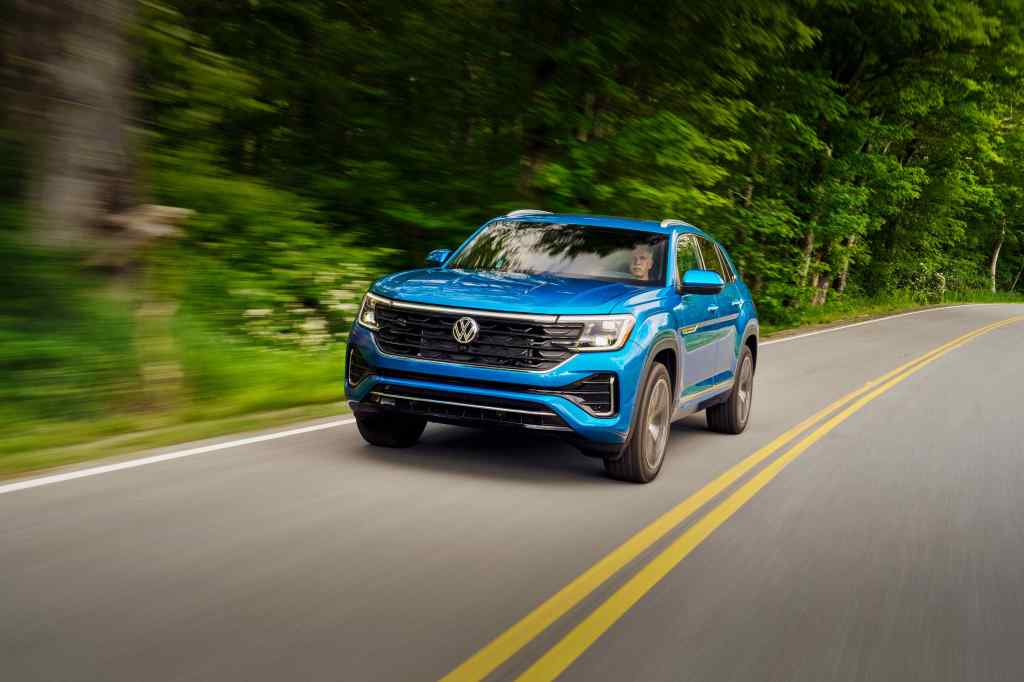
While l am not 100% confident that the Atlas Cross Sport could go trekking though sand dunes, one of the things that struck me about it is that compared to some other SUVs I’ve been in of late, this really feels well-built. . .and it so happens to be built by Volkswagen in Chattanooga, Tennessee.
When you shut the door you think “vault” not “vague.” When you drive the Atlas Sport you think “capable” not “cheap.”
It is, simply, the real deal.
What’s more, in a category where there is such proliferation of models that there is a stultifying sameness, there is another word that comes to mind, which is “style.”
I don’t want to go completely overboard on this, but the Atlas Cross Sport is an SUV that deserves more consideration that it evidently gets.
I say “evidently” because it is a, well, sportier variant of the Atlas. And in Q2 2024 the Atlas outsold what the Atlas Cross Sport did for Q1 and Q2 combined:
Atlas Q2: 19,293
Atlas Cross Sport first half: 18,835
And I suspect that the difference has to do with these numbers:
Atlas: three rows
Atlas Cross Sport: two rows
and:
Atlas: 96.8 cubic feet of cargo with seats folded
Atlas Cross Sport: 78 cubic feet of cargo with seats folded
I guess you could sort of say it is the difference between a pair of Timberlands and Louboutins (of course, the Cross Sport styling isn’t quite that exotic, but you get the analogy).
The Cross Sport is powered by a turbocharged 2.0-liter engine that produces 269 hp and 273 lb-ft of torque. It is mated to an eight-speed automatic. This model has AWD.
The stickered fuel economy numbers are 19 mpg city, 26 mpg highway and 22 mpg combined.
An important characteristic for a vehicle in this class: it has 5,000 pounds of towing capacity.
While the interior is well adorned with serious-seeming-but-attractive materials and there are metal-clad pedals that signify that you’re in R-Line trim, the interface for the 12-inch touchscreen is too fussy for purpose. (Funny thing: many OEMs seem to think that they know how create the digital interfaces for their vehicles, yet compared to companies in that field they just don’t: consider that while Waymo’s first vehicle, the Firefly, was purpose-built, that quickly gave way to vehicles from the likes of Stellantis and Jaguar because Waymo understands what its competencies are.)
There is a vast array of midsize SUVs out there. Lots to consider. Probably too many to reasonably consider.
But while things like Beetles still remain in the consciousness of many Americans and while Golfs are out there in number, these smaller vehicles should not make one not checkout something larger, the Atlas Cross Sport.
When you think of McLaren Automotive, you probably think of supercars like the Artura Spider shown here:
It’s a hybrid that combines a 3.0-liter twin-turbocharged V6 and an axial flux electric motor to produce 690 hp.
Or thought of in action: 0 to 60 mph in three seconds.
A convertible.
When you think of McLaren Automotive, you probably don’t think of nut-runners and other assembly tools.
But at the McLaren HQ in Woking, Surrey, England there is the McLaren Production Centre, where the cars are built.
Of course, they’re built more like a fine mechanical watch than a run-of-the-road motorcar.
But they are still manufactured.
The McLaren announced that Atlas Copco is the company’s “Official Smart Tooling Supplier.”
The builder is deploying Atlas Copco battery-powered, digitally enabled nut-runners and other tools throughout its manufacturing operation. It is leveraging the Atlas Copco Smart Integrated Assembly tools and system for machine learning to improve production operations.
Matt Walton, Chief Manufacturing Officer, McLaren Automotive:
“In addition to our commitment to embracing cutting-edge technologies, we remain dedicated to preserving the essence of our hand-built approach.”
Maybe its from the racing ethos where you get as many suppliers and even tangentially related companies to become sponsors.
Still, an “Official Smart Tooling Supplier” for a manufacturing operation certainly seems like a novel approach.
Wonder if the line workers have Atlas Copco patches on their shirts. . . .
One of the most significant vehicles that Ford has launched during the past few years—arguably more significant than the Mustang Mach-E, which people seem to get excited about—is the Maverick, a midsize pickup truck that is smaller than the Ford Ranger, another midsize pickup truck, which has seemingly lost its mojo.
So let’s put some numbers to the “significant” claim.
Through the first half of 2024 the respective U.S. sales for the vehicles:
Mustang Mach-E: 22,234
Maverick: 77,113*
And for good measure:
Ranger: 15,175
So why is the Maverick, which went on sale in late 2021 as a model year 2022 vehicle, so successful?
Because it is small, fun, funky, functional, and economical.
As for the last item: the starting MSRP for a 2024 Maverick XL with a 2.0-liter EcoBoost engine, is $23,920. For those interested in a 2.5-liter hybrid version, that’s $25,420.
The functional part is that it is a bona-fide truck. As in something with the ability to handle a 1,500-pound payload and tow up to 4,000 pounds (with the 2.0-liter).
And the really clever bit that Ford designers and engineers did was to embrace the fact that they were creating something that would have a low price point.
Typically there seems to be a tendency for them to pretend that whatever it is they’re putting on the road is more expensive than it is, which leads to faux execution inside (in particular) and out.
In the case of the Maverick, while the materials may not be the stuff of an F-150 King Ranch edition, those materials are treated with an honesty and an innovative spin such that they make the truck all the better because there is an authenticity to it.
Now, for model year 2025, the Maverick is getting a refresh.
And a new model.
“One of the first things you’re going to notice is a slimmer, more modern headlight profile,” says Josh Blundo of the design team.
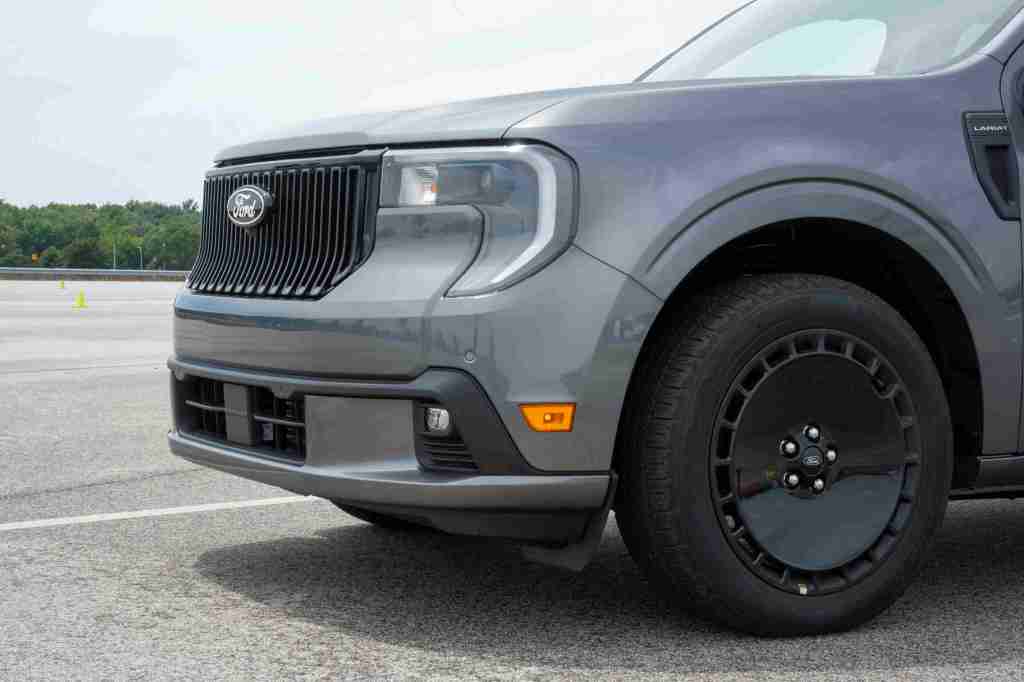
The front fascia for the ’25 Maverick Lariat features “chicklets” on the grille. The front ends of each of the available models—XL, XLT, Lariat, Tremor, and Lobo—has a differentiated look. (Images: Ford)
The primary change for the Maverick trims across the board—and there is a new trim added, the Tremor—is in the front, not only in terms of the headlights, but the fascias, which are specifically designed for each trim (e.g., the Lariat trim has a grille featuring what Blundo refers to as “chicklets,” small metallic rectangles that pop on the black grille).
Inside the most obvious change is the 13.2-inch touchscreen—standard across the lineup—which Blundo says is as big as the screen in any Ford model. Yes, as big at one in an F-150.
Kirk Leonard from the engineering team—who has been with Maverick since just after the launch of the ’22 MY vehicle, and who came to it from Super Duty, which goes to show that this is a serious truck—points out, “Just because we’re a small truck doesn’t mean we get a pass on the capability, durability and toughness that customers expect from our vehicles.” So while the Maverick may be fun, it is not a poseur.
Leonard says “The number-one thing customers have been asking for is all-wheel drive for the hybrid.”
So the ’25 Maverick is available with a AWD system for the hybrid.
Leonard adds, “They wanted all-wheel drive but they didn’t want to give up on fuel economy.”
So, he says, they’re estimating that the AWD Maverick with the 2.5-liter hybrid system will deliver 191 hp, 155 lb-ft of torque, and 40 mpg city.
Those who are even more interested in fuel economy but not interested in all-wheel drive can get the front-drive version, which Leonard says will provide an estimated 42 mpg in the city, and a 500-mile range on a tank of gas.
The Maverick is also available with a 2.0-liter EcoBoost engine that provides 238 hp and 277 lb-ft of torque.
And There’s This. . .
Josh Blundo is one of those guys who is a quintessential “car guy.” While a teen in New Hampshire he was sketching cars, which really wasn’t a thing that his peers were doing. He went to the College for Creative Studies in Detroit and found that car culture was everywhere.
Which is evidently an environment he thrives in.
He says that when the Maverick was first launched he saw that it had a certain minimalism that he finds appealing. And something to use as a launch pad for creation.
Which lead to the design of the Maverick Lobo model.
Lobo. Lowered and with a look that combines street truck and tuner cultures, says designer Josh Blundo.
Although this fits within the “street truck” modified niche, Blundo says, “Street trucks really represent a broad culture. A lot of people think ‘muscle’ trucks—full-size trucks with V8s.”
Then, at the other end of the spectrum, he says, are tuner vehicles. In this case they’re mainly sedans and hatches—Civics and Golfs and the like.
“Maverick, because of where it sits in the truck space, unibody and more focused on handling than straight-line performance, sits in the middle ground,” Blundo says.
So for the Lobo aesthetic they lowered the truck ½ inch in the front and 1.12 inches in the rear, which results in a roof height that’s 0.8 inches lower. And that roof is painted black, as are the 19-inch wheels. (Speaking of the roof: there are two available configurations, Standard and High. High, among other things (e.g., heated steering wheel and seats; spray-in bedliner) includes a moon roof.)
There are a Lobo-specific front fascia and painted rear bumper.
Kristen Keenan and her colleagues in Color + Materials provided the Lobo with a unique interior execution. Keenan, who had worked designing performance footwear at Nike, says that that experience helped inform what they did inside the Lobo, such as using ActiveX, a high-end synthetic that looks good and wears well.
Because this truck is not just about show but also go, there are things like a twin-clutch rear drive unit that provides torque vectoring and an upgraded cooling system.
The truck offers the “Lobo mode,” a drive mode that essentially minimizes the intervention of the stability control system so that the truck can be thrown around on a track—a closed track, notes Keith Daugherty, an engineer who worked on the Lobo and deployed elements from the European and U.S. Ford parts bins (brakes from the Euro Focus ST; strut mounts from the Mach-E).
And, yes, as a daily driver the Lobo has available, like other Mavericks, things like Pro Trailer Hitch Assist, because at the end of the day, it’s a truck.
==
*While some may quibble that this is an unfair comparison, given that one is an EV and the other is a pickup truck, the Maverick is a pickup truck that is available as a hybrid, and according to James Gilpin, Maverick brand manager, about half of all Mavericks sold are hybrids. This means about 38,550 Mavericks sold are electrified, still greater than the 22,234 EVs.
According to the British trade association the Society of Motor Manufacturers and Traders (SMMT), through the first half of 2024 the car brand MG had 4.38% of the UK market.
While that may seem, at first blush, somewhat trivial, it should be noted that MINI was a 2.11%, Land Rover 3.26%, and Ford at 5.64%–and as for that last-named, I’ve been told by people who live there that Ford has been on the scene so long that it is considered indigenous to the U.K., and that Ford’s U.K. showroom has a breadth of offerings that dwarfs MG’s.
MINI is owned by BMW. Land Rover by Tata Motors. And MG SAIC Motor.
MG was established in Oxford in 1930 and had a run until 1972, when its then-owner British Leyland, which itself no longer exists, stopped using the marque.
SAIC has owned the brand since 2005. (It was purchased by Nanjing Automobile Group that year, then SAIC acquired Nanjing in 2007.)
Presently MG offers 11 models in the U.K. of which only four are pure ICE vehicles, with the remainder hybrids or EVs.
But next month a British company, Frontline Cars, is going to be bringing its MGB-based LE60 to Monterey.
The Frontline LE60. An MGB brought up to date with a V8. (Image: Frontline Cars)
Interestingly, this restomod is powered by a 375 bhp 4.8-liter V8. Frontline points out that this is “almost quadruple the power of the original MGB.”
But one wonders: while the company now selling vehicles carrying the MG badge are mainly non-ICE, doesn’t a V8-powered sportscar that is returned and updated from the past seem like some sort of curio?
Cadillac, in 2003, decided to really strut its stuff on the world stage.
It looked at competitors—BMW with its M line, Mercedes with AMG—and decided it needed a performance line.
So it created “V.”
“Take that!” it said, while offering additional engineering in models to make them perform at higher levels.
Then it upped things when it introduced the CT6-V Blackwing in 2018, a vehicle deploying the twin-turbocharged V8 engine that was designated “Blackwing.” Those vehicles also came with various aero and suspension mods.
And now. . .
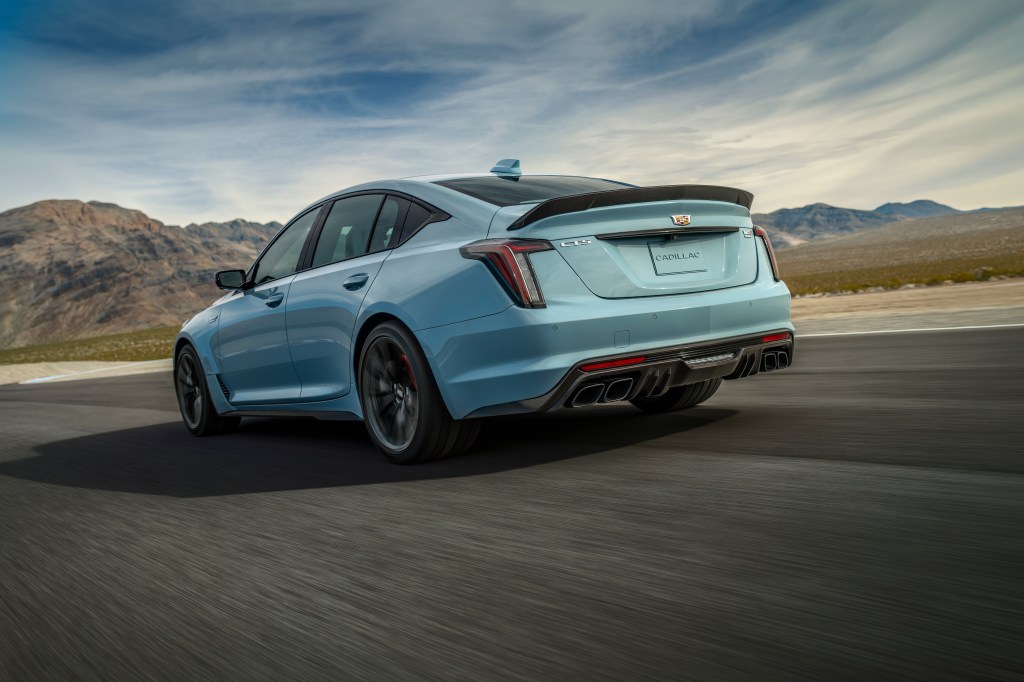
Earlier this year Cadillac introduced the 2025 CT5-V Blackwing.
Yes, it has a 6.2-liter supercharged V8 that pumps out 668 hp and 659 lb-ft torque.
Oh, and it’s a midsize four-door sedan.
Yes, you can drive it to Kroger.
One of the things that has happened in the U.S. in the era of V has been an increase in the number of private race tracks.
Rather than golf country clubs with lockers, these are special racetracks with garages.
Which probably goes a long way to explaining the 2025 CT5-V Blackwing Precision Package.
You could take it for a Sunday drive in the park—especially if it’s a private motorsports park: CT5-V Blackwing Precision Package. (Image: Cadillac)
“This new Precision Package will enable the CT5-V Blackwing to be incredibly light on its feet at all speeds — both on road and track.”
Odds are, this is not oriented for those who are going to get groceries.
This package is largely predicated on changes to the chassis including: increased spring rates. . .larger front stabilizer bar. . .new front steering knuckles and rear suspension toe links. . .recalibrated MagneRide dampers. . .carbon ceramic brakes. . . .
Yes, elements that make a difference when showing your stuff at the track on a Saturday afternoon.
But you’ll have to wait.
Production for the CT5-V Blackwing Precision Package will begin in early 2025.
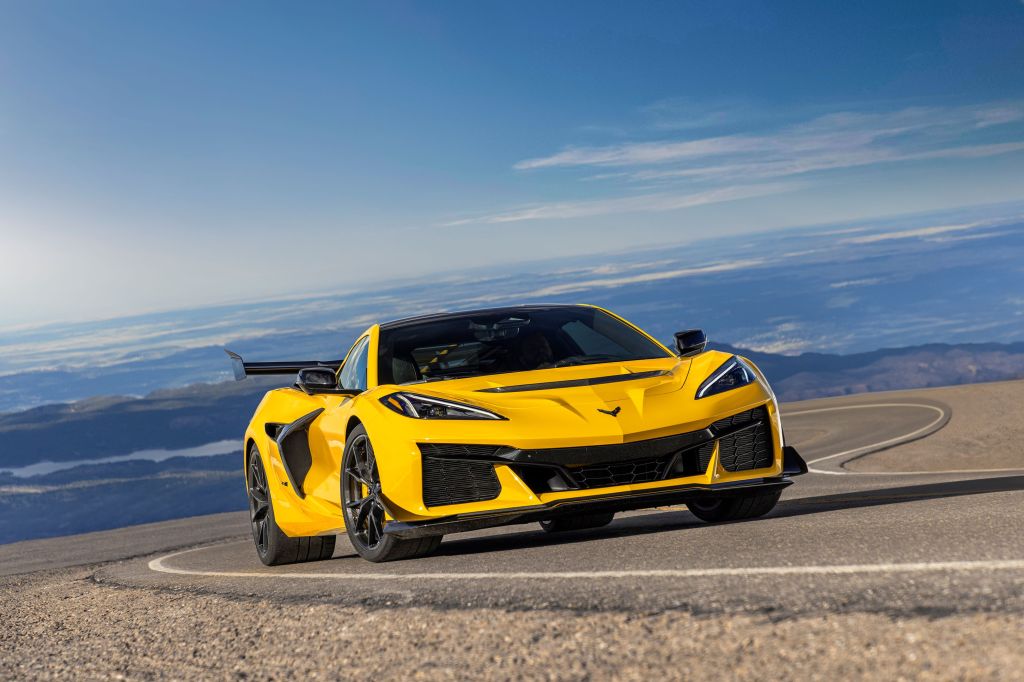
And while it won’t be launched until next year—and “launched” is a good word for this vehicle, the ’25 Corvette ZR1, while undoubtedly something that will be produced in limited numbers, will likely drive interest in the more readily available Corvettes.
The ZR1 is a special model, with its 1,064-hp 5.5-liter, twin turbocharged, DOHC flat-plane crank V8.
The car will have a top speed of over 215 mph.
And while it looks and certainly is fast, it won’t launch to the sky as there is a carbon fiber aero package that produces in excess of 1,200 pounds of downforce when the ZR1 hits top speed.
Now there are electric vehicles that have higher top speeds, though not many, and not readily accessible as at a Chevy dealer.
And the instant torque of an EV may be more impressive than the impressive 828 lb-ft that the ZR1 LT7 generates—at 6,000 rpm.
But the ZR1 will provide a visceral experience as well as the one predicated purely on acceleration.
This sensory suite of sound and vibration is simply something that cannot be as genuinely obtained in an electric vehicle.
At some point, after a sufficient number of enthusiasts, the type of people who would consider paying what is estimated to be on the order of >$180,000 for a car, haven’t driven combustion-powered vehicles, things like the ZR1 will fall out of fashion, undoubtedly being perceived as having insufficient refinement because of the very characteristics that make it so exhilarating to drive.






 shinymetalboxes