A Better Battery Range Predictor

You’ve undoubtedly seen someone—or been that someone—walking along carrying a gas can having run out of fuel. What happens when an EV is out of energy? This project is working to keep that from being a question that needs an answer. . . .

Apparently, the battery management systems in EVs are little better than crap shoots when it comes to providing accurate information as to whether there is sufficient charge in a battery to get from point A to point B.

One reason is there are lots of parameters that need to be taken into account in order to make the assessment, ranging from the condition of the battery to its discharge rate, from the traffic between A and B and the ambient temperature.

To address this overall uncertainty, engineers at the University of California, Riverside (UCR), have developed a metric, State of Mission (SOM). Mihri Ozkan, a UCR engineering professor described it: “It’s a mission-aware measure that combines data and physics to predict whether the battery can complete a planned task under real-world conditions.”

Some models use physics equations that don’t deal with changing environments. Some use machine learning models that provide output but no information regarding how that output was achieved.

The SOM takes into account both information from the batteries’ performance over time as well as electrochemistry and thermodynamics.

Cengiz Ozkan (also a UCR engineering prof): “By combining them, we get the best of both worlds: a model that learns flexibly from data but always stays grounded in physical reality. This makes the predictions not only more accurate but also more trustworthy.”

But there is still a hurdle that the UCR team needs to get over as the SOM development continues.

“Right now,” Ozkan said, “the main limitation is computational complexity. The framework demands more processing power than today’s lightweight, embedded battery management systems typically provide.”

It always comes down to sufficient power, one form or another.

2025 Toyota Highlander 25th Edition AWD

The 25th anniversary is the Silver Anniversary. This anniversary Highlander is available in Heavy Metal. . .

By Gary S. Vasilash

One of the things Toyota did early on that caused many of those in Detroit to grumble was use the platform from one vehicle for another. This wasn’t a case of simply slapping new fascias on a car and using different seat fabrics and saying “Voila! something different!” but of creating something different.

This approach had several advantages. It spread engineering costs from one vehicle to another. It increased scale for a given platform. Both of these things led to better quality (focused engineering resources) and lower costs for consumers (economies of scale).

Case in point: the Toyota Highlander. The vehicle was introduced at the 2000 New York Auto Show as a model year 2001 vehicle.

It was based on the platform used for the Camry sedan, with slight modifications to accommodate things like a higher ride height.

Toyota Highlander 25th Edition. Celebrating a quarter century. (Image: Toyota)

This was not only clever, but arguably revolutionary, given that back then vehicles with that body architecture had frames, like pickup trucks. Cars like the Camry, with unibody construction, provided a more comfortable ride.

So one could say that the body-on-frame vehicles were sport utility vehicles (SUVs) and the first gen Highlander ushered in the midsize crossover utility vehicle (CUV). (The first-generation Toyota RAV4, introduced in the U.S. for the 1996 model year, was based on the Corolla platform, so it gave rise to the compact CUV segment.)

There was something else that happened with the Highlander that’s of some significance.

Model year 2006 was available with a hybrid powertrain. That made the Highlander the first Toyota after the Prius that had one. While it might have seemed that the Camry would get a hybrid after the Prius, that didn’t occur until model year 2007.

(The hybrid in the Highlander could have had something to do with the fact that also in model year 2006 the Lexus RX 400h was launched: the “h” is for “hybrid.”)

Currently, the Highlander is in its fourth generation. It is clearly a case of improvements all along the way.

For the 2025 model there is a special edition, the 25th Edition. Perhaps not the cleverest of names, but a well-appointed Highlander.

The celebration of the milestone is performed with a variety of touches, inside and out.

On the exterior view there are—yes, changes to the front and rear fascias (silver accents on the bumpers), 20-inch wheels, and side rockers.

Inside there are carpeted floor mats and an all-weather rear cargo liner. The seats have leather trim.

And in the space between inside and out there are illuminated door sills and puddle lamps (although they shine on the outside, they are meant to help you get to the inside, so we’ll put them in this intermediate space).

The powertrain (there is a 2.5-liter four-cylinder engine coupled with three permanent magnet motors (two front, one rear)) provides a combined output of 243 hp.

This results in EPA fuel efficiency numbers of 35 mpg city, 34 mpg highway and 35 mpg combined.

Which is most impressive for an AWD vehicle with a third row.

But about that third row. . . .

The legroom back there is 28 inches. No, not a whole lot of room.

The 25th Edition is based on the Highlander Limited Hybrid grade which provides things like a 12.3-inch infotainment touchscreen and 11-speaker JBL audio system. Yes, there is a small volume knob for those who prefer torquing a knob rather that using the steering wheel controls.

The base MSRP for the vehicle is $52,680, which is certainly reasonable for something that (1) is so well-appointed, (2) a hybrid and (3) is limited to 2,500 units.

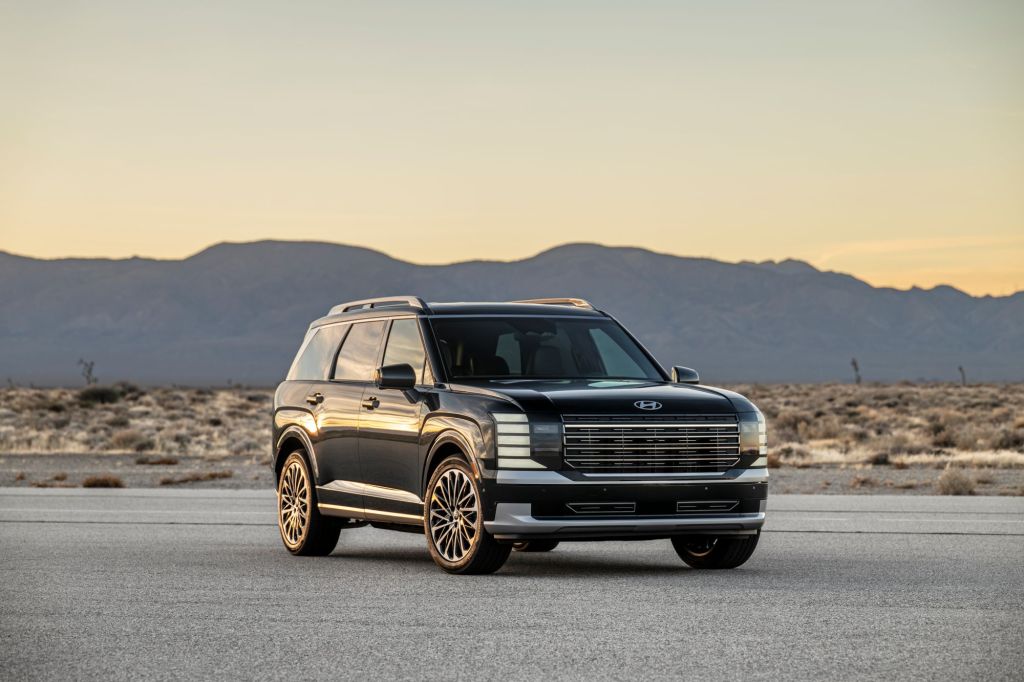
2026 Hyundai Palisade Calligraphy AWD

It may be positioned as a mass-market three-row, but it is a whole lot more—arguably a segment above

By Gary S. Vasilash

In 2024 the auto industry spent some $29.5 billion on advertising. That’s about 9% of all of the ad spend from all categories and industries, making it one of the top categories.

One of the things the ads do is not only try to convince people to buy whatever, but to perceive whatever in the way that the advertiser wants us to.

Or put simply, if it is a truck the goal is to make sure the viewer understands that it is rugged and capable.

If it is a vehicle that is in the “luxury” category, then it must be presented in a way that makes the viewers realize there is something special about the vehicle that sets it apart from “mainstream” vehicles.

Of course, in the case of trucks they must be engineered to be rugged and capable.

And if it is a luxury vehicle, then there must be attributes—say top-notch materials used in the interior and an impressive infotainment system—that would make the implied purchase premium seem appropriate.

There are simply some things that are necessary to validate the positioning of the vehicle.

But one thing that this does is segments what people may look at.

Sure, someone who wants a truck may simply look at the overall architecture of the vehicle and determine that it is, indeed, a truck.

The lux part is what, at least in the context of the Hyundai Palisade Calligraphy, that has fuzzy borders.

A three-row crossver with massive exterior styling. (Images: Hyundai)

While people would correctly perceive Hyundai to be a mainstream brand—and even the people at the Hyundai Motor Group decided that it would have a separate higher-end brand, Genesis—the Palisade Calligraphy interior is every bit as nice as any Cadillac, Lincoln, Lexus, Mercedes, etc. I have been in of late. And lately I’ve been in a lot (I was one of the jurors for the 2025 Wards 10 Best Interiors & UX Awards, and if you scroll down on this page you’ll see we were in a lot of interiors, and while you won’t see the Palisade on the list, that’s because it wasn’t available during our testing; I’m confident it will be there next year).

The materials, the design, the technology, the comfort, the convenience, and the attention to detail are all first-rate.

Comfort, space, and technology in quantity–and with quality.

Now it should be pointed out the Calligraphy is the top trim for the Palisade, which is available in five other trims, with the SE that has a starting MSRP of $39,435.

The Calligraphy driven here has a MSRP of $56,060, and with one option($245)—and this speaks to the fact that the vehicle as trimmed is absolutely rife with things that would likely otherwise be options—and inland freight and handling ($1,495) the whole thing comes to $57,800. (What is the option?, you wonder. Absurdly enough, carpeted floor mats.)

Recognize this is a seven-passenger, three-row all-wheel drive crossover that has heated/cooled, power-adjusting and reclining front and second row seats, as well as third row seats that also recline. A vehicle with a 12.3-inch infotainment screen and Bose premium audio. A vehicle with a total interior volume of 181 cubic feet of which 161.9 are devoted to passengers. (Max cargo is 86.7 cubic feet—and the folding of the second and third rows are done with a snap, not effort; with all rows in place it is 19.1 cubic feet). A utility that, yes, can tow (up to 5,000 pounds).

This is a big vehicle: 119.2 inches long, 78 inches wide, and 69.5 inches wide, with a 116.9 wheelbase. (One thing that should be noted is that the fidelity of the cameras and the fast-acting dynamic lines shown on the infotainment screen allow maneuvering in parking lots a whole lot easier than you might think.)

While I had the Palisade I was asked whether I would prefer it or the three-row Hyundai Ioniq 9, an electric vehicle with an award-winning interior.

Without question, the Ioniq 9 is a whole lot quicker and responsive thanks to its dual motors (talking about the long-range AWD version here) that produce 303 hp and 446 lb-ft of torque, compared with the 3.5-liter V6 in the Palisade that produces 287 hp and 260 lb-ft of torque (you’ve got to take into account, however, the Palisade is about 1,400 pounds lighter than the Ioniq 9).

The long-range AWD Ioniq 9 provides an estimated range of 311 miles. The EPA numbers for the Palisade are 18 city/24 highway/20 miles per gallon combined. It has a 19-gallon fuel tank. So that means a range, based on the combined figure, of 380 miles,

While 79 miles may not seem like a big deal, imagine using the Palisade, coming home from a holiday weekend, with the second and third rows being occupied by kids who were antsy not long after you pulled away from the cottage. Then recognize that the 79 miles could represent an hour more driving and that even though the Ioniq 9 can be charged from 10 to 80% in 24 minutes (which means you’d get 249 miles of range at 80%), the Palisade can be fully refueled—for 380 miles—in about five minutes.

I’d opt for the Palisade.

And for those shopping for a three-row crossover: a luxury brand or this one? I’d have a hard time determining why this isn’t the better choice.

Getting Off Off-Road?

Maybe people are tiring of dirt, rocks and Coleman-stove cooking. . .

By Gary S. Vasilash

One of the things that OEMs are banking on is a continued interest in various outdoor activities, whether it is overlanding (as in traveling to places off the beaten path using one’s vehicle, in effect, as base camp) or spending a weekend day or two at an off-road park, driving on terrain that would leave most vehicles stuck on a rock.

So there are various Jeeps and Broncos and GMC AT4X models and Chevy Trail Bosses (GM really needs something that is more specific to enhance its cred in this space: everyone—even those who are taken aback when they have to navigate on a gravel road—knows what a Jeep or Bronco is. But AT4X?).

But maybe, just maybe, the get-away-from-it-all-and-everybody phenomenon COVID drove may be slowing down.

Jeep Wrangler Rubicon X: pavement is optional. (Image: Stellantis)

The Powersports industry includes a variety of vehicles that are built for off- and on-road excursions.

According to a recent figures from Statistical Surveys, in July 2025 (the latest numbers), the Powersports industry was down year-over-year by 4.06%. And last year wasn’t exactly robust, as it was down 2.37% YoY.

The biggest hits were in the motorcycle categories. Touring bikes were down 16.46% and dirt bikes down 15.96%.

Maybe this indicates more people are packing their Travelpro luggage and climbing on planes and fewer are packing their Thule roof-top storage containers.

The Loyalty Lag

Seems that people are less inclined to stick with a brand than they were a year ago. . . .

By Gary S. Vasilash

While it may seem like a long while ago, it was just a few years back, in 2021, during the lingering COVID crisis, made all the more trying by the semiconductor crisis, when people were buying vehicles from the transporters that arrived at dealer lots.

This was an issue of wanting a vehicle and probably not doing a whole lot of—if any—due diligence vis-à-vis the attributes of the brand or model.

Clearly, brand loyalty was not top of mind for most of those consumers. A new set of wheels was, and they were willing to pay a premium if that’s what it took. (And it did.)

However, since then things have more or less balanced such that consumers not only have choice, but they don’t have to rush into a purchase. (They still need a lot of money, though that’s a separate issue.)

So this is a case where they are probably more rational in their decision making.

If you have a good experience with a vehicle from a particular company you are likely inclined to stay within that company. Brand loyalty.

Having a loyal customer base makes it easier for OEMs to move product than if they have to convince many in a market of their attributes.

From the consumers’ point-of-view, says Tyson Jominy, senior vice president of data & analytics at J.D. Power, “Brand loyalty matters to vehicle buyers because it’s often associated with higher residual values, making vehicles from trusted brands a more financially sound choice over time.”

But there can be reasons why someone might switch from one brand to another, like the availability of the particular type of vehicle being looked for (e.g., if you’re looking for a car, then unless you want a Mustang you are out of luck at your Ford dealer because all of the other cars have been discontinued).

J.D. Power just released its 2025 U.S. Automotive Brand Loyalty Study. It indicates that brand loyalty is, in effect, under water.

Specifically, according to Jominy, “Brand loyalty averages 49% across all nameplates and segments in this year’s study.”

Or, 51% of consumers will buy something else.

What is somewhat surprising is the not-exceedingly-high levels of loyalty.

That is, the number-one brand in the premium vehicle category is Porsche, with 58.2% loyalty.

For premium SUVs, the leading brand is Lexus, with 57.4%.

In the mass market, it is Toyota at 62%, which at least gets out of the 50%s, which is more positive.

And for mass market SUVs it is Honda, also at 62%. (It is worth noting that in the overall mass market Honda, at 55.5%, is second to Toyota, so it evidently has above-average brand loyalty.)

When it comes to trucks, for the fourth time in as many years, Ford is first, at an impressive 66.6% loyalty rate. (And to be fair, noting Honda’s performance, second in loyalty in the truck category is Toyota, at 61.2%.)

But back to that overall 49%.

Last year’s study had the overall loyalty at 51%. A two-point decline may not seem like a big deal, but (1) it is directionally not good and (2) it shows that more consumers are going to follow something other than tradition.

Neither is good for OEMs.

//

Note: J.D. Power conducted the study based on transaction data from September 2024 through August 2025 and included all model years traded in for a new vehicle.

More Than a Bunch of Folks Driving Cars

NACTOY announces semifinalists, which means jurors will be doing a lot of driving. But significantly, it announces a scholarship program, too

By Gary S. Vasilash

The North American Car, Truck and Utility of the Year jury consists of 50 journalists* all who work for or contribute to a number of outlets—digital, print, audio, video.

Not only is there a wide array of perspectives that isn’t necessarily the case were they all to work for one outlet (of course, it is incomprehensible that any outlet today covering the automotive industry would have that many people on staff), but the NACTOY awards are completely independent, having no sponsorship.

Although the makeup of the jury has changed over the years, as it has been presenting awards to vehicles since 1994—predicated on such things as innovation, design, safety, handling, driver satisfaction, user experience, and value—it has a solid basis of institutional knowledge when it comes to what makes for award-winning vehicles.

Today NACTOY announced its “The Best of 2026” list, semifinalists for the Car, Truck and Utility awards.

They are:

2026 North American Car of the Year

  • Audi A5
  • Dodge Charger
  • Honda Prelude
  • Kia K4 Hatchback
  • Mercedes-Benz CLA
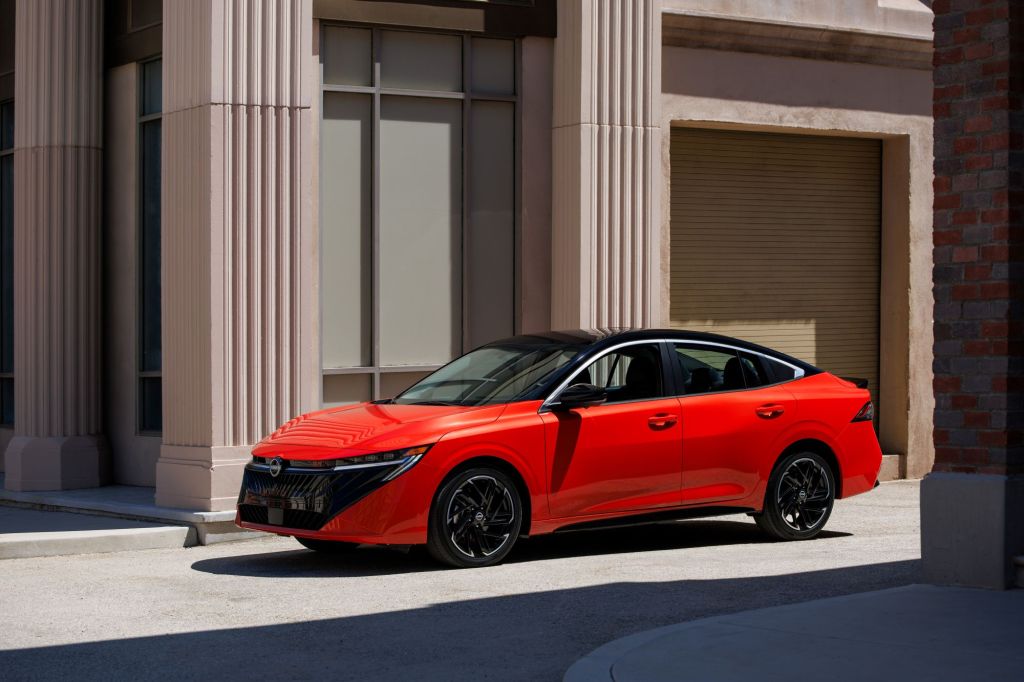
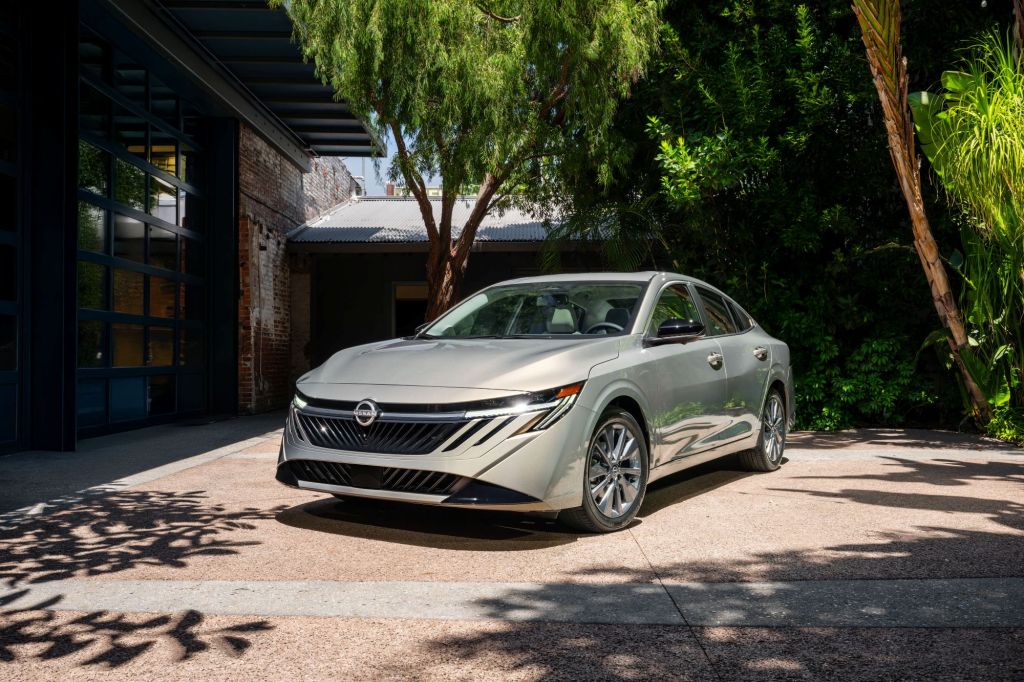
  • Nissan Sentra

2026 North American Truck of the Year

  • Ford F-150 Lobo
  • Ford Maverick Lobo
  • Ram 1500 Hemi
  • Ram 2500
  • Rivian R1T Quad Motor

2026 North American Utility Vehicle of the Year

  • Acura ADX
  • Audi Q5
  • Cadillac Escalade IQ
  • Cadillac OPTIQ
  • Cadillac VISTIQ
  • Ford Expedition
  • Genesis GV70
  • Honda Passport
  • Hyundai Ioniq 9
  • Hyundai Palisade
  • Jeep Cherokee
  • Lucid Gravity
  • Nissan Leaf
  • Polestar 4
  • Subaru Forester Hybrid
  • Toyota 4Runner
  • Toyota RAV4 Hybrid
  • Volkswagen Tiguan
  • Volvo EX30

The jurors will drive the vehicles at a multi-day event in suburban Detroit in October. The winners will be announced on January 14, 2026, at the Detroit Auto Show.

But there is something arguably more important that NACTOY president Jeff Gilbert announced today: “While our 50 automotive journalists delight in honoring the best vehicles of a new model year, it’s also important to leave a lasting legacy.”

And that legacy takes the form of the SAE NACTOY Automotive Journalism, Design, and Engineering Innovation Scholarships.

Starting in the 2026-27 academic year there will be two scholarships presented, one to an automotive journalism student and one to an automotive design or engineering student.

(For those interested in pursuing the scholarships, go here.)

Acknowledging those vehicle manufacturers who have done a superlative job and helping students who may become the next developers of vehicles or NACTOY jurors goes well beyond just judging ride, handling, performance, and other attributes.

==

*I am one of the 50.

Mercedes’ “Real-World” Performance

Impressive for an EV. . .but one that isn’t as real as a gas-powered one you can buy right now. . . .

By Gary S. Vasilash

Mercedes-Benz recently announced that it performed a “real-world” test of an electric vehicle—a “lightly modified” Mercedes EQS—for a distance run:

It went from Stuttgart, Germany, through Denmark, to Malmo, Sweden, without a stop for recharging.

This means it traveled 749 miles. What’s more, there were 85 miles remaining in the battery.

Now presumably “real-world” means that they performed the test in the world that we know, regular highways.

Because what isn’t “real-world” in the context of what we know is that the sedan was equipped with a solid-state battery system developed in cooperation with Mercedes-AMG High Performance Powertrains, the same operation that provides tech for the Mercedes Formula One team.

Most of us don’t have access to that kind of tech in our real worlds.

Mercedes “lightly modified” EQS traveled from Stuttgart to Malmo—749 miles—without needing to recharge the solid-state battery powering the vehicle. (Image: Mercedes)

The solid-state lithium-metal cells were produced by Factorial Energy, a Woburn, Massachusetts-based company that is working with Mercedes, Stellantis and Hyundai on the solid-state tech.

You can’t buy a vehicle (for now) in the real world that has a battery of this type, to say nothing of one that was developed with an F1 supplier.

According to Markus Schäfer, Member of the Board of Management of Mercedes‑Benz Group AG, Chief Technology Officer, Development & Procurement:

“The solid-state battery is a true gamechanger for electric mobility. With the successful long-distance drive of the EQS, we show that this technology delivers not only in the lab but also on the road. Our goal is to bring innovations like this into series production by the end of the decade and offer our customers a new level of range and comfort.”

Which is a fair point.

But back to the real world for a moment.

The Mercedes S 500 is not unlike the Mercedes EQS, although it is a gasoline-powered vehicle.

The S 500 fuel economy numbers are 21 mpg city, 31 mpg highway, 24 mpg combined.

The S 500 has a 20-gallon fuel tank.

So if we take the combined number, that gives it a range of 480 miles, which is short of the 749 miles from Stuttgart to Malmo.

Even though the route from Stuttgart to Malmo is mainly highways, if we take the 24 mpg number it only provides 620 miles of range.

However, one assumes that during a 749-mile drive there would be a need for at least one stop to attend to some personal issues.

During such a stop, a vehicle can be refueled in about five minutes. So let’s say that to be on the safe side someone stopped after using 450 miles of range, leaving 30 miles in the tank, and refueled.

That means there would be 299 miles left to go, but the full tank would provide 499 miles of range, or arrival in Malmo with 181 miles of range still in the tank.

And this is with a production vehicle you can get at your local Mercedes dealer today.

2026 Volvo V90 Cross Country B6 AWD Ultra

A wonderfully executed wagon. . .

By Gary S. Vasilash

If you’ve watched the TV series “Wallander,” you’ve seen the title character, played by Kenneth Brannagh, driving a Volvo XC70 SUV. The program is based on crime novels written by Henning Mankell. He is Swedish. The show is based in Sweden. And Volvo, of course, is based in Gothenburg, Sweden.

The vehicle is completely appropriate for the series. If you’re going to drive in Sweden, drive Swedish.

But perhaps if police detective Kurt Wallander was more serene he would up his game and drive the Volvo V90 Cross Country. . . .

It is easy, however, to imagine Brannagh (who, by the way, was knighted by Queen Elizabeth way back in 2012, so the man isn’t simply a wonderful actor and director) rolling around in a V90, as it would be in keeping with both the functional: presumably directors travel with some gear. . .

. . . and the comfortable, as working on a set all day is certainly tiring, so that ergonomic, leather-clad, driver’s seat that provides heating and cooling and, as an $800 option, a massaging function, is certainly something that would be appealing. In addition to which, there is an optional adaptive air suspension system on the vehicle as-driven ($1,200) which smooths the ride notably.

It rides well in less rocky environments, too. (Image: Volvo)

(There is, of course, the crystal Orrefors shift knob, but Sir Brannagh is probably used to seeing things like that.)

The V90 has an electrified powertrain. There is a 48-volt mild hybrid system that uses regenerative braking; it has an integrated starter generator (so the auto start-stop isn’t in the least bit troubling, for those who find that fuel-saving function unsettling). The turbo-charged 2-liter engine (mated to an eight-speed automatic) produces 295 hp and 310 lb-ft of torque.

The powertrain provides good performance (let’s not lose sight of the fact that this is a station wagon that is meant for daily drives, not something to leave people pinned back into those comfortable Scandinavian seats) and good fuel economy: 22 mpg city, 29 highway and 25 mpg combined. But you want to run it on premium (91 octane).

A word about it being a station wagon rather than a utility. First know that Volvo has an array of SUVs (EX90, EX40, EC40, EX30, XC90, XC60, and XC40).

While the V90 does provide solid cargo space—69 cubic feet with the second row folded; 19.5 cubic feet with the second row up—it is not as capacious as, say, an XC90. But how often does someone pack their vehicle to the max? (And let’s face it, if there is a whole lot that needs to be transported, one can get a Thule roof-top cargo carrier. (Yes, although there are other brands, Thule is Swedish, too, so let’s keep it thematic.))

That said, the V90 rides, handles and maneuvers much more lithely than a ute, and that makes a big difference during those daily drives.

In fact, I submit that were one to go to their local Volvo dealer and test drive back-to-back an XC90 and the V90, although the higher H-point and consequent visibility of the XC90 is certainly an advantage, the overall drivability of the V90 is a real benefit.

I also suspect that as many people have been driving utes for the past few years they’ve forgotten how driving something that’s more sedan-like can feel.

The Honda Prelude: Return of the Sporty Coupe

This time, the vehicle is a hybrid. . . .

By Gary S. Vasilash

The Honda Prelude, which first arrived in the U.S. in 1979, has always been a sporty coupe.

Since its introduction there have been five generations:

  • 1979-82
  • 1983-87
  • 1988-91
  • 1992-96
  • 1997-2001

Yes, the run ended near the turn of the century.

An issue is simply that sport coupes are pretty much confined to a niche market.

The biggest sales year for the Prelude was back in 1986, when some 80,000 were sold.

Put that number against the number of Accords or Civics sold in a given year, and one might argue that Honda management was nothing if not supportive of the approach to spirited driving provided by the Prelude.

And that spirit will soon be back, as Honda has announced that later this fall the sixth-generation Prelude will go on sale in the U.S.

(Images: Honda)

Yes, it is still a sports coupe.

But what makes this one different is what’s found under the hood:

  • A 2.0-liter Atkinson cycle direct-injected engine that is supplemented by two electric motors. The result is a system output of 200 hp and 232 lb-ft of torque.

To help assure the kind of driving performance the Prelude has been known for:

  • A new development called “Honda S+ Shift.” This manages the coordination between the engine and the motors, including rev matching and gear holding, that is accessible through the paddle shifters.
  • The use of chassis hardware from the Civic Type R, including dual-axis strut front suspension and larger brakes 13.8-inch front rotors with Brembo monobloc four-piston aluminum calipers; 12.0-inch rotors in the back)
  • Enhanced Honda Agile Handling Assist, which integrates the powertrain, braking and steering for better control

Of course, sometimes people just want to have a pleasant drive, so there are three drive modes, including Comfort.

No surprise: the other two are GT and Sport.

To simplify things, the two-motor hybrid will be available in one trim.

Not only does this simplify the consumer buying experience, but it also means there is a single model to produce, thereby improving the scale of production, important when it comes to vehicles that aren’t likely to have Civic/Accord-type numbers.

2025 Lexus NX 350 F Sport

It is a well-done compact crossover. . .

By Gary S. Vasilash

(Image: Lexus)

It has a 2.4-liter four-cylinder engine that produces 275 hp.

It has an eight-speed automatic transmission.

It has all-wheel drive.

It has aluminum pedals and an aluminum scuff plate.

It has bolstered driver and passenger seats.

It can tow up to 2,000 pounds (when appropriately setup).

It has LED lamps, fore and aft.

It has a 14-inch touchscreen, with wireless Apple CarPlay and Android Auto.

It has a head-up display.

It has 20-inch alloy wheels.

It has a panoramic glass roof.

It has adaptive variable suspension and performance dampers.

It has features like these that are fairly common to other compact crossovers.

It is a Lexus NX 350, which makes it somewhat different from other compact crossovers.

It is built on the Toyota TNGA-K platform.

It shares that platform with the Toyota RAV4.

It is not simply a RAV4 with better accoutrements.

It is different in terms of overall execution, inside and out.

It is a stylish, fashionable vehicle as the RAV4 has become a truckier vehicle.

It stands out with its sheet metal in a good way, one that telegraphs that this is not just one of many in the category.

It has an odd interior door opening mechanism.

It looks like this in the closed position.

(Image: gsv)

It is activated by doing this—twice.

(Image: gsv)

It is something that someone with large fingers might find difficult.

It is something that someone with long fingernails is not going to like at all.

It is a small thing.

It is a small thing that people use every day, often multiple times per day.

It is not good ergonomics.

It is echoed, in a way, by a comparatively diminutive volume knob for the impressive Mark Levinson audio system.

It can be contrasted with the excellent knobs (driver and front passenger) that are used to adjust interior temperature.

It has all-speed dynamic radar cruise control, lane tracing assist, lane departure alert with steering assist, road sign assist, and other tech.

It warns you of cross traffic.

It is pleasant to drive—quiet, confident.

It has an MSRP of $49,335 but with the addition of the sporty F SPORT package ($2,865) and other options, adding in the delivery, processing and handling fee, it has a total, in this instance, of $59,505.

It has metal pedals, indicating some sportiness.

(Image: Lexus)

It is assembled in Fukuoka, Japan.

It is likely to be more expensive with the 15% tariff on Japan-built vehicles.

It is worth considering, depending on the size of your fingers.