For no reason other than the fact that it is an amazing photo, there’s this: the MINI John Cooper Works WRC, campaigned by Prodrive, a UK-based independent motorsports company, driven by Kris Meeke at Rally Italy in 2011:
Yes, a flying MINI. (Image: Classic Nostalgia)
(The reason this photo has come up is because Prodrive’s 40 years of development will be celebrated at Classic Nostalgia, an event that is being held in the UK on July 20-21.)
Cigarette advertising was banned from Formula One at the end of 2006. The Marlboro liveries that had become so visible on the circuit were to be no more.
But it is not like the companies that are purveyors of products like cigarettes aren’t interested in reaching about 1.5-billion F1 viewers (as in TV, not in the stands) per year.
Livery artist MILTZ and the McLaren MCL38. (Image: Vuse)
So BAT, which describes itself as “a leading, multi-category consumer goods business” that has as its purpose “create A Better Tomorrow by Building a Smokeless World” has announced through its Vuse brand that the livery for the McLaren Formula 1 team for the 2024 Japanese Grand Prix will be created by a Japanese artist named MILTZ and sponsored by BAT.
BAT was once known as “British American Tobacco.” Among its cigarette offerings are Lucky Strike, Dunhill and Kool. Vuse is a vape product, part of the company’s portfolio that also includes the “Heated Product brand glo; and Velo our Modern Oral (nicotine pouch) brand.”
BAT reports that the “non-combustible products”—a.k.a., things that aren’t cigarettes—provided 16.5% of its 2023 revenue and it is working to bring that number up to 50% by 2035.
This sounds like something out of a movie where scientists in an isolated lab create something that is, well. . . .
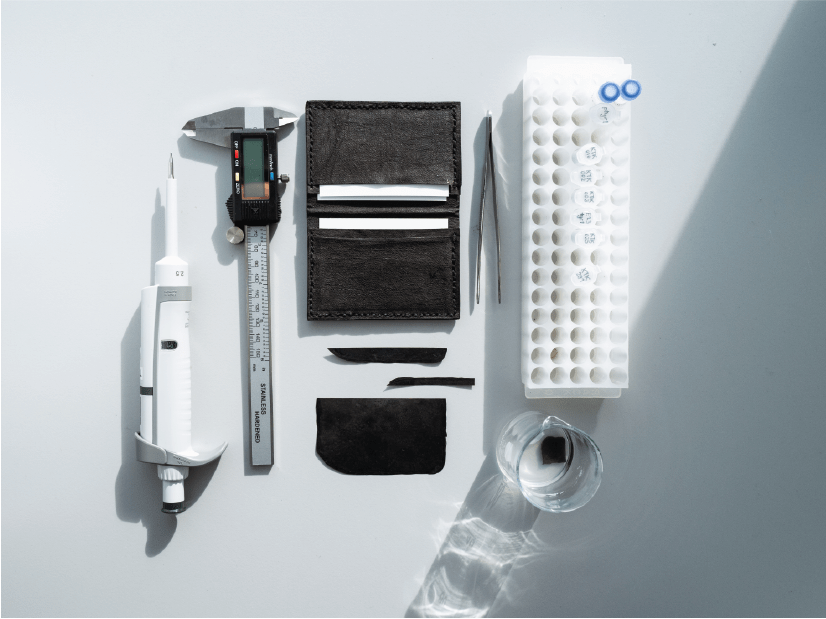
Researchers at Imperial College London have created a way that self-dyeing, vegan, plastic-free “leather” can be grown.
They’ve modified the genes of a bacteria species that produces sheets of microbial cellulose with the modification also making the bacteria produce a dark black pigment know in the lab world as “eumelanin.”
Among that scientific gear is the wallet that was grown from engineered bacteria to resemble the look and feel of leather. (Image: Imperial College London)
Beyond Black
But they’ve also found that using genes from other microbes they can produce colors. They shine blue light on the surface of the bacteria that respond by producing colored proteins. This allows the creation of logos and other patterns in the materials.
While they’ve produced a shoe and a wallet as examples, there are other applications for the material about which Professor Tom Ellis of Imperial College London’s Department of Bioengineering said:
“Bacterial cellulose is inherently vegan, and its growth requires a tiny fraction of the carbon emissions, water, land use and time of farming cows for leather.
”Unlike plastic-based leather alternatives, bacterial cellulose can also be made without petrochemicals, and will biodegrade safely and non-toxically in the environment.”
As automotive interiors become increasingly less plastic- and cow-intensive, presumably this could translate into seating surfaces and trim.
While geography isn’t necessarily destiny, there is something about the Honda Passport being built in the company’s complex in Lincoln, Alabama. It seems somehow appropriate that a vehicle that is biased toward the outdoors would come from a locale that is not full-on urban (i.e., the population of Lincoln was 6,845 in the 2020 census; it is approximately 45 miles due east of Birmingham). I’m guessing that not long after one leaves the Lincoln city limits there is access to a number of driving surfaces that are less developed than, say, compared with the situation in Detroit (where the Grand Cherokee, a Passport competitor, is produced), so those putting the vehicle together have a good sense of what’s needed, and the Honda culture is such that the people who engineer the vehicle listen.
When the 2024 Passport was launched last fall, Lance Woelfer, assistance vice president of Honda National Auto Sales, American Honda Motor Co., said, “With more rugged off-road performance than ever before, the 2024 Honda Passport builds on our legacy of engineering rugged, capable and comfortable SUVs for active, weekend adventurers.”
(Image: Honda)
Somewhat off the beaten path
To be sure, some “weekend adventurers” are inclined to go to places that are far off the unbeaten path, but this two-row midsize crossover, while certainly more robust than you might expect a vehicle from Honda to be (assuming that you associate it with Accords and Civics), probably isn’t the ute that hard-core off-roaders would opt for. (For those so inclined, know that the ground clearance is 8.1 inches and the approach and departure angles are 21.1° and 24.3°, respectively.)
However, the standard in the Passport lineup is Honda’s i-VTM4 torque-vectoring all-wheel drive system that sends torque where it is needed, as much as 70% to the rear wheels, and then 100% of that can be shifted to the wheel that needs it, based on conditions (i.e., if the left wheel is off the ground or there is a slick patch beneath it, such as when stuck in the snow, the torque will be shifted to the right wheel to get things moving).
A superb characteristic of the i-VTM4 system is that things happen automatically: no knobs, buttons or levers required. (It seems to me that those who are occasionally dealing with uncharacteristically demanding conditions, such as when doing some weekend adventuring, probably have their hands sufficiently full (e.g., trying to avoid that downed tree and working to miss the jagged rock on the other side) without needing to do something else but piloting the vehicle.)
Big on black
The trim package driven here, the Black Edition, looks sufficiently aggro, but for someone who is trail-oriented would likely opt for the TrailSport version of the Passport
But the Black Edition, with trim added to the front fascia, blackout treatments on features front and back, and painted—black—20-inch alloy wheels, has an appearance that is particularly striking.
On the inside there is—no surprise—more black, such as the seats (the fronts are ventilated; the rear heated), though there is brightly contrasting red stitching that provides a brightening accent. What I found notable is that even the door opening lever is black, something that might otherwise go untreated: they are nothing if not thorough.
And while on the inside know there are an 8-inch color touchscreen and a 540-W audio system, CarPlay and Android Auto compatibility, two USB ports in the front (an A data port and a C charging port—and it should be mentioned there is a Qi wireless charger) and two for the backseat passengers (boy C charging ports).
Performance and people
The Passport is powered by a 280-hp V6 that generates 262 lb-ft of torque at 4,700 rpm. It is mated to a nine-speed automatic that offers paddle shifters. The vehicle uses regular unleaded, which is probably a good thing as its EPA numbers are 19/24/21 mpg.
The Passport provides room for people—EPA passenger volume 114.9 cubic feet—and objects—a maximum behind the first row of 100.7 cubic feet and 50.5 cubic feet with the second row up.
And to protect the people and objects, there the Honda Sensing array (with functions ranging from adaptive cruise to collision mitigation braking).
The MSRP for the ’24 Honda Passport Black Edition is $47,970.
If you don’t drive it, should you really wear it? And why?
By Gary S. Vasilash
One of the more interesting characters in the William Gibson oeuvre is Cayce Pollard of Pattern Recognition.
Pollard is a marketing consultant. But she is highly sensitive to things like branding on clothing so if she gets something that has a logo she must remove it.
Seems that her profession and her predilection are at odds.
(Image: MINI)
Many people are highly sensitive to branding, too, but unlike Pollard, they are sensitive if the branding is insufficiently bold.
They want the association to be front and center, not in the least bit cryptic.
So if they happen to be fans (ideally owners, I suppose) of MINI, then the MINI Lifestyle Collection 2024 offers a range of goods so that “they are always and everywhere connected with their favorite brand.”
Among the goods are:
MINI Car Face Detail T-Shirt
MINI Outline Print Hoodie
MINI Caps (“combine the bright shade of Rebel Red with the new Vibrant Silver”)
“A cumulative national capital investment of $53-$127 billion in charging infrastructure is needed by 2030 (including private residential charging) to support 33 million PEVs.” That’s according to a report from National Renewable Energy Laboratory (NREL), “The 2030 National Charging Network: Estimating U.S. Light-Duty Demand for Electric Vehicle Charging Infrastructure.”
The ”PEV” is for “plug-in electric vehicle.”
The way the NREL figures it, there will be:
26.8 million Level 1 and Level 2 chargers at single-family homes, multifamily properties and workplaces
182,000 fast-charging ports on highways and within local communities
1 million Level 2 ports in high-density neighborhood, office buildings and retail outlets.
That is quite a span in the estimated spend to put in all those chargers.
Note that much of the investment will be made by individual homeowners. There is the cost of the equipment, the cost of an electrician, the cost of things an electrician will find when making the installation, and, if there is Level 2 rather than Level 1, then the probable need to get 240-Volts to the garage, and. . . .
It is likely to be more than a grand.
But let’s say all of that is done. Let’s say that the $53-$127 billion has been spent.
All good, right?
Well, there is something else in the report that probably deserves considerably more attention:
“The cost of grid upgrades and distributed energy resources have been excluded from these estimates. While these excluded costs can be significant in many cases and will ultimately be critical in building out the national charging network, they tend to be site specific and have been deemed out of scope for this analysis.”
“Significant” means “a whole, whole lot” on top of the aforementioned billions.
Automotive business plans nowadays tend to have a title, perhaps in order to make investors think that the OEMs really have something going on because of their naming method.
Nissan has been running its Nissan NEXT business plan from FY 2020 to FY 2023.
It has its long-term Nissan Ambition 2030 waiting in the wings.
This past week it announced The Arc, which is a bridge between the two.
In announcing it, Makoto Uchida, Nissan president and CEO, said, “This plan will enable us to go further and faster in driving value and competitiveness. Faced with extreme market volatility, Nissan is taking decisive actions guided by the new plan to ensure sustainable growth and profitability.”
At its basis it is about selling more vehicles. Vehicles that are more profitable for the company.
Which is pretty much what any OEM wants to do.
So it is going to roll out 30 new models—16 electrified (which means they can be hybrids) and 14 ICE—during the next three years, then from FY 2024 to 2030 there are plans for a total 34 electrified vehicles.
On a global basis Nissan anticipates that 40% of its global sales will be electrified vehicles, then 60% by 2030.
A few days after The Arc was announced Nissan made another announcement, which is that it is going to continue in the ABB FIA Formula E World Championship racing series “until at least 2030, reinforcing its Ambition 2030 electrification plans”
Presumably the thought is that if it is seen as a leader in electric vehicle racing customers will figure that it has the chops when it comes to consumer EVs, too.
And, of course, there is the obligatory comment about how there is technology transfer from the race track to the street, which a high-level powertrain engineer at a competitive company recently told me is more rhetoric than reality, given the difference in what the requirements are for the types of vehicles.
Maybe what companies really need to do is come out with a plan called “The Best,” and simply say “We are going to make the best damn vehicles for our customers, period.”
That might focus their efforts on what really matters.
“The simple fact is, no matter how skilled the driver, speed affects both the likelihood of a crash and the severity of crash injuries. High speeds leave a driver less time to react, less room to brake and less chance of surviving the force of a potential crash. Why are we promoting car sales by glorifying speed?”—Chuck Farmer, vp, Research & Statistical Services, IIHS
Likelihood and severity: 300,000 auto-related injuries in the U.S.; 12,000 deaths related to speed.
Farmer wrote a piece on the IIHS website calling into question OEM advertising that is predicated on “glorifying speed.”
He notes: “One might suppose that the viewer is aware enough to separate fantasy from reality, and we all know that speeding is dangerous.”
Do we?
“We’re all above-average drivers.”
And live in Lake Woebegon.
“We would never try to imitate the extreme stunt driving seen in the ads.”
We might not, but what about the kid down the street?
“But might we be tempted to push the boundaries of speed just a bit?”
Might the sun rise tomorrow?
Listen to the rhetoric surrounding electric vehicles. You’ll undoubtedly hear about its performance—as in torque and speed, not as in savings of electricity over gas or in the improved emissions performance.
“Buy and EV because it is really quick.”
Farmer:
“Today’s vehicles are more reliable, more efficient, more comfortable and safer than ever before. Shouldn’t that be enough of a selling point?”
According to Merriam-Webster luxury is defined as “something adding to pleasure or comfort but not absolutely necessary” and “an indulgence in something that provides pleasure, satisfaction, or ease.”
Premium is “of exceptional quality.”
While purveyors of vehicles that are beyond the mainstream certainly want those vehicles to be considered “luxury vehicles,” I’d argue that with few exceptions (e.g., a Bugatti or Rolls-Royce) “premium vehicles” is a better moniker.
It’s not that premium vehicles don’t provide pleasure or comfort or satisfaction or ease, but generally they are necessary (i.e., people need to get somewhere; these are not necessarily vehicles that are weekend-only) and consequently they must be of “exceptional quality.”
Exceptional
And an excellent example of that is the Acura TLX Type S, the top-of-the-line version of the sport sedan.
This car has a 3.0-liter turbo V6 under its hood that produces 355 hp and is mated to a 10-speed automatic.
This car has sport seats with Milano leather with Ultrasuede inserts that help hold on in the seat when that engine is put to work.
Capable
This car has the Acura-exclusive Super Handling All-Wheel Drive (SH-AWD) system, which may have an awkward name, but which makes the performance of the car anything but, as it transfers torque—based on an array of inputs, from steering angle to throttle position to g-forces to. . .—from the front to the rear (as much as 70% of the torque can be transferred to the back) as well as from side to side, depending on conditions.
Which brings me back to the notion of “exceptional quality.”
Credible
Here is a vehicle that can go, according to Car and Driver, from 0 to 60 mph in 4.6 seconds that has an array of amenities—ranging from a superb ELS Studio 3D audio system to Brembo brakes that not only are functional but, peeking out from within the alloy wheels, telegraph the seriousness of the performance of the car—that can comfortably fit a family and, as it is built at the legendary Honda Marysville Assembly Plant (the engine is built at the nearby Anna (Ohio) Engine Plant), one has the confidence that there is build quality, as well as the quality associated with the visible craftsmanship on how everything thing goes together, from the panel gaps on the exterior to the stitching on the interior.
The TLX Type S starts at $57,000. For most people, I suspect, that is in the category of “luxury.”
But definitions notwithstanding, this is a car that looks good, drives well, and will probably provide many miles of confident driving, whether that’s throwing it through the proverbial curves or taking the kids to school.





 shinymetalboxes