
Toyota Studies Crashes. . .

. . .so maybe you won’t have to experience the consequences

By Gary S. Vasilash

An adult human head weighs an average 4.5 kg.

A child, 3.5 kg.

Clearly something that you’re unlikely to know.

But some of the researchers at the Toyota Collaborative Safety Research Center (CSRC) in Saline, Michigan know that and a whole lot more about the human body, particularly the human body in relation to motor vehicles, whether that body is on the outside of a vehicle at speed or inside one.

Yes, the CSRC researchers are all about determining the consequences of accidents as well as doing research on preventing accidents, be it by assuring that drivers pay attention to their task or by creating infrastructure that can alert drivers to potential hazards ahead.

Toyota established CSRC in 2011 and through FY 2027 will have invested $115 million in the operation.
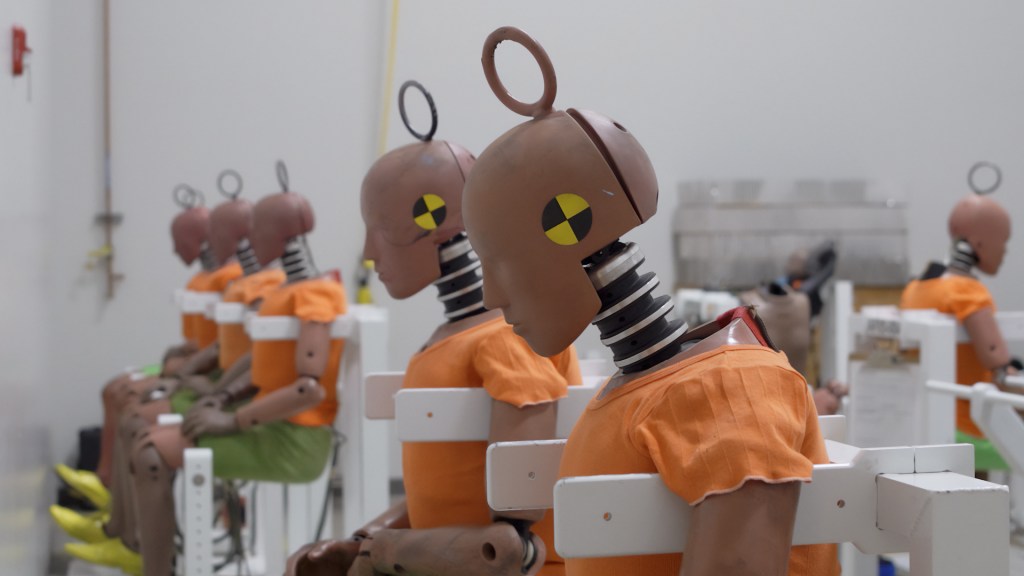
Inside the Toyota CSRC. (Image: Toyota)

One interesting aspect of the approach taken is found in the first word of the name of the outfit: Collaborative.

CSRC works hand-in-hand with universities and research institutions to carry out the investigations, some of which it has long-term relationships with (e.g., it has been working with the University of Virginia (UVA) for 15 years).

As Jeff Makarewicz, Toyota Motor North America Group Vice President, R&D, put it: “CSRC was built on the idea that the best safety research happens when you invest in relationships over time, with the best institutions, the best researchers, and a shared commitment to publishing what you find.”

Yesterday (June 2) it announced 10 new research projects—including three with UVA:

  • “Virtual testing sensitivity to human model body updates”
  • “Foot posture and implication for ankle injury risk prediction”
  • “Lumbar spine injury prediction with crash test dummies”

The other seven range from “Adapative interfaces for increasing ADAS adoption” with MIT to “Naturalistic vulnerable road user detection with Micro-Doppler Radar” with Purdue.

One of the things that Toyota researchers have developed for this research is THUMS—the Total Human Model for Safety. This is a virtual crash-test dummy. It recently released version 7 of THUMS, which includes greater fidelity to things including the spine and the small intestine.

(Let’s face it: thinking about a motor vehicle accident in relation to the small intestine may be more disturbing than the average weight of a head.)

Not only does Toyota make THUMS freely available to whoever wants to use it, the research performed by CSRC and its research partners is also open.

There is an interesting knock-on effect of CSRC.

Dr. Zhaonan Sun did his Ph.D. work at UVA: he was a graduate research assistant at its Center for Applied Biomechanics, supervised by Dr. Jason R. Kerrigan. That center is the largest injury biomechanics research center in the world.

Sun is now a principal scientist at CSRC. Consequently, given the collaborative research model he is working with Kerrigan and other former UVA colleagues on safety-focused research.

So not only does CSRC contribute to the knowledge base that can lead to safer vehicles, but also to helping develop more people who can carry on that work.

You spend some time learning about lap belt interaction with the pelvis in frontal crashes (work Sun performed) and the effect of subcutaneous adipose tissue (a.k.a., “fat”) and you quickly know that safe driving isn’t just something to think about, but something to do.

And when you see a demonstration of a head model being propelled into the hood of a Toyota Sienna minivan by a large electrohydraulic device you also know that being a watchful pedestrian is a good thing to be.

Toyota’s Significant Collaborative Safety Research

Since its establishment in 2011, the Toyota Collaborative Safety Research Center has been working with an array of North American intuitions on making things better for drivers and pedestrians. And it has just completed its 100th project

By Gary S. Vasilash

 Toyota has a suite of driver-assistance systems and alerts—based on hardware and software—that it calls “Toyota Safety Sense” (TSS). Elements of the system include a pre-collision system, lane departure alert with steering assist, dynamic radar cruise control, and more.

Other OEMs have their TSS-like systems.

But what other OEMs don’t have is the Toyota Collaborative Safety Research Center (CSRC), established in 2011 by Akio Toyoda and funded (through 2026) to the tune of $115 million.

CSRC has collaborated with a number of organizations, from the Children’s Hospital of Philadelphia to Virginia Tech, from The Ohio State University Biomechanics Research Center to the Texas A&M Transportation Institute.

CSRC has announced the competition of its 100th research project, a study with the Massachusetts Institute of Technology AgeLab on the “Non-Driving Related Tasks” (NDRTs) performed by drivers while, ostensibly, driving.

Things like interacting with steering wheel controls, center stack interaction, using a phone (known in the research world as a “PED”: Personal Electronic Device), eating or drinking, interacting with passengers, fixing hair, singing to self. . . .

A whole lot of things that are not directly related to the task at hand (i.e., driving).

The researchers had some 450 hours of driving data—video and digital information—and in it they annotated more than 145 hours of NDRT behavior.

Dr. Bryan Reimer, research scientist at the MIT AgeLab and founder and co-director of the Advanced Vehicle Technology Consortium (of which Toyota is a founding member), explained that an objective is to determine the impact of SAE Level 2 driver assistance technologies on driver behavior when it comes to engaging in NDRTs.

Dr. Bryan Reimer of the MIT AgeLab says he has worked with dozens of OEMs on projects and is impressed with Toyota’s commitment to safety research. (Image: gsv)

Although every driver knows that they are not to do many of the things that are within the NRDT sphere, Reimer says there’s what he calls “the Cheeseburger Equation.”

You are hungry. You stop at a fast-food place and buy a cheeseburger. If you don’t eat inside the restaurant, you take the cheeseburger into your vehicle. And if you don’t remain parked, you drive your vehicle. And eat the cheeseburger.

That’s just going to happen, Reimer says.

Now the objective isn’t to create cheeseburger-facilitating vehicular automation.

Rather, it is to determine the methods to discourage drivers from performing NDRTs, thereby enhancing vehicular safety.

(Reimer says that positive suggestions can help reinforce correct behaviors in a way that telling people what not to do doesn’t do.)

In addition to announcing the completion of the 100th, CSRC announced 10 new projects:

  • “Analysis of Speed Assist Implementations and Context-Aware Improvements.” with Touchstone Evaluations
  • “Driver behavior adaptation to L2 automation,” with MIT AgeLab
  • “Evaluating driving performance and behavior across varying vehicle specifications and driving contexts,” with Virginia Tech Transportation Institute
  • “Safety benefits of in-vehicle alerts and notifications,” with Oregon State University
  • “User Acceptance Factors for In-Vehicle Safety Systems Targeting Impared Driving,” with Impact Research
  • “Comparing applicability of global ADAS testing scenarios in the U.S. context,” with University of Michigan Transportation Research Institute
  • “Skeletal data for anthropometry and posture,” with University of Michigan Transportation Research Institute
  • “Biological sex in ankle bone material properties,” with The Ohio State University Injury Biomechanics Research Center and University of Waterloo
  • “Interacting While Driving: Evaluating Attentional Demands of In-Vehicle Interfaces,” with Auburn University

Much of the information developed has been and is shared with other interested parties throughout the vehicle environment and some have contributed to the development of standards.

At a time when budgets are being not merely cut but chopped, it is laudable that Toyota continues to do safety research.

It doesn’t simply result in better vehicles, but there have been more than 400 students, postdocs, and researchers from collaborating institutions that have worked on CSRC programs, and that experience is proliferated throughout industry for the betterment of all involved parties.

Speed Kills. So Why Advertise It?

By Gary S. Vasilash

“The simple fact is, no matter how skilled the driver, speed affects both the likelihood of a crash and the severity of crash injuries. High speeds leave a driver less time to react, less room to brake and less chance of surviving the force of a potential crash. Why are we promoting car sales by glorifying speed?”—Chuck Farmer, vp, Research & Statistical Services, IIHS

Likelihood and severity: 300,000 auto-related injuries in the U.S.; 12,000 deaths related to speed.

Farmer wrote a piece on the IIHS website calling into question OEM advertising that is predicated on “glorifying speed.”

He notes: “One might suppose that the viewer is aware enough to separate fantasy from reality, and we all know that speeding is dangerous.”

Do we?

“We’re all above-average drivers.”

And live in Lake Woebegon.

“We would never try to imitate the extreme stunt driving seen in the ads.”

We might not, but what about the kid down the street?

“But might we be tempted to push the boundaries of speed just a bit?”

Might the sun rise tomorrow?

Listen to the rhetoric surrounding electric vehicles. You’ll undoubtedly hear about its performance—as in torque and speed, not as in savings of electricity over gas or in the improved emissions performance.

“Buy and EV because it is really quick.”

Farmer:

“Today’s vehicles are more reliable, more efficient, more comfortable and safer than ever before. Shouldn’t that be enough of a selling point?”

Apparently not.

Toyota Advancing Safety Research

Something that ought to be top of mind, tends not to be. But it still is for Toyota

By Gary S. Vasilash

One of the areas in automotive development that doesn’t get the attention it deserves—probably as it is not particularly sexy—is safety.

But find yourself in the process of an accident and you hope that the OEM that built the vehicle you’re traveling in is on the leading edge of safety research.

Toyota, which established the Collaborative Safety Research Center 10 years ago with the objective of performing open research with universities and hospitals (the former have lots of smart people and the latter have lots of smart people who are on the receiving end of things gone wrong) is sticking with it, as it has announced a five-year, $30-million commitment to the CSRC.

The CSRC has three research tracks that it is pursuing:

  • Human-centric, or helping people understand what advanced mobility can do. Also, customer health and wellness are part of it.
  • Safety assurance, or looking into the intersection of human drivers and automated driving systems.  Let’s face it: there is going to be a mixed of the manual and the automated for some time to come.
  • Assessment, or helping individuals and industry participants understand appropriate decision making predicated on quantitative mobility safety measures.

Explained Dr. Danil Prokhorov, director of Toyota’s Future Research Department and CSRC:

“Humans are at the center of Toyota’s technology development strategy, so we are designing our new safety research in pursuit of ‘Safety for All.’ As part of this, our projects will explore the diversity of safety needs and analyze safe mobility options that accommodate different applications, physical characteristics and levels of accessibility for people and society.”

Safety may not be sexy. But neither is a visit to an ER.