
. . .so maybe you won’t have to experience the consequences
By Gary S. Vasilash
An adult human head weighs an average 4.5 kg.
A child, 3.5 kg.
Clearly something that you’re unlikely to know.
But some of the researchers at the Toyota Collaborative Safety Research Center (CSRC) in Saline, Michigan know that and a whole lot more about the human body, particularly the human body in relation to motor vehicles, whether that body is on the outside of a vehicle at speed or inside one.
Yes, the CSRC researchers are all about determining the consequences of accidents as well as doing research on preventing accidents, be it by assuring that drivers pay attention to their task or by creating infrastructure that can alert drivers to potential hazards ahead.
Toyota established CSRC in 2011 and through FY 2027 will have invested $115 million in the operation.
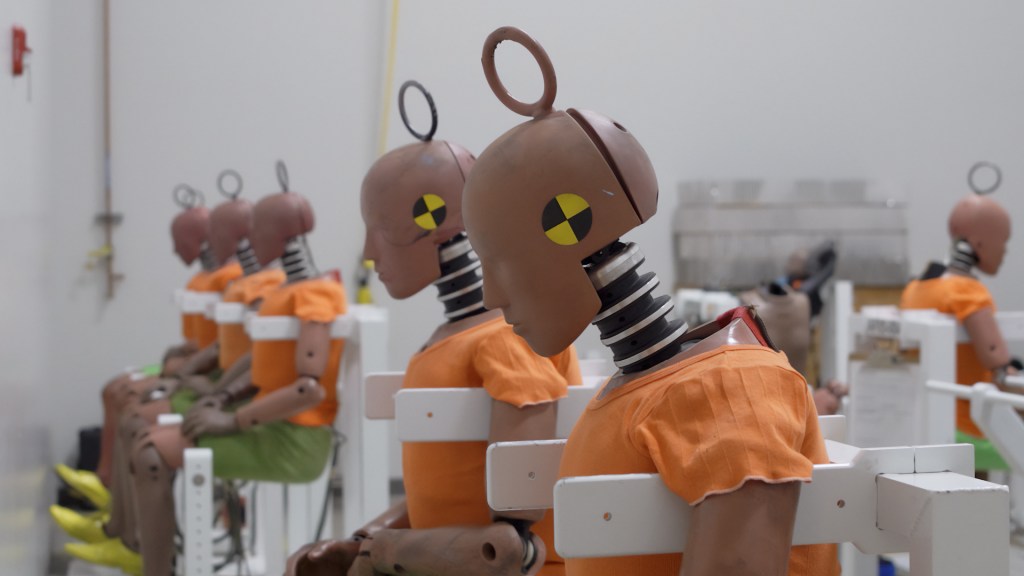
One interesting aspect of the approach taken is found in the first word of the name of the outfit: Collaborative.
CSRC works hand-in-hand with universities and research institutions to carry out the investigations, some of which it has long-term relationships with (e.g., it has been working with the University of Virginia (UVA) for 15 years).
As Jeff Makarewicz, Toyota Motor North America Group Vice President, R&D, put it: “CSRC was built on the idea that the best safety research happens when you invest in relationships over time, with the best institutions, the best researchers, and a shared commitment to publishing what you find.”
Yesterday (June 2) it announced 10 new research projects—including three with UVA:
- “Virtual testing sensitivity to human model body updates”
- “Foot posture and implication for ankle injury risk prediction”
- “Lumbar spine injury prediction with crash test dummies”
The other seven range from “Adapative interfaces for increasing ADAS adoption” with MIT to “Naturalistic vulnerable road user detection with Micro-Doppler Radar” with Purdue.
One of the things that Toyota researchers have developed for this research is THUMS—the Total Human Model for Safety. This is a virtual crash-test dummy. It recently released version 7 of THUMS, which includes greater fidelity to things including the spine and the small intestine.
(Let’s face it: thinking about a motor vehicle accident in relation to the small intestine may be more disturbing than the average weight of a head.)
Not only does Toyota make THUMS freely available to whoever wants to use it, the research performed by CSRC and its research partners is also open.
There is an interesting knock-on effect of CSRC.
Dr. Zhaonan Sun did his Ph.D. work at UVA: he was a graduate research assistant at its Center for Applied Biomechanics, supervised by Dr. Jason R. Kerrigan. That center is the largest injury biomechanics research center in the world.
Sun is now a principal scientist at CSRC. Consequently, given the collaborative research model he is working with Kerrigan and other former UVA colleagues on safety-focused research.
So not only does CSRC contribute to the knowledge base that can lead to safer vehicles, but also to helping develop more people who can carry on that work.
You spend some time learning about lap belt interaction with the pelvis in frontal crashes (work Sun performed) and the effect of subcutaneous adipose tissue (a.k.a., “fat”) and you quickly know that safe driving isn’t just something to think about, but something to do.
And when you see a demonstration of a head model being propelled into the hood of a Toyota Sienna minivan by a large electrohydraulic device you also know that being a watchful pedestrian is a good thing to be.
 shinymetalboxes