When I think “fuel economy” I think of, well, fuel. Liquid fuel. Gasoline. Things measured in miles per gallon, not miles per kilowatt hour.
So when I looked that the just-released “Model Year 2024 Fuel Economy Guide” from the U.S. Dept. of Energy I was more interested in seeing what the fuel economy ratings are for various vehicles, ignoring the full electric vehicles*, but giving attention to the plug-in and standard hybrids because in some cases, like minivans, there really is no option when consulting the “Fuel Economy Leaders”:
MINI Cooper Hardtop (2 and 4 door): 32 mpg combined
Compact car
Toyota Corolla Hybrid: 50 mpg combined
Midsize car
Toyota Prius (hybrid): 57 mpg combined
Large car
Honda Accord Hybrid: 48 mpg combined
Small pickup truck
Ford Maverick HEV FWD (hybrid): 37 mpg
Standard pickup truck
Chevrolet Silverado 2WD (diesel): 26 mpg combined
Small SUV
Kia Nio FE (hybrid): 53 mpg combined
Standard SUV
Toyota Grand Highlander Hybrid: 36 mpg combined
Something for everyone—especially those who don’t like to pay a lot at the pump.
*The whole MPGe ranking strikes me as being almost meaningless. While one could say the same for the mpg rating, I think that there is a notion that if a car gets 25 mpg and the average size of a fuel tank is at least 10 gallons (actually it is more on the order of 12.5, but that’s trickier math-wise), then 25 mpg means 250 miles. But unless someone knows the capacity of the battery and is able to do the math, the MPGe is a cipher.
Japanese car shoppers are going to buy more hybrids in 2024—more than half of all sales will be the electrified powertrains—than any other type of propulsion system, according to Bloomberg Intelligence.
“In Japan, hybrids are popular because they’re affordable and reliable, since they don’t rely on the existence of strong charging infrastructure.”
Arguably, those same characteristics—affordability, reliability, and no dependence on the availability of electric chargers (at home or out in the world)—are important to consumers everywhere.
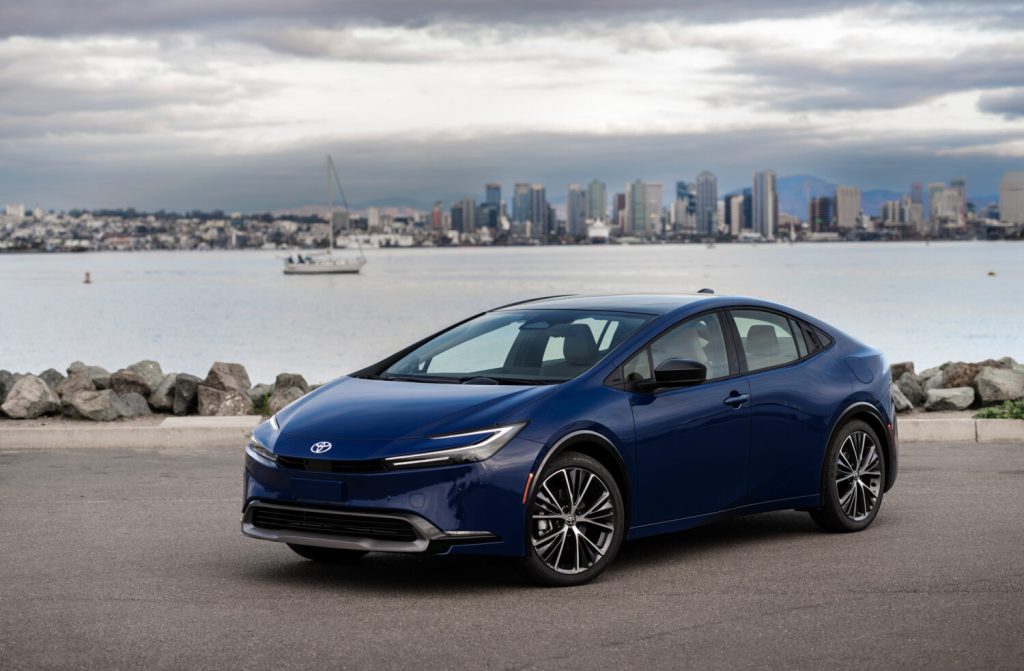
2024 Toyota Prius: Looks good. Travels far. (Image: Toyota)
Although Honda had a hybrid in the U.S. market, the Insight, before Toyota brought the Prius, it was literally just a matter of months—Insight December 1999; Prius June 2000—and Toyota has really become more associated with hybrid technology thanks to its persistence in bringing out hybrids, both as powertrain options to vehicles (e.g., the hybrid RAV4) and as hybrid-only offerings (e.g., the Toyota Venza).
In Japan Toyota has had the Prius available since 1997, so the vehicle, and hybrid tech, are certainly familiar to consumers there.
While the Prius design over the years transitioned from something frumpy to something that looked like the designers were spending too much time watching anime, the 2024 Prius, the fifth generation of the model, is absolutely stunning in looks and certainly not lacking in its efficient performance: the top-of-the-line XLE and Limited models with AWD offer fuel economy of 49 mpg city, 50 mpg highway, and 49 mpg combined. For those who have more frugality, there’s the LE FWD version which is rated at 57/56/57 mpg, which means that given its 11.3-gallon fuel tank (and it takes regular gasoline) it can travel some 640 miles on a tank. That is the definition of “convenience.”
(The 2024 Prius was named the MotorTrend Car of the Year and it is a finalist for the North American Car of the Year, which will be announced January 4.)
Hybrids are garnering more attention in the U.S. market. Not as much as in Japan, but more.
The Ford Maverick Hybrid continues to be a massive hit.
And when Ram brings out its Ramcharger Ram 1500 variant next year, although it will probably emphasize that it is an “electric vehicle,” it is really a hybrid (a series hybrid: there is a battery that powers the electric motor; when the battery gets close to depletion, the gasoline engine operates as a generator to recharge the battery, to keep the propulsion going).
And at an Automotive Press Association Q&A late last month, GM CEO Mary Barra acknowledged that the company has hybrid tech in its portfolio, even though it has no hybrids on offer in the U.S. market.
Arguably, if more Americans knew about the ease of using a hybrid and the efficiency the vehicles provide, they, too, would buy more of them.
Perhaps this will happen when the 2025 Toyota Camry is launched.
The Camry, the perennial best-selling car in the U.S., will be available only with a hybrid powertrain. Clearly, Toyota is that confident in the tech. (Of course, having been putting hybrids under hoods for more than a quarter of a century, it ought to be.)
Affordability, reliability, and no dependence on the availability of electric chargers.
This may cause consumers to pay more attention to hybrids in the U.S., too.
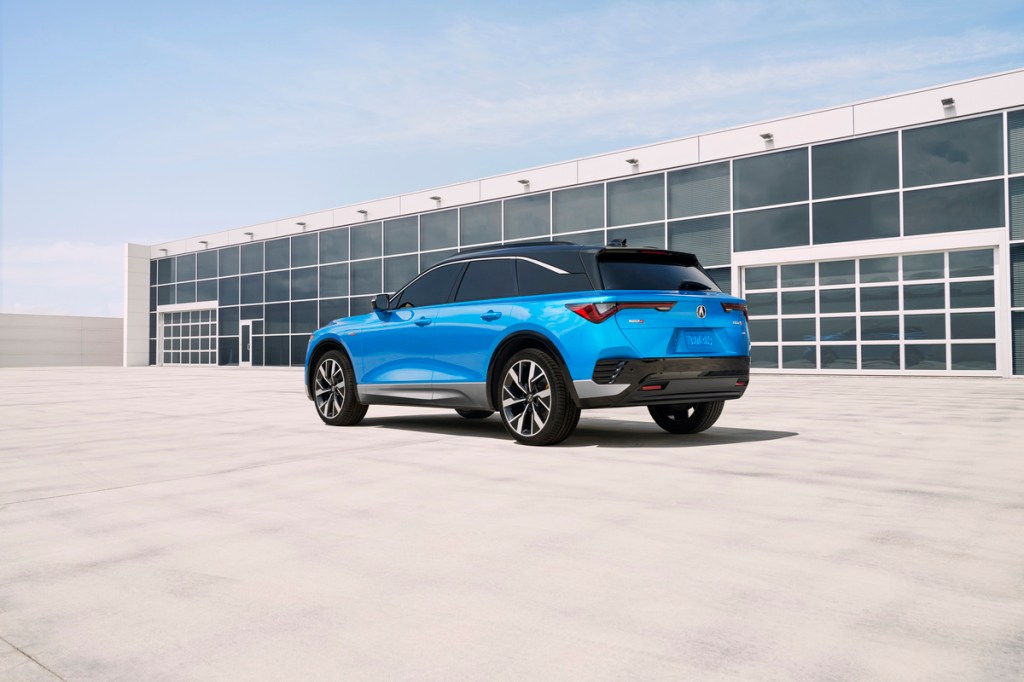
Although it is widely known that Acura is late to the proverbial electric vehicle party, it announced today that reservations are now open for its forthcoming ZDX crossover, which is available as an A-Spec (single-motor, RWD; dual-motor AWD) or as a Type S (dual-motor, AWD, ~500 hp) vehicle.
The 2024 Acura ZDX: coming to a dealership near you (well, assuming you know where an Acura dealership is) sometime next Spring. They say. (Image: Acura)
So it is getting closer, as close as Spring 2024 for those who put down a $1,000 reservation fee. . .but given that the ZDX is based on the GM Ultium platform, there could be some minor or major delivery delays, given that the Ultium track record to date is not exactly confidence-inspiring.
The A-Spec models are said to be “Starting in the range of $60,000” and the Type S offering “Starting in the range of $70,000,” so the vehicles both of which are offered with a 102 kWh battery, don’t have particularly surprising price points.
That is, the Acura MDX has a starting MSRP of $49,850 and makes its way to $73,500.
Acura has always been premium, so for the money it tends to be a good value.
Often better than good.
So maybe it will be late, but it has the right body style for selling EVs, and a handsome body style out of its LA studio (which is undoubtedly surrounded by EVs from various and sundry OEMs, established, burgeoning, trying, and Tesla).
Let’s just hope the ZDX isn’t really late.
It’s not that the party will be over. It will be that people will have all selected their partyhats vehicles and so the number Acura will be able to move will be less than it might be thought and there won’t be a whole lot of popping the cork.
Gebrüder Weiss Holding AG is an Austria-based logistics company. That means it moves things for other companies.
Evidently it is rather good at it, given that the company has been in existence since 1474.
The company announced that a vehicle it is the main sponsor of has set the world altitude record for e-vehicles—a solar-powered transport truck.
Solar truck climbs the volcano in the Andes to prove that it can be done. (Image: Gebrüder Weiss / Anna Pocinska)
The vehicle was developed by Peak Evolution, based on a modified Aebi VT450 transporter, with the combustion engine being replaced by two 120-kW motors.
It drove up the western ridge of Ojos del Salado, the highest active volcano on Earth. It is in the Andes, on the border of Argentina and Chile.
The truck went up to 6,500 meters (a.k.a., 21,325 feet).
Why was Gebrüder Weiss involved? Said Frank Haas, Head of Corporate Brand Strategy & Communications, “This success underlines our ongoing support for sustainable mobility projects and innovative technologies.”
The company is also working with the Austrian Space Forum for a planned mission to Mars.
While such undertakings may seem bizarre, evidently if the company has been in business as long as it has and is able to fund such unusual projects, clearly it knows something that plenty of other companies don’t.
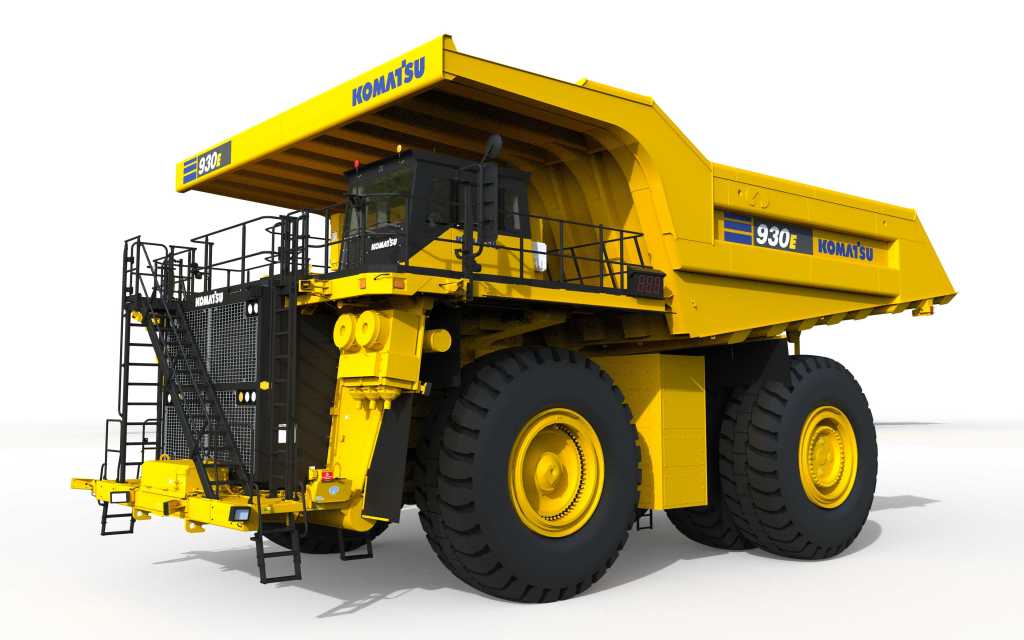
The nominal payload for a Komatsu 930E-5SE—an electric truck that is used in applications like mining—is 640,000 pounds.
Heavy-duty piece of mining gear going to GM fuel cell tech. (Image: Komatsu)
So when Charlie Freese, executive director of GM’s HYDROTEC business says that they believe that fuel cells “can play an integral role in a zero-emissions future, helping to electrify heavier-duty applications,” he’s talking about things like the 930E.
To that end, GM and Komatsu have entered into an agreement through which the companies will co-develop a hydrogen fuel cell power module—on the order of 2 megawatts—to power the 930E.
Dan Funcannon, Komatsu vp of North America Engineering and Development, says Komatsu has pledged to become carbon neutral by 2050.
Typically mining trucks and associated equipment aren’t powered by batteries, aren’t powered by fuel cells, but are powered by diesel fuel.
And diesel isn’t on the pathway to carbon neutrality.
GM HYDROTEC will develop the fuel cell modules, which they refer to as “power cells.” Komatsu will work on the mining truck.
The plan is to have the first prototype tested at the Komatsu Arizona Proving Ground with a few years.
While it may seem like a long time, as Komatsu has a truck and GM has a factory producing fuel cells, let’s face it: when you are on a mining site in the middle of nowhere, you want to make sure that the massive piece of equipment, approximately the size of a small building, works, day in, day out.
One of the things that rental companies do—besides trying to get you to buy all manner of insurance and making you feel marginally criminal and totally liable if you don’t—is sell vehicles from their fleets in order to get an even better ROI.
Hertz, back in 2021, announced that it was going to make a massive investment in electrifying its fleet, with the purchase of some 100,000 Teslas. A few months later it upped the amperage and further announced 65,000 Polestars would be included in lots at airports around the country.
But it seems that the company is rethinking its approach for a couple of reasons.
One of which has to do with the price reductions that Tesla made in order to boost its sales volumes, which had the consequence of putting downward pressure on the residual values of its vehicles. That is, if you buy something for one price and then the same thing is available for a lower price, even before you try to sell your object as used it is worth less than it otherwise would have been.
Hertz CEO Stephen Scherr told The Verge, “The MSRP declines in EVs over the course of 2023, driven primarily by Tesla, have driven the fair market value of our EVs lower compared to last year, such that a salvage creates a larger loss and, therefore, greater burden.”
In addition to which, Hertz discovered that it was costing about twice as much to repair damaged EVs compared to vehicles with internal combustion engines.
“We nonetheless remain committed to our long-term strategy to electrify the fleet,” Scherr also said, which undoubtedly has something to do with the company (1) justifying its initial tranche of EVs and (2) simply positioning itself as a good corporate citizen.
But Hertz isn’t the only rental company rethinking its EV strategy.
Sixt, the German rental company (#2 in Europe; #4 in the U.S.) has decided that as it is electrifying its fleet it is moving away from Tesla and moving toward Chinese OEM BYD.
Again: the residual values and the costly repairs are factors that have played into this move.
While this doesn’t mean that either of these companies are any less interested in electrification, it seems to indicate that their interest in Tesla is waning or disappearing.
“In the first three quarters of 2023, China maintained its position as the primary source of new EU car imports in value terms, growing by an impressive 58.1% and claiming a significant 17.2% market share in value terms.”
While one might imagine that it would be Japan, but that countries auto manufacturers are in third place, at 14.4% of the market, behind South Korea, at 14.6%.
The U.S.? In fifth place, at 10.6%, behind the United Kingdom, which has 14.1% of the EU market.
It’s not so much that the U.S. is so far behind the others (realize that the delta behind the U.K. is 25%), but that China is gaining so much ground in the EU so quickly.
How does this portend for the future of U.S. OEMs, especially if the Chinese start bringing in lower-cost cars that many Americans can afford despite the current 27.5% tariff that the Chinese would have to absorb?
Kelley Blue Book, an outfit with plenty of folks who know a whole lot about vehicles, their value and what consumers like or don’t about those vehicles, has come up with its list of “Best Buy Awards.”
In other words, the vehicles that were launched last year (or which underwent a redesign) that, based on a variety of criteria, KBB thinks people will be happier to acquire than competitive vehicles not on the list.
2024 Toyota Prius (Image: Toyota)
So without further ado, here are the winners of the 2024 Kelley Blue Book Best Buy Awards (all model year 2024 vehicles):
Best New Model: Toyota Prius
Best Compact Car: Honda Civic
Best Midsize Car: Honda Accord
Best Subcompact SUV: Hyundai Kona
Best Compact SUV: Honda CR-V
Best Midsize SUV: Kia Telluride
Best Full-Size SUV: Ford Expedition
Best Compact Truck: Ford Maverick
Best Midsize Truck: Toyota Tacoma
Best Full-Size Truck: Ford F-150
Best Minivan: Toyota Sienna
Best Electric Vehicle: Hyundai Ioniq 5
Best 3-Row Electric Vehicle: EV9
Best Electric Truck: Ford F-150 Lightning
One of the things that is evident from this list is that Ford is a superlative truck company.
Which leads to a question: Where’s anything from General Motors? No Cadillac? Chevy? Buick? GMC? Not one?
Or the company formerly known as Chrysler? Nothing from the Stellantis cadre (Chrysler, Jeep, Dodge, Ram, Alfa Romeo, Fiat)? The company that invented the minivan doesn’t make the Best Buy minivan?
And there is also the noticeable lack of anything with a European pedigree.
Looking into the Ford wins, in the Compact Truck category, there is really only the Maverick, so Ford gets a bonus there because it competes with nothing.
And the only other electric full-size truck that would qualify would be the Chevrolet Silverado EV, though it probably came out too late in the year to be assessed by KBB, so Ford Lightning by default (although it is a bit odd, given that the Lightning was launched in April 2022, not 2023).
Although it seems as though GM execs can’t talk enough about the Ultium platform for battery electric vehicles (there seems to be an inverse relation, however, between talking about it and delivering vehicles based on it: through Q3 it delivered 5,334 Cadillac LYRIQs, 1,216 HUMMER EVs, and 18 Silverado EVs, for a cumulative 6,568 vehicles: you could park all of them at the Mall of America and still have 6,182 parking spaces left over), there is another electric vehicle technology that the company is pursuing that deserves more attention: HYDROTEC, its fuel cell technology.
It has developed what it calls “power cubes.” A cube contains >300 individual hydrogen fuel cells that combined produce 77 kW. (The cube also contains the necessary thermal and power management systems and controls.)
GM HYDROTEC fuel cell “power cube.” (Image: General Motors)
Today GM announced that it has signed a development agreement with Autocar Industries.
Autocar Industries doesn’t build cars. It builds trucks—although its tagline is:
“Some Build Trucks. We Build Tools.”
As in tools that are trucks that are used in vocational applications such as hauling trash or hauling trailers around freight yards.
Charlie Freese, GM executive director, Global HYDROTEC:
“EV propulsion systems like GM’s Ultium Platform are great solutions for electrifying passenger vehicles,* but larger vehicles like Autocar’s class 8 trucks, refuse trucks and terminal tractors require robust solutions that enable significant energy carrying capacity and fast refueling times.”
So they’re going to be developing, along with Triz Engineering, which specializes in commercial vehicle engineering, hydrogen fuel cell-powered vehicles that Autocar will manufacture in its plant in Birmingham, Alabama. The power cubes will be produced at a GM facility in Brownstown, Michigan.
The first vehicles to be built are cement mixers, roll-off trucks and dump trucks. The power cubes can be combined, so if 77 kW isn’t enough, then there can be 154 kW or 231 or. . .
If there is any question about the viability, capability and durability of fuel cells, applications like this one should put it to rest. Freese said that they put the systems through all manner of demanding tests—G-loads, temperature extremes, crashes—and the carbon fiber hydrogen tanks have been subjected to small-arms fire. (There are also military applications; the Autocar trucks aren’t likely to be taking fire.) These things are meant to get the job done.
(The thing about hydrogen for vehicles is that whereas people talk about the lack of infrastructure for electric vehicles, the infrastructure for hydrogen refueling is essentially non-existent except for some places in California. Consequently, building vehicles for the mass market doesn’t make a whole lot of sense now. Building vehicles for specfic applications–like what Autocar does–makes a whole lot of sense because users can create dedicated refueling without having to worry about pumps dotting a highway: they know where their equipment is going to be at the end of the day, so they can put the refueling equipment there. Still, perhaps when people start realizing that even fast-charging EVs will take about 20 minutes to get the battery charged 80% and hydrogen refueling is functionally and temporally the same as that at one’s local gas station (i.e., fill it up in <5 minutes), perhaps the demand for fuel cells for passenger vehicles will grow.)




 shinymetalboxes