Tesla’s Price Hokey-Pokey

By Gary S. Vasilash

In January Tesla cut the price of various Model 3 and Model Y configurations by as much as 20% in the U.S. (there were also price reductions in other markets).

But after the U.S. Treasury Department adjusted its vehicle classification rules pertaining to federal tax rebates through the Inflation Reduction Act, Tesla made price adjustments—again.

This time up.

So there have been additions of as much as $1,500 to the base prices for Model Ys.

Part of this is predicated on those reversed rules.

Whereas the Model Y had been classified by the government as passenger vehicles, it (except for the three-row version) is redefined to be an SUV.

This is advantageous because the retail price cap for those looking for a rebate on an electric car was $55,000, which is pretty much an entry point for Model Ys.

SUVs, however, have a price cap of $80,000. So the Model Y pricing can go well beyond the mid $50Ks.

Presumably, Tesla figures it can do this because of the nature of its fan customer base.

Ford reduced prices on its Mach-Es in response to Tesla’s original move.

While it is unlikely that the company would make the same type of sudden increase in price of the Mach-E for the simple reason that the Ford customer wouldn’t be as financially pliable, it wouldn’t be at all surprising were there folks in Dearborn planning the means by which they can made price rises more palatable to potential customers (e.g., different trim packages).

Start of an EV Price War?

By Gary S. Vasilash

Last month Tesla did something that OEMs almost never do. (And in its history, Tesla has done lots of things that traditional OEMs almost never do, so at least in this regard it is being consistent.)

It cut the price of its vehicles in China, Germany, and the U.S.

These weren’t slight, either. In the U.S., for example, the Model Y Performance was cut by 19% and the Long Range version by 20%.

There were all manner of assessments as to why this happened. Some suggested that Elon Musk’s Twitter distraction was causing the company to lose sales. Others were pointing out that there is increased competition from some of the traditional OEMs. (Who, to be frank, are bigger on rhetoric about their electric scale today and tomorrow than they are in putting EVs in customer’s driveways.)

Tesla has some 2/3 of the U.S. EV market.

Mustang Mach-E: When does a popular vehicle–and it is popular–get a price reduction? (Image: Ford)

Consider: while the Ford F Series seems like a force of nature when it comes to sales, in 2022 there were 653,957 of those trucks sold—and GM sold 764,771 Silverados and Sierras combined, so it isn’t like either of the primary players have anything near 2/3. Yet a company that wasn’t taken all that seriously 10 years ago now dominates a category.

Shortly after Tesla made its announced cuts, the folks at Ford joined in on reducing the prices of its 2023 Mustang Mach-E models. The reductions ranged from $600 on the Select eAWD Standard Range model to $5,900 for the GT Extended Range.

Ford clearly wants to move metal. What’s curious, though, is that in 2022 it sold 39,458 Mach-Es, which is a 45.4% increase over the number it sold in 2021. It’s not like things were lagging. (Ford execs may have noticed that in July of last year GM cut the prices of the Bolt EV and Bolt EUV by $5,900 and $6,300, respectively, and those vehicles ended the year at 38,120 deliveries, not only close to that Mach-E number, but a 53.5% increase over 2021–greater than the Mach-E rise. Although it is hard to imagine the vehicles being cross-shopped..)

Everyone knows that EVs are more expensive than vehicles with internal combustion engines for a wide array of reasons. And while the overall percentage of EVs sold in the U.S. is still small—5.8%–it is growing, not declining.

So why were the cuts to prices made and will other OEMs follow suit?

Those are the primary questions raised and discussed on this edition of “Autoline After Hours.” Charlie Chesbrough, Cox Automotive Senior Economist, and Joe White, Reuters Global Automotive Correspondent, join “Autoline’s” John McElroy and me to talk about those topics and more.

And you can see the show here.

Is This the Definition of Irony?

By Gary S. Vasilash

“Scottsdale, Ariz.Tread Lightly!, a non-profit dedicated to promoting outdoor recreation through stewardship and educational programs, will receive $500,000 from the sale of the first production unit of the 2024 GMC HUMMER EV Edition 1 SUV at the Barrett-Jackson Scottsdale Auction on Jan. 28, 2023.”—GMC news release

While the curb weight of the electric SUV has not been revealed, know that the pickup version of the HUMMER EV crushes the scales at 9,063 pounds.

Presumably the SUV version is not notably—if at all—wispier.

About Accelerating Product Development & the Corvette E-Ray

By Gary S. Vasilash

One of the things that all vehicle manufacturers seek to do is to decrease development time.

This is not only so they can get new, more competitive models on the street more quickly than there competition—though there is that—but because developing a new vehicle is really, really expensive, so if they can reduce the amount of time required, ideally this means the amount of resources are similarly reduced, which means reduced costs.

And the first rule of the auto industry is to make money.

Making sure that all of the elements go toward providing the kind of ride and handling that is expected for a given model (i.e., a plush sedan will have different characteristics than a sports coupe) is an expensive and time-intensive undertaking.

Consider, for example, a test vehicle is assembled then put out on a ride and handling course and it is determined that there is something off in the steering or suspension.

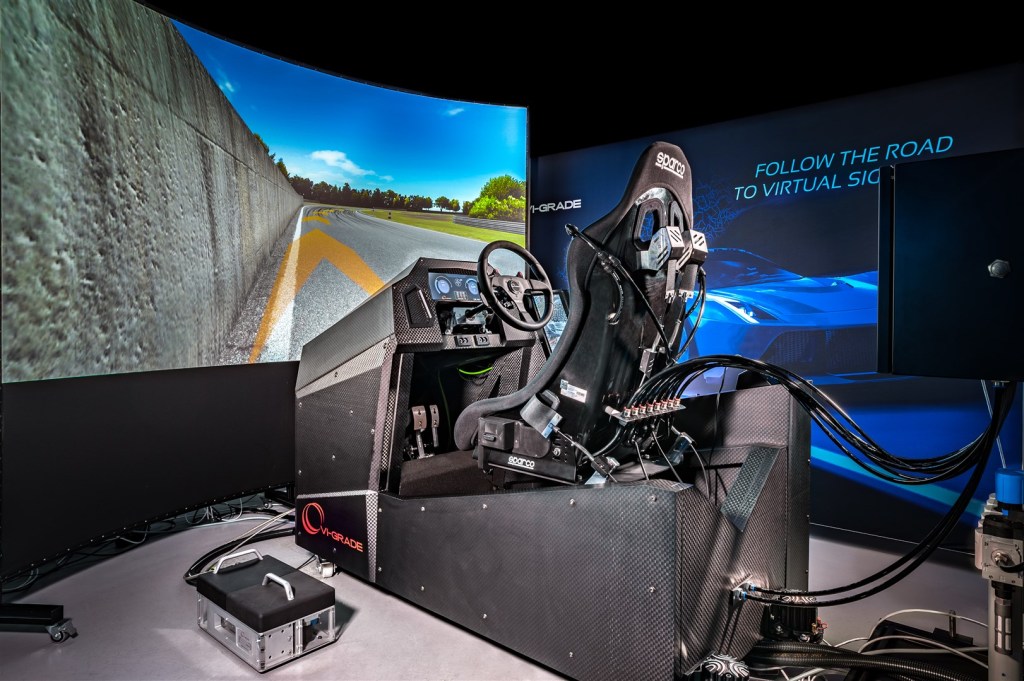
VI-grade simulation system for product development. (Image: VI-grade)

Once it is determined what the issue is (shocks? tires? something else?) there is a replacement made and the test is run again. Making that replacement can require manufacturing of new components. As those components are being made as one-off prototypes, they are certainly not cheap. And it is likely that it takes weeks for them to be ready.

None of which contributes to quick product development.

VI-grade, a company based in Darmstadt, Germany, has an alternative: a simulation-based approach.

This is a sophisticated combination of hardware and software: Yes, it is like a driving simulation game rig but one that has much, much, much more fidelity to reality. After all, the elements are taken from the CAD and CAE files that describe the various elements that go into making the vehicle and there are sophisticated visuals and haptics involved in a VI-grade system.

On this edition of “Autoline After Hours” VI-grade’s Michael Hoffman talks with “Autoline’s” John McElroy, freelance writer Don Sherman, and me about how the tech works (in a way that non-engineers can understand).

Also, Sherman, who is more than a minor expert on all-things Corvette, shares what he’s recently learned about the E-Ray hybrid from the Corvette engineering team.

And you can see it all here.

How Canadian Companies Developed an All-New EV Crossover

By Gary S. Vasilash

Each year there are some two million vehicles and $35-billion in auto parts produced in Canada. The country has several top-notch facilities, both in terms of companies that produce things and universities that develop things of an automotive nature.

Canadian Prime Minister Justin Trudeau has a plan for a zero-emissions future by 2050. So the Canadian Automotive Parts Manufacturer’s Association (APMA), being aware of that plan, decided that it would do its part by developing an electric vehicle. A vehicle that is designed and engineered in Canada and is fully assembled using parts, systems and technologies from Canadian suppliers, 58 in all.

Project Arrow: An EV developed by a team organized by the Canadian Automotive Parts Manufacturer’s Association. It’s all-Canadian. (Image: Project Arrow)

Named “Project Arrow” (a tribute to a supersonic jet development program that occurred in Canada in the 1950s), the $20-million (CN), the crossover was designed by the Carleton University School of Industrial Design, engineered by an APMA-led team, and the running prototype was built at Ontario Tech University.

The Project Arrow vehicle had its debut at the 2023 CES in Las Vegas earlier this month.

According to APMA president Flavio Volpe the Project Arrow vehicle had a massively successful reveal. He said that the focus going forward is that if an OEM is interested in taking the crossover to production, it will be as Canadian as it is now (this wouldn’t be the case of, “Quite a crossover. We’ll build it in ________________ (not Canada) with parts from suppliers in _______________ (not Canada).” This won’t happen.)

On this edition of “Autoline After Hours” Volpe provides insights into the vehicle that has a 500-km (a.k.a., 310-mile) range, and 550 hp from its dual-motor setup. The price would be less than $60,000.

One interesting thing that Volpe points out is that the Lexus RX is produced in Cambridge, Ontario, and that that vehicle was one that the Project Arrow team benchmarked.

Volpe talks with “Autoline’s” John McElroy, freelance writer John Voelcker and me.

Watch this “Autoline After Hours” right here.

AAH on CES

By Gary S. Vasilash

The CES show, which is produced by the Consumer Technology Association, was once an event that when by the non-acronymic moniker: Consumer Electronics Show.

That seemed to be somewhat limiting, so the official name was changed to just the three letters.

One could argue that it worked out fairly well because now CES is what some say the best auto show running.

At the recent 2023 CES there were some 3,200 exhibitors at the Las Vegas Convention Center at nearly 10% of the total were in the Vehicle Technology category, with everything from suppliers of sensors to well-known OEMs like VW to want-to-be-known ones like Sony Honda Mobility.

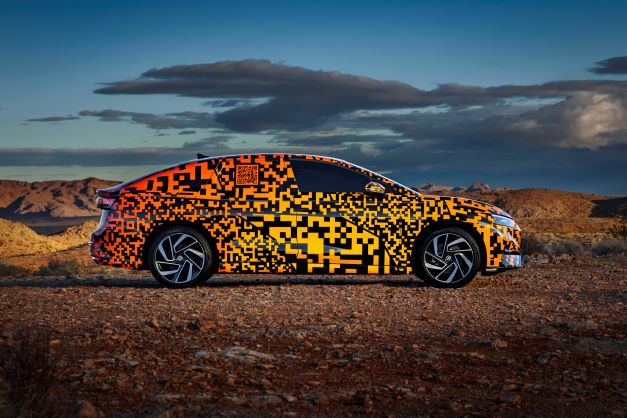
Clever, color-changing camo for the VW ID.7, a vehicle shown at the 2023 CES. (Image: Volkswagen)

On this edition of “Autoline After Hours” Chris Thomas, former chief technology officer at BorgWarner who is now an industry consultant and Paul Eisenstein, publisher and editor-in-chief of The Detroit Bureau, join “Autoline’s” John McElroy and me to talk about what they saw at CES. (The other three were there. I wasn’t.)

The conversation ranges from small radar sensors that could be deployed in vehicle interiors to determine what’s on a given seat and under the hood to determine the level of washer fluid (they are both small and economical) to the BMW concept car that features an exterior material that allows the selection of 32 different colors and combinations thereof—when you want them.

The consensus of the group is that technology is what is driving changes in the auto industry and CES is the correct venue for the exhibition of that technology. (It should also be noted that the CEOs of BMW and Stellantis made keynote addresses; the show also has a conference element to it.)

While there continues to be some doubt about the prospect of traditional auto shows going beyond the function of showing the consumers the latest in vehicles that they can also see at their local dealers, going back to the function of providing a look at what could be, it seems that there is no question about the viability of CES providing the latter function in a very big way.

You can see the show here.

Building Cars Is Hard

By Gary S. Vasilash

On September 18, 2021, this announcement was made by Rory Harvey, vice president, Global Cadillac:

“Today, reservations for the 2023 Cadillac LYRIQ Debut Edition sold out in just over ten minutes and we continue to see a lot of enthusiasm around the brand – both current product and in our all-electric future. The initial response for LYRIQ has been extraordinary. Since the show car unveiling last year, more than 200,000 people have expressed interest in learning more about the vehicle and our electric future.”

Deliveries of the electric SUV, which had obtained significant, deserved acclaim, began in July 2022.

The Cadillac LYRIQ: an impressive electric SUV that more people would undoubtedly like to be behind the wheel of. . .except production is rather limited. (Image: GM)

The LYRIQ is built in the GM assembly plant in Spring Hill, Tennessee. The factory originally built for Saturn. At the plant the Cadillac XT5, Cadillac XT6 and GMC Acadia are also produced.

LYRIQ went into production on March 21, 2022.

So keep in mind: production starts in March, deliveries start in July, and thousands of people wanted to get behind the wheel of Cadillac’s first electric vehicle.

Now admittedly all OEMs in 2022 had to deal with all manner of issues related to COVID and chips and supply chain snafus.

But here is something that is simply startling:

GM announced its U.S. deliveries for 2022.

All in, 2,274,088 vehicles, making it #1 in the U.S.

Cadillac LYRIQ: 122 vehicles.

How many of those LYRIQ “hand wavers” are going to put down their arms and go across the street to an Audi or Mercedes store?

And what about those who were part of the 10-minute sellout? How are they feeling about their decision?

Yes, building vehicles is hard.

But you would imagine that for a vehicle that is as important to Cadillac as the LYRIQ is, that would have been addressed and any speedbumps mitigated.

(Incidentally: while the LYRIQ was the vehicle with the fewest deliveries among all GM vehicles for 2022, the second lowest was another electric vehicle that sold out in 10 minutes when its reservations opened in October 2020 and is now said to be sold out for at least two years: the HUMMER EV. GM delivered 854 in all of 2022.)

Sony Honda Mobility: Huh?

By Gary S. Vasilash

That Sony and Honda announced last fall that they were forming Sony Honda Mobility was certainly curious. Perhaps Sony execs felt a compulsion to get into automotive because its long-time rival Panasonic has been supplying electric vehicle batteries for the past several years, and it wanted to get into the vehicle space, as well.

And as for Honda—well, given that it is a comparatively small OEM, it needs to establish partnerships where it can, so having already signed up with GM, going with Sony is probably considered to be a useful thing for no other reason than the electronics manufacturer has lots of tech, and that’s certainly useful to an OEM.

AFEELA prototype: yes, a sedan. (Image: Sony Honda Mobility)

SHM revealed the name of its new brand, AFEELA, and a prototype vehicle to accompany it. While there are some who criticize the name, odds are people looked askance at “Trinitron” back in 1968 and “Acura” in 1986.

But here’s a curious thing about it:

The company says that it aims “to create a new mobility lifestyle by leading people’s hearts and minds towards an open, pleasant and exciting experience. To realize this, we aim to revolutionize the mobility space as a Mobility Tech Company, alongside like-minded people who are pioneering a new future with creativity, through cutting-edge technology, and with passion.”

And it introduced a car.

Somehow the goals and the delivery mechanism seem rather disconnected.

A car.

Some Surprising Toyota Numbers

By Gary S. Vasilash

One thing that is occurring is that OEMs are decreasing the number of types of vehicles that they have on offer.

Consider, for example, Ford.

If you want a “car,” then you’d better be happy with a Mustang because that’s all that’s available.

It has gone from arguably a “full-line” manufacturer to a SUV/truck manufacturer.

And it is doing well in that truck category, as the company announced that the F-Series is the best-selling truck in the U.S. for 46 years running, and that it sold more than 640,000 trucks in 2022 (this isn’t just the F-150 but the F-550 chassis cab, so it is a mix of personal and commercial vehicles).

Toyota RAV4 (Image: Toyota)

Toyota is a full-line manufacturer, as it builds cars, trucks and utes.

And while it might seem as though this spreading might cause some dilution of vehicle sales (i.e., with a range to chose from, a consumer might pick a car rather than a ute or a truck rather than a car, thereby diminishing the overall sales for a given vehicle), when it added up its 2022 U.S. sales it had some impressive numbers:

  • The Camry is the best-selling passenger car for 21 years running
  • The Tacoma is the number-one small pickup and has been for the past 18 years
  • The RAV4 is now the best-selling SUV for seven years in a row

While some might think that the car segment isn’t all that interesting, know that it sold 295,201 Camrys in 2022.

It also sold 222,216 Corollas (the number-one selling compact in the U.S.)

And there are other cars on offer: Supra, GR86, Mirai, Avalon, and Prius.

The Tacoma clearly is a truck with legs. There were 237,323 sold in 2022. A point of comparison would be the combined number of the Chevy Colorado and GMC Canyon: 117,016.

The RAV4 run is perhaps the most impressive of all. While Ford and GM can legitimately argue—as can the Stellantis Jeep brand—that they have deep, deep SUV know-how and capability, the RAV4, of which 399,941 were sold in 2022, just keeps leading the list.

Seems that offering a full line can have some advantages for the OEMs’ sales and the customers’ choice.

Why Would Apple Bother?

By Gary S. Vasilash

The 23rd KPMG Global Automotive Executive Survey—some 900 execs in 30 countries surveyed—includes an array of findings that should be of startling interest to OEMs, particularly those vehicle manufacturers that are, as they sometimes say, “all in” on electric vehicles.

For example, in the 2021 survey the execs predicted that by 2030 EVs would be 52% of the U.S. market.

A year later that number is down to 29%.

Quite a tumble.

Remember: these are execs in the auto industry, people whose livelihoods depend on how vehicle sales play out.

(Do some of those people look at that 29 and think about the billions being invested in EV assembly plants and battery facilities?)

Another question was about what companies would be market leaders in electric vehicles by 2030.

The top three are Tesla, Audi and BMW.

The fourth is somewhat of a surprise: Apple.

While the rumors of an Apple entry into auto have been rife for a number of years, the question as to why the company would want to get into what is a low-return space should squelch said rumors.

Vehicle manufacturers aren’t doing particularly well from a Wall Street valuation point of view.

Here is a list published today by CNBC of the performance of OEMs over the past year:

  • Ferrari (RACE): -18%
  • Stellantis (STLA): -25%
  • Toyota (TM): -26%
  • Nissan (NSANY): -35%
  • General Motors (GM): -43%
  • VW (VWAGY): -46%
  • Ford (F): -46%
  • Fisker (FSR): -57%
  • Tesla (TSLA): -68%
  • Nio (NIO): -68%
  • Lordstown (RIDE): -69%
  • Nikola (NKLA): -75%
  • Rivian (RIVN): -82%
  • Lucid (LCID): -83%
  • Canoo (GOEV): -86%

Yes, every single one of those companies with a minus sign in front of two digits.