Guess this means the big time for the quirky science enthusiast
By Gary S. Vasilash
Bill Nye is not a real doctor, nor does he have a master’s degree—in science. (A BS in mechanical engineering from Cornell.)
But he has made science interesting to the young and old alike.
There he is, always wearing a bowtie (and a suit or lab coat) rolling out in an understandable manner the science behind everyday life.
Well, he is wearing the bowtie. (Image: Porsche)
And he does so in a way that he seems to be the lovable everyman teacher from one’s middle school.
One of the things that a lovable everyman teacher from one’s middle school probably could only dream of is a Porsche Taycan.
But Nye has been hired by Porsche to create a YouTube channel for a series of shows that explain what makes the $79,900 electric Porsche special.
For some people what makes it special are:
It is a Porsche
It has a starting price of $79,900 and goes to $185,000.
It is worth noting that Porsche had also hired Keanu Reeves and Alex Winter to star in a video, “Going the Distance,” during which they take a road trip in SoCal in Taycans.
While that is somewhat understandable (e.g., getting on the accelerator really does earn a “Whoa!”), it is somewhat sad that Bill Nye has gone Hollywood.
Of course, were he Bill Nye Math Guy he would be able to explain the likely sudden increase in his bank balance.
Let’s face it: there are plenty of traffic jams on the ground. Meanwhile, in the sky. . . .
By Gary S. Vasilash
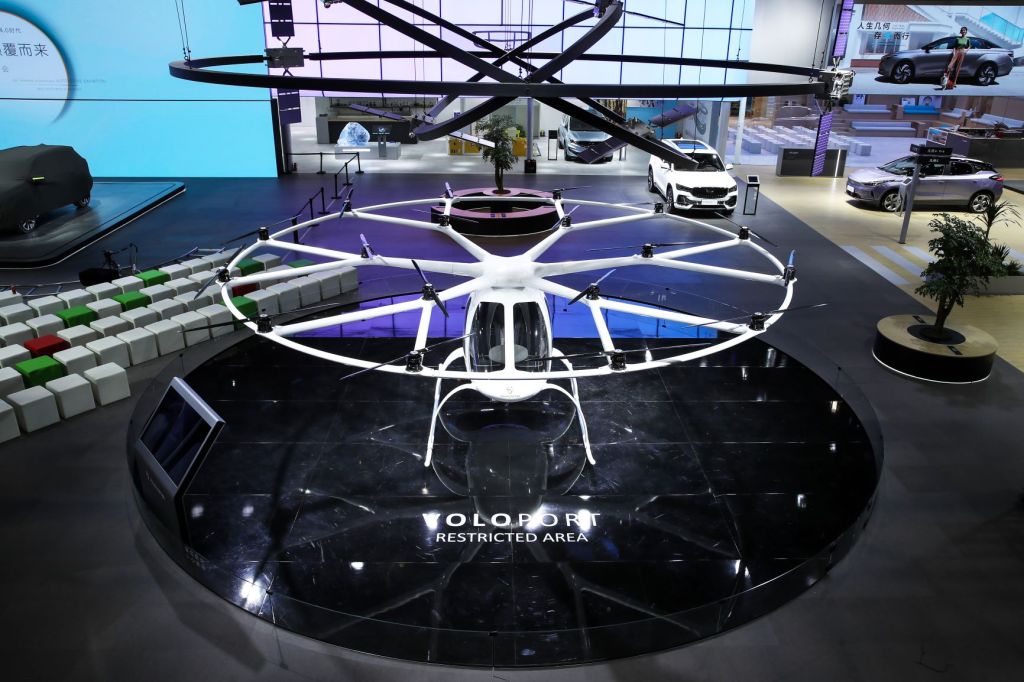
While plenty of companies, including Geely, are showing off electric vehicles at the Shanghai Auto Show, there is one vehicle that is particularly intriguing in the Geely Technology Group exhibit: the Volocopter 2X.
The Volocopter 2X in the Geely booth at the Shanghai Auto Show. (Image: Geely)
It is an electric air taxi.
The category is called “urban air mobility” (UAM).
The objective is to provide transport services, like a cab, but in the air.
Geely, which invested in Volocopter in 2019, and Volocopter have agreed to a joint venture through which they’ll be offering UAM services in China.
Said Florian Reuter, CEO of Velocopter, “Geely’s market leadership in China and forward-thinking approach to expanding mobility options make them a great strategic investor. They are an invaluable partner for bringing urban air mobility to China—one of the most promising markets for the UAM industry globally.”
The 2X is a two seater.
It has flown test flights in China, and is the model that they’ll be starting service with.
It has 18 rotors and nine exchangeable batteries, which is said to provide redundancy in case of failure during service.
Volocopter is presently working on a fifth-generation model, the VoloCity, which has a speed of 110 km/h and a flight duration of 35 minutes.
Lexus has revealed the major midcycle update of the seventh generation ES, which appeared in 2018. The ES is a sedan. The ES is one of the fundamental products of the brand that we now know as Lexus. In 1989 at the North American International Auto Show in Detroit Lexus was introduced to the world with two models: the LS 400 sedan and the ES 250. While many associate Lexus with the wildly popular RX crossover, it wasn’t introduced until 1989.
Without the ES, arguably, we wouldn’t have the Lexus that we now know: Let’s face it, while the top-of-the-line LS is notable, its sales potential is limited. (That is: the starting MSRP for an LS is $76,000, while the starting price for an ES is $40,000. The difference is not trivial.)
The 2022 Lexus ES. Yes, people still like to drive cars. (Image: Lexus)
Lexus has seven cars in its lineup: IS, RC, ES, GS LS, LC and LFA. In 2020 there were 68,205 Lexus cars delivered. Of that number, 43,292 were ES models. Second to it is the IS, at 13,600.
Of course, the brand that made luxury crossovers a thing has five models in the SUV category. In 2020 it sold 206,836. Of that number, 101,059 were RX models. Second to it is the NX, at 55,784.
While it is clear that the crossover is certainly bringing in more buyers, note how important the ES is to the overall car sales: 63% of the total. The RX represents about 49% of the crossover total.
So for 2022 the brand has made some modifications, such as making its Lexus Safety System+ 2.5 as standard equipment (among its elements: Pre-Collision System (PCS) that uses enhanced sensors; it includes Frontal Collision Warning (FCW), Automatic Emergency Braking (AEB), Pedestrian Detection and Bicyclist Detection, and Intersection Turning Assist (under certain conditions it will recognize an oncoming vehicle when performing a left-hand turn, or a pedestrian when performing left and right-hand turns; it activates PCS if needed)).
They’ve modified the instrument panel design, doing such things as moving the center screens (standard 8-inch and optional 12.3-inch) forward 4.3 inches for easier accessibility.
On the outside there are new grille patterns. There are new wheels.
They’ve modified the ride and handling characteristics thanks to things like the use of a new rear suspension member brace. They’ve updated the braking system. . .and even enlarged the size of the brake pedal.
They’re even offering an FSPORT accessory and handling package for the hybrid version of the ES.
Lexus is putting a lot into the ES.
Look at those numbers for last year.
And consider this: in 2020 there wasn’t a single Cadillac model—not a car, not a crossover, that had sales of 43,292. The closest is the XT5 crossover, at 35,223.
The Audi RS e-tron GT produces 590 hp, net. Just sayin’. . .
By Gary S. Vasilash
There are 14 vehicles in the Audi of America lineup. The best-selling model during Q1 was the Q5 crossover, with 14,731 units delivered. The vehicle that had the least amount of sales is the R8 sports car, at 148 units. This gives you a sense of the spread from top to bottom, as Audi sold 54,840 vehicles.
What is surprising is how well the e-tron and e-tron Sportback—electric vehicles—did for the brand, with the former accounting for 3,474 units and the latter 850.
Put another way, electric vehicles are a solid contributor to Audi’s overall sales.
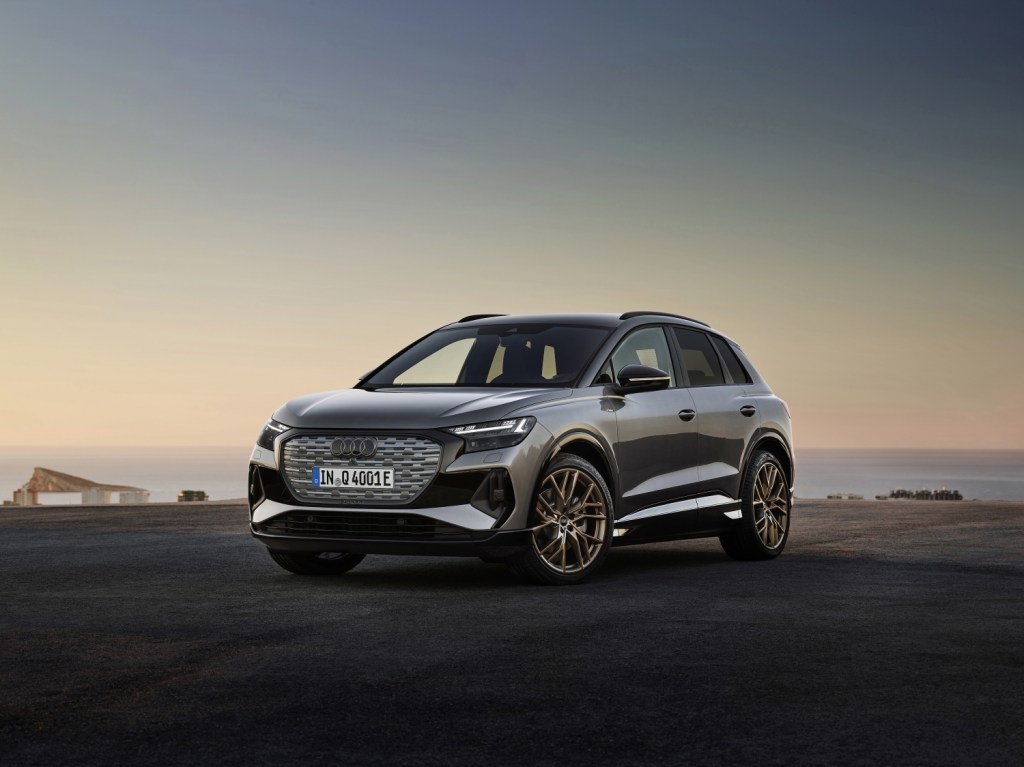
The Audi Q4 e-tron. Part of the company’s electric offensive. It plans to have more EV models for sale in the U.S. by the end of 2021 than any other OEM. (Image: Audi)
And that number is likely to do nothing but increase. This summer the e-tron GT electric sports sedan will launch. With a starting priced of $99,990, odds are the numbers will be low. But there will be numbers.
But before the year is out, there will be two more models added to the electric Audi lineup, the Q4 e-tron and the Q4 Sportback e-tron.
Notably, the Q4 e-tron, a compact crossover, will have a starting price of under $45,000. And then there could be incentives and credits that could put people in an electric Audi for much less.
To learn about what Audi is doing in the EV space, on this edition of “Autoline After Hours” we talk with Matt Mostafaei, the Audi e-tron product manager. (The “we” consists of “Autoline’s” John McElroy, Stephanie Brinley of IHS Markit, and me.)
Mostafaei explains that one of the biggest challenges that they face with regard to getting more people to buy an e-tron is a lack of familiarity that they have with EVs. He suggests that once they’ve an understanding of the advantages that can be realized—like plugging in one’s vehicle at night, analogously to plugging in a phone, so as to have a full charge every morning—as well as the driving dynamics that are provided by an EV*, this will change.
While Tesla is certainly the dominant player in the category, and while Mostafaei says that they’d be glad to have Tesla owners or intenders come into Audi dealerships, he maintains that there is a far greater number of potential customers than just those who have gone the Tesla route.
Just think of all of the people who fuel their vehicles with gasoline. That’s a market.
Audi isn’t adding all of those EVs to its lineup just to be au courant.
As Mostafaei puts it, they see where the market is going and they’re going to help drive it forward.
In addition to which, McElroy, Brinley and I discuss a number of other vehicles, electric and otherwise, as well as the benefits OEMs—and consumers—can realize from tech like Ford’s just-introduced BlueCruise hands-free driving technology, and autonomous driving tech that will be shuttling people in Dubai—and which is shuttling pizzas in suburban Houston.
Four doors and a box on the back of a compact vehicle
By Gary S. Vasilash
Of the 2022 Hyundai Santa Cruz, which will be available late this summer, Jose Munoz, president and CEO, Hyundai Motor North America, says, “Our customers will wonder just how they managed before owning one.”
He also says the vehicle “breaks open all new segment territory, both for Hyundai and the industry as a whole.”
What is it?
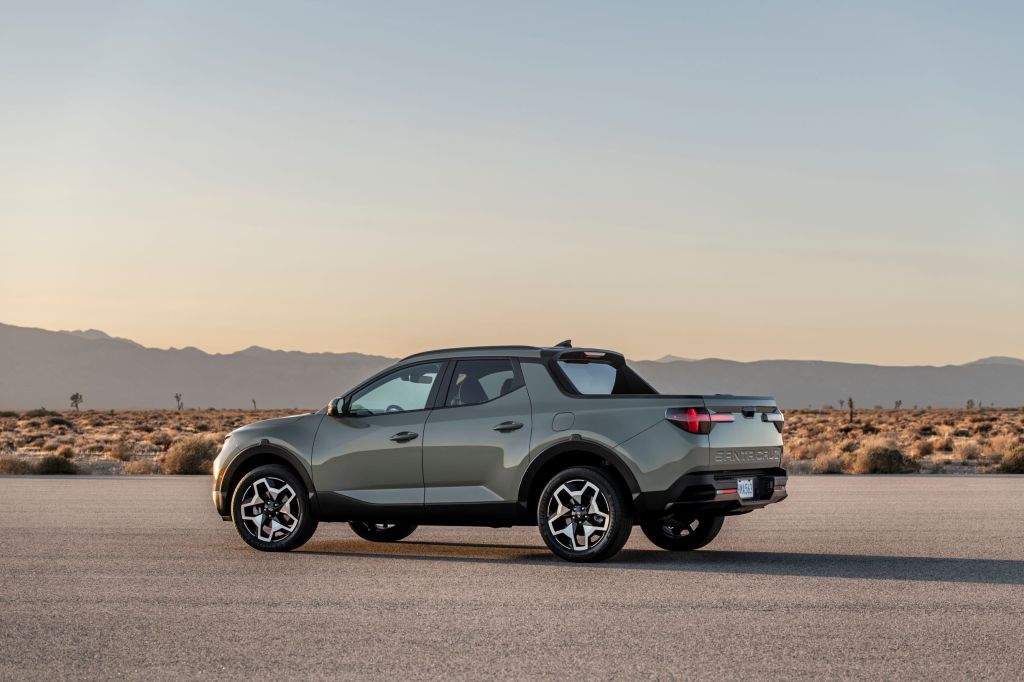
A compact crossover with a box on the back like a tiny pickup. The bed length is 48.4 inches on the upper level and 52.1 inches below.
Think of it as about four feet.
Really not much for those who are looking for a pickup-like capability.
2022 Hyundai Santa Cruz. (Image: Hyundai)
But to be fair to the Santa Cruz, a 2010 Ford Explorer Sport Trac has a bed length of 49.2 inches, so the Santa Cruz is right there.
Which leads one to wonder about opening up a new segment.
One could argue that although the Honda Ridgeline is positioned as a pickup truck, it is in many ways like an Accord with a 63.6-inch box on the back instead of a truck (and the reference to the Accord is a good thing).
Which leads one to wonder about opening up a new segment. Or living without it.
Oh, well.
Hyundai isn’t referring to the Santa Cruz as a pickup. Nor is it calling it an SUV. Rather, it is a “Sport Adventure Vehicle.”
When BMW brought the X5 to market in 1999, it didn’t like the “sport utility vehicle” nomenclature. So it insisted that the X5 was an SAV—a Sport Activity Vehicle.
That didn’t stick.
In customer research, Hyundai found that people—“often living in urban environments”—wanted something that they could use for stuff, whether it is stuff that they bought at REI or Home Depot. Throw and go: the bed is ready to accommodate whatever.
Again, not a whole lot of stuff, but if you’re living in an apartment in an urban setting, you don’t have a whole lot of stuff.
Hyundai makes comparisons of the Santa Cruz with pickups. When it comes to beds, there is really no comparison—the Nissan Frontier is the next shortest, at 59.4 inches.
The Santa Cruz is wider than the Frontier—75 v. 72.8 inches—and just a smidge narrower than the Toyota Tacoma, which is 75.2 inches. The Tacoma, however, is 212.2 inches long, compared with 195.7 inches for the Santa Cruz.
A comparison with a traditional pickup doesn’t really play to the potential advantages of the Santa Cruz.
Credit to Hyundai to delivering on the concept that it showed at the North American International Auto Show in 2015 in a manner that looks extremely close to the show car.
Yes, small(ish) sedans still matter to some companies—and some consumers. After all, there were 55,903 Civics sold through March, and that is notable
By Gary S. Vasilash
While I must confess I don’t completely understand the “breaks cover” term for a vehicle reveal, it seems that that is de rigueur in headlines for events like that, so I figured I’d use it. Breaks cover.
2022 Honda Civic. It will become available later this year. (Image: Honda)
There isn’t a whole lot of information about what will be the eleventh generation of the venerable Civic (any car that’s been around for 11 generations gets that honorific—at the very least).
It will be a model year 2022.
The sedan will be produced at Honda of Canada Manufacturing, which is in Alliston, Ontario.
There will be a Civic Hatchback coming a few months after the Civic Sedan. It will be produced at Honda Manufacturing of Indiana in Greensburg.
Honda will offer more information about the Sedan on April 28, during its first 20th anniversary Honda Civic Tour event, headlined by H.E.R. One wonders whether the fans at the concert will be interested in specs of the songs.
This, of course, will be a virtual tour.
The car, which has, to remind you, broken cover, will be real.
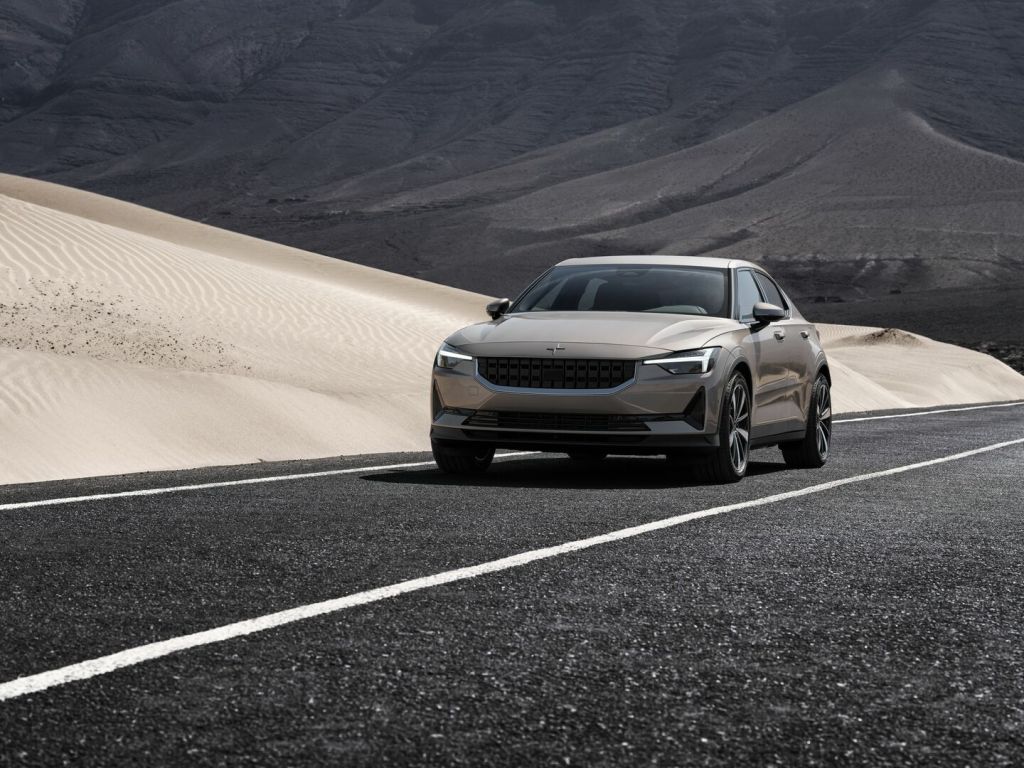
The Polestar 2—which comes from a company named “Polestar”—has now become three.
That is, there is the Polestar 2 Launch Edition, an EV with two electric motors. That’s one.
Now there will be two others: One that is the single motor Polestar 2.
The Polestar 2 (Image: Polestar)
Another that is a dual motor Polestar 2.
Which makes three.
Now the Launch Edition has motors on both the front and rear axles. It has a combined output of 408 hp. (Yes, it is an electric vehicle, but people are more familiar with horsepower than kilowatts. For now.)
Then there will be the Polestar 2 with one motor. The motor will be on the front axle. But rather than a motor with an output of 204 hp—as is the case for the Polestar 2 Launch Edition—the output of that motor will be 231 hp.
The third is the dual-motor Polestar 2, which, motor-wise, is like the Polestar 2 Launch Edition, but which can be ordered with different amenities, thereby permitting people to get into it for less than the price (although Polestar has yet to release pricing) of a Polestar Launch Edition.
Sometimes people complain about companies (think Audi or Cadillac) using alphanumerics instead of names.
This is one case where maybe that would be a better idea.
Back in ’92, Michael Boskin, then Bush 41 economic advisor, said it didn’t matter whether a country produced potato chips or microchips. Guess what?
By Gary S. Vasilash
“CEO Summit on Semiconductor and Supply Chain Resilience.”
That’s what a meeting held yesterday in Washington and Cyberspace was named, which included CEOs from a number of companies, including General Motors, Ford and Stellantis.
The point is that there is no resilience in the supply chain for semiconductors.
Evidently it is something that hadn’t been deemed to be necessary.
But then there was the pandemic.
Then people suddenly started working from home. Students started studying from home.
And there was a recognition that—oops!—the home compute equipment wasn’t (1) up to snuff and/or (2) not in sufficient numbers to accommodate the whole family.
Meanwhile, people at companies like Sony and Microsoft were busy working on their new gaming consoles. And things like PlayStations and Xboxes require sophisticated microprocessors.
The auto industry shut down for a couple of months last year. There were thoughts that it would be down for longer.
When you’re not making cars and trucks you don’t need lots of things, from steel to tires to. . .semiconductors.
But the auto industry came back.
And the number of semiconductors on the shelves began decreasing—and not replenished just-in-time, or at any time.
Some vehicles were built without control modules that would be added later. Which is not exactly a tenable way of doing things.
So factories were put on hold. When you don’t have the parts, you can’t build the vehicles.
Consequently, the meeting in Washington.
Within the Biden $2-trillion infrastructure plan there is money—some $50-billion—for semiconductor manufacture.
Odds are, the $2-trillion infrastructure plan is going to remain just that. A plan. It is going to be difficult to get sufficient support to pass it.
President Biden told attendees at the meeting that there is bi-partisan support for addressing the semiconductor dearth.
There ought to be. Left or right, urban or rural, 99% or 1%–this country’s infrastructure is predicated on private vehicle drivership and everyone needs one (or economic access to one).
As vehicles get more technologically sophisticated, the number of chips needed is only going to grow.
If this issue isn’t significantly and substantially addressed, then not only is this going to affect the vehicle manufacturers, but everyone who would like to get a new vehicle.
A surprising story about the use case for electric mopeds
By Gary S. Vasilash
Matt Brueggeman says that when he was growing up in suburban Chicago, his family had three Chevy Tahoes. He acknowledges that they were good vehicles. But he also admits that it occurred to him that the Tahoe wasn’t the most efficient vehicle to transport a single person to, say, go visit a nearby friend or to go pickup a carton of milk.
After graduating from the University of Wisconsin, where he studied Chinese, he moved to Beijing for six years.
While there the absurdity of the Tahoe really became evident to him, as he watched people riding on electric mopeds.
The Flux EM1: It won’t replace a car. But it offers an alternative for those quick trips. (Image: Flux Mopeds)
When he returned to Madison he and his colleagues decided to start a company to allow people to sensibly take local trips. Brueggeman is the co-founder and CEO of Flux Mopeds.
With time, research and development they came up with the Flux EM1. It is an electric moped that has a limited range—50 miles on two batteries. A limited top speed—38 mph. A limited capacity—300 pounds.
It also has a comparatively limited MSRP: $2,400.
And on this edition of “Autoline After Hours” Brueggeman talks about how the vehicle came to be and how it is doing in the market. He talks with “Autoline’s” John McElroy, John Beltz Snyder of Autoblog Green and me.
Brueggeman explains that while the mopeds are produced in China there was extensive engineering developed in the U.S. He says that while the owner of a moped in China can get a broken part fixed by a corner repair shop, that’s not the case in the U.S., so they’ve engineered the units to be as robust and reliable as possible.
He says that the company is keeping its costs down by not selling through dealerships and not carrying inventory: it is build to order.
And while you might think that this is a vehicle that would be on college campuses or being ridden in downtowns by urban hipsters, Brueggeman says that the big market for the company is. . .RV owners. (Why tow a car when you can stick an EM1 on the back?)
If you’re interested in micromobility, you’ve got to watch this show. Right here.
That assumes it (1) is a car and not a different type of vehicular architecture and (2) comes to exist
By Gary S. Vasilash
Apple’s head Tim Apple Cook talked with the New York Times’ Kara Swisher earlier this week and had some interesting comments about what is reportedly known as “Project Titan,” the Apple vehicle project that seems to be one of those on again, off again undertakings.
There is something, based if nothing else than the fact that there are Apple-owned vehicles that are racking up miles in California, according to the state’s DMV.
Three interesting quotes from Cook:
“An autonomous car is a robot.” Generally we think of robots as things that have arms, not tires. But in terms of the sensors and processors and the fact that it is meant to perform specific tasks under various conditions, that is indeed the case.
“We love to ingrate hardware, software and services, and find the intersection points of those because we think that’s where the magic occurs.” Perhaps this indicates that if there is going to be a vehicle, there is going to be some serious vertical integration going on: Apple doing most of it. (Which leads to the question about producing the vehicle, because this is a difficult thing to do. Of course, there are no capital constraints that Apple would face in terms of facilities, resources and people, so maybe it could pull a DIY.)
“We investigate so many thinks internally. Many of these never see the light of day. I’m not saying this one will not.” Of course, he’s also not saying this one will. For some reason motor vehicles (that’s motor as in “electric motor”) have become interesting things to all manner of tech companies. Remember when Detroit was dismissed as the “Rust Belt”? Now it seems that vehicle development and manufacturing—although not necessarily being done in the Rust Belt—seems to be an appealing thing for tech companies large and small, from lidar companies none of us have ever heard of to, well, Apple.





 shinymetalboxes