And it isn’t whether or not there’s free coffee at the dealership
“The future of Volvo Cars is defined by three pillars: electric, online and growth. We want to offer our customers peace of mind and a care-free way of having a Volvo, by taking away complexity while getting and driving the car. Simplification and convenience are key to everything we do.” That’s Lex Kerssemakers, head of global commercial operations, for Volvo Cars.
Volvo announced it will be all-electric by 2030. And that it is launching a line of electric vehicles that will be available online only.
This doesn’t mean that Volvo dealers are going to be looking for something else to do come 2030.
It does mean, however, that there will be some offerings tailored to the ever-increasing number of people who can’t figure why you need to go to a special place to buy something when they have a perfectly good digital device at hand.
“Online and off-line need to be fully and seamlessly integrated. Wherever the customer is in their journey – online, in a showroom, in a Volvo Studio, or driving the car – the customer experience needs to be top-notch,” Kerssemakers added.
Although General Motors is bullish on the whole notion of people driving around in electric vehicles (EVs), for the most part that’s something that is off into the future because there aren’t a whole lot of EVs out there for people to drive—vehicles from GM or any other OEM, for that matter.
GM has had the Bolt EV in dealerships since 2017, a compact car. Compact cars of any type aren’t exactly high on the lists of consumer gotta-haves, and let’s face it: GM’s offering in this space hasn’t been such that people are likely to think when they go out shopping, “Hmm. . . I think I’ll go check out GM compact models.”
Which is to say that the company needs to modify its approach, and with the Bolt EUV it has done that—a bit.
2022 Chevrolet Bolt EUV: Second EV in the Chevy lineup. (Image: Chevrolet)
According to program engineer Rob Manitian, the Bolt EUV shares no sheet metal with the Bolt EV. That said, the Bolt EV has undergone a midcycle refresh so in its new execution, it has a different look, as well.
The rationale for the Bolt EUV is to make the vehicle have more of a “utility” appearance, because if there is something that market wants—and that Chevy has on offer from small to medium to large—its something that seems “utile.”
Seems is pretty much the operative word for the Bolt EUV when it comes to utility vis-à-vis its stable mate.
That is, the Bolt EUV is bigger than the Bolt EV:
The EV has a wheelbase of 102.4 inches; the EUV 105.3.
The EV has an overall length of 163.2 inches; the EUV 169.5.
The height difference is just 0.2 inches.
The size difference is manifest in the rear legroom:
The EV offers 36 inches; the EUV 39.1.
But here is where the seems kicks in: Cargo volume.
The cargo volume behind the rear seat in the EV is 16.6 cubic feet and it is 57 cubic feet with the rear seat folded.
The cargo volume behind the rear seat in the EUV is 16.3 cubic feet and it is 56.9 cubic feet with the rear seat folded.
While those numbers are not significantly different—especially that 0.1 cubic foot difference—one might imagine that the EUV might offer a significant difference when it comes to accommodating stuff, which it clearly doesn’t. (OK. It has standard roof rails. But. . . .)
If you’re not putting someone in that rear seat, then one could say that the choice between the two is pretty much a wash, given that the vehicles have the same platform and propulsion system.
The vehicle is powered by a 150-kW permanent magnet motor. (A.k.a., 200 hp) There is a 65-kWh lithium-ion battery pack that provides an estimated range of 250 miles on a full charge. With a Level 2 charger (240 V) the battery goes to a full charge in 7 hours; with a DC fast charge system, up to 95 miles in 30 minutes.
Because of the increase in the wheelbase, there is a different driving dynamic, one that is appreciated when using. . . Super Cruise.
That’s right: the hands-free driver assistance technology that has been heretofore available only in Cadillac models has moved to the Bolt EUV.
The Super Cruise system makes use of sensors—radar, cameras, on-board—and a LiDAR map. (No, it doesn’t have LiDAR but the mapping of some 200,000 miles of roads—like freeways—that has been done with a LiDAR system. What does that mean? Simply that it is really accurate. In addition to which, GM has a contract with a company that is out there right now, scanning more roadways and updating existing ones, information that goes to Super Cruise via over-the-air updates.)
You activate the system, set speed for adaptive cruise, and assuming you’re on roadway that is good to go, you center the car in the lane, it then gives you a lightbar on the steering wheel indication that it is ready, so you push the button a second time. . .and remove your hands from the steering wheel.
The Bolt EUV then maintains speed—adjusted based on the set spacing via the adaptive cruise—and maintains the lane. The road curves; the steering wheel makes the adjustment.
You are not permitted to take a nap or read a newspaper because there is an unobtrusive “Driver Attention System” that uses infrared lighting and a small camera on top of the steering column that keeps an eye on your eyes (even through sunglasses) so that if you’re paying insufficient attention to what’s going on, the system let’s you know that’s not acceptable behavior.
But to return to the wheelbase for a moment. When driving at freeway speeds in the adjacency to big rigs, unless you’re in a full-size SUV or pickup truck, you’re going to feel buffeting. The addition six inches of wheelbase undoubtedly helps keep things from feeling too unsettling when the Bolt EUV is, essentially, driving itself (I suppose that this point I ought to have in big red letters something that says YOU ARE RESPONSIBLE FOR BEING IN CONTROL OF THE VEHICLE because as modern as it is, you’re still in charge).
The interior of the vehicle is fresh and contemporary without being too overtly “futuristic” in execution. I actually wish it did seem to be a bit more advanced because let’s face it: this is still leading-edge technology compared to about 95% of everything else on the road, so those who are adopting it ought to get a nod that they’re participating in the creation of the future. (It is worth noting that the front end of a white Bolt EUV does resemble a Star Wars stormtrooper, however.)
But perhaps the biggest takeaway of the Bolt EUV is that while it is a technologically sophisticated vehicle, it is a normal vehicle. It is a vehicle that anyone can drive without feeling as though they’re in something that is uncomfortably different (“Uh, how do I ________________”).
Which is what will really matter in order to get more people behind the wheels of EVs.–gsv
Even before COVID this was going to be different. Now it will be really different
When the 2019 North American International Auto Show (NAIAS) closed its doors at what was then still known as “Cobo Center,” Rod Alberts, executive director of the Detroit Auto Dealers Association (DADA), the organization that puts on NAIAS, and his team had a idea for what they would do the following year, something that would be significantly different from the cars-on-carpet approach that had long been characteristic of not only the Detroit Show, but auto shows in general.
For one thing, the date would change to June, which is certainly a much more climatically hospitable time of year.
For another, rather than just staging an event at an expo center, the expo center would be an element of something that would take advantage of a wider footprint in downtown Detroit.
Rod Alberts (Image: DADA)
It wouldn’t just be a matter of people looking at vehicles, but having the opportunity to experience them—including autonomous vehicles.
While a map of NAIAS was historically one with the boundaries being formed by the walls of a single building, the new map was one that stretched far beyond Jefferson and Washington Blvd.
But then there was COVID.
On March 28, 2020, NAIAS put out a statement that included a statement from Rod Alberts: “With the more than 100 convention centers and facilities around the country being considered to potentially serve as temporary hospitals, it became clear to us that TCF Center”—the rebranded Cobo Center—”would be an inevitable option to serve as a care facility to satisfy our community’s urgent health needs.
“One of the hallmarks of NAIAS since the very beginning has been our commitment to being socially responsible. Our thoughts continue to be with those whose lives have been impacted by this devastating virus. And we support the city and state’s mission to help preserve life in the face of this challenging situation.”
The 2020 NAIAS was canceled.
So Alberts and his team flipped the pages of the calendar to June 2020.
January 11, 2021, with COVID-19 getting worse than it had been in March 2020, Rod Alberts and his colleagues canceled the 2021 NAIAS.
But they announce a new event, one that will be held September 21-26, not at TCF Center and its environs, but at the M1 Concourse in Pontiac, Michigan, which is 87 acres dedicated to motorsports, including a 1.5-mile track.
While the reimagined NAIAS that was going to be held in Detroit would have offered some rides, the nature of those rides would have been nothing like what Alberts says is going to happen at what is named “Motor Bella.”
He’s talking fast.
And not only does the M1 allow fast, there is also an off-road facility, so he’s talking dirty, too.
Fast cars, rock-crawlers and a whole bunch of new sheet metal in a whole different venue.
Alberts talks all about Motor Bella on this edition of “Autoline After Hours” with “Autoline’s” John McElroy, Detroit Free Press car critic Mark Phelan, and me.
Alberts, who has probably been to more auto shows in venues around the world than most people have been to auto shows in their home towns, says that the team at NAIAS is completely aware of the what expectations are among especially younger audiences, so they’re going to be staging the Motor Bella event to appeal to not only this younger demographic, but to car enthusiasts of all types.
But while Motor Bella will be an alternative—given that it is outdoors, it can accommodate a COVID environment that, one hopes—will be less onerous—Alberts says the they’ll be back downtown, too.
If you have any interest in the transformation of auto shows, this is something you need to watch.
In light of the kerfuffle between Stellantis, owner of the Jeep brand, and the Cherokee Nation, whose chief, Chuck Hoskin, Jr., told Car and Driver that the Stellantis marque really ought to give up the name “Cherokee” for its Grand Cherokee and Cherokee vehicles as a matter of respect, we thought we would bring you names that poet Marianne Moore came up with for Ford in 1955 when it was searching for a name for what would become the Edsel.
Hurricane Accipter The Impeccable Symmechromatic Thunderblender The Resilient Bullet Intelligent Bullet Bullet Cloisoné Bullet Lavolta The Intelligent Whale The Ford Fabergé The Arc-en-Ciel Arcenciel Mongoose Civique Anticipator Regna Racer Aeroterre Fée Rapide
Moore’s final suggestion: Utopian Turtletop.
If you think about it, “Anticipator” would be a good name for a Level 2+ or higher autonomous vehicle.
Incidentally: Moore was no poetic slouch. Among her many writing awards are the National Book Award and the Pulitzer Prize.–gsv
Will EVs provide Cadillac the jolt it needs to make it matter—again—in the market? Todd Lassa considers the proposition
As “Standard of the World,” Cadillac has had two distinct eras. The first started in 1908, when the luxury marque won engineering’s prestigious Dewar trophy for the precise interchangeability of its parts and earned that tagline; it ended at the beginning of World War II, shortly after it discontinued its second V-16 engine design and LaSalle sub-brand. The second era was from the new OHV high-compression V-8 of 1949 to, roughly, the mid-1970s. Even the over-chromed, over-finned, over-sized Cadillacs had a cache from here to Europe and Asia that began to fade in the 1970s, when Mercedes-Benz made them look in comparison like rental cars for the executive with a generous expense account.
Cadillac has been trying to earn back its “Standard of the World” reputation since the early part of the 21st century, when it started converting back to mostly rear-wheel-drive-based sedans. Despite some very good efforts, from the second- and third-generation CTS to the all too short-lived CT6 (and especially the CT6-V Blackwing), its flagship remained the big Tahoe/Suburban-based SUV, the Escalade. And if the ’71 DeVille came off as an overpriced ’71 Chevy Caprice (as Motor Trend so noted in a feature article asking whether the extra $3,000 was worth it), the ’21 Escalade still is basically a glorified ’21 GMC Yukon Denali with an extra-fancy dashboard.
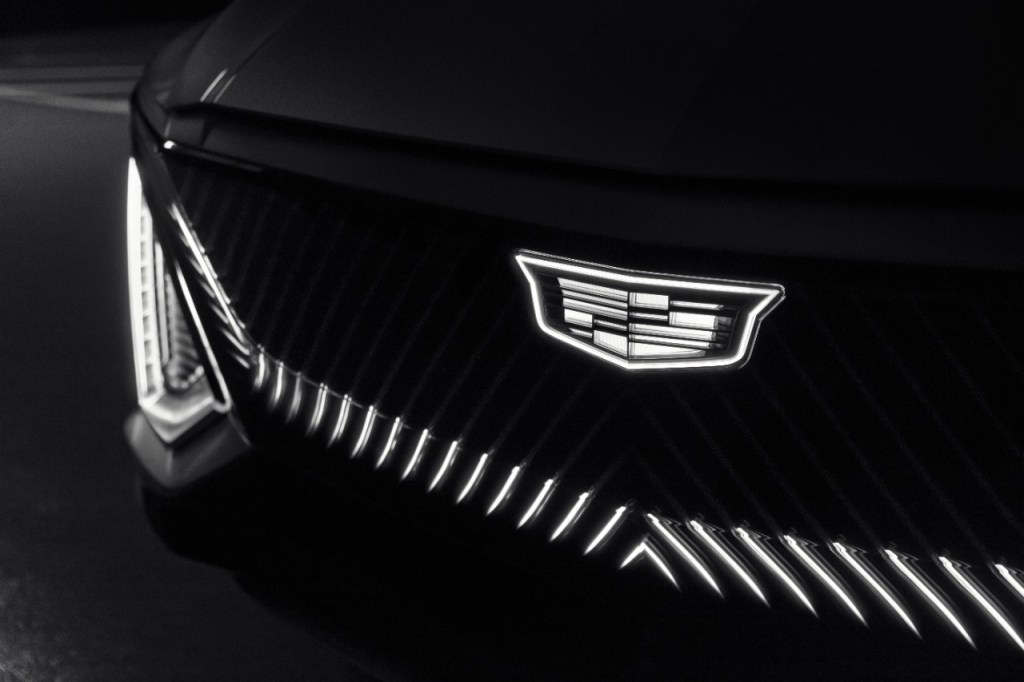
A fresh face of Cadillac. (Images: Cadillac)
General Motors tried all sorts of extracurricular schemes to earn spots in car magazine comparison tests alongside the best from Mercedes, BMW, Lexus and Audi, including the Sixteen concept of 2003, powered by two Chevy small blocks welded together: several failed European export attempts; moving HQ to Manhattan, and (unrelated, as it was then-CFO Dan Amman who didn’t want to relocate to Detroit) hiring the exec credited with making Audi what it is in North America, Johan deNysschen, after he spent a month running Nissan’s Infiniti luxury brand.
DeNysschen had grand plans for Cadillac, which GM had just split off into a separate business entity, so it wouldn’t have to share more than the unseen bits (e.g., truck platforms, wiring harnesses and other things consumers aren’t particularly aware of) with Chevys, Buicks and GMC models. In what I believe was his first interview as president of Cadillac, in early fall 2014 for Automobile magazine, he told me the marque would eventually get a Mercedes S-Class competitor and a high-end sports car or two.
DeNysschen lasted in the job about three-and-a-half years. Some auto news reports overplayed his responsibility for initiatives including an edgy ad campaign (along with incorrectly blaming him for the Manhattan HQ) that failed to move the metal and a subscription service called “Book by Cadillac” (all lux-car sub services except for maybe Volvo have since fallen), but the real reason he left, not in a huff, but in a minute-and-a-huff, is that he clashed with top GM management, most of them lifers, over vehicle pricing.
To become Standard of the World again, you can’t put money on the hood as though the brand sells through one big network of Fast Eddy car lots, where its all about the deal, but that’s what they did. DeNysschen wanted to rebuild slowly by selling a product that could stand hood-ornament-by-hood-ornament with Mercs and Bimmers, but he fully recognized that it would take a good decade or more for new, younger luxury buyers to believe that the Caddy had the same level of cache´.
DeNysschen has been gone now as long as a full product lifecycle. He landed at Volkswagen USA (an even tougher job, but that’s another column), and Cadillac is still at it, offering the Mercedes E-Class-size CT5 for the price of a C-Class, and the BMW 3 Series-size CT4 for the price of a BMW 2 Series Gran Coupe.
But GM has figured a way back to the Standard, perhaps out of necessity: Electric vehicles (EVs).
Despite what you may have read in the mainstream press, GM hasn’t suddenly discovered EVs. There were more than two decades between the 1966 Chevy Electrovair experiment and the Saturn-esque EV1—admittedly, the Electrovair was pretty much for internal work and to show to the world that it could be done while the EV1 was also something of an external test program, as there were Californians who had the opportunity to lease the vehicle for their daily drives. What’s more, GM developed the extended-range Volt and the fully electric Bolt, both of them Chevrolets for the mass market, and it is now concentrating R&D efforts on what it calls the “Ultium” platform—batteries, motors and underlying platform.
In 2013 the Cadillac ELR went into production. It used the same Voltec extended-range EV technology that powered the Volt. In part, this was a response to analysts who pointed out the company should have used what is now known as plug-in hybrid tech in a $60,000 luxury car rather than a $40,000 commodity hatchback sedan. The Volt had gone into production three years earlier. By the time the ELR launched on the first-generation Voltec technology, it had inferior technology next to the Chevy Volt with its updated extended-range system. The ELR was a disaster.
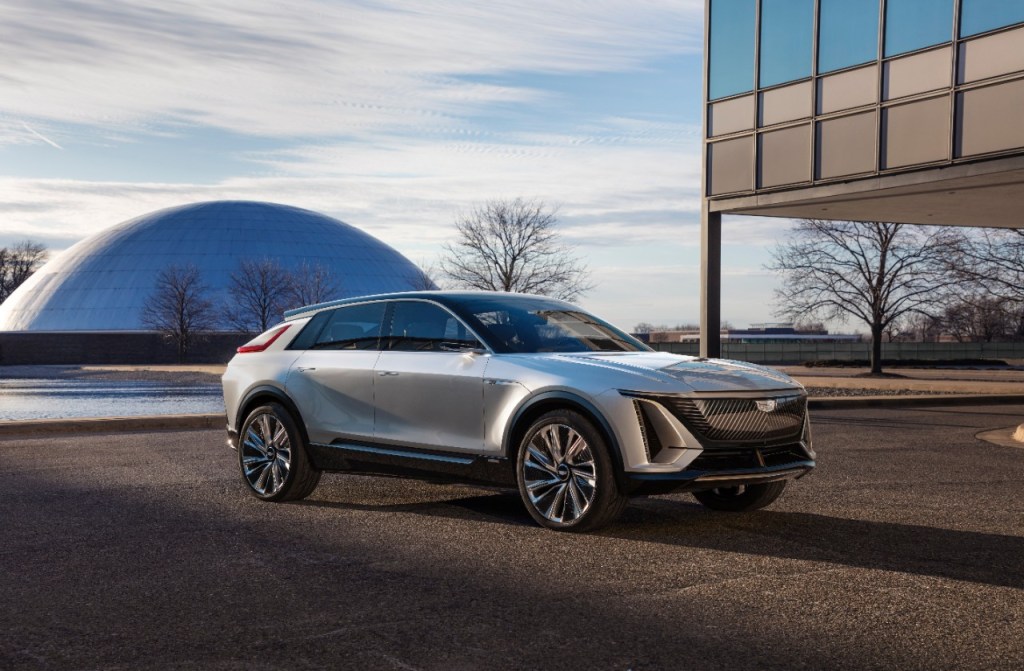
Cadillac LYRIQ with the GM Design Dome in the background.
GM – or should I say, “gm,” given its new lower-case logo – is planning its big EV rollout of the next five or so years with new models to cover every U.S. brand. This time, however, it starts with higher profit-margin prestige models, like the GMC Hummer and the Cadillac Lyriq SUV.
What’s more, GM has announced that Cadillac will become the company’s lead brand for electric vehicles, with plans calling for it to sell essentially only EVs by 2030. (Going back to deNysschen’s plan for dealers selling on quality not price, it is interesting to note that late last year GM offered to buy out Cadillac dealers who weren’t interested in going down the electric road, and some 150 of them—about one in six—took the offer.)
If the production Cadillac EVs, especially the >$100,000 Celestiq luxury sedan, are close to the prototypes GM showed off last March in the legendary GM Design Dome, they could rule the segment ahead of German, Japanese, British and South Korean luxury brands. Price them against the only real competition to date: the Tesla lineup. And if the Ultium EV platform delivers on its promise to reduce the cost of the technology but with highly competitive range and performance, Cadillac could become the Standard of the Electrified World and, importantly, make money while doing so.
GM could mess this up, of course, as it has so many times in the past. But I didn’t get the sense from the presentations last March that CEO Mary Barra, President Mark Reuss, and others in the company that they were at all nervous about continuing the automaker’s usual fatal flaws, like too-cheap interiors, disappointing execution, or a management reorganization that places emphasis back on V-8 pickup trucks and SUVs, reducing EV production plans below Corvette output and cancelling promising models after two years, pretending that this has been the plan all along.
Let’s face it: Even if they come up with superb products it is going to take Cadillac some time to convince those who are likely to buy premium-priced EVs that they want a Cadillac crest on their purchase. However, there is one possibility that would play to Cadillac’s advantage in the EV space: There will be a cohort of younger buyers who are looking for EVs and who have little or no impressions of the brand, so they’d be just as willing to go Cadillac as any other marque.
Still, it seems as though electrification could be Cadillac’s best shot.—Todd Lassa
Yes, once there were knobs. Knobs, buttons and things you would manually manipulate.
This is the “screen” of the SEAT 1400, a sedan introduced in 1953:
(Images: SEAT)
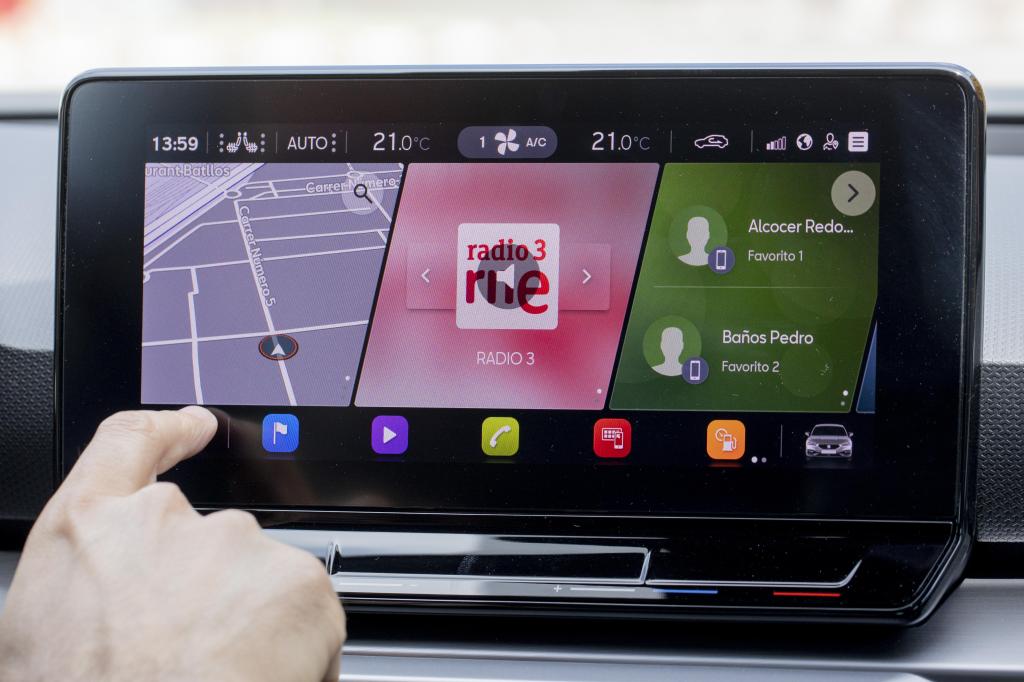
If nothing else, it is a reminder that somehow people were once able to get by without a 10-inch screen and 2,000 icons, which is the case in the current-generation SEAT Leon, the Spanish company’s best-selling vehicle:
No knobs.
There is something to be said for the simple charm of the 1953 approach.–gsv
This is visually impressive and the EV numbers are solid. Dare we think “game-changer”?
Although Hyundai currently offers a model named “IONIQ”—a hybrid, a plug-in hybrid and an electric vehicle (EV)—it is creating a new brand for its EVs that is named “IONIQ.”
Which is slightly confusing.
But it has happened before, when the company launched the Genesis Coupe (a replacement for the Tiburon) and then decided that it would use “Genesis” as the name for its luxury brand. There are undoubtedly some boy racers around with their tuned Genesis Coupes, which probably annoys the hell out of those who are piloting their G90s.
Hyundai has introduced what is the first IONIQ vehicle, the IONIQ 5, an EV.
It is a midsized crossover.
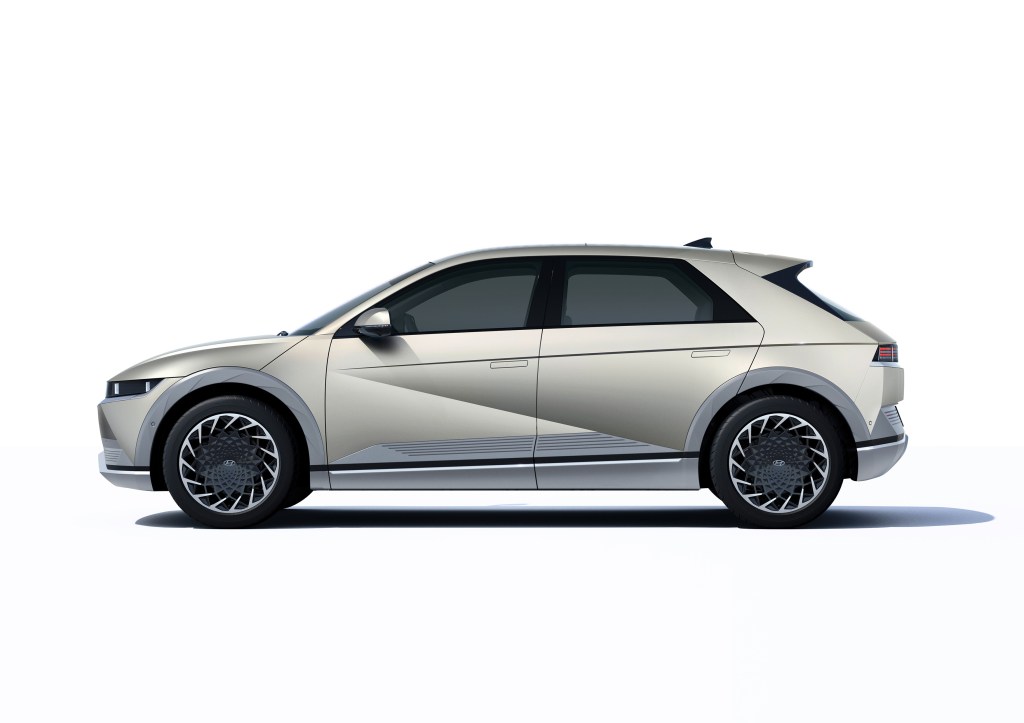
The IONIQ 5 is based on the Electric-Global Modular Platform, which will be the basis of many electric vehicles to come from the Hyundai Group. (Image: Hyundai)
The factors that seem to be the most germane to people regarding EVs is (1) their range and (2) how long it takes to get a charge into them.
As for the former, Hyundai has released figures: a two-wheel drive IONIQ 5 with a 72.6-kWh battery will have a range of from 470 to 480 km on the Worldwide Harmonized Light Vehicle Test Procedure, which is not the same approach in testing that provide EPA numbers. For those who are not thinking in metric, the 470 to 480 are 292 and 298, respectively.
As for the charging, with a 350-kW charger the battery goes from 10% to 80% in 18 minutes. And if there are only five minutes available and the same type of charger, it can get 100 km, or 62 miles, of range.
It should be noted that the standard battery is 58-kWh.
The design, with its creases and angles, certainly indicates that the IONIQ 5 is a 21st century vehicle without having a cartoonish appearance.
According to the company, the way the front and rear portions of the crossover meet at the doors (doors, by the way, which have a remarkable diagonal crease) is an example of the company’s “Parametric Design” approach. What’s slightly confusing is that Hyundai notes that this design language was first used for the new Hyundai Tucson.
At some point they’re going to have to figure out the separation of the brands.
That said, the IONIQ 5, which is to launch later this year, certainly has the looks and the specs that is going to make it an exceedingly strong contender in the EV space.
If Tesla is Apple, then think of Hyundai—or IONIQ—as Samsung.–gsv
This van is compact, capable and electric. And it has a hell of a price-point
This is nothing if not clever.
Even were it not for COVID-19, the success of e-commerce was driving all manner of commercial delivery vehicles into neighborhoods across the U.S. The pandemic has only accelerated that growth, and suddenly even businesses that never imagined that they’d be in the delivery business (e.g., restaurants that aren’t based on pizza) suddenly are if they want to stay in business.
One of the characteristics of electric vehicles is that because they have fewer parts than a vehicle with a combustion engine, there are fewer things that could break. In addition to which, there are fluids, like oil, that need to be changed.
Companies that have fleets of vehicles (even if that fleet consists of, well, one), know that maintenance is both costly and time consuming.
So that’s on the good side of the ledger for an electric delivery vehicle.
So James Taylor, who is the founder and CEO of Electric Last Mile Solutions (and a man who has run operations with names that you might be more familiar with, like Cadillac and Hummer), says that a right-sized delivery vehicle that happens to be electric can be a cost-effective game-changer for many companies.
The vehicle that will be offered by Electric Last Mile Solutions (ELMS) is a Class 1 delivery van. It is based on a model that is on the road in China, the Sokon EC35. It has a cargo capacity of 170 cubic feet and a maximum payload of 2,403 pounds. It is compact, with a 120-inch wheelbase and a length, width and height of 177, 66 and 78 inches, respectively.
The ELMS Class 1 delivery vehicle. (Image: ELMS)
It has a 100 kW electric motor from JJE and a 42-kWh battery from CATL.
It has a range of 150 miles.
Back to that cost of equipment issue.
According to Taylor, the vehicle is going to be priced at about $32,500. When you take the $7,500 federal tax credit off of that, it is at $25,000, a price, he says, that someone can get a combustion-powered Class 1 van for. So because of the reduction in required maintenance and other factors, Taylor says the total cost of ownership is about 35% better than the traditional approach.
The vehicles will be produced in Mishawaka, Indiana, in the 675,000-square-foot factory that used to be the Hummer plant. It has the capacity to build over 100,000 vehicle per year, which is probably a good thing for Taylor because he says that they have more than 30,000 reservations for the vehicle.
The bodies-in-white will be delivered to the plant so there is no stamping, welding or painting involved. It will be all about assembly.
Because there is a vast array of requirements in the commercial space, Taylor says upfitters will actually work within the Mishawaka plant so customers will get their van from the factory.
It is very clever.
Taylor talks about what ELMS is doing on this edition of “Autoline After Hours” with “Autoline’s” John McElroy, Christie Schweinsberg of Wards Intelligence and me.
In addition, McElroy, Schweinsberg and I discuss a variety of other subjects including the need for better and more extensive EV charging infrastructure, the introduction of the Chevrolet Bolt EUV, Jaguar Land Rover’s plans to go electric, Ford of Europe’s electrification plans, and a whole lot more.
Driving a car with some years on it can be very expensive. This subscription service provides a vehicle for the month for the price of a single fine
Barcelona is one of the wonderfully walkable cities in the world, which benefits, in part, from the implementation of a 95-square kilometer low-emission zone, which has some serious teeth: pre-2000 gasoline-powered vehicles entering the zone and diesels that were built before 2006 are charged from €100-150. The zone operates Monday through Friday, from 7 am to 8 pm.
Of course, there’s an app for MÓ (Image: SEAT)
Barcelona is also the HQ of VW’s SEAT. Which undoubtedly makes it challenging to be, well, a car company.
So SEAT created MÓ, a mobility business. It has launched a flexible subscription model for its eScooter 125. For € 70 a week or €150 a month, SEAT MÓ is offering not only the scooter, but roadside assistance and 24-hour customer service.
Not entirely surprising: the subscription project is based in the center of Barcelona, which is where the e125s are picked up and deposited.
BMW owns Designworks, which has a studio in Newbury Park, California. Newbury Park is not on the Pacific. But not far from it, either.
Designworks designs a variety of things, including, well, BMWs. But it has also collaborated with airlines, the North Face, and other companies for which they’re not designing cars.
The latest company: Sea Ray.
The boat producer.
Designworks collaborated with Sea on the Sundancer 370 Outboard. The Sundancer series is celebrating its 45th anniversary.
Sea Ray 370 Outboard (Image: BMW)
Charlie Foss, Sea Ray Design Director, said, “Working together with Designworks, we were able to produce a fresh set of design principles that pay homage to our brand’s past which indicating the future, resulting in a look that is undeniably Sea Ray. An output of the collaboration was the definition of four key design characteristics to inform Sea Ray models moving forward: sleek, confident, athletic and distinctive.”
Beyond BMW’s ownership of Designworks, there is another connection between Sea Ray and automotive.
Foss: “Automotive-inspired design is part of the Sea Ray history, dating back to collaboration with Harley Earl Associates in the early 1960s.”
About Earl
Earl was the first head of the General Motors Art and Color Section, established by Alfred P. Sloan in 1928. Earl headed GM design until 1958. He turned 65. He had to retire. (He was succeeded by Bill Mitchell.) And then he established his own firm. Earl died in 1969, age 75, in West Palm Beach, Florida. Which is on the Atlantic.






 shinymetalboxes