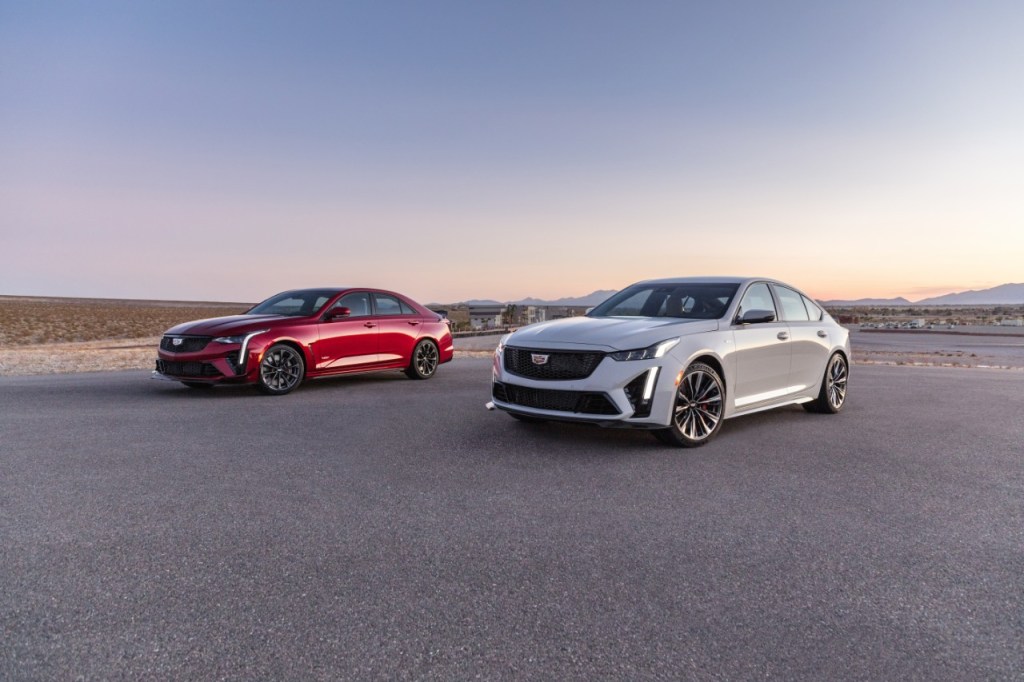
If when you think “Cadillac” you think of something big and lush and lumbering like the Escalade (no offense to the SUV, but it is 211 inches long and weighs up to 6,015 pounds, a.k.a., three tons), then the 2022 V-Series Blackwing vehicles are going to absolutely upend that notion: The CT5-V Blackwing is powered by a hand-built (think about that for a moment) 668-hp. 6.2-liter supercharged V8 mated to a six-speed manual TREMEC transmission; the sedan has a top speed of over 200 mph.
Then there’s the CT4-V Blackwing, which is smaller, a subcompact, and is certainly no slouch, as it is fitted with a 3.6-liter twin-turbo V6 such that it has an estimated top speed of 189 mph. Equipped with the optional 10-speed automatic (which is also available for the other car), it has an estimated 0 to 60 mph in 3.8 seconds.
2022 CT4-V Blackwing (left) and CT5-V Blackwing (right): engineered to perform. (Image: Cadillac)
Of course, when you go fast you also need to, well, stop, so there are serious Brembos deployed, with the CT5-V Blackwing featuring the largest factory-installed brakes in Cadillac history: 15.67 x 1.42-inch front rotors and 14.7 x 1.1-inch rear rotors. (There is also a lightweight carbon-ceramic brake package available, which is helpful in track situations, in particular, as it reduces unsprung mass by 53 pounds and rotating mass by 62 pounds.)
At this point you might be wondering why these vehicles are being named with their full names. That’s because you can go to a Cadillac dealership and buy a CT4 or a CT5. Or you can buy a CT4-V or a CT5-V.
The Blackwing execution is a whole different thing.
And so to that end, on this edition of “Autoline After Hours” Tony Roma, chief engineer of Cadillac V-Series Blackwing, provides a deep dive into the features that they’ve brought to the vehicles in order to make them track-capable vehicles straight out of the dealer’s showroom.
Roma talks with “Autoline’s” John McElroy, Chris Paukert of Roadshow by CNET and me.
Roma says that their objective was to make a vehicle that is “light, nimble and precise.”
Which is arguably what some people might not think about when it comes to Cadillacs.
Then McElroy, Paukert and I discuss a variety of other subjects, including Cadillac’s electric future (Roma is also the chief engineer for the forthcoming, ultra-luxury Celestiq electric vehicle), the agreement between Google and Ford and the whole issue of data monetization, January sales and a whole lot more.
No, this is not predicated on some prognostication wrapped in a Tweet by Elon Musk, nor by the potential that Syd Mead fans may actually get their Cybertruck before the end of 2021.
No, this is not predicated on Joe Biden’s plan recommendation to transform the government’ fleet of ~650,000 vehicles from gasoline and diesel to electric as part of the “Buy American” initiative.
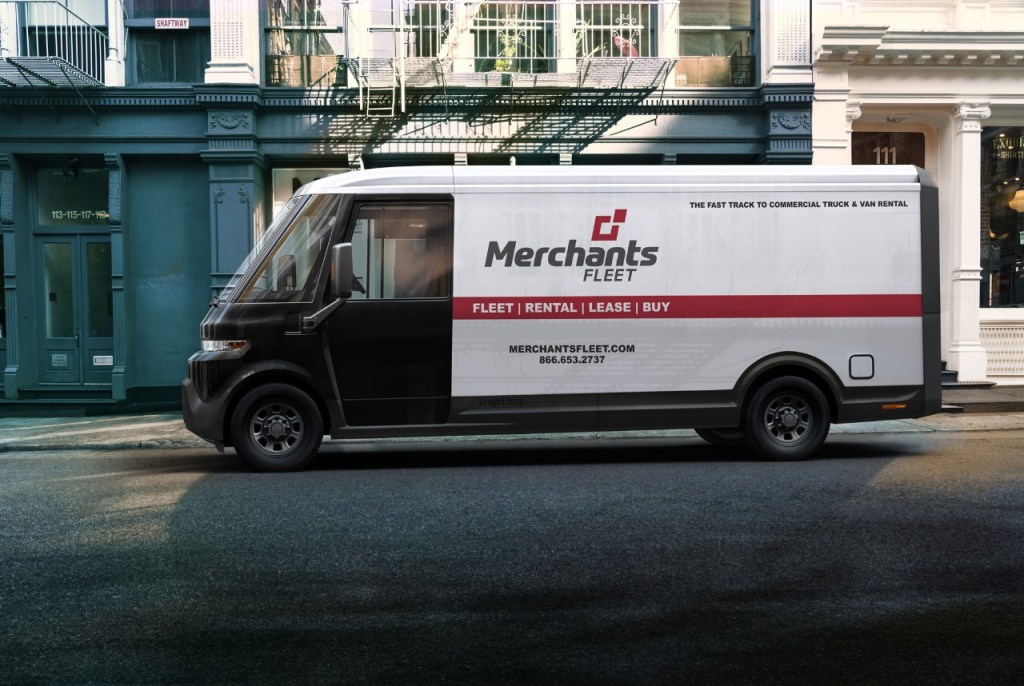
Merchants Fleet has ordered 12,600 BrightDrop EV600s, an all-new, electric light commercial vehicle purpose-built for the delivery of goods and services over long ranges. (Image: GM)
No, this is not even predicated on GM CEO Mary Barra’s statement last week that the vehicle manufacturer intends to become completely (i.e., product and process) carbon-neutral by 2040, including an “aspiration” to eliminate tailpipe emissions by 2035.
No, this is because of three other data points that all came out on the same day this week, all of which indicate that electric vehicles are taking on some significant substance.
1
BrightDrop Gets Second Order
BrightDrop, the company that GM recently established for business deliveries that is predicated on EVs and logistics software, has obtained an order for 12,600 BrightDrop EV600s, from Merchants Fleet, a company that describes itself as “the nation’s fastest growing fleet management company.” Deliveries of the EV600, a light commercial vehicle with some 600 cubic feet of cargo capacity and a range of up to 250 miles, are to start in 2023. The first customer for the trucks is FedEx. The importance of cargo vehicles for EVs can’t be overstated. Not only has Amazon invested a few hundred million in Rivian, but it has ordered 100,000 electric trucks, with deliveries starting later this year.
2
Edmunds Declares “Pivotal Year”
“After years of speculation and empty promises, 2021 is actually shaping up to be a pivotal year for growth in the EV sector. We’re not only about to see a massive leap in the number of EVs available in the market; we’re also going to see a more diverse lineup of electric vehicles that better reflect current consumer preferences.” That’s Jessica Caldwell, Edmunds’ executive director of insights. While the projected growth of EV retail sales is still small—according to Edmunds, they were 1.9% in 2020 and are expected to reach just 2.5% of the market in 2021—the firm anticipates that the greater number of available products in 2021, 30 vehicles including 13 SUVs and six trucks, should start making a big difference.
3
EY Sees “Massive Evolution” in Transport
“Electrifying transport is critical for Europe to meet its tough emissions targets and create a decarbonized future. Transitioning fleet first will pave the way and generate new commercial opportunities, including vehicle-to-grid and electric vehicle charging solutions among others. In order to achieve this, a fleet-centric approach is needed across both government and industry, which aims to remove barriers in areas including common standards and investment,” says Serge Colle, EY Global Power & Utilities Leader. While he is specifically talking about Europe, where the CO2 emissions standards are demanding and becoming more so, the focus on fleets (think things like EV600) is key because as EY research indicates: “the lessons learned from accelerating fleet electrification such as the development of sustainable business models that support charging infrastructure investment and integration of smart charging capability, will enable the wider secondary and passenger vehicle market to transition quicker.” First the fleet. Then the driveway.–gsv
One of the consequences of the pandemic is the increase in the number of commercial vehicles on the roads—as in, for example, all of those FedEx, UPS and Amazon Prime trucks crowding in suburban neighborhoods like a street in New York City pre-pandemic.
Who knew there was such a demand for home deliveries?
So to meet the demands for medium-duty commercial trucks (as well as buses and heavy-duty pickups), ZF has announced that it is investing $200-million in its plant in Gray Court, South Carolina, to produce its ZF PowerLine 8-speed automatic transmission.
This is a new transmission, as it went into production at the ZF HQ production facility in Friedrichshafen, Germany, at the end of 2020; the factory in South Carolina is scheduled to start exclusively supplying the North American market in 2023.
ZF PowerLine 8-speed transmission for truck applications. (Image: ZF)
A couple points about the transmission:
Although it is an 8-speed, Christian Feldhaus, Director Commercial Vehicle Driveline Technology North America, ZF, says, “ZF PowerLine proves equal, but in most cases, higher performance and efficiency than other transmissions with 9 and 10 speeds.” Or more gears are not necessarily better.
In addition to which, although there is increased attention to electric commercial vehicles—such as those Amazon will be getting from Rivian and General Motors’ new BrightDrop—one might wonder about a transmission ostensibly for ICE applications. Feldhaus: “With its modular design, PowerLine is prepared for mild hybrid and plug-in hybrid variants, making it a true technology bridge to future mobility.”
Arguably, post-pandemic there may be a falling off of home-delivery demands. But odds are people who have found it to be a convenient way to get things may stay with it.
So there’s going to be a need for a lot of transmissions.–gsv
In his previous essay looking at the inexorable increase in the cost of vehicles that is putting new ones out of the reach of many, Todd Lassa rhetorically asks, “So what’s the average Joe to do?” So he continues. . .
The answer is bicycles. Before the pandemic, bicycle sales were strong as urban planners re-designed cities to be less auto-centric, and the bike industry innovated with disc brakes and tubeless tires trickling down to $1,000 commuter models, as high-end road bikes adapted electronic shifting. Electric-assisted (e-bikes) and bike-friendly clothing lines formal enough to be worn at office make the commute easier, even in northern cities.
The U.S. market exploded after last March, and severe shortages, especially of those commuter-style bikes were compounded by factories closed to avoid pandemic spread and tariffs against Asian manufacturers by the Trump administration. More than 90 percent of bicycles sold worldwide come from Taiwan and China, with the Giant Manufacturing Company building frames for most the world’s mainstream brands.
Cars and light trucks aren’t going to disappear en masse as urban planners design more, wider bike lanes onto the streets, but more balance between the two types of conveyances is not a bad thing, even for auto enthusiasts.
Pinarello Dogma F1. (Image: Pinarello)
Annual U.S. bike sales numbers are not as reliable as auto sales by registration. The industry is split between cheap commodity bikes sold at big box stores like Walmart, and more “serious” higher quality bikes sold at bicycle shops. The U.S. Commerce Department does count bike and bike frame import numbers (serious enthusiasts can build their own bikes at home by ordering a high-quality aluminum or carbon-fiber frame and adding components from Shimano, SRAM and other suppliers), says Stephen Frothingham, Bicycle Retailer and Industry News’ editor-in-chief. By last October, Frothingham told me, 13.6 million bikes and bike frames were imported into the U.S. for the year, up 19% over the same period in 2019. He estimates the full-year number of bike imports will come to “well over 14.5-million sold in 2020.” Does that number sound familiar?
If you haven’t purchased a new bike in a few years, you might be a bit surprised to walk into a reputable bike shop and find most models priced between roughly $1,000 and $5,000. A new Pinarello Dogma F12, probably the Ferrari SF90 of bikes, will set you back $6,500, frame only, or $12,000 fully built. But consider that the cheapest model you can buy in the U.S. from Ford, the company that put America on wheels, is the wonderfully mediocre EcoSport subcompact crossover, at $21,240. –Todd Lassa
Tom Liu said it had to be “instantly recognizable.” He also said that he was influenced in the exterior design of the vehicle, which he helped create, by the F-22 Raptor, which, ironically enough, is a stealth fighter, which is, by its design, not to be seen (OK, at least not by sensors).
There was also a convenience to this: Liu was talking about the design of the 2021 Ford F-150 Raptor, the third generation of the vehicle that is built to be able to perform off road and fast—desert racing, in particular, as Carl Widmann, Ford Performance chief engineer, said, “Raptor is rooted in Baja 1000 racing,” and added, “And like a trophy truck, every aspect of Raptor has been engineered to deliver precision capability when your foot is flat on the floor, way out in the middle of nowhere roaring across the desert.”
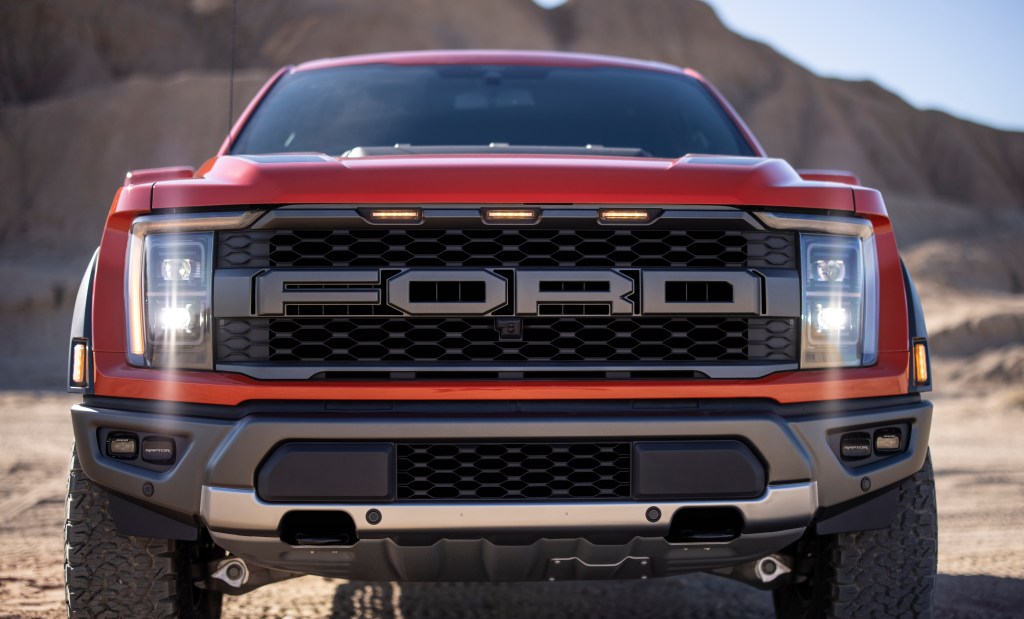
What “menacing” looks like. (Images: Ford)
To the point of Liu and the Raptor the fighter jet and Raptor the truck that is literally engineered to catch air during some of its off-road exploits, he said that like the aircraft, the truck is “Fast, nimble and technologically advanced. It is American power and performance. It is packed with technology—and it looks menacing.”
So there are things like a heat extractor on the power dome hood and functional side vents at the top trailing edges of the front fenders that are to provide a visual nod to the air intakes on the F-22. There are shear surfaces that are stealth-like. And adding to the menace are aspects including the blacked-out grille, blacked-out taillights, massive steel front and rear bumpers, and a massive front skid plate.
It looks fit for purpose and its purpose probably isn’t making a run to the store for a gallon of milk. (Not that you couldn’t, of course.)
///
The F-150 Raptor is based on the F-150 that contractors and others who are not likely to do much in the way of rock crawling in. It is built on the same assembly line at the Dearborn Truck Plant in Dearborn, Michigan (or about 2,400 miles from Ensenada, where the Baja 1000 starts: there isn’t a whole lot of desert around Dearborn).
But it is an F-150 that has been built to take a whole different set of parameters in terms of what it is likely to encounter: for example, while they start with the heavy payload, fully boxed steel frame from the “regular” truck, Jack Cooper, architecture engineer for Ford Performance, said that they’ve modified and reinforced it.
A notable difference truck-wise is the chassis. There is a newly developed five-link rear suspension that features extra-long trailing arms, a Panhard rod, and 24-inch coil springs. “We couldn’t find it in the parts bin,” program manager Tony Greco says of why they had to devise a new rear suspension. The front suspension has been redesigned, as well. One of the key aspects of the suspension for a vehicle like a Raptor is wheel travel. The suspension for this third-generation vehicle is 14 inches in the front and 15 inches in the rear.
The shocks are FOX Live Valves. These internal bypass shocks feature electronic control technology that permits damping rate adjustments at a rate of 500 times per second; the shocks, which have 3.1-inch diameter anodized aluminum bodies, feature base valves that provide 1,000 pounds of damping per corner at racing speeds.
While the standard Raptor runs on 35-inch tires, it can be equipped with a package that brings it up to 37 inches, or what Ford says are the largest factory-fitted tires on a light-duty full size pickup.
///
Among the tech aspects of the new Raptor are:
Terrain Management System: dial in adjustments that change the steering feel, transfer case behavior, stability control, active valve exhaust, active damping, throttle mapping, shift points, and digital display. There are seven modes: Slippery, Tow/Haul, Sport, Normal, Off-Road, Baja and Rock Crawl.
Trail 1-Pedal Drive: In situations that call for two-pedal driving like crawling rocks or negotiating trying trails, this function allows throttle and brake modulation through the brake pedal. The driver gets acceleration by pushing down on the throttle and braking by lifting.
360-degree camera package: This option, in addition to providing an all-around view, provides a real-time tire track overlay for the front view, which means that the path ahead of the wheels can be seen such that a spotter may not be necessary.
///
The Raptor has a 3.5-liter EcoBoost V6 engine with twin turbos. While the horsepower and torque numbers aren’t released as of this writing, Ford describes it as a “high-output engine delivering torque low in the rev range where it counts,” so presumably it has the stuff to deal with the sand as well as that to skim over it. And on the subject of driving hard, it has high-power fans built into the cooling system. The compression ratio is 10.5:1.
What to do with a Raptor.
The engine is mated to a 10-speed automatic which, in turn, is attached to a torque-on-demand transfer case.
There are standard electronic locking rear diff and an available Torson front limited-slip differential. They are fitted with 4:10 final drive ratios.
There is something that seems a bit odd about the powertrain system. There is a 36-gallon gas tank. It is recommended that it be filled with premium unleaded.
Here’s something to consider about the relationship announced yesterday between Ford and Google. The companies indicated their collaboration “This may include projects ranging from developing new retail experiences when buying a vehicle, creating new ownership offers based on data, and more.”
The word that doesn’t appear in the announcement is monetization.
As in “data monetization.” As in getting a return from the data that is associated with the owner, driver, passenger of a vehicle.
You know: the sort of thing that drives the valuation of companies like, well, Google.
A question is “who owns the data”? While you might think that you do, again, look at the valuation of Alphabet (or Facebook): where do you think the value comes from?
Let’s say for example that the value for the data from a given vehicle is $5.
Let’s further say that the two companies split it. (That’s what “partners” do.)
In 2020, a not particularly good year so far as vehicle sales goes, Ford sold 2,044,744 units in the U.S.
So if the value per vehicle is $5, and each gets half, then $2.50 x 2,044,744 = $5,111,860 each. If it is $10 per vehicle (remember, they’re also talking about using this during the “retail” portion of the transaction, so sliding in a few bucks is not necessarily going to be all that noticeable), then that would be $10,223,720 each.
Until December 13, 2016, what is now known as “Waymo,” the company that is developing “fully autonomous” vehicle technology, was known as the “Google Self-Driving Car Project.” In the four years since, Waymo has gone far beyond something that would be described as a “project.” What’s more, it has raised a few billion dollars in outside investment so it is no longer a Google—or more appropriately, an Alphabet—solo undertaking.
Alphabet is a huge company. A company with a market cap on the order of $1.29-trillion. It doesn’t break out the Waymo numbers, but it is now estimated that the company is worth some $30-billion.
Ford has a market cap of $42.6 billion.
Which puts it ahead of Waymo but way behind Alphabet.
And what’s interesting to note is that while Ford has had the number-one selling pickup truck for 44 years running—and sold 787,422 last year alone—Waymo has sold 0 anything.
However, Ford and Google announced that they’ve entered into “a unique strategic partnership.” I wonder how much this is like when an OEM comes out with a new vehicle and calls it the “First-ever [fill-in-the-name].” Of course it is the first-ever. There hasn’t been one.
(Image: Ford)
So Ford doing something extensive with Google is “unique” because they haven’t done it before.
Ford is buying space on the Google Cloud. This brings with it all sorts of opportunities in terms of data analytics and AI and, well, all that those giant clouds bring. Here’s one: it will help Ford “Fast track the implementation of data-driven business models.” Of course.
There will be a “new collaborative group” named “Team Upshift” that “will push the boundaries of Ford’s transformation, unlock personalized consumer experiences, and drive disruptive, data-driven opportunities.”
Ford will start using the Android operating system as the OS for its vehicles starting in 2023.
Ford president and CEO Jim Farley: “As Ford continues the most profound transformation in our history with electrification, connectivity and self-driving, Google and Ford coming together establishes an innovation powerhouse truly able to deliver a superior experience for our customers and modernize our business.”
Sundar Pichai, CEO of Google and Alphabet: “From the first moving assembly line to the latest driver-assist technology, Ford has set the pace of innovation for the automotive industry for nearly 120 years. We’re proud to partner to apply the best of Google’s AI, data analytics, compute and cloud platforms to help transform Ford’s business and build automotive technologies that keep people safe and connected on the road.”
To be sure, this is a big deal for Ford, especially as General Motors announced a similar(ish) deal with Microsoft a couple weeks ago. Perhaps the third shoe will fall and someone will announce a partnership with Amazon.
As for Google, well, they like customers partners. After all, how else to get to a valuation of over $1-trillion?–gsv
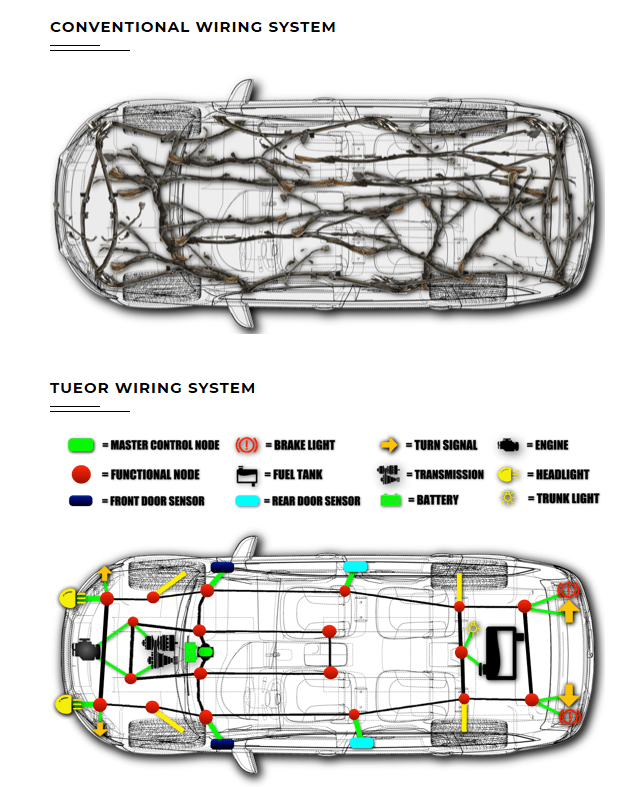
Although one of the claimed benefits of the Digital Current System (DCS) developed by Tueor Technologies is that it is “hack-proof,” what is possibly more compelling is that according to Dan Greene, chief operations officer for the company, is that it eliminates from 80 to 90% of the wiring needed for a vehicle’s electrical control system.
Just one loop of coaxial cable. It carries power. It carries data. It combines grounding and feedback.
There is a master control node running the system. There are sensor nodes, switching nodes and slave nodes. Each of the nodes has a varying level of intelligence, from obtaining information to essentially doing a single task, such as locking and unlocking a door.
Should the cable break, the DCS keeps working, Greene says.
The unhackability is predicated on the fact that it is a closed system and should there be an update necessary—over-the-air or otherwise—it cannot be loaded into a vehicle system unless there is explicit permission given by the owner. And to prevent something non-desirable from piggybacking onto a valid update, Greene says a check-sum system can be setup so if something is supposed to be X and it is seen to be X + 1, then it will not be permitted to load into the system.
According to Greene, Tueor began its work on the system to address the ability to hack medical devices like pacemakers and insulin pumps. Then they moved on to satellites. Then to military vehicles, working with AM General on the Stryker armored vehicle.
Auto application?
Not yet.
Seems that OEMs and suppliers are not engaging with the Tueor team.
Greene and his colleague John Dinkel talk about the DCS on “Autoline After Hours” to “Autoline’s” John McElroy; Henry Payne, auto critic for the Detroit News; and me.
Then John, Henry and I discuss a number of subjects, with a particular focus on electric vehicles, as Henry is an enthusiastic owner of a Tesla Model 3 and as on the day of the show GM’s Mary Barra announced that the corporation plans to be carbon-neutral in both its operations and products by 2040. Part of that undertaking includes “an aspiration to eliminate tailpipe emissions from new light-duty vehicles by 2035,” which means an increase in the number of vehicles it puts on the road that don’t have internal combustion engines but possibly frunks under the hoods.
We talk about innovation and corporate cultures. And a whole lot more.
Auto sales plummeted by one-third in the second quarter of last year, according to S&P Global Market Intelligence, and at the time it felt the like tip of disaster for the car business. The global pandemic stifled demand as the supply side was strangled by shuttered factories and parts and components that couldn’t be shipped to automakers.
General Motors had to shut its Chevrolet Corvette assembly plant for several weeks, but this turned out to be more a supply problem for the automaker than a demand problem, as consumers on the $60,000-plus end of the sports car market generally weren’t the people losing jobs and income.
This gets to a drum I’ve been beating for years. The idea of building brand-new cars and light trucks for working class and middle-class Americans, the very model incubated by the Curved-Dash Oldsmobile and brought to life by the automated assembly lines of Henry Ford’s Model T, the car that put America on wheels, is over.
Latest proof is the comeback of new vehicle sales from those dark days at the end of the first quarter in 2020 and through the second quarter, into much healthier third and fourth quarters. Calendar year 2020 vehicle sales in the U.S. dropped 14.4% from 2019, to 14,645,049 cars and light trucks says Automotive News, but that’s far better than anyone expected from that second quarter drop.
Even with a pandemic that most economists say created our most severe economic crisis since the Great Depression 90 years ago, the 14.6-million sales number is far more palatable to the industry than the 2008-2009 Great Recession, when sales dipped below 11 million at its nadir. With the current pandemic, the auto industry mirrors the economy in general, in which college-educated professionals, management and executive-level employees and their employers spend their workdays in home offices, seeing their colleagues and clients on Zoom rather than in person.
Presently, of Americans who can work at home, unemployment is 3.9%, but for those who have to report to a work site, the rate is 8.9%, KMPG chief economist Constance Hunter told The Washington Post. (Jan. 28, 2021).
About the same time that auto sales fell by one-third, the April 2020 U.S. unemployment rate reached 14.8%. By December 2020, auto sales climbed to near-pre-pandemic levels, but the U.S. unemployment rate was still high at 6.7%, compared with just 3.5% for January and February 2020, according to tradingeconomics.com. The rate for Black and Hispanic Americans is significantly higher, and the Congressional Research Service singles out heavy job loss in the leisure, hospitality industry and restaurants. Your favorite waiter or waitress at the local Olive Garden isn’t shopping for a new Kia, let alone a new Cadillac these days.
Meanwhile, tech barons and big-time investors in tech stocks like Amazon, Facebook and Apple are buying new cars, if the strength of the luxury market is any guide.
In its sales report issued the first week in January, General Motors boasts the all-new 2021 Cadillac Escalade that launched in the middle of the ’20 calendar year—when shutdowns and job losses were growing–“retook market leadership” in the fourth quarter, meaning it began to outsell the Lincoln Navigator again. And here’s the kicker: GM noted that 43% of the new Escalades have “a transaction price of more than $100,000.”
Clearly it was more supply problem and less demand accounting for the 14.4% dip for the year which included phase-out sales of the last of the old model as well as the new, ’21 ‘Slade. Before the pandemic, the average new car transaction price hovered around $38,000, already up significantly from the low-$30s earlier in the ‘10s. The current average is now $40,573, according to Edmunds. Meanwhile, the U.S. Census Bureau estimates the median household income was $68703 (latest figures). Yikes.
BMW was one of the few leading luxury marques that suffered a sales drop worse than the industry average in 2020, of 17.5%. Archrival Mercedes-Benz also had a sales decline, 8.9%, but that was better than the overall industry 14.4% decrease. Tesla was up 20.3%. Jaguar sales dropped 29.8% to 18,586 vehicles; its sister brand, Land Rover was down just—comparatively speaking–15.5%, to 80,034.
The boom in the SUV and truck market plays a big role in making luxury items of brand-new vehicles, even among the commodity brands. Small sedans and hatchbacks that many brands have cut from their lineups in the last few years were entry-level models. Small sport/utilities and crossovers generally are priced a size category up from their sedan counterparts. One surviving commodity compact sedan, the 2021 Honda Civic LX, starts at $22,425 (including destination charge), while the CR-V LX, a compact SUV sharing many of the Civic’s bits, starts at $26,525, and that’s with front-wheel-drive. Good luck finding a FWD compact SUV of virtually any brand on a dealer’s lot in the north. If you want an AWD CR-V, you must move up to the EX trim level, and that starts at $29,035 before adding floor mats, $6,610 more than the Civic LX sedan.
Toyota’s CR-V rival is the RAV4, America’s bestselling vehicle after full-size Ford, Chevy and Ram pickup trucks. Last year’s RAV4 sales were down just 3.9% to 430,387. Toyota’s luxury division undoubtedly more than made up for that dip with much higher profit margins on the 2,574-unit increase in Lexus GXes sold last year, up 9.9% to 28,519, a sport-utility that starts at $54,275. The Lexus GX was the only model among Toyota’s two North American-market brands to post a sales increase last year. The full Lexus lineup is off just 7.7%, compared with the Toyota brand’s 11.9% drop.
So what’s the average Joe to do? There’s always the used market, but even that is become a bit rich. According to Edmunds, in Q4 2020 the average monthly payment for a used car was $ 437, and that for a 68.1-month loan.—Todd Lassa
The UK has become the first European country to pass 100,000 deaths from COVID-19.
And while there is nothing good to say about that, the energy company bp (once known as “British Petroleum”) is doing something good:
Providing fuel free of charge for UK emergency services vehicles until March 31
Teaming with Deliveroo on its “Lunch for Lifesavers” program and donating 250,000 bp/M&S meals to staff and volunteers at vaccination centers and to front line NHS workers in the UK
The vehicles that qualify for the free fuel include police, fire, NHS ambulances, NHS trust non-emergency vehicles, blood bikes, and vehicles used by NHS-contracted companies involved in responding to the COVID-19 pandemic.
Last year bp ran a similar program and supplied more than 10-million liters of fuel.
Explaining why the company is doing this, Bernard Looney, bp chief executive, said, “A year into this crisis, it continues to take a heavy toll on our neighbours and our nation. These latest initiatives use our resources and reach across the country to support essential services and the people who are working around the clock to keep us all safe. The UK has been our home for over a century and we feel it’s important that we do our bit to help.”






 shinymetalboxes