Kia’s New Badge

Kia is a company on the move, with hopes to have global sales of 2.92 million vehicles in 2021, up from the 2.61-million sales it had in 2020.

This will be bolstered by its brand transformation plan that is predicated on something called “Plan S,” a business strategy. The company is working to improve its profitability through flexible production operations in the regions it operates in.

For example, in the U.S. it produces the Telluride, Sorrento and K5 (previously known as the Optima), and in 2020, the Telluride (75,129) and Sorento (74,677) were its third and fourth overall best-selling vehicles in the market.

And there is something else that will certainly help.

Going from this logo:

Existing Kia logo. (Images: Kia)

To this:

New Kia logo.

Yes, that will certainly make a difference for a company whose vehicles are so design-forward.–gsv

Train Time

According to the US Transportation Security Administration (TSA), in 2020 is screened approximately 61% fewer passengers in 2020 compared to 2019, 324-million vs. 824-million.

And while there are undoubtedly lots of people who are anxious (in a good way) to climb on a plane with the family and go to Orlando to feel the socially distanced embrace of Mickey, business travel, which is where airlines really make their nut, with overall predictions that there will be a decline of double-digit magnitudes, with Bill Gates—who knows a little more than something about business, to say nothing of travel—anticipating it may be down by as much as 50%.

Which leads me back to yesterday’s subject: trains.

Is it possible that there could be a return to the rails for business travelers in parts of the country that aren’t the East Coast?

Having spent a non-trivial amount of time in Detroit Metro, especially early in the morning, I’ve seen (and been at) the gates for blurry-eyed business travelers on their way to ORD or MDW.

They’ve left their house, driven to the airport, gone around and around the parking structure attached to the terminal (surprising that DTW has a great terminal yet a parking structure without detailed information about where there really are parking spaces), clearing security (even for those who have purchased CLEAR, there are many times when you ask someone, “This this the CLEAR line?” as it seems like it ought to be for those who only take an annual trip to MCO), then waiting to board. The flight—and Chicago flights are sometimes not as quick as they ought to be—finally gets you there.

In other words, it is a multi-hour adventure.

The train from Detroit to Chicago takes five hours. Let’s face it, it is well known that because more people take Delta rather than Amtrak, Amtrak in places like Detroit isn’t what it could be were it to have more passengers (= revenue).

But consider the experience. Drive to station. Park. Get on train. Fire up wifi. Sleep. Reconnect. Arrive. All in, less time.

Arguably, there could be more robust internet put on trains (additional mass isn’t as critical when you’re talking about something that is flat on the ground vs. at 35,000 feet) such that the ever-prevalent Zoom meetings could be conducted during the train trips.

Admittedly, this seems not likely.

So would someone saying there would be a 60% drop in air travelers back in January 2020.

Can Hydrogen Carry the Freight (and Commuters)?

One of the things that people probably don’t think too much about is the extent of the U.S. freight rail network: approximately 140,000 miles of track, according to the U.S. Department of Transportation.

Also according to the US DOT, as of 2016 (its most recent number) there were 26,716 Class 1 freight locomotives hauling 315,227 Class 1 freight cars. And Amtrak had 434 locomotives and 1,402 cars.

As for transit rail, 7,190 vehicles for commuter rail, 10,775 for heavy rail, and 2,553 for light rail.

All of which is to say that there are a lot of goods and people being transported by rail.

2021 Toyota Mirai. It is powered by hydrogen. Can trains be, too? (Image: Toyota)

So it was interesting to note that two firms have announced the signing of a memorandum of understanding in which NextGenPropulsion (NGP) is going to be purchasing solid-oxide fuel cell (SOFC) systems from Fuel Cell Enabling Technologies (FCET), which developed the system.

Odd are you have not heard of NGP or FCET. We hadn’t.

But it is interesting to know that on the NGP team there are people who had worked with people at the University of Birmingham and the University of Warwick in the U.K.—and as you may recall, the steam locomotive had its start in the U.K., as George Stephenson is credited with developing the world’s first successful locomotive. Apparently there are prototype hydrogen-powered trains on the rails in the U.K.

However, those locomotives are using PEM fuel cells and the NGP tech is SOFC, which, according to Dr. Keith Baarson, a founder and a chief engineer of NGP, says represents “a high-efficiency ell at a price point that will make the commercialization of hydrogen-powered rail not only a possibility, but an obvious replacement for current, century-old technology.”

Sure, fuel-cell powered Toyota Mirais and Hyundai Nexos may be sexier, but things like this is where there can be return-on-investment for users, so it is undoubtedly an area where hydrogen is going to achieve a significant presence.

New Bentayga: Big Hopes for the Hybrid

Although full electric vehicles garner lots of attention, there is still something to be said for non-full-electric vehicles: plug-in hybrids, which have bigger batteries than non-plug-in hybrids, so they can go farther on full electric power. (Yes, conventional hybrids have an EV button that allows them to creep along without the engine running, but you surely can’t depend on that range being much, especially if you do something crazy like turning on the HVAC system.)

New Bentley Hybrid. Cruise through the city center on electricity. (Images: Bentley)

And the latest to be said about plug-in hybrids (PHEVs) comes from Bentley, which is launching the Bentayga Hybrid.

Not only does Bentley proclaim that it is “the only electrified true-luxury SUV in the world”—presumably things like the Audi Q5 PHEV aren’t sufficiently “true”—but makes a very bold prediction: the PHEV Bentayga “will become the best-selling member of the new Bentayga family.”

Other family members are the Bentayga V8 and the Bentayga Speed. Neither of which, obviously, is focused on ecological motoring.

The Bentayga Hybrid provides “up to 31 miles of electric-only range” measured on the NDEC protocol. So one could roll through London on electricity alone, then take advantage of the 3.0-liter twin turbocharged V6 that provides 443 bhp and 516 lb-ft of torque and open it up on the motorway.

The hybrid features a 17.3-kWh lithium battery and a 94-kW motor. The motor is housed in the transmission case, between the engine and the transmission proper.

Like a Ford Explorer.

Bentley first offered a Bentayga Hybrid in 2018. One of the key features of that vehicle was the Power Dock, which was co-designed and developed along with Philippe Starck: it was designed as a home charging station and is described as “a functional piece of art that will enhance any home.”

Charging device designed, in part, by Phillipe Starck.

Buy a car. Get an artwork.

According to Bentley stats, over 90% of the customers used their first-gen Bentayga “a daily basis or several times a week.” Imagine. You buy an SUV that costs ~$160,000 and you drive it regularly.

Here’s a quote from Adrian Hallmark, chairman and CEO of Bentley Motors, that is worth pondering: “The Bentayga Hybrid is the next step on our journey to becoming the world’s leading sustainable luxury mobility company. Bentley will transform from a 100-year-old luxury car company to a new, sustainable, wholly ethical role model for luxury, and the Bentayga Hybrid is the first model to pioneer our company’s recently announced Beyond100 strategy.”

Surely, this one vehicle has a heavy load.

Tesla 2020: The Numbers

509,737. Let’s call it what it is: that is a highly respectable production number for calendar year 2020, the number of Models S, X, 3 and why produced by Tesla.

Tesla doesn’t break down the numbers by specific models.

Rather, it reports it this way:

Model S/X:   54,805

Model 3/Y:    454,932

A lot of cars.

ooo

Tesla doesn’t break out where the vehicles are built. Its Giga Shanghai is building the Model 3 and Model Y production is anticipated (if not occurring). The plant is said to have a capacity of 250,000 vehicles a year.

So it could be that given that the Tesla plant in Fremont, California, is building all four models, perhaps a considerable number of the Model 3/Y are being produced in Shanghai. (After all, there are those 54,805 that had to be manufactured.)

ooo

Tesla is credited with doing things that traditional OEMs have not done. (Not the least of which is selling electric vehicles at volume.)

In that reporting of 2020 production it is doing something traditional OEMs have not done:

Reporting based on platforms.

That is, the S/X share a platform. The 3/Y share a platform.

So rather than separating the volumes, it is aggregating the platforms.

ooo

There is a number set of numbers Tesla reported for the year: deliveries.

So while it produced 509,737 vehicles, it delivered 499,550.

Obviously, a number of those vehicles are in transit. Or sitting on lots (not dealer lots, per se).

Tesla shorts will also argue that there are probably a non-trivial being held back for post-production fixes.

Which may be the case.

Which is doing something traditional OEMs have done.

Freep’s Phelan’s Picks

Detroit Free Press auto critic Mark Phelan happens to spend more time driving cars than any dozen people you know—a dozen pre-COVID drivers. Somehow, the pandemic hasn’t inhibited Phelan’s seat time.

Each year Phelan picks what he considers to be the best vehicles introduced during the past year.

2021 Cadillac Escalade (Photo by Steve Fecht for Cadillac)

And his list has been revealed:

Cadillac Escalade: Utility of the Year

Ford F-150: Truck of the Year

Hyundai Elantra: Car of the Year

As for place and show?

For utes:

Ford Mustang Mach-E

Ford Bronco Sport

For trucks:

Ram TRX

Jeep Gladiator Mojave

For cars:

Nissan Sentra

Genesis G80

Realize that these are vehicles that have been introduced during the past year, so it isn’t a rating of the best companies.

That said, it can’t be overlooked that Ford has not only a first-place win, but a full third of the list.

Hyundai Motor Group—which has Genesis under its awning—has a win and two vehicles on the list.

And FCA—soon to be Stellantis—missed first place, but had two on the list.

ooo

How competitive the industry is can be determined by taking a look at the list of the semifinalists that were announced by the jury of the North American Car, Truck and Utility of the Year. (Full disclosure: Mark Phelan and I are both jurors.)

Cars:

Acura TLX

Cadillac CT4/CT4-V\Genesis G80

Hyundai Elantra family (includes N Line and HEV)

Kia K5

Mercedes-Benz E Class Sedan, All-Terrain, Coupe, Cabriolet

Nissan Sentra

Polestar 2

Utilities:

Cadillac Escalade

Chevrolet Tahoe/Suburban

Chevrolet Trailblazer

Ford Bronco Sport

Ford Mustang Mach E

Genesis GV80

Hyundai Santa Fe

Kia Seltos

Kia Sorento

Land Rover Defender

Mazda CX-30

Nissan Rogue

Toyota RAV4 Prime

Toyota Venza

Volvo XC40 P8 Recharge

Truck:

Ford Super Duty

Ford F-150

Ram 1500 TRX

Jeep Gladiator Mojave

The category finalists that NACTOY picked are not unlike Phelan’s, with a couple of exceptions:

Car:

Genesis G80

Hyundai Elantra

Nissan Sentra

Truck:

Ford F-150

Jeep Gladiator Mojave

Ram 1500 TRX

Utility:

Ford Mustang Mach-E

Genesis GV80

Land Rover Defender

The results of that will be announced on January 11, 2021.

Here’s one thing that can be said about all of those vehicles:

Tough crowd.

Aston Martin Going Racing

Back in the early 1920s, Count Louis Zborowski, a “fabulously wealthy son of a Polish Count”—oddly enough, one born in Elizabethtown, New Jersey—“and an American heiress” who had “a fortune that in today’s money would comfortably class him as a billionaire,” according to Aston Martin, was fundamentally responsible for getting the British firm into Grand Prix racing, with the company’s first effort at the French Grand Prix in 1922, with the Count behind the wheel of one of the two cars entered into the event. Neither car finished.

Aston Martin Chassis TT1–the company’s original race car. (Image: Aston Martin)

Zbrowski? He joined the Mercedes team in 1924 and died racing in the Italian Grand Prix at Monza, colliding with a tree. His father, William Eliot Morris Zborowski, died in a racing accident in 1903, during a hill climb in France.

Lawrence Stroll, a Canadian billionaire, is the Executive Chairman of Aston Martin Lagonda. A consortium of investors he led put £182 million into the company last January, then reworked the agreement in March so that the group owns about 25% of the company.

Stroll has long been involved in racing. His son Lance is a driver. Stroll owns Circuit Mont-Tremblant in Quebec. He isn’t a mere spectator or fan. He is of the fabric of the sport.

And now he has revived the Aston Martin Formula One team.

According to AutoExpress, as of late October 2020 Aston Martin had delivered a total 2,752 cars and had an operating loss of £ 229 million.

Which makes one wonder about whether it makes a whole lot of sense to go racing, an undertaking that is notoriously cash-intensive.

Here is something of an interesting coincidence: Mercedes—remember Zbrowski’s car (and it seems that his father might have been piloting one up that hill in France)?—has entered into an agreement with Aston Martin through which it may be able to acquire as much as 20% of the company.

Ford, Mahindra and FCA

“The global economy and business environment are not the same as October last year [2019].” That is what Ford spokesman T.R. Reid told Reuters as part of the explanation of why the automotive joint venture that Ford was going to be crafting with Mahindra and Mahindra Ltd. has been called off.

October 2019 was when the companies announced they would be forming a JV that would focus on the development of vehicles especially for emerging markets.

COVID-19 has had an effect on those markets as well as, well, all markets. Consequently, the no-go between the two companies.

Ford has operations in India including the Chennai Vehicle Assembly Plant, Sanand Vehicle Assembly Plant, Sanand Engine Plant and Chennai Engine Plant.

India is part of Ford’s International Markets Group (IMG), which spans “100 emerged and emerging markets.”

Ford plans to operate in a status quo mode in India for the time being.

It should be pointed out that Ford’s current approach is to evaluate its operations the world over; it is “allocating capital in ways that advance Ford’s plan to achieve an 8% company adjusted EBIT margin and generate consistently strong adjusted free cash flow.”

Which is a heavy lift, even in a non-pandemic world.

Mahindra did have some good news of late, in that in late December the International Trade Commission decided that the 2021 Roxor—off-road vehicle, as in one that is not street-legal—doesn’t infringe on the “trade dress” of the Jeep Wrangler.

FCA, not surprisingly is not happy. Also not surprisingly, FCA is going to appeal.

U.K. Drivers Love Their EVs

U.K. electric vehicle buyers—both full-electric and plug-in hybrids—love their vehicles. That’s according to the annual EV Charging Survey conducted in the U.K. by Zap-Map, a mapping service that provides an app that shows where charging stations are located.

The firm surveyed 2,132 EV owners—52% of whom got their vehicles in 2020, 73% of whom are first-time owners of this type of tech—and found that 91% said they wouldn’t trade their vehicle for a more conventionally powered one.

The survey says that on a scale of 0 to 100, full battery electric vehicles score 92, plug-in hybrids are at 84, and vehicles with internal combustion engines are at 72.

And only 1% indicate that they “miss my petro/diesel/hybrid.”

However, it needs to be pointed out that the number of U.K. vehicle owners with battery electric vehicles and plug-in hybrid vehicles is comparatively low compared to the other categories.

According to the Society of Motor Manufacturers and Traders (SMMT), through November, battery electric vehicles have a 5.8% of the total market; plug-in hybrids have 3.9% of the market.

Or 9.7% of the whole market.

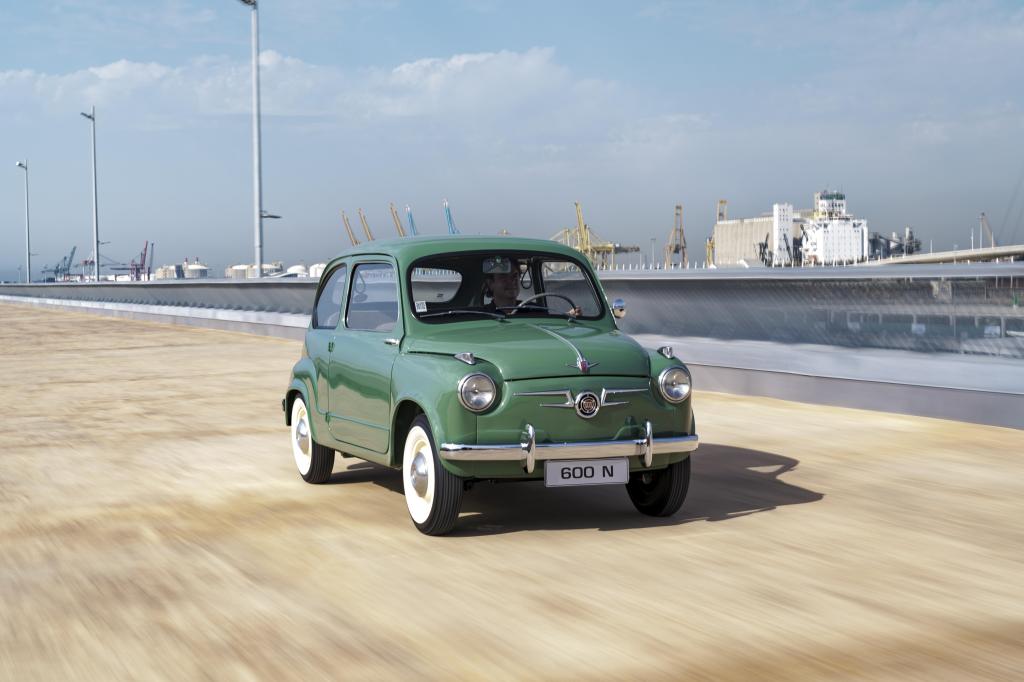
SEAT 600: One Cute Car

The fact that SEAT celebrated its 70th anniversary in 2020 was probably not all that notable for people who (a) don’t live or work in Barcelona or (b) aren’t automotive historians.

That said, the company was able to show off some of the vehicles that the company has launched (it says 75 over this period), including the SEAT 600, which was introduced in 1957.

(Image: SEAT)

And it is clearly one of the cutest cars you’re ever going to see.

According to SEAT, when the SEAT 600 was introduced, it was “the start of motorization in Spain. Back then, a motorcycle sidecar was considered a family vehicle.”

Which probably explains why this diminutive city car was said to be sufficiently sizeable to take mom, dad, four kids and grandmother on a trip, including luggage.

While nowadays, thanks in large part to Elon Musk, when people are now putting down deposits of varying amounts to hold their place in line for the purchase of a vehicle, it turns out the SEAT 600 was ahead of the curve: before the car went into production there was a waiting list two years long.

Admittedly, production rates then weren’t exactly what they are now, because five years into production SEAT had produced 100,000. So that would be an average of 20,000 per year.

Not a huge number.

By the time of the final model, the 600 L, in 1973, the SEAT 600 went out of production. Total build over the years the SEAT 600 was produced: ~800,000 units.

Not many cars. But cute.