Although COVID took a whack at micromobility systems in the U.S., there is something of a comeback, with some 130 cities in the U.S. offering e-scooter sharing systems from companies including Lime and Bird.
A study of e-scooter crashes in urban environments was conducted by Chalmers University of Technology in Gothenburg, Sweden, and funded by the Swedish Transport Administration (as Chalmers is in Sweden).
Seventeen rental scooter were setup with sensors.
Data from 6,868 trips were acquired and analyzed.
One of the findings was, well, somewhat unsurprising: Marco Dozza, who participated in the study, said, “The risk of being involved in a crash is greatest the first time you ride an electric scooter. For those who have ridden less than five times, the risk is still more than twice as high.”
Perhaps part of this has something to do with how some people pilot the scooters, thinking it is analogous to a bicycle.
It isn’t.
Dozza: “It is not possible to steer and brake with an electric scooter in the same way as with a bicycle, so riding with one hand on the handlebar is significantly more difficult – and dangerous – than many people might think.”
One-handed riding increases the risk of a “safety-critical event” by 6.5 times.
One surprise about the vehicles involved with e-scooters in these events: the greatest percentage didn’t involve other scooters, but cars.
30.2% of safety-critical incidents were between an e-scooter and a car or van. 19% with other scooters. 15.9% with pedestrians. 4.8% with bicycles.
Dozza: “Since bicycles and electric scooters should be ridden on bike lanes, I had expected more conflicts with bicycles. The fact that so many cars are involved suggests that many crashes may occur when the electric scooter is ridden outside the bike lanes, or when there is no bike infrastructure available. The risk of crashes is greatest at intersections, and my impression, even though this is not something that the study has concluded, is that it may be difficult for motorists to see the electric scooter riders in time, especially if they are not riding on a bike path.”
This all makes e-scooter commuting seem rather risky.
Shouldn’t everyone at Nissan be focused on appealing vehicles, not sharp knives?
By Gary S. Vasilash
Somehow this doesn’t seem. . .right.
Nissan, as is well known, is having some overall market difficulties.
Nissan Design America has taken this moment to collaborate with Chef Hiroyuki Terada and knifemaker Kiryu.
The collaboration has created the Z NISMO Precision Sushi Knife.
Sure, it is sharp, but. . . . (Image: Nissan)
According to Nissan, this execution was performed because Precision, Performance and Expertise are qualities that the Nissan Z car and Japanese knife-making share.
Last year in the U.S. Nissan sold 3,164 Z models in the U.S.
That is a small number. But it is a 78.7% increase over the previous year.
It is two more vehicles that Alfa Romeo Stelvios sold in the U.S. in 2024. Not exactly a vehicle that is top of mind.
The point is: Nissan needs to move more metal.
And not the kind used to produce knife blades.
The company ought to be 100% focused on products of a vehicular type.
Sure, the Z NISMO Precision Sushi Knife may be a bit of a diversion.
But it really can’t afford people paying attention to anything else than vehicles.
It isn’t often you can find a vehicle of this type that is (1) affordable and (2) actually fun to drive.
By Gary S. Vasilash
In 2024 Mazda North American Operations reported “record-breaking” sales. It sold 424,382 vehicles.
Of that total, 46,980 were cars. The remainder, 377,402 were crossovers.
The cars consisted mainly (as in 38,877) in the form of Mazda3s. The MX-5 Miata made up the balance in the car calculations.
But look at all of the crossovers.
The point is, Mazda has made a concerted shift away from the cars. Many driving enthusiasts who knew they needed to buy cars mainly for purposes of daily transportation would often opt for a Mazda because (1) it had sporty driving dynamics, (2) it was affordable and (3) it would do what needed to be done in terms of simply getting you to work or school in an appealing package.
Years ago at a press conference where an SUV was being introduced a writer for one of the buff books asked a company exec, “I get the utility part, but what about the sport?”
That must have been 20 years ago.
And in that time, while there has been an explosion of SUVs (or some would say “CUVs,” because most of them are based on car platforms so they are considered “crossovers,” but what isn’t taken into account is that many SUVs are based on truck platforms, so aren’t they crossovers, too?), the levels of stylistic sportiness, either in terms of the exterior sheet metal or the powertrain and chassis combination have been lacking.
Even the utility isn’t what one might think. People interested in carrying people and goods would be better off getting a minivan.
Mazda CX-30. You can carry things. And enjoy the driving experience while doing so. (Image: Mazda)
The Mazda CX-30 is sporty and it is comparatively affordable, with the trim driven here having an MSRP of $32,940, which is well under the average transaction price for a vehicle nowadays such that even though it is a bit so-so on the miles per gallon front—22 mpg city, 30 mpg highway, combined 25 mpg—you’d have cash left over for filling the tank quite readily, even if you opt to fill it with premium. Why would you do that? Because on premium the turbo-charged four produces 250 hp. On regular gas the output is 227 hp. So sportier is simply a bit more expensive.
The engine is mated to a six-speed automatic. There are paddles should you desire to shift-it-yourself, of course.
The vehicle features Mazda’s i-Activ AWD system, which monitors where the torque needs to go, and G-Vectoring Control Plus, which both adjusts torque and braking when cornering.
Chassis-wise, the front suspension is MacPherson strut with a stabilizer bar and in the rear a torsion-beam setup.
All of which goes to the point of this being sporty.
There is utility, too, given the configuration of the vehicle, offering 20.2 cubic feet with the rear seat in place (per EPA) and 45.2 cubic feet with the seat back folded (per SAE).
Given this is the S Carbon Turbo trim, there is an appropriate use of fitting materials, such as terracotta leatherette/suede seat coverings, as well as a suede material on the IP. The IP has a 10.25-inch infotainment touchscreen. There are, of course, wireless CarPlay and Android Auto, and even Alexa.
The answer to that question isn’t “around here” unless you live somewhere like Shenzhen
By Gary S. Vasilash
Any new vehicle worth considering—or so it seems—has a gauge cluster and accompanying infotainment screen that brings to mind all of the digital signage in Harry Reid International Airport (formerly McCarran) in Las Vegas touting everything from tired rock acts (which explains why they’re in “residence” rather than on the road: they’re tired) to shows that you would want to see but would have a hard time explaining once you returned from that business trip.
Omdia’s Automotive Display Intelligence Service has calculated that in 2024 there were shipments of 232 million automotive display panel shipments, an increase of 6.3% over 2023.
The firm attributes much of the growth to demand in China.
Speaking of which, it is surprising to see the companies that are global leaders in the auto display business: companies that you’ve probably not heard of.
How many names do you recognize? (Image: Omdia)
The top producer is BOE, which had a market share of 17.6%. It shipped 40.9 million units.
It was followed by Tianma, with a 15.9% market share and shipments of 36.9 million displays.
A name with some familiarity, LG Display, was fifth, with a 7.7% share and 17.98 million shipments.
According to Stacy Wu, Omdia senior principal analyst, “Looking ahead, LCD fab capacity for automotive displays will become increasingly concentrated in advanced production lines, particularly G6 LTPS and G8 a-Si/Oxide fabs in China. While this shift enhances production efficiency, it also presents challenges in supply chain diversification as automakers and tier 1 suppliers navigate an increasingly complex global trade environment.”
Which probably means that the vast majority of displays used throughout the world come from China, and in places like the U.S., with the new tariff regime, they are likely to become increasingly expensive.
Enhanced production efficiency can get you only so far.
In which we wonder a bit about engine nomenclature. . .
By Gary S. Vasilash
As everyone doesn’t know, a Newton is the force required to accelerate a one-kilogram object one meter per second second. So a Newton meter is essentially the measurement of a forward push.
Another way of looking at it (which is similarly less helpful for understanding because unless you have a master’s degree. . .in Science! you are likely not to get this, either) is that a Newton-meter is the unit of torque in the International System of Units (SI).
In this part of the world, where we don’t much cotton to things of an international nature, we use foot-pounds instead when it comes to torque.
One Newton-meter is equal to 0.73756215 pound-force-feet.
Got that?
In March 2019, when internal combustion was still the thing and people weren’t concerned about kWh and the like, Cadillac, undoubtedly wanting to get its international bona fides in order, decided on a new nomenclature system for its vehicles predicated on torque figures in Newton-meters. But because some of those numbers can be somewhat awkward, a decision was made to round up to the nearest 50 so there would be a nice round number used on the exterior badging.
Guess it is hard to come up with things to name the various vehicles in your showrooms.
Generally speaking, there has been the use of engine names on vehicles with varying levels of success over the years. Ford using “EcoBoost” had its moment. GM’s “Ecotec” didn’t have much in the way of resonance.
The all-time champ, one that can still achieve knowing nods, is the Dodge HEMI.
Someone can have absolutely no idea of what a horsepower is, to say nothing of a Newton-meter, and still know that the HEMI badge means bad-ass performance.
Which is a roundabout way of getting to the Mazda CX-90 S Premium Plus, a three-row SUV built on Mazda’s electrified Large Platform.
And if you think “Mazda” and something diminutive like the Miata (officially known as the MX-5), then the CX-90 may come as something of a surprise because it is nothing if not sizable: 122.8-inch wheelbase; 200.8 inches long; 78.5 inches wide; 68.2 inches high.
It provides 57 cubic feet of space for those in the front row; 51 cubic feet for those in the middle; 35 cubic feet for those in the rear (OK, a bit tight, but. . .).
And in terms of cargo capacity, there is 75 cubic feet with the second and third rows folded and 16 cubic feet if the seat backs are vertical.
But you’re wondering what all of that engine stuff at the start of this piece has to do with this vehicle. . . .
It’s this: For some reason known probably only to the marketing team, on the front quarter panel of the CX-90 there is a black and chrome badge that reads: “INLINE 6.”
That’s what’s under the hood. Does it matter? (Images: Mazda)
That’s right: the vehicle has a 3.3-liter, turbocharged, inline six-cylinder engine. Perhaps this is to differentiate the Mazda from something like a Chevy Traverse, which has an INLINE 4. (Though it doesn’t indicate that.)
From a performance point of view, the Mazda powertrain produces 340 hp and 369 lb-ft of torque (or, for those of you who are now SI mavens, 500 Nm, which is a fairly impressive number on its own, so maybe that would be a good moniker: CX-90 500).
The use of the word “powertrain” rather than “engine” is deliberate, for you may still recall the word “electrified” above.
The vehicle is fitted with what is called the “M-Hybrid Boost.” This is a 48-volt mild hybrid system, which means that it serves as a, well, boost, especially at starting from low speeds. It also helps with the overall efficiency, which is what I noticed in driving, as the low-speed boost was “meh,” but getting a combined 27 mpg for a vehicle weighing some 4,900 pounds with three rows and all-wheel drive is certainly satisfying.
Somehow I think it would have been cooler, if no more meaningful, to have “M-Hybrid Boost” on an exterior badge rather than INLINE 6. At least it would seem more future-oriented if no more clear to consumers.
Because the CX-90 is the top-of-the-line, the interior is well appointed with Nappa leather, streamline-design metal trim pieces, and a large piece of fabric on the IP with intricate stitching which appears as though it has more to do with high-fashion than Newton-meters.
That large surface is covered with an intricately stitched fabric.
All, in, however, this model is an interesting alternative to the vehicles in this category that have been available for a longer period of time, especially as Mazda seems to be making a serious effort to get its foot in the proverbial door in the three-row SUV space so it is over indexing.
What it takes to be successful is more than any one thing. . .
By Gary S. Vasilash
When it comes to the German luxury Big Three, it seems as though Mercedes is roiling with things like headcount reductions and other measures to reduce costs; Audi is somewhat invisible (in the U.S. its 2024 sales were down by 14%, which puts it in third place, but at 196,576 to second place Mercedes’ 324,528, so that is a far-away third), and BMW, well, it would be fair to say it is doing well.
Last year BMW Group sold a total 371,346 vehicles in the U.S., up 12.3%.
(Image: BMW)
There are arguably two reasons this is likely the case:
BMW has an assortment of powertrains: ICE, hybrid and EV. Customers have a choice.
The company’s supervisory board made an announcement today regarding members of its board of management, focusing on the Development Division, but going beyond that. Oliver Zipse, chairman of the board of management, said: “Technology and innovation are and will remain key success factors for BMW. “That is why we have been combining the technological expertise and the great innovative capacity of our Development, Production, Purchasing and Supplier Network Divisions in our comprehensive technology clusters for years.”
Note well Development, Production, Purchasing, and Supplier Network.
The success of a company just isn’t what it puts under the hoods of its vehicles or what kind of ADAS is deploys.
It is predicated on the integration of parts of its organization.
Without this solid integration, something gets left out and problems arise.
When it comes to compact crossovers, the Toyota RAV4 is a pioneer, having made its way to U.S. showrooms in January 1996.
The acronymic designator is said to stand for “Recreation Active Vehicle with 4-wheel drive.”
That “4” bit has morphed somewhat as (1) you can get a RAV4 with “all-drive,” not four-wheel drive (a primary difference being a transfer case, which the ute doesn’t have) and (2) the vehicle is available with front-wheel drive (though all-wheel is an option).
The vehicle is now in its fifth generation.
What is somewhat astonishing is the vehicle’s market performance in the U.S. in 2024. It became the best-selling vehicle in the U.S. To get to the top it had to supplant the Ford F-150 pickup, which had been #1 for so long that were someone to have an oversized foam finger with the Ford logo on it from when the F-150 got there it would now be crumbly.
Who would have thought that a compact SUV would supplant a full-size pickup in the U.S. market? Not me.
Through the years the exterior design of the vehicle has gone from boxy and functional (presumably as in “utility”) to softer to sharper to where it is now, which is fairly truck-influenced.
Maybe this is why it is doing so well in the market against trucks.
Even on the inside there are things like rubber-wrapped knobs that allow good grip and there are even buttons that are used, for example, to activate the heated steering wheel (this is an upper grade XSE model, incidentally). It has a wonderful simplicity compared to so many vehicles in this category (and others) that are focusing on doing things through screens and capacitive interfaces rather than, well, knobs and buttons.
Look: Real knobs and buttons!
(“But wait!” you say. “There aren’t any knobs or buttons on my phone, and that works just fine, thank you very much.” Yes, that is true, but consider this: you are holding your phone and staring at it in order to do something. A vehicle that weighs nearly two tons (in this case 3,775 pounds) and is traveling at, say, 70 mph is not the same thing: you’re eyes need to be on the road not trying to get to the right position on a surface to adjust the temperature.)
Oh, there is a 10.5 inch screen for infotainment. Toyota offers “Connected Services Drive Connect” that includes an “Intelligent Assistant” that is accessed via a “Hey Toyota.” Using that you don’t need to use any knobs or buttons or screens or surfaces. Just your voice.
The vehicle driven here is powered by a 2.5-liter four-cylinder engine that is orchestrated with two motor generators and a continuously variable transmission. There is one motor in the front and one in the rear which provides the all-wheel drive capability. The rear motor operates as needed and without a torque distribution system. Otherwise, the vehicle operates as a front-wheel drive vehicle, thereby helping optimize fuel economy.
And on that subject, the estimated fuel economy is 41/38/39 mpg (city, highway, combined). So with a 14.5-gallon fuel tank, you’ve got a considerable range.
The vehicle isn’t going to throw you back into your seat when you mash the accelerator—but then why would you? This is not engineered for that.
As for the “utility” aspect, there’s 37.5 cubic feet of cargo volume with the second row in position and 69.8 cubic feet when that seat is folded.
Seems like people who don’t haul things like gravel or equipment on a regular basis and so need a pickup have figured that that is enough volume to make that Costco run with a RAV4.
Fifth-gen RAV4. Exterior design is biased toward the “utility” rather than the “sport” in the SUV. (Image: Toyota)
So now the tariffs on everything from Canada and Mexico that are covered by the USMCA agreement are pushed back to April 2.
This is really quite silly.
For supporters of the Administration, this is being characterized as a “deal-making” strategy.
Couldn’t it also be characterized as someone not knowing what the hell is going on and so can’t make up their mind?
Don’t serious people know what they’re going to do and follow through?
This on-again-off-again is nothing but waste for those who are trying to run businesses.
And that waste costs money for nothing. Think of all the people at OEM and supplier companies that are spending time figuring out how to handle things that are supposed to be happening–and then aren’t.
Sure, it is good that they are not happening, but given the competitive nature of the auto industry it would probably be better if these people weren’t busy trying to figure out how to deal with vehicles that are being produced in their own factories and concentrataing on how to compete with those being built by others.
In addition to which, if the objective is to prevent fentanyl from crossing the borders, as well as migrants, wouldn’t it be simpler and more straightforward to (1) address the issue with the leaders of Canada and Mexico (does anyone really imagine Trudeau and Sheinbaum are unwilling to sit down and talk about how these issues can be mitigated without having their economies put in some jeopardy?) and (2) increase the security at the borders to interdict this rather than to cause potential pain at the grocery store and dealership for American citizens?
Here’s hoping that something is resolved before there is a Take Four.
So let’s see: on Tuesday (yesterday) the Trump administration imposed 25% tariffs on everything coming from Canada and Mexico, including automobiles.
This afternoon (Wednesday) the Trump administration, through White House press secretary Karoline Leavitt, announced that the automakers have a one-month reprieve.
Leavitt: “We spoke with the Big Three auto dealers. We are going to give a one-month exemption on any autos coming through USMCA.”
While it is possible that they talked to auto dealers—perhaps Leavitt is looking for some new wheels—odds are they talked with Big Three auto execs.
This may seem to be a quibble, but it goes to the point that if, indeed, Leavitt didn’t mean dealers—after all, dealers are probably not experts on the United-States-Mexico-Canada Agreement that was orchestrated by Trump during his first administration—the administration isn’t exactly hitting on all cylinders when it comes to understanding the auto industry and this isn’t an encouraging statement from the White House.
To be sure, a month extension is not a bad thing.
But anyone who knows even a little about the way businesses operate—especially incredibly complex businesses like the auto industry—there needs to be a horizon of planning that isn’t merely a month long.
As you may recall, on February 3 he pushed back the tariffs by a month, to yesterday.
So this month-by-month situation is not good for the auto industry.
And let’s keep in mind that so far, at least, there are still 25% tariffs coming to steel and aluminum imports, and these are supposed to take effect March 12.
While he rolled copper into the materials he said he is going to put a tariff on, on February 25 he signed an executive order that launches “an investigation into how copper imports threaten America’s national security and economic stability.”
This means that the Commerce Department is supposed to report on the copper supply chain conditions and then make recommendations before tariffs go into effect. Unless he simply says to hell with waiting and puts tariffs on copper.
Perhaps it is a good thing he is doing what he can to minimize electric vehicle sales because EVs use a lot of copper.
The price of eggs still hasn’t come down and soon the prices of vehicles are going up. . .
By Gary S. Vasilash
If you were thinking about buying a new vehicle, you might hurry given the application of tariffs on vehicles imported from Canada and Mexico.
No, it won’t mean that the price will go up 25%. But they will go up sufficiently such that you’ll more than notice it on your loan payments.
Anderson Economic Group has figured that vehicle prices will rise on the order of $4,000 to $10,000.
Now, of course, this pass through of pricing isn’t going to be instantaneous.
But it is going to be significant.
According to Stephanie Brinley, analyst at S&P Global Mobility, the vehicle manufacturers are going to be building some 20,000 fewer vehicles per day.
Brinley, speaking to the Automotive Press Association, also pointed out that there is a whole lot of trade going back and forth across the borders, and this is not only parts being produced by suppliers.
Say you want to buy a Ford F-150. Those trucks are built at plants in Dearborn and Kansas City. No problem there.
But say you want a V8.
That’s built in Windsor, Ontario, Canada.
EV sales are already tough.
Chevy has a hit with the Equinox EV. A large part of that is undoubtedly that it is a 315-mile range EV that starts at $41,900. For now.
It is built at the GM plant in Ramos Arizpe, Mexico.
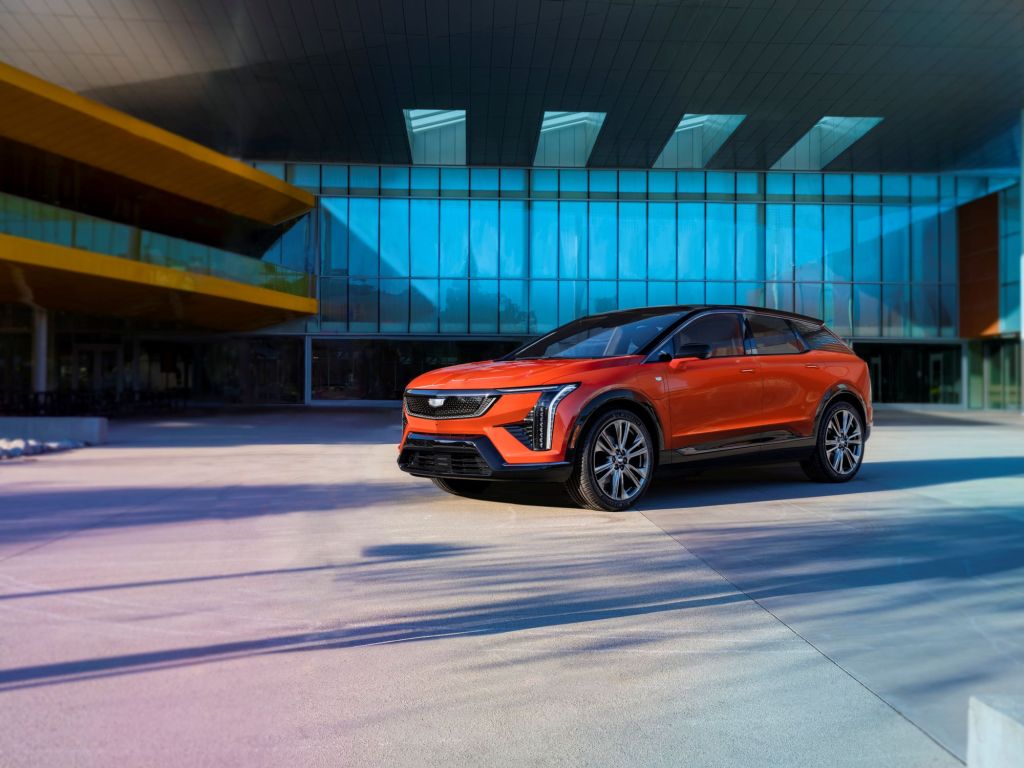
So are the Chevy Blazer EV and the Cadillac Optiq.
Let’s say you want to buy a Ford Mustang GT, which ranks highly in the 2024 Made in America Auto Index from Kogod School of Business.
What’s the likelihood that if the price of other things in the showroom go up (the Mustang Mach-E is built in Cuautitlan, Mexico) the price will be held on the Mustang GT with the gas engine?
Low, I suspect. After all, not only are there going to be fewer vehicles to sell, they’re going to want to make something, and there’s only one way that’s going to happen.
Sure, maybe the vehicle manufacturers will eat the costs. For a while.
But if the trade dispute carries on, there will be little appetite for that.