One of the questionable Christmas presents that car companies doing business in the UK happened just before the holiday, when the country’s Department of Transport, which has on the books a mandate that by 2030 there will be no new vehicles sold with gasoline or diesel engines under their hoods, announced an eight-week period during which the OEMs would have the opportunity to weigh in on how this can be achieved.
Note this is not an “If.”
As things stand, there are annual targets that must be achieved in terms of zero-emission vehicle—a.k.a., electric vehicles—by the companies.
The UK government is committed to this, apparently, although one wonders if the auto industry begins to crumble because of the penalties associated with not meeting the targets.
Penalties in the form of a fine of £15,000 for every vehicle sold that doesn’t meet the target.
For example, consider Ford, which has been part of the UK’s automotive structure since 1911.
The mandate has it that 22% of a carmaker’s sales in 2024 are electric.
How did Ford do? Apparently 6.8% for the first 11 months, so unless there was some massive change, it will be well below the government bogey.
Which means serious fines.
This is sort of an insult-to-injury situation in that the company has been investing billions of dollars/pounds/euros—pick your currency—in EVs, and because people aren’t as interested in buying them as they are other products, it costs Ford (and other companies that don’t meet the mandate) more.
“Aside from the billions invested in new technologies and products, it has cost manufacturers in excess of £4 billion in discounting in the UK this year alone. This is unsustainable and, with the 2025 market looking under even greater pressure, it is imperative we get an urgent resolution, with a clear intent to adapt the regulation to support delivery, backed by bold incentives to stimulate demand.”
Which probably means that the government is going to have to pony up more money in order to generate demand.
And Ford isn’t the only company with the lack-of-demand situation. It is estimated EVs will represent 18.7% of the UK car market in 2024, not the mandated 22%.
In 2025 that goes up to 28%.
Hawes’ “unsustainable” is an understatement.
This isn’t just a UK issue.
In the US, where EV sales in 2024 were on the order of 9%, currently standing EPA greenhouse gas regulations have it that more than 50% will need to be EVs by 2030.
The company just keeps refining it year after year, making it all the better for truck buyers
By Gary S. Vasilash
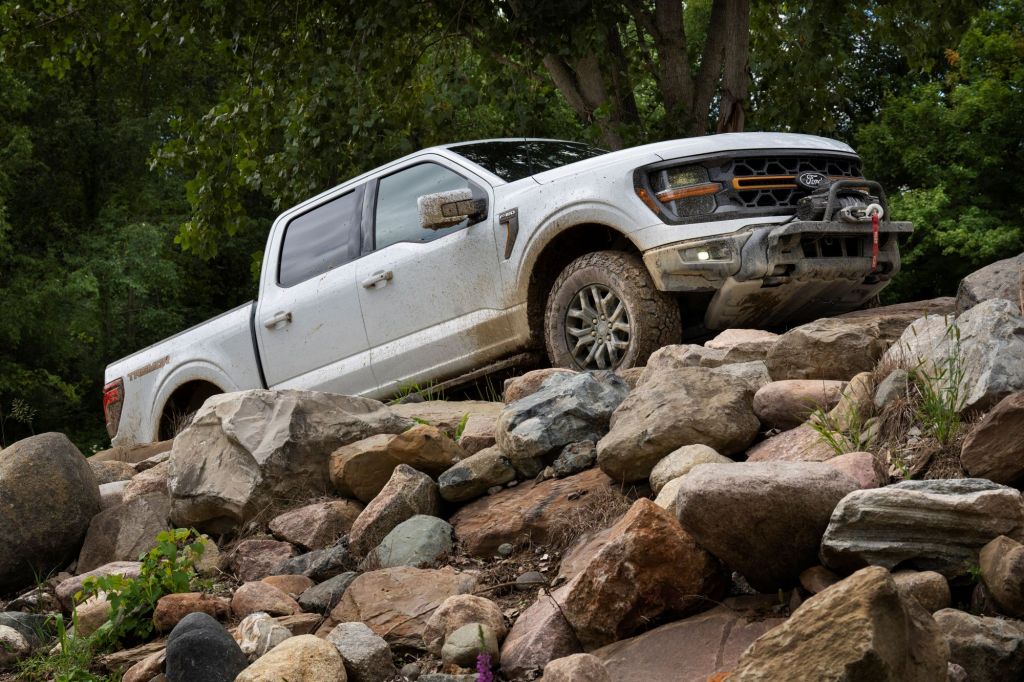
You’ve got to hand it to the men and women at Ford who have been mightily working for 48 years, dedicated to making the F-Series trucks the best-selling truck models in the U.S. for all those years running.
Ford F-Series: It climbs to the top and stays there. (Image: Ford)
Realize that of all of the segments in the showroom the pickup is the one where there is absolutely intense competition, especially with General Motors in the form of the Silverado and Sierra pickups and Stellantis with the Ram offerings.
Toyota keeps hanging in with its Tundra full-size, which racks up about a quarter of what a Ford or Chevy does in a given quarter.
Nissan realized its Titan wasn’t as mighty as it had hoped, so it has left the scene.
GM, in particular, has been working hard to take some of the luster off of the Ford crown. It often sums the Silverado and Sierra sales so that it can show as a corporation it is selling more pickups. But when someone goes into a showroom to buy a truck, they probably don’t want to have to go to visit the store of another brand to check its offerings (i.e., going from a Chevy dealer to a GMC outlet).
Ford with the F-Series simply checks more of the boxes on the needs and wants lists.
In addition to being the best-selling truck for 48 years in a row, the F-Series sets another record: It is the best-selling vehicle of any type in the U.S. and has been since the Gerald Ford administration (43 years running).
One of the interesting things about the F-Series is that while the F-150, the truck that you probably imagine when someone uses the term “F-Series” (I do), seems to have been around for approximately forever, is actually celebrating its 50th year in 2025.
You may be surprised at brands that aren’t making new-vehicle buyers all that chuffed. . . .
By Gary S. Vasilash
Maybe it has something to do with comparatively low numbers.
The J.D. Power 2024 U.S. Sales Satisfaction Index (SSI) Study ranks Porsche, for the second year in a row, as having the most satisfying sales experience. It has a score of 851 out of 1,000.
Industry average is 818.
In the first nine months of 2024 Porsche delivered 61,471 vehicles in North America (so this is the U.S. and Canada and Mexico).
The brand that arguably built itself on customer satisfaction, Lexus, is below average in SSI, at 812 (putting it in a tie with Mercedes, and putting those two above only Alfa Romeo at 810 and Genesis at 781).
In the first nine months of 2024 Lexus delivered 248,200 vehicles in the U.S. (just U.S.)
(And Mercedes sold 264,600 in North America.)
There are 202 Porsche dealers in the U.S.
There are 244 Lexus dealers in the U.S.
So, assuming (unrealistically, of course) that each dealership sold the same number of vehicles during the first nine months:
Needless to say, the people working at the Lexus dealership is a whole lot busier.
According to J.D. Power: “Buyer satisfaction is based on six factors (in order of importance): delivery process; dealer personnel; working out the deal; paperwork completion; dealership facility; and dealership website.”
You know: the regular routine of going in to buy a car, which is often not unlike going to an endodontist for some serious work.
Now certainly there probably isn’t a tremendous amount of cross-shopping between a Lexus store and a Porsche facility: the least expensive Lexus is a UX, which starts at $37,515 and the least expensive Porsche is a Macan, starting at $62,900.
But the SSI puts Lexus behind (in order): Infiniti, Jaguar, Acura, Land Rover, Lincoln, Volvo, Cadillac, BMW, and Audi, which are cross-shoppable.
What is also surprising is that Toyota brand, which competes in the “Mass Market” SSI category, is also third from the bottom, above only Mitsubishi and Chrysler—and with 777 points, it is well below the segment average of 798 and remarkably below the leading marque, MINI at 829.
Of course, MINI had sales of just 17,552 in the first nine months of 2024, which is a fraction of Toyota’s 1,481,319. Still, that puts Toyota well behind other mass market brands like Ford (805 points), which sold 1,473,642 vehicles through Q3.
Product, which Lexus and Toyota certainly have, is one thing.
Getting people to buy those products while feeling good about the experience is another thing entirely.
Seems like the folks in the sales department of Toyota Motor North America have some work on their hands.
Carvana, the purveyor of used vehicles, has discovered that EV investigators are spending more time searching based on a 226% increase in the number of page views on its site for the vehicles compared to Q3 2023.
The top five vehicles, according to its “EV Trends Report,” searched for are:
Tesla Model 3
Ford Mustang MACH-E
Hyundai IONIQ 5
Kia EV 6
Nissan LEAF
Given that there are hundreds of thousands of Model 3s out there right now, it shouldn’t come as much of a surprise that people are looking, perhaps, to score a deal on a pre-owned one.
The LEAF’s long time in market probably helps explain its presence.
But it is somewhat surprising that given that the IONIQ 5 and EV 6 are comparatively new (the Hyundai came out in December 2021 and the Kia in January 2022), they are on the list, not the Chevy Bolt, which was launched in December 2016, so there are undoubtedly more of them available on the used market.
But that is clearly ICE thinking.
Carvana found that the average model year search range for EVs was from 2020 to 2023. The average search range for ICE vehicles was 2018 to 2023.
So potential used EV buyers are interested in what’s newer.
What are the features EV searchers are interested in?
Third-row seat
Heated steering wheel
Apple CarPlay
Sunroof
Adaptive cruise control
Features that indicate EVs are being generally perceived as being a “regular vehicle”: ICE searchers were also interested in third-row seating and a sunroof. Rather than a heated steering wheel, it is heated seats. And Apple CarPlay and adaptive cruise are replaced by a rear-view camera and a tow hitch. (Perhaps the last-named has something to do with why the F-150 Lightning was knocked off the list and the MACH-E on it: towing with an EV is not particularly good, so EV intenders probably are no longer interested in that possibility.)
One thing that doesn’t get a whole lot of attention in discussions about EVs are the volumes in the factories where they are built. . . .
By Gary S. Vasilash
In announcing its Q3 performance, General Motors did the typical approach of accentuating the positive. As the company’s sales were down 2.2% in the quarter compared with Q3 ’23 and are down 1% year-to-date compared with ’23, that wasn’t going to be it.
Rather, as Rory Harvey, GM executive vice president and president of Global Markets is quoted:
“GM’s EV portfolio is growing faster than the market because we have an all-electric vehicle for just about everybody, no matter what they like to drive.”
While in Q1 ’24 GM’s U.S. share of the EV market was 6.5%. It reached 9.5% in Q3.
Clearly its EV sales are on an upward trajectory. But multiple models can drive up production costs.
The Models
Taking BrightDrop commercial vehicles out of the picture, since January GM has sold 70,450 EVs.
Specifically:
20,318 Cadillac LYRIQs
15,232 Chevy Blazer EVs
8,582 Bolt EV/Bolt EUVs
10,785 Equinox EVs
5,252 Silverado EVs
8,902 GMC HUMMER EVs
387 Sierra EVs
The LYRIQ is built in Spring Hill, Tennessee.
The Blazer EV is built in Ramos Arizpe, Mexico.
The Bolts are built in Orion, Michigan.
The Equinox EV is built in Ramos Arizpe.
The Silverado EV, HUMMER EV and Sierra EV are made in Detroit-Hamtramck.
Seven vehicles.
Three factories.
And some 70,450 have been built over a nine-month period.
While there is certainly some sharing of components, there are things like body stamping that aren’t common, which means dies. And the interiors of the three vehicles built at the Factory ZERO plant are different executions, though, again, there are some common parts.
But the point is, there are different costs associated with these vehicles’ production.
Capacity Utilization
Let’s say that the production capacity of an assembly plant is 250,000 vehicles per year.
A rule of thumb is that such a plant must operate at 80% capacity in order to be profitable, so that would be 200,000 units.
Even if the production of EVs doubles from the end of Q3 to the end of Q4, that’s 140,900 vehicles, or 70.45% of a 250,000-unit-capacity plant.
Now in the case of the Ramos Arizpe plant, in addition to the Chevy EVs it is producing the ICE Blazer and the Honda Prologue EV. The former has sales through Q3 of 40,545 vehicles and the latter 14,179.
So with all four of the vehicles being built there, there is an output through Q3 of 80,741.
If that number is doubled by the end of the year to 161,482 (which, of course, won’t happen), that would be about 65% capacity utilization of a 250,000-vehicle plant.
But let’s go back to the 70,450 units of GM EVs sold through Q3.
It is worth noting that during the same period there were 70,710 Chevy Colorados sold.
One model. One plant.
And it shares Wentzville Assembly with the GMC Canyon (26,956 sold through Q3, or 6,638 more vehicles than the best-selling GM EV. In fact, you could add the sales of the Silverado EV and the Sierra EV onto that LYRIQ number and it would still be short of the Canyon: 25,957.)
Profitability in EVs is going to take GM and some of its competitors a bit more than reduced battery costs.
A few thoughts from the Cox Automotive Q3 assessment. . .
By Gary S. Vasilash
While new EV sales are growing—remember, this is from a small base, so the growth in total numbers is not all that impressive—used EV sales are really doing quite well, or so the numbers from Stephanie Valdez Streaty, director of Industry Insights, Cox Automotive, who has a keen focus on EVs, indicate.
That is, year over year there is an increase of 64.4% for used EVs while new ones year-over-year it is up 12.6%.
In August there was a 90-day supply of new EVs. There was a 38-day supply for used EVs.
Still Pricey
One likely reason for the increased used EV sales is that the average transaction price in August was $35,937, compared with $56,574 for new EVs.
Realize that the now-used EVs probably had an ATP north of $56,574 when purchased new, so the buyer of a used EV is undoubtedly getting quite a well-loaded vehicle for the money.
I wonder whether a second used buyer will be all that interested in a vehicle, given concerns about battery longevity.
Leases Matter
In the new EV market leasing continues strong, Valdez Streaty noted. At 39% she says it is almost double the industry average. This probably has something to do with the ability to get IRA tax credits for EVs assembled in the U.S. And luxury vehicles, of which there are still plenty with EV powertrains, tend to have more leases than mainstream vehicles, so it makes sense to lease.
Overall Numbers
Looking at the powertrains in vehicles in August, ICE vehicles are at 81.6%, EVs at 8%, hybrids at 8.5% and PHEVs at 1.9%.
If you think about it, as OEMs began to pour money into EVs they subtracted from hybrids (e.g., the Ford Explorer had been offered with a hybrid, but the ’25 model doesn’t have one).
The company that didn’t pull back on hybrids—which actually continued to expand its offerings—is Toyota. Valez Streaty says that in Q2 2024 Toyota had 47% market share for hybrids—more than twice Honda’s second-place 20%.
Ford, it is worth noting, came in third at 14%, undoubtedly thanks to the F-150 PowerBoost Hybrid model.
Hybrids are typically referred to as a “transitional technology.”
Seems that that transition is going to take a whole lot longer than those outside Toyota anticipated.
The European Union is ahead of the U.S. in the acceptance of electric vehicles. That is, according to Cox Automotive, in 2023 the EV share of the U.S. vehicle market was 7.6%.
The European Union has just reported that in 2023 the number of EVs registered represents 14.6%.
What’s interesting about the 2023 number in the U.S. is that Cox Automotive reckonings show that Tesla sales represented 55% of all EV sales in the U.S.
There are now 30 brands offering EVs in the U.S., including Tesla, yet the company that seems to be going out of favor through the first half of 2024 has 49.7% of the market.
Taking out its estimated (it doesn’t provide clarity about sales in particular countries, including the U.S.) 304,451 vehicles from the 2024 first half total of 599,372, that means there were a total of 294,921 EVs sold in the U.S. in the first half of 2024.
To put that into perspective, in the first half of 2024 there were 248,295 Toyota RAV4s sold in the U.S.
So this means that 29 vehicle brands sold 46,626 more vehicles than a single model.
Questions
It is easy to get excited about percentage increases until they are contextualized.
Will the number of EVs on offer continue to grow? Yes.
Will the number of EVs sold increase as they become available in different segments? Yes.
Will growth in EV sales continue should there be a change in Washington that eliminates the incentives to buy an EV?
There’s the question that doesn’t have an answer.
But there’s something that provides perhaps of a hint in Germany.
Cautionary tale?
Meanwhile, back in Europe, EV growth continues, primarily because of government support and/or regulations.
According to T&E, “Europe’s leading advocates for clean transport and energy,” during the first half of 2024 EV sales were up in the EU by 9.4%–but that’s by leaving out the largest car market, Germany.
With Germany, the EV sales grew in the EU by 1.3%.
The organization’s Lucien Mathieu, cars director, said, “Germany is the sick man of Europe when it comes to electric cars. Meanwhile, markets which have strong, predictable incentives for EV adoption are reaping the rewards.”
At the end of 2023 Germany stopped providing a subsidy for the purchase of an electric vehicle. T&E calculates that that caused a 16.4% decrease in EV sales in Germany in the first half of 2024.
According to T&E:
“In the first half of 2024, EV sales grew in markets with supportive regulatory environments:
In France, which has a social leasing scheme to provide cheap electric cars to low-income households, BEV sales increased by 14.9% in H1 2024;
In Italy, BEV sales increased by 7.0% in the first half of the year, with a sales peak in June 2024 when new EV incentives were launched;
In Belgium, the company car segment drove the BEV market with a 47.8% increase in the first half of the year;
In the UK, the ZEV mandate has driven the BEV market, with sales increasing by 9.2% in H1 2024.”
Which raises a question: are “markets which have strong, predictable incentives” real markets or artificial ones?
Germany has some appealing EVs from small VWs to generally lauded BMWs to Mercedes lux.
And it is not like no one is buying EVs in Germany: T&E has EV sales in the first half representing 12.5% of the market.
Still, given the amount of investment and attention paid to EVs, the numbers seem somewhat small.
When it comes to customers, auto companies like them young and well-heeled.
Young because if they get the customers early and they do a good job in at least meeting and ideally exceeding expectations, this increases the possibility that they’ll stick with the brand or go up a level (i.e., from Chevy to Cadillac; from Toyota to Lexus; from VW to Audi).
And as for having plenty of disposable income—well, that’s obvious. After all, those Platinum and Unobtainium trims don’t come cheap.
This is borne out by a study conducted by research firm Numerator on electric vehicles.
As for comparative youth, it found that 42% of EV owners are Gen Z’ers or Millennials. That’s in the context of those two cohorts representing only 30% of all vehicles.
As for wealth, there are at least a couple of indicators: 44% are said to be from high-income households. Only 30% of the average vehicle owners are in that stratum.
And 77% of EV owners live in households with two or more vehicles. This is compared to 68% of all households with vehicles.
What seems somewhat odd, however, is that EV owners are twice as likely to walk or bike to get around and are four times as likely to take public transit than the non-EV owners.
While it might be thought that these Gen Z and Millennial EV owners are all about the environment, Numerator found that only 48% of them cited the environment as why they opted to go electric.
Seventy-four percent said it was for cost savings on fuel.
To put some numbers around that:
According to the EPA, the average cost of a gallon of regular was $3.48 in 2023. Also, the average miles per gallon achieved in new vehicles in 2023 was 26 mpg. In its “Fuel Economy Guide” it estimates the average driver racks up 15,000 miles per annum.
So, 15,000 divided by 26 is 577. And multiplying that by 3.48 gets us to an annual outlay of $2,008, or $38.61 per week.
Not a whole lot, but evidently even the wealthy watch their wallets.
One of the most significant vehicles that Ford has launched during the past few years—arguably more significant than the Mustang Mach-E, which people seem to get excited about—is the Maverick, a midsize pickup truck that is smaller than the Ford Ranger, another midsize pickup truck, which has seemingly lost its mojo.
So let’s put some numbers to the “significant” claim.
Through the first half of 2024 the respective U.S. sales for the vehicles:
Mustang Mach-E: 22,234
Maverick: 77,113*
And for good measure:
Ranger: 15,175
So why is the Maverick, which went on sale in late 2021 as a model year 2022 vehicle, so successful?
Because it is small, fun, funky, functional, and economical.
As for the last item: the starting MSRP for a 2024 Maverick XL with a 2.0-liter EcoBoost engine, is $23,920. For those interested in a 2.5-liter hybrid version, that’s $25,420.
The functional part is that it is a bona-fide truck. As in something with the ability to handle a 1,500-pound payload and tow up to 4,000 pounds (with the 2.0-liter).
And the really clever bit that Ford designers and engineers did was to embrace the fact that they were creating something that would have a low price point.
Typically there seems to be a tendency for them to pretend that whatever it is they’re putting on the road is more expensive than it is, which leads to faux execution inside (in particular) and out.
In the case of the Maverick, while the materials may not be the stuff of an F-150 King Ranch edition, those materials are treated with an honesty and an innovative spin such that they make the truck all the better because there is an authenticity to it.
Now, for model year 2025, the Maverick is getting a refresh.
And a new model.
“One of the first things you’re going to notice is a slimmer, more modern headlight profile,” says Josh Blundo of the design team.
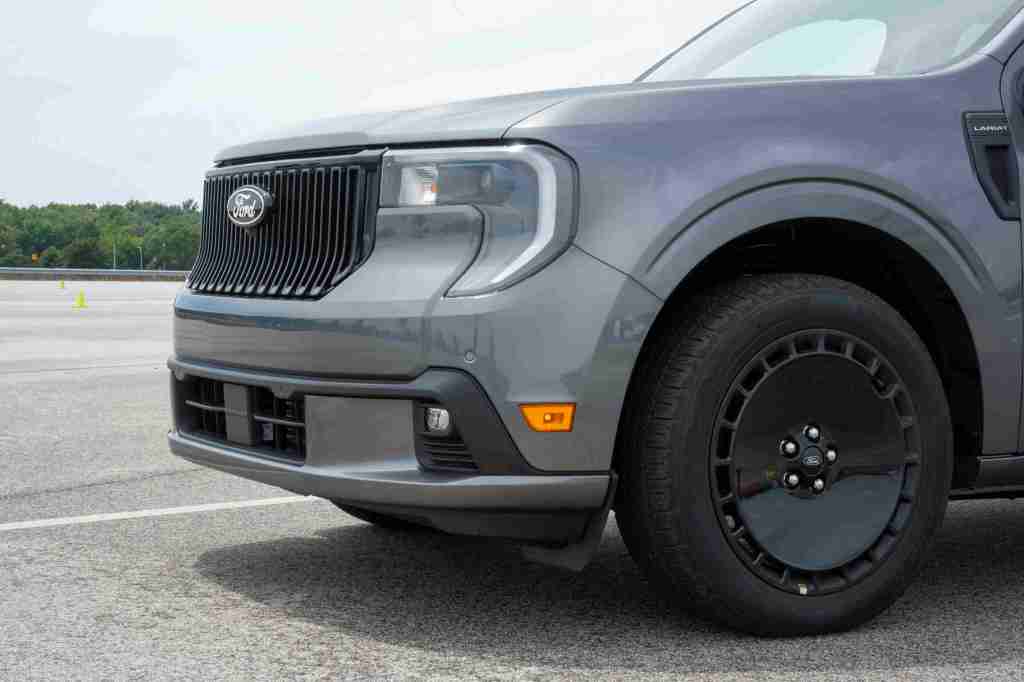
The front fascia for the ’25 Maverick Lariat features “chicklets” on the grille. The front ends of each of the available models—XL, XLT, Lariat, Tremor, and Lobo—has a differentiated look. (Images: Ford)
The primary change for the Maverick trims across the board—and there is a new trim added, the Tremor—is in the front, not only in terms of the headlights, but the fascias, which are specifically designed for each trim (e.g., the Lariat trim has a grille featuring what Blundo refers to as “chicklets,” small metallic rectangles that pop on the black grille).
Inside the most obvious change is the 13.2-inch touchscreen—standard across the lineup—which Blundo says is as big as the screen in any Ford model. Yes, as big at one in an F-150.
Kirk Leonard from the engineering team—who has been with Maverick since just after the launch of the ’22 MY vehicle, and who came to it from Super Duty, which goes to show that this is a serious truck—points out, “Just because we’re a small truck doesn’t mean we get a pass on the capability, durability and toughness that customers expect from our vehicles.” So while the Maverick may be fun, it is not a poseur.
Leonard says “The number-one thing customers have been asking for is all-wheel drive for the hybrid.”
So the ’25 Maverick is available with a AWD system for the hybrid.
Leonard adds, “They wanted all-wheel drive but they didn’t want to give up on fuel economy.”
So, he says, they’re estimating that the AWD Maverick with the 2.5-liter hybrid system will deliver 191 hp, 155 lb-ft of torque, and 40 mpg city.
Those who are even more interested in fuel economy but not interested in all-wheel drive can get the front-drive version, which Leonard says will provide an estimated 42 mpg in the city, and a 500-mile range on a tank of gas.
The Maverick is also available with a 2.0-liter EcoBoost engine that provides 238 hp and 277 lb-ft of torque.
And There’s This. . .
Josh Blundo is one of those guys who is a quintessential “car guy.” While a teen in New Hampshire he was sketching cars, which really wasn’t a thing that his peers were doing. He went to the College for Creative Studies in Detroit and found that car culture was everywhere.
Which is evidently an environment he thrives in.
He says that when the Maverick was first launched he saw that it had a certain minimalism that he finds appealing. And something to use as a launch pad for creation.
Which lead to the design of the Maverick Lobo model.
Lobo. Lowered and with a look that combines street truck and tuner cultures, says designer Josh Blundo.
Although this fits within the “street truck” modified niche, Blundo says, “Street trucks really represent a broad culture. A lot of people think ‘muscle’ trucks—full-size trucks with V8s.”
Then, at the other end of the spectrum, he says, are tuner vehicles. In this case they’re mainly sedans and hatches—Civics and Golfs and the like.
“Maverick, because of where it sits in the truck space, unibody and more focused on handling than straight-line performance, sits in the middle ground,” Blundo says.
So for the Lobo aesthetic they lowered the truck ½ inch in the front and 1.12 inches in the rear, which results in a roof height that’s 0.8 inches lower. And that roof is painted black, as are the 19-inch wheels. (Speaking of the roof: there are two available configurations, Standard and High. High, among other things (e.g., heated steering wheel and seats; spray-in bedliner) includes a moon roof.)
There are a Lobo-specific front fascia and painted rear bumper.
Kristen Keenan and her colleagues in Color + Materials provided the Lobo with a unique interior execution. Keenan, who had worked designing performance footwear at Nike, says that that experience helped inform what they did inside the Lobo, such as using ActiveX, a high-end synthetic that looks good and wears well.
Because this truck is not just about show but also go, there are things like a twin-clutch rear drive unit that provides torque vectoring and an upgraded cooling system.
The truck offers the “Lobo mode,” a drive mode that essentially minimizes the intervention of the stability control system so that the truck can be thrown around on a track—a closed track, notes Keith Daugherty, an engineer who worked on the Lobo and deployed elements from the European and U.S. Ford parts bins (brakes from the Euro Focus ST; strut mounts from the Mach-E).
And, yes, as a daily driver the Lobo has available, like other Mavericks, things like Pro Trailer Hitch Assist, because at the end of the day, it’s a truck.
==
*While some may quibble that this is an unfair comparison, given that one is an EV and the other is a pickup truck, the Maverick is a pickup truck that is available as a hybrid, and according to James Gilpin, Maverick brand manager, about half of all Mavericks sold are hybrids. This means about 38,550 Mavericks sold are electrified, still greater than the 22,234 EVs.
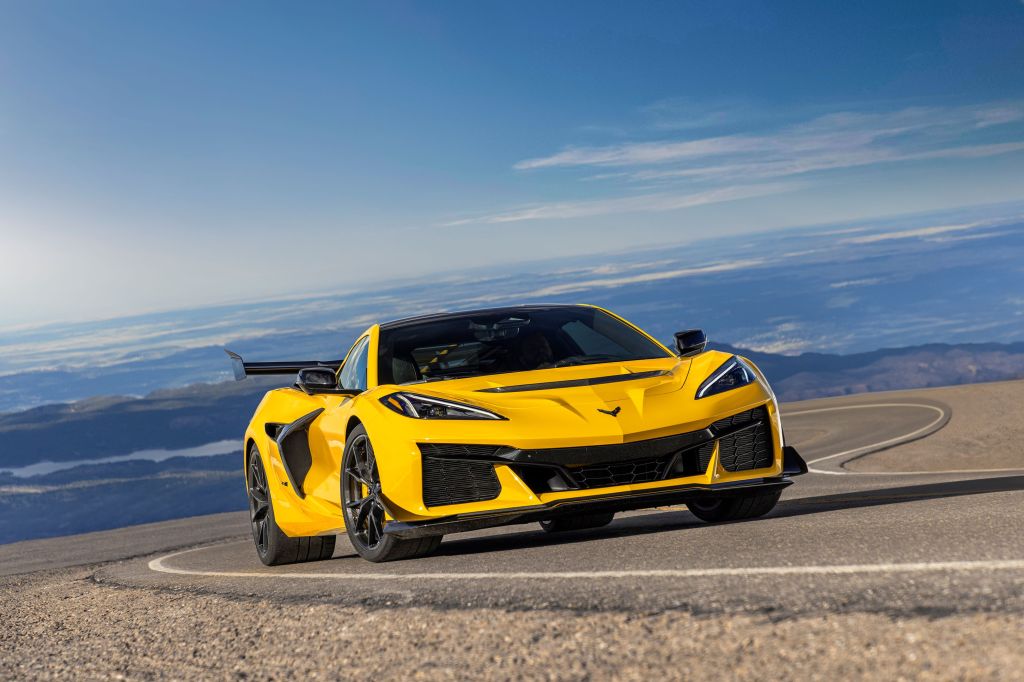
And while it won’t be launched until next year—and “launched” is a good word for this vehicle, the ’25 Corvette ZR1, while undoubtedly something that will be produced in limited numbers, will likely drive interest in the more readily available Corvettes.
The ZR1 is a special model, with its 1,064-hp 5.5-liter, twin turbocharged, DOHC flat-plane crank V8.
The car will have a top speed of over 215 mph.
And while it looks and certainly is fast, it won’t launch to the sky as there is a carbon fiber aero package that produces in excess of 1,200 pounds of downforce when the ZR1 hits top speed.
Now there are electric vehicles that have higher top speeds, though not many, and not readily accessible as at a Chevy dealer.
And the instant torque of an EV may be more impressive than the impressive 828 lb-ft that the ZR1 LT7 generates—at 6,000 rpm.
But the ZR1 will provide a visceral experience as well as the one predicated purely on acceleration.
This sensory suite of sound and vibration is simply something that cannot be as genuinely obtained in an electric vehicle.
At some point, after a sufficient number of enthusiasts, the type of people who would consider paying what is estimated to be on the order of >$180,000 for a car, haven’t driven combustion-powered vehicles, things like the ZR1 will fall out of fashion, undoubtedly being perceived as having insufficient refinement because of the very characteristics that make it so exhilarating to drive.


 shinymetalboxes