Ford Sells a Lot of Trucks. Again.

By Gary S. Vasilash

For those of you still humming Mariah Carey’s “All I Want For Christmas Is You,” here’s a bit of context for an announcement Ford made this morning:

The year that the Ford F-Series started making its consecutive run as the best-selling truck in the U.S., Ms. Carey was seven.

The F-Series has taken the lead for 47 years in a row.* They’re looking at more than 700,000 of them driven off of dealer lots in 2023.

2024 Ford F-150 Platinum. So nice that you probably wouldn’t want to use it as. . .a truck (Image: Ford)

And underscoring the curious popularity of trucks in suburban driveways as well as on work sites (curious because I rarely see my pickup truck-owning neighbors doing anything with the boxes on the back of those vehicles that they couldn’t manage with a trunk), the F-Series has been the best-selling vehicle in the U.S. for 42 years running.*

There is, of course, the question of whether “the most” means “the best.”

After all, McDonald’s has sold more hamburgers than any other company in the world and there is probably no one who doesn’t know whether they can get a better burger.

But one thing it certainly means is that the F-Series provides an unparalleled level of value for more people than any other pickup.

While there may be specific attributes of trucks from other OEMs that are more appealing or necessary for some purchasers, which means those trucks are more valuable for those people, on an overall basis Ford is consistently delivering.

Credit where credit is due. (And you’ll probably need good credit to get a full-size pickup: according to Kelley Blue Book, the average transaction price (ATP) for one in November 2023 was $66,590. You could get an entry-level luxury car for an ATP of $57,889.)

(On a related-unrelated subject, the tremendous number of trucks sold by Ford—closely followed by GM and Ram—in the context of vocational or functional (i.e., towing, hauling) uses of the vehicles might indicate that people are less environmentally keen than might be expected. After all, light-duty pickups aren’t exactly fuel-economy leaders, so were people concerned about carbon, they’d be buying more efficient vehicles for their daily drives. Yes, there are an electric F-150 and Chevy Silverado and one coming from Ram, but from the point of view of resource utilization, as in the massive batteries that have to be constructed, if those trucks aren’t being used as, well, trucks, then that isn’t exactly the most-environmental choice.)

*As the announcement was made a couple days before the actual end of the year, it is a bit of estimation on behalf of Ford. A small bit.

Hyundai, Amazon & the Transformation of Dealership Transactions

By Gary S. Vasilash

The announcement that Hyundai and Amazon have entered into a partnership agreement which will have Hyundai models sold through the Amazon interface will have repercussions in automotive retail the likes of which have probably never been experienced before— perhaps those inflatable gorillas and floppy men had a fairly big effect, or so the traditional car-buying model might have it.

Now this doesn’t mean that the dealership model is kaput. Well, at least not in 2024, when the availability of Sonatas and Tucsons can be configured on the site.

Dealers are still part of the picture.

Customers can search on Amazon for the Hyundai of interest, configure it, and even select their method of financing. The vehicle will then go through a dealership for delivery.

And it is likely that individual dealerships will be able to establish their own storefronts on Amazon the way the purveyors of an array of products do.

A Change Is Coming. Fast.

One of the arguments that is made regarding people purchasing cars on the internet and why it isn’t going to make a difference is that people like to take test drives. People like to see the sheet metal. People like physically see what it is that they’re going to be spending tens of thousands of dollars for over a few years.

True.

But consider this: one of the things that nearly knocked out Best Buy was “showrooming”: People would go to a store to check out that big-screen TV and then go home and buy it on Amazon.

They’d, essentially, kick the tires, and then complete the transaction elsewhere. Best Buy did the work. It didn’t get the reveune.

The incredibly friendly Amazon interface will undoubtedly make it all the easier for Dealer A to promote better deals than Dealer B, so if the Dealer B is where the customer did their showrooming, then A may come out on top. While people can check on individual dealer websites to see what’s available, this setup with Amazon will undoubtedly facilitate that.

And what of the salespeople? Will any given dealership need as many going forward?

Dealership value is undoubtedly going to change profoundly—and not necessarily for the better.

Something like this was bound to happen.

And now it has.

(One of the things that must be considered vis-à-vis this partnership is that Hyundai is clearly positioned as a company that sees how the world works. People buy lots of stuff online. People want convenience. So Hyundai is facilitating that. Many other OEMs are busy perpetuating past practices despite their pronouncements about the future. Those OEMs are like Nokia. Hyundai is like Samsung.)
Polestar Says It Out Loud

By Gary S. Vasilash

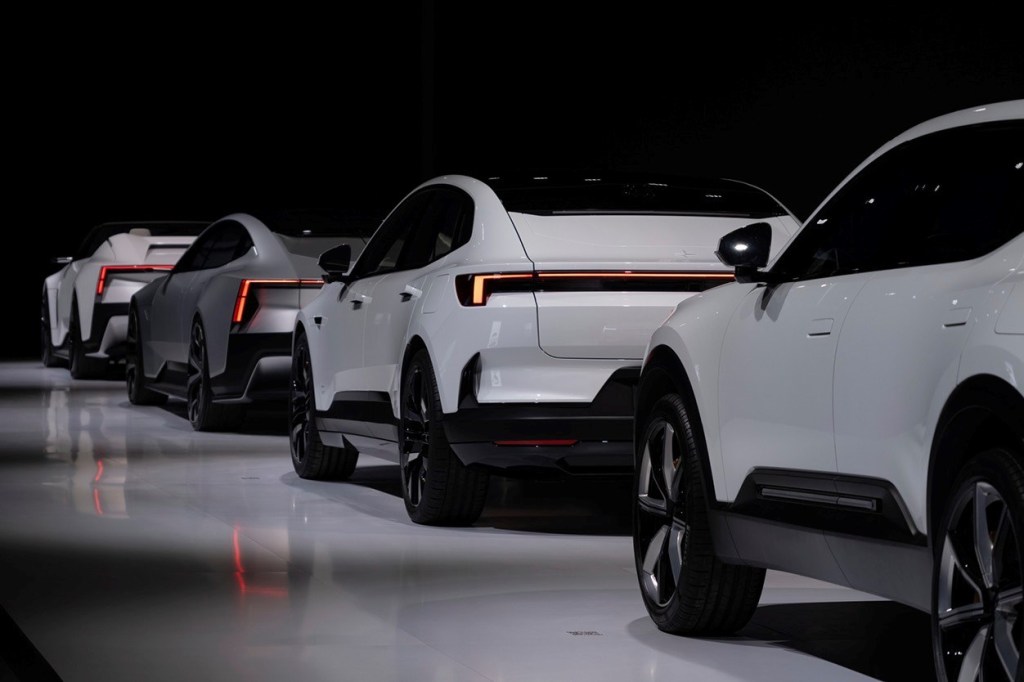
Polestar is an electric vehicle company that, in effect, spun out of Volvo, but Volvo is owned by Geely, but is traded on NASDAQ (as PSNY), so let’s not even try to sort out where the Gothenburg, Sweden-headquartered company exists. (It has announced it will build the forthcoming Polestar 3 in a plant in South Carolina next year. . .the Volvo plant in South Carolina.)

Anyway, yesterday as part of its Q3 earnings presentation it announced a “strengthened business plan.”

Which is notable because the company has stated it is going to put margins ahead of volume.

(Image: Polestar)

Thomas Ingenlath, Polestar CEO, stated, “Margin over volume is our way forward, supported by a gorgeous line-up of four exclusive performance cars.”

Meaning that Polestar is going to focus on the premium end of the EV market.

It figures that as of 2025, when it has four models in production, it will have an annual volume of 155,000 to 165,000 cars, which in and of itself is a rather small number and is smaller when you take into account it is selling globally.

Consider This

According to Kelley Blue Book, in September the average transaction price of a luxury vehicle in the U.S. was $62,342, down 6.2% from September 2022.

Here’s the key to that: “Luxury price declines in 2023 are primarily driven by aggressive price cuts at Tesla, the luxury market leader.” The Model 3 price was down 26% compared to the previous year.

And in the EV space, the average transaction price in September was $50,683, or down about 22% from the previous year “led again by market leader Tesla.”

(Tesla, because of its margins, is really the only OEM that can build mass volumes of EVs and afford to cut its prices.)

The point is, the EV market in the U.S. is pretty much a premium market.

And in the U.S., EVs are pretty much a premium proposition.

When Chevy announced the Equinox EV it made much of the fact that it was going to be a $30,000 vehicle, but it covered itself with “about” and announced a starting price of $34,995. While that is below the average price of an EV, what are the odds there will be many $35,000 Equinox EVs available?

When Chevy announced the Silverado EV work truck earlier this year, pricing was to be just below $40,000, but as reality set in, the price is now above $70,000.

EVs are an expensive proposition.

Let’s face it: until there is some massive change in battery technology (batteries are where most of the cost of an EV is found), the EV market is going to be characterized by prices higher than the ICE market—KBB found that the average transaction price for compact cars in September was below $30,000.

Credit to Polestar for saying it is going to put its profit ahead of volume, something other OEM execs don’t seem to want to say out loud.

Hyundai and Hybrids

By Gary S. Vasilash

In reporting its October sales, Hyundai noted that the company that was once thought of mainly in the context of its style-setting Sonata sedan (remember when the 2011 model came out with its “Fluidic Sculpture” styling that made all other sedans seem as though they came from an earlier age?) had 81% of its retail mix in. . . SUVs.

Of course, that has a little something to do with the fact that in the car category there are the Sonata, Elantra and recently introduced IONIQ 6 EV sedan, while in the SUV category there are:

  • IONIQ 5
  • Kona
  • Nexo
  • Pallisade
  • Santa Fe
  • Tucson
  • Venue

(There is also the Santa Cruz pickup, for purposes of providing a look at the entire showroom.)

Hyundai Tucson PHEV (Image: Hyundai)

While there were 9,456 Elantras sold—an 11% increase compared with October 2022 sales—there were 9,700 Santa Fes sold—and that’s a decrease of 10% compared to last year and it still is more than the Elantra sales.

But what is more interesting in some regards is this observation from Randy Parker, Hyundai North America CEO:

“This was the best-ever October for total and retail sales for our segment-leading Tucson HEV, Tucson PHEV, Santa Fe HEV and IONIQ 5 SUVs along with our Elantra HEV.”

Yes, hybrids are doing increasingly well at Hyundai, though there is also that full battery-electric IONIQ 5.

Overall, electrified vehicles represented 21% of Hyundai’s October sales, a 49% year-over-year (YoY) increase.

In terms of the hybrid YoY increases:

  • Elantra HEV:          +15%
  • Santa Fe HEV:        +81%
  • Tucson PHEV:         +170%
  • Tucson HEV:           +14%

Odds are those OEMs that decided to deemphasize hybrids to promote full electric vehicles are giving their portfolio strategy a hard re-think.

Underwhelming Domestic OEM EV Sales

If you listen to the pronouncements of traditional OEMs about their EV efforts, you’d think that there is probably some sort of parity vis-à-vis their internal combustion engine business.

As in GM (remember: “All in” on EVs) selling plenty of EVs, and the Ford F-150 Lightning being in demand the same way the ICE versions of the truck are.*

So it comes as a surprise how few EVs the traditional OEMs are selling in the U.S.

According to the just-released Kelley Blue Book “Electric Vehicle Sales Report” for Q3, when it comes to General Motors, year-to-date it has sold:

  • 49,531 Chevrolet EVs
  • 5,334 Cadillacs
  • 1,216 GMCs

That’s a total of 56,081 EVs over nine months. If we include Brightdrop commercial vehicle sales, it boosts the number to 56,414.

The GMC HUMMER EV was introduced in October 2020. During the past three years, there have been 2,071 of them sold. (Image: GMC)

GM sold 65,255 Chevy Trax models, or 15,761 more units than sales of the Bolt EV/Bolt EUV sold through Q3.

Meanwhile, over at Ford:

  • 46,671

To put that in perspective: during the first three quarters of 2023 it sold 56,427 of its giant Expedition SUVs. So the Mustang Mach-E, Lightning and E-Transit commercial van summed are nearly 10,000 fewer.

And while adding things together: GM and Ford combined sold 103,085 electric vehicles.

Meanwhile, according to KBB Tesla sold 493,513 EVs.

Think about that: two of the biggest, most legendary OEMs in the U.S. together sold about a fifth of a company that was established 20 years ago.

*To be fair, Stellantis brands (Chrysler, Dodge, Jeep) sold 0 EVs.

Don’t Count Out Cars: Lesson from Honda August Sales

By Gary S. Vasilash

For those who think that cars—those lower-roofed vehicles with two or four doors that aren’t designed to be able to or pretend to be able to traverse Moon-like surfaces—have had their day, August sales results from Honda are instructive.

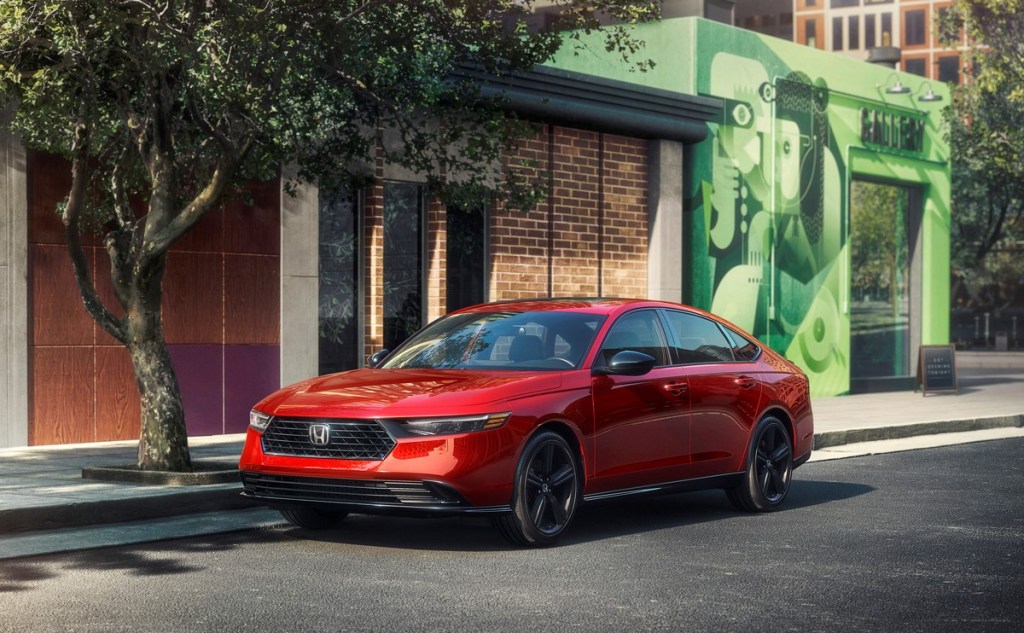
For the month Honda sold 17,661 Accords, which is a 52% increase over August 2022. The car sales are up 36.3% for the year compared to 2022.

(Image: Honda)

And Civic sales increased 133.1% in August over the previous year, 17,077 vehicles. For the year Civic sales are up 47.5%.

To be sure, Honda sold a lot more non-cars in August: 65,047 compared with 34,738.

However, there are five vehicles in the non-car category vs. two.

The CR-V crossover is the brand’s biggest seller, 30,991 units.

However, the closest sales number to either of the cars is achieved by the HR-V, which was at 11,404. That’s a third lower than Civic sales.

GM Making Money—Thanks to Trucks

By Gary S. Vasilash

General Motors reported exceedingly good earnings for Q2: non-adjusted net income attributed to stockholders of $2.57 billion. It was $1.69 billion last year.

The company thinks it will make a lot more this year than it previously expected:

  • $9.3 billion to $10.7 billion is the new target
  • $8.4 billion to $9.9 billion was the previous target

Getting Deluxe for Bucks

A big part of this: full-size truck and SUV sales, especially the high-trim trucks.

  • At GMC 70% of Sierra HD trucks were lux. Some 50% of Sierra light-duty trucks were. And 74% of Canyons were loaded.
  • At Chevy, about 75% were top trim models.

Nine Chevy SUVs—One Economical

Of course, GM points out that the Chevy Trax, an “affordable SUV” (starts at $20,400) had an increase in sales of 115%. (Last year it sold a total of 26,597 Trax models so if the sales were to double this year compared to last, it would still be fewer than Blazer 2022 sales, 67,246.)

Where’s the Money Going?

And regarding trucks, GM noted it is investing to “strengthen our industry-leading full-size truck and SUV business.”

With:

  • $1-billion invested in a plant in Flint, Michigan for next-gen heavy-duty trucks
  • $0.5-billion in Arlington, Texas for next-gen full-size SUVs
  • $0.6-billion for next-gen light-duty trucks

Maybe not the crazy money being thrown at electric vehicles, but clearly there are plans in place for next-gen trucks and SUVs that will continue to haul in the money.

EV Issues

As for EVs, the company built 50,000 in the first half and plans to build 100,000 in the second.

What’s interesting is that in Q2 it sold 15,700 EVs, which is down from the 20,700 it sold in Q1 ’23 and the 16,300 it sold in Q4 2022.

Clearly, not the right direction.

In terms of EV sales, the Chevy Bolt has been making the biggest difference. Through the first half there were 33,659 sold.

The Bolt Will Be Back

However, GM had announced that the Bolt, which doesn’t use the company’s Ultium battery technology, was going out of production. . .until today, when it announced there will be the development of a new Bolt, that will use the battery tech.

GM chair and CEO Mary Barra said, “Our customer’s love today’s Bolt. It has been delivering record sales and some of the highest customer satisfaction and loyalty scores in the industry.”

Starting at $26,500, it is also one of the most cost-competitive EVs in the market, which undoubtedly accounts for more than a slight amount of that popularity.

As long as GM can keep the price low, the Bolt should continue to do well.

If GM ups the price significantly, then its EV sales numbers will grow, but at an anemic pace.

Ford F-150 Lightning & the Potential of Scale

By Gary S. Vasilash

As is widely known, there is a pricing benefit when lots of something is made.

The technical term is “economies of scale.”

Companies get to buy components in bulk and, like a giant pack of paper towel or a vat of peanut butter from Costco, the prices are consequently reduced.

That said, Ford announced today that it is cutting the prices for F-150 Lightning models. The Pro model on Saturday had an MSRP of $59,974. Now it is $49,995. A reduction of $9,979. Some 16% off.

And probably figuring those who would buy a Platinum Extended Range wouldn’t need to have as great a reduction, today the MSRP is $91,995, or $6,079 less than it was Saturday.

In announcing the price reductions, Marin Gjaja, chief customer officer, Ford Model e (the electric vehicle part of the company), said, “Shortly after launching the F-150 Lightning, rapidly rising material costs, supply constraints and other factors drove up the cost of the EV truck for Ford and our customers.”

That was a situation where economies of scale were not working.

Gjaja continued, “We’ve continued to work in the background to improve accessibility and affordability to help to lower prices for our customers and shorten the wait times for their new F-150 Lightning.”

Arguably they are getting better scale.

But there could be something else at play here.

Through the first half, Ford delivered 8,757 Lightnings.

As of this fall it will have the ability at the Rouge Electric Vehicle Center to produce 150,000 per year.

At the current rate, it would take a long time to get to 150,000.

VW EV Globally

By Gary S. Vasilash

Volkswagen Group—as in the whole thing, globally (everything from Audi to VW, with Lambo, Porsche and others in between—is taking the electrification of its portfolio quite seriously and so was rather pleased with its sales of battery electric vehicles during the first half of 2023.

It delivered 321,600 EVs—a 48% year-on-year improvement.

In Europe its EV deliveries were up 68%, to 217,100 EVs.

Which means 104,500 for the rest of the world.

In the U.S., there were 29,800 EVs delivered by the Group. That was a 76% improvement.

Meanwhile, over in China in the first half, things actually fell by about 2%, to 62,400 EVs.

These numbers provide a good sense of how EVs are playing out in various markets: the Europeans are buying a lot, as are the Chinese. While the numbers are growing in the U.S., compare the 76% improvement with the 2% decline in China: The Chinese bought 32,600 more EVs than U.S. customers, yet that’s a decline.

A Word About Mercedes-Benz USA Q2 Sales

By Gary S. Vasilash

Although there is increasing rhetoric about the U.S. economy being bad, you really couldn’t come to that conclusion based on the Q2 2023 sales of Mercedes-Benz in the U.S.

It achieved some impressive figures, such as sales in its “Top-End” segment of 26,927 units, or a 40% increase compared to Q2 2022.

A standout for the brand in that segment is the G-Class, that seriously geometric vehicle that seems as though it could bash through brick walls without a scratch while driving up hill in sand towing a full-size Airstream trailer.

G-Class sales were up 553%.

There were 3,088 of them sold in Q2.

It starts at ~$140,000.

And over on the electric vehicle side of things, the EQS, which starts at $104,400, was delivered 2,456 times, for a 25% rise compared with Q2 ’22.

It is worth knowing that the non-electric S-Class had sales of 3,164, a comparative decrease of 19.3% from Q2 ’22, which could be interpreted as those who have some serious money to spend on vehicles are going electric.