How Canadian Companies Developed an All-New EV Crossover

By Gary S. Vasilash

Each year there are some two million vehicles and $35-billion in auto parts produced in Canada. The country has several top-notch facilities, both in terms of companies that produce things and universities that develop things of an automotive nature.

Canadian Prime Minister Justin Trudeau has a plan for a zero-emissions future by 2050. So the Canadian Automotive Parts Manufacturer’s Association (APMA), being aware of that plan, decided that it would do its part by developing an electric vehicle. A vehicle that is designed and engineered in Canada and is fully assembled using parts, systems and technologies from Canadian suppliers, 58 in all.

Project Arrow: An EV developed by a team organized by the Canadian Automotive Parts Manufacturer’s Association. It’s all-Canadian. (Image: Project Arrow)

Named “Project Arrow” (a tribute to a supersonic jet development program that occurred in Canada in the 1950s), the $20-million (CN), the crossover was designed by the Carleton University School of Industrial Design, engineered by an APMA-led team, and the running prototype was built at Ontario Tech University.

The Project Arrow vehicle had its debut at the 2023 CES in Las Vegas earlier this month.

According to APMA president Flavio Volpe the Project Arrow vehicle had a massively successful reveal. He said that the focus going forward is that if an OEM is interested in taking the crossover to production, it will be as Canadian as it is now (this wouldn’t be the case of, “Quite a crossover. We’ll build it in ________________ (not Canada) with parts from suppliers in _______________ (not Canada).” This won’t happen.)

On this edition of “Autoline After Hours” Volpe provides insights into the vehicle that has a 500-km (a.k.a., 310-mile) range, and 550 hp from its dual-motor setup. The price would be less than $60,000.

One interesting thing that Volpe points out is that the Lexus RX is produced in Cambridge, Ontario, and that that vehicle was one that the Project Arrow team benchmarked.

Volpe talks with “Autoline’s” John McElroy, freelance writer John Voelcker and me.

Watch this “Autoline After Hours” right here.
AAH on CES

By Gary S. Vasilash

The CES show, which is produced by the Consumer Technology Association, was once an event that when by the non-acronymic moniker: Consumer Electronics Show.

That seemed to be somewhat limiting, so the official name was changed to just the three letters.

One could argue that it worked out fairly well because now CES is what some say the best auto show running.

At the recent 2023 CES there were some 3,200 exhibitors at the Las Vegas Convention Center at nearly 10% of the total were in the Vehicle Technology category, with everything from suppliers of sensors to well-known OEMs like VW to want-to-be-known ones like Sony Honda Mobility.

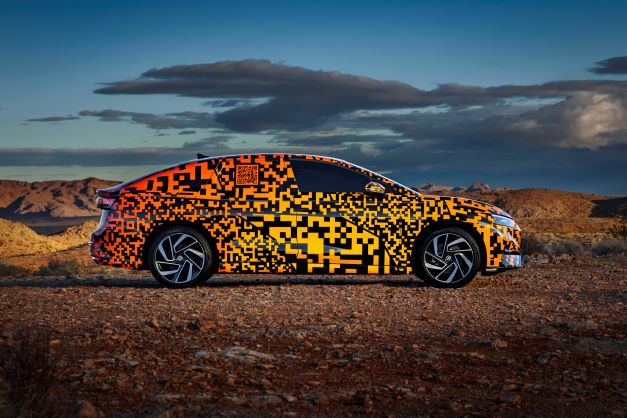
Clever, color-changing camo for the VW ID.7, a vehicle shown at the 2023 CES. (Image: Volkswagen)

On this edition of “Autoline After Hours” Chris Thomas, former chief technology officer at BorgWarner who is now an industry consultant and Paul Eisenstein, publisher and editor-in-chief of The Detroit Bureau, join “Autoline’s” John McElroy and me to talk about what they saw at CES. (The other three were there. I wasn’t.)

The conversation ranges from small radar sensors that could be deployed in vehicle interiors to determine what’s on a given seat and under the hood to determine the level of washer fluid (they are both small and economical) to the BMW concept car that features an exterior material that allows the selection of 32 different colors and combinations thereof—when you want them.

The consensus of the group is that technology is what is driving changes in the auto industry and CES is the correct venue for the exhibition of that technology. (It should also be noted that the CEOs of BMW and Stellantis made keynote addresses; the show also has a conference element to it.)

While there continues to be some doubt about the prospect of traditional auto shows going beyond the function of showing the consumers the latest in vehicles that they can also see at their local dealers, going back to the function of providing a look at what could be, it seems that there is no question about the viability of CES providing the latter function in a very big way.

You can see the show here.

Toyota’s Approach to Environmentally Appropriate Vehicles

By Gary S. Vasilash

There is an on-going criticism of Toyota that it is behind other OEMs when it comes to electric vehicles.

Which is true if the companies in comparison are Ford and GM.

At present, Toyota has one full battery electric vehicle, the bZ4X. It also has one hydrogen-powered electric vehicle—generally referred to as a “fuel cell electric vehicle” or “FCEV”—the Mirai.

At present there are no Lexus electric vehicles, battery or otherwise.

The EPA has recently published “The 2022 EPA Automotive Trends Report.” It examines greenhouse gas emissions and fuel economy.

In the report it shows that from 2016 to 2021, the miles per gallon for the aggregate of vehicles produced by the following companies are:

  • Ford:                      22.8 to 22.9 mpg
  • GM:                       22.4 to 21.6 mpg
  • Stellantis:               21.5 to 21.3 mpg

In other words, Ford improved by 0.1 mpg while GM and Stellantis both went in the wrong direction.

Similarly, the CO2 measures are:

  • Ford:                       389 to 385 grams per mile
  • GM:                        397 to 414 grams per mile
  • Stellantis:               413 to 417 grams per mile

In the case of CO2 measures, less is better. Ford got a bit better. The other two didn’t.

Stellantis presently has no full battery electric vehicles. It does have plug-in hybrid (PHEV) versions of the Pacifica, Wrangler and Grand Cherokee.

Ford has battery electrics. The F-150 Lightning, the Mustang Mach-E and the E-Transit. It also has hybrid versions of the Escape, Maverick, F-150, and Explorer. Lincoln offers hybrid versions of the Aviator and the Corsair but no battery electrics.

GM has the Chevrolet Bolt EV and Bolt EUV, Cadillac LYRIQ and HUMMER EV battery electric vehicles at present and no hybrids.

So how does Toyota measure on the EPA metrics?

  • Toyota:                    25.0 to 27.1 mpg

and

  • Toyota:                    355 to 327 grams per mile

Or simply put, in the aggregate, the vehicles that the company put out in the market between 2016 and 2021 are, from an environmental standpoint, better than the vehicles from the other three manufacturers.

And it is worth noting that in 2021 Toyota, with sales of 2.3-million vehicles, was the top manufacturer in the U.S. GM sold 2.2 million, Ford 1.9 million and Stellantis 1.8 million.

It didn’t have the bZ4X last year, so that doesn’t count in its numbers. It did have the Mirai, but the number of those it sells could pretty much fit in the parking lot of a large stadium.

But what it does have are the Prius and Venza and hybrid versions of the Corolla, Camry, Avalon, Sienna, Highlander, Sequoia, RAV4, Tundra, and Lexus ES, UX, NX, RX, LS, and LC.

It could be argued that those vehicles contributed a lot to the “greener” performance of Toyota compared with Ford, GM and Stellantis.

It could also be argued that especially compared with Ford and GM Toyota is some sort of Luddite when it comes to green powertrain technology. . .yet the EPA figures don’t indicate that what it is putting on the road is in any way behind the curve.

On this edition of “Autoline After Hours” we are joined by Jordan Choby, vice president of Powertrain Control at Toyota Motor North America R&D. He joins us from the Toyota Gardena, California campus where fuel cell development is occurring.

Choby explains that, yes, Toyota is working on battery electric vehicles and it plans to have 30% of its global volume be electric vehicles by 2030, but that the company is operating on model that is providing consumer choice regarding the type of engine or motor that is under the hood of their vehicle.

Choby talks with “Autoline’s” John McElory, Tom Murphy of Autoweek, and me.

And you can see the show here.

Cadillac CELESTIQ Explained

By Gary S. Vasilash

“Go make something epic.”

That, Tony Roma, chief engineer of the Cadillac CELESTIQ, says was the mandate he and his team received from GM management to develop a vehicle for the brand that is more like an aurora borealis than a mere halo.

This is a full-size uber-lux electric vehicle that customers will commission, not simply buy.

The Cadillac CELESTIQ is an expression of what can be accomplished by a team given a mandate to “make something epic.” (Image: Cadillac)

It is a sedan that has aluminum mega-castings at the base of its overall structure and an exterior skin made primarily with carbon or glass fiber panels. Roma says that the doors are made with SMC—because the material is transparent to radar, and there are radar units in the doors. Yes, the vehicle is also ladened with plenty of technology, including Ultra Cruise, which will allow hands-free driving in multiple driving scenarios, going well beyond the Super Cruise that GM offers in Cadillacs and other brands.

The CELESTIQ has an 111-kWh Ultium battery pack and a two-motor, all-wheel drive system that generates an estimated 600-hp and 640 lb-ft of torque: Roma says that the car goes faster in a straight line than a CT-5 Blackwing—but the vehicle, he says, is powered such that it provides confidence for the driver and is not meant to have performance for performance’s sake.

This is not simply another vehicle in the Cadillac lineup: the companies benchmarked for the CELESTIQ included Rolls-Royce and Bentley. The pricing for the vehicle is on the order of $300,000+.

Roma says that the production rate of the hand-built vehicles—and the building is going to occur not in a factory, but at the GM Global Technical Center in a special clean-room like facility that is called the “Artisan Center.” The company has made an $81-million investment for producing the vehicle. Within the Artisan Center there will be no more than six vehicles being built at any given time.

Speaking of the development of the vehicle Roma says, “This is all-in house. We didn’t write a check [to another company] and put our badge on it.”

The CELESTIQ, in effect, is a vehicle that makes a statement that Cadillac is a brand that is competitive at the highest echelon within the auto industry.

Roma talks about the engineering that goes into the CELESTIQ on this edition of “Autoline After Hours” with “Autoline’s” John McElroy, Frank Marcus of MotorTrend and Richard Truett of Automotive News.

It is arguably one of the most comprehensive insider looks on what will be a landmark vehicle, not only for Cadillac, but for the overall auto industry.

And you can see it here.

All About Jeep

By Gary S. Vasilash

While Jeeps have been rolling along—literally and figuratively—since 1941, and while the competitors have come, gone, and come back again, it seems that the brand has essentially stuck to its knotting,* building vehicles that allow drivers the freedom to go places where other vehicles would fail to get beyond the parking lot.

Jeeps now come in a wider range than ever, with the iconic Wrangler at one end of the spectrum and the Grand Wagoneer at the other.

Spend some time driving a Wrangler on the highway and you’re going to hope that you get to your destination sooner rather than later—and you’re going to hope that the destination includes some serious off-road driving.

Coming in 2024: the fully electric Wagoneer S–although it will likely have a different name by then. (Image: Jeep)

Spend some time driving a Grand Wagoneer and you’re going to hope that you get to your destination eventually (no hurry)—the comfort and amenities make the term “first class” seem numerically weak.

To help get a better understanding of what is this on-going phenomenon, on this edition of “Autoline After Hours” we talk with Jim Morrison, senior vice president and head of Jeep brand North America.

Morrison was appointed senior manager of Product Marketing for Jeep in 2010 and he has been involved with Jeep in several positions since, getting his current one in 2019.

Like other vehicle brands, Jeep is making the transition to electrification, with current plug-in hybrid versions of the Grand Cherokee and Wrangler (both with the nomenclature 4xe) proving themselves to be well accepted in the market.

Jeep has announced that there will be a full battery electric vehicles coming by 2024, the Jeep Recon and the Wagoneer S (with the latter name being a place holder as the Jeep community is getting an opportunity to provide potential names for the vehicle).

Morrison talks about where Jeep has been—and where it is going—with “Autoline’s” John McElroy, Roman Mica of TFLcar, and me on this edition of the show.

You can see it here.

*While “knitting” is generally the word used, “knotting” seems more Jeep-like robust.

The Transformation at ZF

By Gary S. Vasilash

One of the aspects of the industry’s transition to electric vehicles that doesn’t get a whole lot of attention is that suppliers are responsible for large portions of a vehicle, so as there is the move from internal combustion engines to electric motors, as there is an increase in the importance of software, suppliers need to undergo a transition. . .or they will find themselves under water in short order.

However, making the switch isn’t like throwing a switch.

There are existing competencies within an organization—the things that allowed it to be selected as a supplier in the first place.

But now those competencies, while not completely irrelevant—let’s not lose sight of the fact that internal combustion engines aren’t going away for several more years—are less important within a supplier’s portfolio.

And there is the abiding issue of having the financial wherewithal to make the change, both from the standpoints of people and installed base of capital equipment.

Regardless of what list of the top suppliers you consult, you’ll find ZF right up there.

(Image: ZF)

Going Mobility

Martin Fischer heads up ZF’s operations in North America.

He describes what ZF is now as “a technology supplier to the mobility industry.”

Were you to ask someone in the industry about what ZF is just a few years ago, they’d probably answer, “The company that makes those impressive eight-speed automatic transmissions.”

While the company continues to produce those eight-speeds, Fischer says on this edition of “Autoline After Hours” that they’re not going to be making more investments in eight-speeds.

There are other things on the agenda.

Fischer says the focus today is on technologies related to autonomous driving, electric drive systems and components, and integrated safety, technologies that are both physical and digital.

To help the company move to new places, Fischer says they first started out with small teams that developed products, then integrated those people into the larger company so that everyone becomes involved.

The classic portfolio that ZF has had is undergoing a significant change, with everything from controllers that it is collaborating with NVIDIA on to electric motors to steer-by-wire systems and more. Not the sort of things that one might imagine a “classic” supplier would have the wherewithal to do–at automotive scale and quality.

What ZF is doing is essentially a masterclass in maintaining relevance in a changing industry.

Talking to Fischer are “Autoline’s” John McElroy, Lindsay Brooke of Automotive Engineering, and me.

You can see the show here.

How To Achieve a Smooth Ride

By Gary S. Vasilash

Noise-canceling headphones work not by adding something like the hissing of white noise to take the place of the annoying sound that you’re trying to minimize, but by, well, canceling the noise.

That is, sound takes the form of waves. The headphones determine that nature of those waves then generate a counterwave which has the effect of canceling the original wave.

Automotive OEMs have been using tech of this sort to make the cabins of cars quieter. Again it is a matter of detecting the noise that is to be eliminated, creating a counter wave, then playing it through the speakers of the audio system.

So sound is waves, or vibrations.

There is something else that vehicles encounter that create vibrations: road surfaces. Because they are not absolutely smooth, there are some vibrations. Because most ordinary roads are far from being absolutely smooth, there are lots of vibrations.

What about detecting those vibrations and then setting up counter vibrations in the suspension system?

That is, simplistically put, what Massachusetts-based ClearMotion is doing with a system that is one part software and one part mechatronics. The software portion takes care of determining what the vibrations are that need to be countered; the mechatronics portion produces the motion that is necessary to perform the task. There are four Activalve units for a given vehicle, one on each corner.

Christian Steinmann, ClearMotion CEO, says that not only does the setup provide a smoother ride—something that will be increasingly important as there are increased levels of autonomy, which means that people will be able to do things like read or watch videos rather than keeping their eyes on the road—but it enhances the overall handling of the vehicle.

Steinmann talks about the system on this edition of “Autoline After Hours.” Joining “Autoline’s” John McElroy and me is freelance auto journalist Jack Nerad.

And you can see the show here.

By the way: the analogy to noise-cancelling headphones isn’t a fanciful one: ClearMotion acquired the Bose Ride business, Project Sound active suspension and software to develop into its system.

Bob Purcell: from the EV1 to the VIA Skateboard Chassis

By Gary S. Vasilash

Bob Purcell has been in the EV space for a number of years. In the early 1990s when General Motors was developing the EV1 Purcell was involved. He was to become the head of the then-newly formed Advanced Technology Vehicles Division at the company. After nearly 17 years at GM Purcell left the corporation and worked at companies involved in batteries and electric propulsion systems.

Purcell is now the CEO of VIA Motors, which is a producer of an electric skateboard chassis for application in Class 2 through Class 5 cargo vans, trucks and buses.

The skateboard chassis allows an array of upfitting opportunities. (Image: VIA Motors)

Although he had his start with a passenger car (the EV1), Purcell is convinced that commercial vehicles are the ideal place for electric propulsion.

As he explains on this edition of “Autoline After Hours” this is because the total cost of ownership of an electric truck is less than that of one with a thermal engine, thanks to things like reduced maintenance requirements. In addition to which, he says there is a 4:1 per mile cost benefit (electricity vs. liquid fuel). All things that add up to improvements to the bottom line of commercial carriers.

(While personal vehicle owners can also experience the same advantages, it isn’t often—if ever—that you hear the buyer of a new EV say, “I got this because the life-cycle costs are a distinct advantage.”)

Purcell talks with “Autoline’s” John McElroy, Sam Abuelsamid of Guidehouse Insights, and me on the show.

Beyond his discussion of what they’re doing at VIA, Purcell shares plenty of insights on both his career as well as the overall EV landscape. The man is clearly an EV proponent, but unlike many boosters of the tech, Purcell has a deep base of knowledge in the space, which makes him far more credible than the average EV enthusiast.

And you can see the show here.

Toyota, GM, Ford; EVs, AVs and ADAS

By Gary S. Vasilash

Last week Norihiko Shirouzu of Reuters reported “Toyota is considering a reboot of its electric-car strategy to better compete in a booming market it has been slow to enter.”

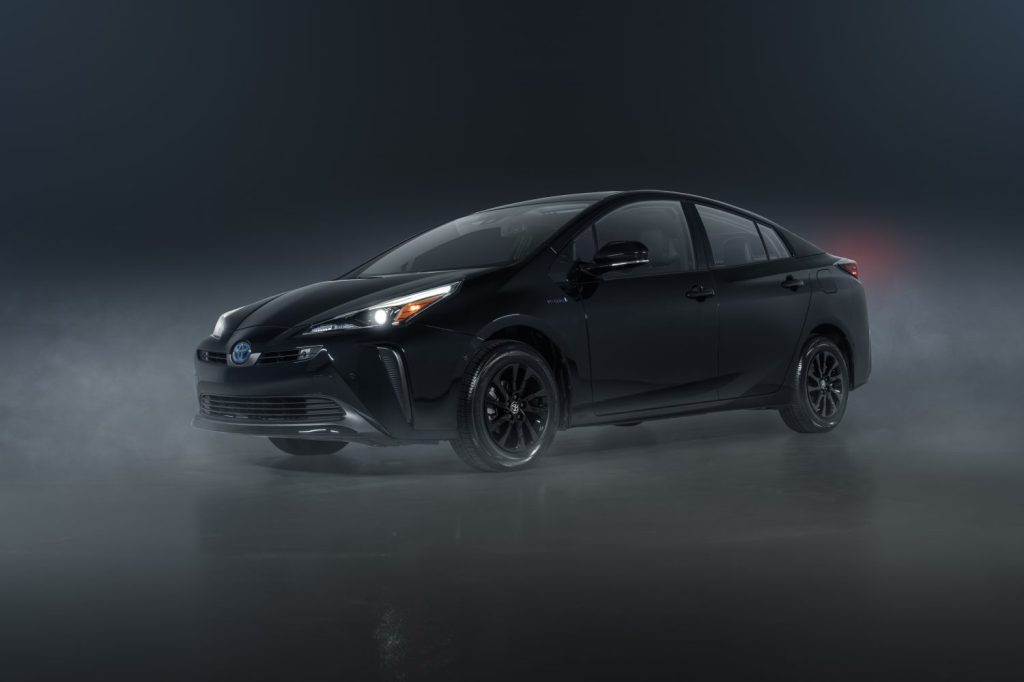
Toyota’s Prius is synonymous with “hybrid.” The company has pretty much hybridized everything. It argues—or maybe that would be “argued”—that it is better to build a whole bunch of affordable hybrids than a comparatively few electric vehicles that are comparatively more expensive: according to Kelley Blue Book, the average price of an electric vehicle in the U.S. in September was $65,291. The average transaction price for vehicles overall, KBB calculated, was $48,094. Which is roughly a 27% delta, which is certainly non-trivial.

Yes, this is a Prius. (Image: Toyota)

Be that as it may, Shirouzu’s sources indicated that “Toyota’s planning had assumed demand for EVs would not take off for several decades.” Which is decidedly not the case.

So is Toyota making a pivot? That is one of the subjects discussed on this edition of “Autoline After Hours.” Joining “Autoline’s” John McElroy and me are automotive consultant/analyst Jack Keebler and long-time auto journalist, currently freelancing at Autoweek, Todd Lassa.

Other topics discussed are the Q3 earnings of both General Motors and Ford, as well as those companies positions on autonomous driving: GM continues to be bullish on the prospects for Cruise, still anticipating revenue of $1-billion from the operation by 2025; Ford is far more conservative, as it announced that Argo AI, the AV company that was owned primarily by it and Volkswagen (each had 39%), was closing. Ford going forward would focus more on Level 2+ and Level 3 ADAS. (Ford CEO Jim Farley: “It’s mission-critical for Ford to develop great and differentiated L2+ and L3 applications that at the same time make transportation even safer.”)

The conversation is wide ranging and lively. And you can see it here.

Saving Cadillac

By Gary S. Vasilash

John F. Smith worked at General Motors at the same time that John F. Smith worked at General Motors.* The latter was to become GM CEO. The former was appointed by the latter to a number of executive positions within GM.

Perhaps the most notable was in 1997, when he was named head of Cadillac.

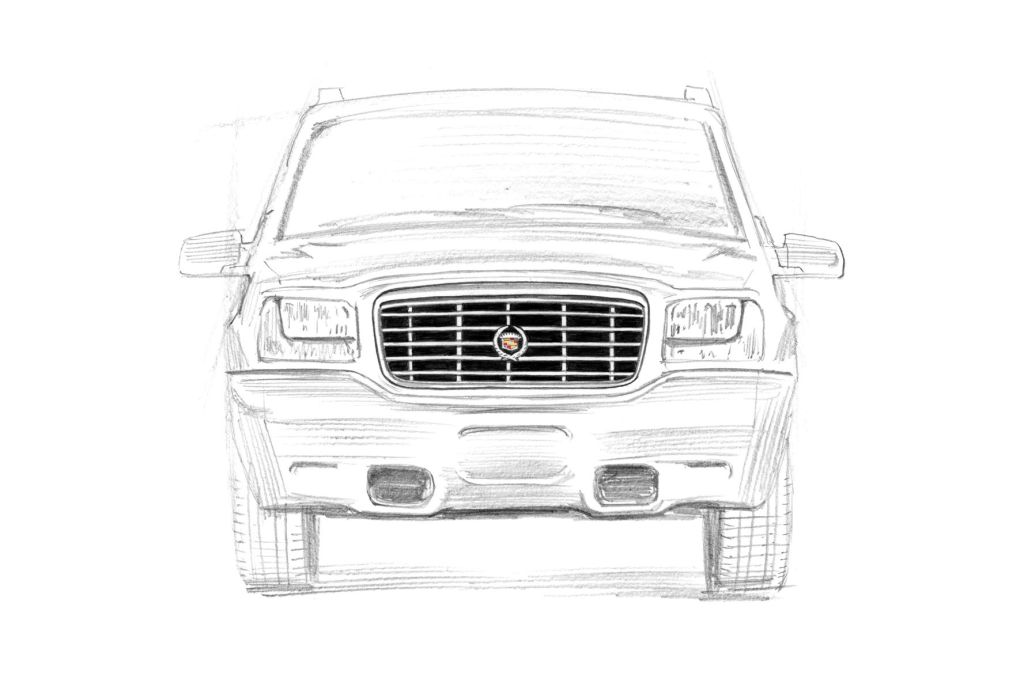
Things weren’t great at that brand back then. Hard to believe, but there was something that is now intrinsic to Cadillac that was absent: the Escalade, the massive truck-cum-SUV that has had visual presence on the road for a little more than two decades now.

The original Escalade. (Image: GM)

The Escalade was to come to be under John Smith’s period at Cadillac, helped into existence by the other John Smith, who was known as Jack.

John Smith talks about his career at Cadillac in this edition of “Autoline After Hours,” as well as a book he has recently had published about some of his adventures in the auto industry, Fin Tails: Saving Cadillac, America’s Luxury Icon (see how important Escalade was/is?).

Also on Smith’s resume are positions including vice president of Planning at General Motors International Operations in Zurich as well as president of Allison Transmission. Which is to say that he has a broad perspective on the auto industry, one broader than just Cadillac.

On this edition of “Autoline After Hours” Smith spends the hour talking with “Autoline’s” John McElroy, Doron Levin, who, among other things, writes about the auto industry at Saving Alpha and me.

And you can see it here.

*Given that “Smith” is the most common surname in the U.S., and “John” has been in the top 10 until 1987, this isn’t exactly surprising.