
About Battery Timing

At some point will it be analogous to buying Duracell, Eveready or Kirkland. . . ?

By Gary S. Vasilash

Compared with GM and Ford, the other company in the “Detroit 3,” Stellantis North America, which is still simply referred to as “Chrysler” in southeastern Michigan, is behind the curve when it comes to electric vehicles.

You can buy or lease an EV from GM or Ford.

But so far, with the exception of the exceptionally limited Fiat 500e (limited as in having a range of 149 miles, which is about half of what many people are interested in when thinking about an EV), there is no mainstream EV available from Chrysler, Dodge, Jeep, Ram, or Alfa Romeo.

But earlier this week it announced that NextStar Energy, a joint venture between Stellantis and LG Energy Solution, has started battery module production in its plant in Windsor, Ontario. Next year it plans to launch cell manufacturing.

The Dodge Charger, electric version. (Image: Dodge)

And the company also announced that it will be operating a demo fleet of Dodge Charger Daytona EVs with solid-state batteries from Factorial, a battery company that it has invested $75-million in.

What is interesting about the Factorial battery is that the company claims they’re working for a range of 600+ miles from a battery that is 33% smaller and 40% lighter than a conventional lithium-ion battery.

However, that fleet won’t go into operation until 2026.

So presumably if all goes well, it would still take some time before the Factorial tech makes its way into production vehicles, which explains why there is the production at NextStar Energy: they’re going to need something sooner rather than later.

Factorial is also working with Mercede-Benz. The two companies announced last month the development of a new solid-state battery technology, about which Markus Schäfer, Chief Technology Officer and Member of the Board of Management at Mercedes-Benz Group AG, said: “The Solstice solid-state battery technology represents another landmark milestone in our partnership with Factorial, which is a cornerstone of Mercedes-Benz’s strategy and commitment to leading the charge in battery development. Solstice offers further improvements in energy density and safety features that will help us develop electric vehicles that set new standards in range, cost, and performance.”

Note the future tense of “will.” Not now. But sometime.

In the meantime Mercedes gets batteries from companies including LG Energy Solution and CATL.

Mercedes, like Stellantis, has had a joint-development arrangement with Factorial since 2021.

So at some point in the future will the situation be that multiple OEMs will have access to the same battery technology and so there will be differentiators required other than charging time and range?
From the Dodge Bros. to the Hellcat Durango

An interesting historical path. . . .

By Gary S. Vasilash

What do Aretha Franklin, Edsel Ford, Rosa Parks, and John and Horace Dodge all have in common?

They’re buried in the same cemetery, Woodlawn, in Detroit.

The Dodge brothers had some other interesting connections while still on the upper side of the ground.

In 1901, the bros moved from Niles, Michigan to Detroit to open a machine shop (it is surprising they didn’t move to someplace like South Bend, Indiana, because there was a non-trivial amount of machining going on there back then; in 1906 two other brothers, John and Miles O’Brien, established South Bend Lathes, which became the world’s largest producer of lathes for a period,and numbered Henry Ford among its customers).

They were contacted by Ransom E. Olds, who had a fire in his factory and required some transmissions, which the Dodge brothers supplied.

Henry Ford put the Dodge brothers under contract in 1903. Henry had to pay the Dodges with stock when he was having some financial difficulties. That stock was then used by the brothers so that in 1914 Dodge Brothers was formed.

Remember when people talked about the COVID pandemic in relation to the so-called “Spanish flu” outbreak in 2018?

Both of the Dodge brothers contracted the flu (and pneumonia) in 1918. Both of the brothers died in 1920.

Their company was sold to an investment bank, which sold it to Chrysler in 1928. At that time, Chrysler Corporation, was just three years old.

The brothers were featured in a series of TV ads in 2014-15 for vehicles including the Dodge Charger, showing that they were non-conformists who were interested in performance.

Which, 104 years after they physically passed, is something that is part and parcel of the company.

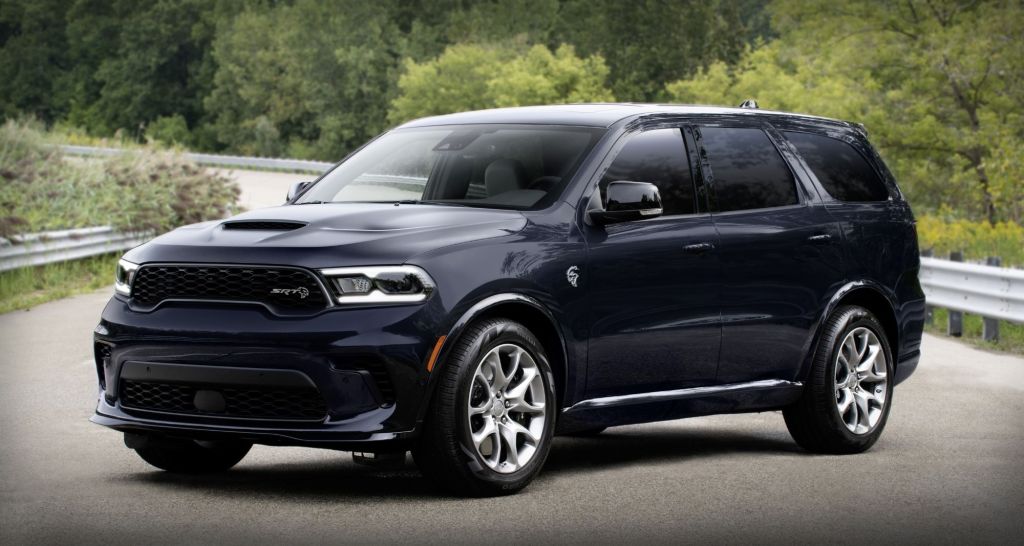
2025 Dodge Durango SRT Hellcat Hammerhead: presumably the thing that John and Horace Dodge might take out for a spin. (Image Dodge)

Which is exemplified by the 2025 Dodge Durango SRT Hellcat Hammerhead special-edition introduced earlier this week.

Perhaps all that need be said about that SUV is that it is powered by a 710-hp HEMI.

And as we have taken a massive historical trail to get to that vehicle, it is notable that the Durango, which is in normal fitment essentially a three-row family-hauler, was first equipped with a HEMI in 2004, or 20 years ago.

EV (Dis)interest

By Gary S. Vasilash

One of the things that isn’t talked about much is the fact that electric vehicles really aren’t that popular unless they come from Tesla.

Flying in the face of that is a finding of Kelley Blue Book that in Q3 2023 EV sales in the U.S. hit 313,086 units, a 49.8% increase over Q3 2022. Such a jump means interest, right?

Well, the total number of EVs sold in Q3 represents 7.9% of total industry sales.

In other words, 92.1% of the vehicles people bought in Q3 weren’t electric.

And to the point of Tesla’s sway over the market—even though KBB saysTesla’s share of market tumbled to 50%–is that KBB acknowledges“Tesla’s price cuts have moved the market, pushing electric vehicle prices down more than 22% year over year, from $65,295.”

That’s right: a single company moves the entire segment.

(And in case you’re wondering, in October, according to KBB, the average transaction price for an EV was $51,762 while the ATP for a non-lux vehicle was $44,331.)

Drilling down a bit more, it is bracing to discover that in terms of share of the EV segment, the mainstream brands really don’t have much in Q3.

  • Chevrolet, 5.1%
  • Ford, 6.7%
  • GMC, 0.4%
  • Hyundai, 6.3%
  • Kia, 3%
  • Nissan, 1.9%
  • Subaru, 0.9%
  • Toyota, 0.9%
  • VW, 3.4%

And know that the 6.7% for Q3 Ford racked up represents 20,926 vehicles: 14,842 Mach-Es, 3,503 F-150 Lightnings and 2,617 E-Transits.

Ford sold 23,931 Mavericks in Q3, of which 56.5% were hybrids. Somehow that 20,926 EVs sold—encompassing three models, one of which is based on the best-selling pickup Since Time Began—seems more than anemic.

So even before Ford started talking about having to make adjustments as a result of the salary and benefit increases in the proposed agreement with the UAW, the auto company suddenly found things like the F-150 Hybrid more interesting.

When I ask knowledgeable people about the subject, they point out that much of the EV development and promotion is predicated on government regulations, more than organic customer demand. Look at those puny percentages up there, slices of the 313,086 vehicles sold by companies ranging from Audi to Volkswagen.

There’s not much there there.

Yes, there will be more EVs offered. More EVs sold.

But—again, absent Tesla—the market demand isn’t at all what it sounds like it should be.

Another example of this not-big demand is something that some point to as a real success story: the Chevrolet Bolt EV.

Here are the sales figures for the past five years:

  • 2018: 18,019
  • 2019: 16,418
  • 2020: 20,754
  • 2021: 24,828
  • 2022: 38,120

Whoa! you might think. From 2018 to 2022 the sales of the Bolt EV doubled! Remarkable.

But there are a couple of elements that need to be considered.

For one thing, Chevy added a (slightly) different body style, the more ute-like Bolt EUV in 2021, which certainly added some interest to the model(s).

And in June 2022 General Motors cut the price of the Bolt to persuade customers to buy one—sort of like what Elon has been doing.

Had Dodge made a substantial price reduction to the SRT Hellcat Redeye Widebody, the Brotherhood of Muscle would exponentially increase its membership of all genders and municipalities throughout the country would have a sharp uptick in revenues from speeding tickets.

If there is a change in the political situation, those regulations that are driving EV development and sales and those incentives that do the same (what if the government offered $7,500 tax credits for the purchase of a Hellcat?), the question of actual market demand is really going to matter.

Jeep? Ram? Huh?

By Gary S. Vasilash

The first half (H1) 2023 results for FCA US LLC—that part of Stellantis that is often referred to by the shorthand “Chrysler”—are out.

And look odd.

It is generally considered to be the case that the real U.S. crown jewels that the company based in the Netherlands obtained when Fiat and PSA merged were Jeep and Ram, the brands that don’t offer things that in any way, shape or form resemble cars.

For the U.S. sales for the first half of 2023 there is only one Jeep model that has actually had greater sales compared with H1 2022, the Compass. And arguably the Compass is, by and large, the least Jeep-like Jeep of all Jeeps in the showroom.

Wrangler sales are off by 15% and the Grand Cherokee is down 7%. Those two vehicles are essentially the bookends of the brand.

There was great hope for the Wagoneer and the considerably more expensive Grand Wagoneer, but they are off 21% and 26%, respectively.

An argument could be made that Jeep had the segment to itself for a long, long time and now things like the Bronco Sport and Bronco are taking away sales. Which could, indeed, be the case because for H1 Bronco Sport is up 7.8% and Bronco 6.8%.

Another thing might be that post-pandemic the whole “overlanding” phenomenon is waning and those who are more likely to use their Wranglers as Wranglers are still buying Wranglers and the rest have moved on to something else.

As for the Grand Cherokee, it is possible that some of its sales have gone to the Dodge Durango. Its sales for H1 are up 82%. Realize that there are plenty of dealerships that have Jeep, Ram, Chrysler, and Dodge under the same roof, so someone shopping could easily see a Durango and opt for it because, say, a Grand Cherokee with the sought configuration isn’t available.

Overall Jeep brand sales are off by 12% compared with the same period last year.

Meanwhile, over at Ram, it is only off 2%–but it would seem that it should be up.

For example, Ford truck sales are up 23.1%. GM also shows black ink for truck sales, with all flavors of Silverado being up 1.6% in H1 and the Sierra portfolio up 20.2%.

What is strange about the Ram numbers is that the Ram pickup is down 9% for H1 and the only reason why the brand isn’t down more is because the two commercial trucks on offer—the ProMaster Van and the ProMaster City—are both up, 50% for the Van and 70% for the City.

As for the other FCA US brands, that Durango has really boosted Dodge H1 results: up 31%.

Even Chrysler brand is up 23% thanks entirely to the Pacifica minivan, which is up 26%. The only other vehicle in the Chrysler showroom is the 300, which is (a) down 5% for H1. And given that for the first half there were 73,845 Pacificas sold and 7,197 300s. . .well, it makes one wonder about the on-going value of the Chrysler brand.

So maybe a few years from now that shorthand identifier for the company will be something else. But what that is isn’t entirely clear at this point.

Dodge CEO Tim Kuniskis on the Transition to Electric

By Gary S. Vasilash

Perhaps more controversial than Dylan going electric in 1965. . .

If you think about “Dodge,” you have a pretty good idea of what it is: A lineup of muscle cars. It is a brand that has pared itself down to an essence, as things like the Journey and Caravan have gone away, leaving the bulk of the brand on the shoulders of two vehicles, the Charger and the Challenger. (The Durango is still in the showroom.)

The positioning of the brand is unapologetically the “Brotherhood of Muscle,” although all genders are encompassed within the club.

Dodge Charger Daytona SRT Concept: Dodge goes electric. (Image: Dodge)

One might think that this whole muscle car thing is an anachronism. HEMI engines don’t seem to a thing that would resonate in the age of Greta Thunberg.

However, in the first half of 2022, Dodge outsold Chrysler, Fiat and Alfa Romeo combined: 84,761 to 73,010.

There is a defined niche of buyers for whom muscle cars matter. And they buy them.

Although the platform underpinning the Charger and Challenger is, by contemporary standards, vintage, the people at Dodge have kept things going by introducing special editions and packages for the cars (e.g., the SCAT Pack Swinger, a tribute to the late ‘60s and early ‘70s).

Tim Kuniskis is the CEO of Dodge. And on this edition of “Autoline After Hours” he explains how Dodge will keep being propelled forward with cars even though he admits “cars are dead”—albeit dead for those who don’t necessarily consider their vehicles to be a representative of who they are. The Brotherhood of Muscle knows what matters to them and prove it every day.

Still, Kuniskis and his team are fully aware that the market is changing, moving away from HEMIs to electric propulsion.

So rather than pretending that it is otherwise, they have rolled out with “Last Call” editions of the Charger and Challenger and revealed the bad-ass battery electric Charger Daytona SRT Concept.

They are putting the proverbial pedal to the metal as they drive toward an electric future.

As Kuniskis points out in the show, people who drive muscle cars think somewhat differently than ordinary car consumers.

For example, do you think someone with a supercharged 6.2-liter HEMI Hellcat high-output V8 under the hood—a 797 hp or 807-hp engine, depending on package—is at all concerned with the fact that they may get a combined mpg of 15? Given that, what is the likelihood that someone getting an electric muscle car is going to be concerned whether the range is 300+ miles or a fraction of that—as long as the car moves like a bat-out-of-hell (which explains why the propulsion system in the concept is named “Banshee”)?

Ordinary EV buyers are largely concerned about range. Dodge EV buyers will focus on performance. (OK: some of them will be concerned with range, but they’re going to want to make sure that their cars seem to be hellacious performers.)

Kuniskis talks about the present and the future of Dodge with “Autoline’s” John McElroy, Chris Paukert of Edmunds, Mike Musto of Hemmings and me.

Even if you aren’t particularly interested in muscle cars per se it is a fascinating look at how a brand that is as intensely focused on one segment as Dodge can make a transition to a different technology model without disaffecting its customer base.

One can imagine that the Dodge switch to an electric future will become a business school case study, which you can learn about now, for free, here.