
Impressive for an EV. . .but one that isn’t as real as a gas-powered one you can buy right now. . . .
By Gary S. Vasilash
Mercedes-Benz recently announced that it performed a “real-world” test of an electric vehicle—a “lightly modified” Mercedes EQS—for a distance run:
It went from Stuttgart, Germany, through Denmark, to Malmo, Sweden, without a stop for recharging.
This means it traveled 749 miles. What’s more, there were 85 miles remaining in the battery.
Now presumably “real-world” means that they performed the test in the world that we know, regular highways.
Because what isn’t “real-world” in the context of what we know is that the sedan was equipped with a solid-state battery system developed in cooperation with Mercedes-AMG High Performance Powertrains, the same operation that provides tech for the Mercedes Formula One team.
Most of us don’t have access to that kind of tech in our real worlds.
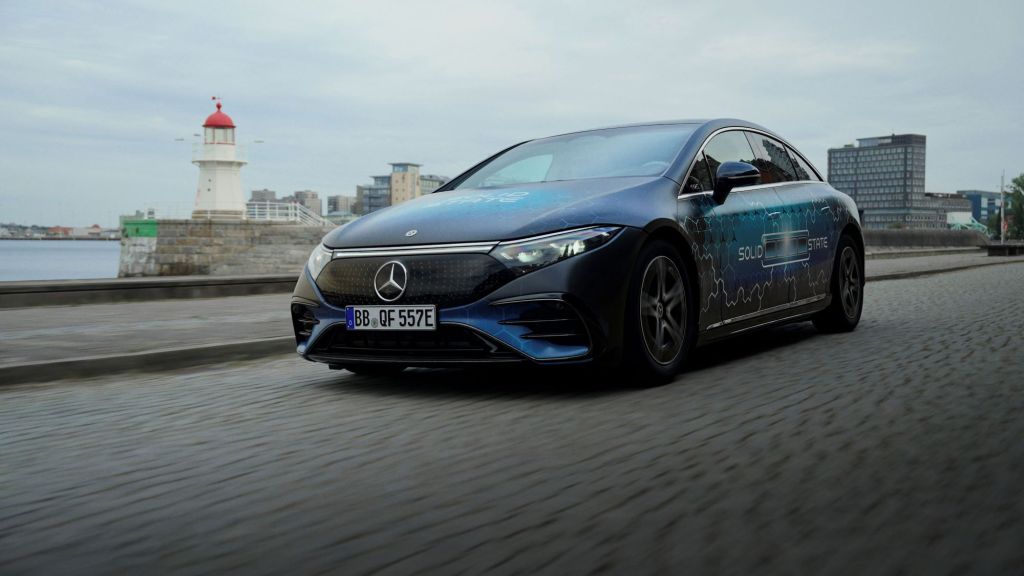
The solid-state lithium-metal cells were produced by Factorial Energy, a Woburn, Massachusetts-based company that is working with Mercedes, Stellantis and Hyundai on the solid-state tech.
You can’t buy a vehicle (for now) in the real world that has a battery of this type, to say nothing of one that was developed with an F1 supplier.
According to Markus Schäfer, Member of the Board of Management of Mercedes‑Benz Group AG, Chief Technology Officer, Development & Procurement:
“The solid-state battery is a true gamechanger for electric mobility. With the successful long-distance drive of the EQS, we show that this technology delivers not only in the lab but also on the road. Our goal is to bring innovations like this into series production by the end of the decade and offer our customers a new level of range and comfort.”
Which is a fair point.
But back to the real world for a moment.
The Mercedes S 500 is not unlike the Mercedes EQS, although it is a gasoline-powered vehicle.
The S 500 fuel economy numbers are 21 mpg city, 31 mpg highway, 24 mpg combined.
The S 500 has a 20-gallon fuel tank.
So if we take the combined number, that gives it a range of 480 miles, which is short of the 749 miles from Stuttgart to Malmo.
Even though the route from Stuttgart to Malmo is mainly highways, if we take the 24 mpg number it only provides 620 miles of range.
However, one assumes that during a 749-mile drive there would be a need for at least one stop to attend to some personal issues.
During such a stop, a vehicle can be refueled in about five minutes. So let’s say that to be on the safe side someone stopped after using 450 miles of range, leaving 30 miles in the tank, and refueled.
That means there would be 299 miles left to go, but the full tank would provide 499 miles of range, or arrival in Malmo with 181 miles of range still in the tank.
And this is with a production vehicle you can get at your local Mercedes dealer today.

 shinymetalboxes