
EV Public Charging Isn’t Doing Much Better

J.D. Power sees improvement. But were we grading on the usual scale. . .

By Gary S. Vasilash

The J.D. Power 2024 U.S. Electric Vehicle Experience (EVX) Public Charging Study is out, and the research firm finds improvement in that experience.

Sort of.

Said Brent Gruber, executive director of the EV practice at J.D. Power, “While the customer satisfaction scores for public charging continues to prompt concern, the results offer reasons for optimism.”

He’s undoubtedly an optimistic individual.

The study found that on a 1,000-point scale, the satisfaction with speed at Level 2 chargers has dropped 4 points to 451.

DC fast charger speed is more satisfying, up from 588 in 2023 to 622.

While that 34 point bump is good, remember Power is using a 1,000-point scale, so if you were in school and got that 622 on a test. . . .

And then there is the issue of non-charging. As in showing up at a charging station and not being able to charge.

Power found 19% of the surveyed EV owners had that problem. A one-point improvement over 2023.

The researchers found that nationwide 61% said the reason there was a wasted visit was because the charger was out of service or didn’t work.

Huh?

The average transaction price for an electric vehicle in July was $56,520, according to the latest figures from Kelley Blue Book.

So someone buys an EV for that price, glides into a charging station—and nearly one out of five times has to leave because the damn thing doesn’t work.

Yes, some 80% of EV owners charge at home, but that means some 20% of EV drivers don’t.

In addition to which, some of the 80% of EV drivers who charge at home are likely to take trips at some point—vacation or business—which could likely mean they need to charge along the way.

And they’re likely to find some 20% of those chargers out of order.
Can an EV Save You Money? (Maybe.)

By Gary S. Vasilash

The average price of a new gasoline-powered vehicle in March (the latest figure available) was $47,218.

That according to Kelley Blue Book.

The average price of a new electric vehicle in March was $54,021.

So quick math has it that there is about a $6,800 difference.

Energy Savings?

Researchers at Argonne National Laboratory have done some calculations regarding the amount of money that an EV can save a driver versus the same driver in a gas-powered vehicle.

They estimate that an EV can provide a savings of “up to $2,200 annually.”

Which essentially means, in effect, that in year four of owning the $54,021 EV rather than the $47,218 ICE the savings would start to accrue. (Yes, this would assume the unrealistic outright purchase of the vehicles, though an argument could be made that with comparative financing rates, the comparison works.)

Expensive Gas, Cheap Electricity. . .

However, the researcher found: “The largest fuel savings were found in areas with high gasoline prices, low electricity prices, preferences for larger vehicles and high annual mileage driven.”

So this sounds like the stars need to be aligned for that $2,200 to be achieved.

There’s Another Shoe to Drop

What’s more (or less), according to the National Association of Insurance Commissioners, “On average, EVs cost up to $44 more to insure per month than gas-powered vehicles, with the most expensive to insure being Tesla’s Model Y and Model 3.”

That would be an additional $528 per year, which would reduce the $2,200 to $1,672. Not trivial. But not as robust.

DIY Cost Check

The folks at Argonne have developed a web-based calculator that allows you to figure out how much you’d save based on the size of vehicle, annual mileage, fuel prices, electricity prices, and other parameters.

You can find that here.

All that said: How many people make a decision about what vehicle to buy predicated on how much they’ll save at the pump or socket?

I’m guessing not a whole lot.

Question About Charging Location

When Volvo and Starbucks announced a partnership last month for electric vehicle charging, it seemed reasonable.

ChargePoint DC fast chargers would be installed at up to 15 Starbucks outlets between Seattle and Denver. So when someone needed to get some “juice” they could also get some “joe.” (Admittedly corny but irresistible.)

In the case of a Volvo C40 Recharge, the battery could go from a 20% state of charge to 90% in about 40 minutes with a fast charger.

Hanging out at a Starbucks for 40 minutes is certainly the sort of thing that people do.

Which brings us to an announcement made by Chase, as in the bank, that it is partnering with EVgo. The two will install 50 EVgo chargers at 50 Chase branch locations.

This arrangement will offer 100-kW and 350-kW chargers which can bring vehicles up to an 80% charge in from 15 to 40 minutes.

Does anyone spend that amount of time at a bank?

Free Gas

By Gary S. Vasilash

Back in 2005, when gas prices were rising, some OEMs, as well as local dealers, offered consumers pre-paid gas cars. Mitsubishi, for example, depending on model, provided $1,500 to $2,500 for a vehicle purchase.

What’s interesting is that 2005 wasn’t really all that bad a year gas-price-wise.

That is, in 2002, according to the U.S. Energy Information Administration, gas averaged at $1.38 a gallon. It was something of a steady climb to $3.29 a gallon in 2008. The average price in 2005 was $2.31.

Today Kia America and Electrify America announced that buyers of the Kia EV6 electric SUV will get 1,000 kilowatt-hours of free charging at Electrify America stations.

In a clearer context: that’s enough energy to drive from 3,500 to 4,000 miles. Depending on the model. And the comparative heaviness of one’s right foot.

While that is certainly a nice bonus, it is puzzling that when there are vehicles ostensibly as good as the EV6 that the pot needs to be sweetened with some electrons.

To be sure it is a customer convenience, but doesn’t it, in some way, undercut the basic goodness of the vehicle (i.e., “Hey, you might be thinking of something else, but we’re going to put a cherry on top, so it is better!”)? Not that I have anything against free energy, but somehow the value proposition of the vehicle itself ought to be sufficiently compelling.

“So, Sally, why’d you buy the EV?”

“Free charging.”

Electrify America Tops in Charging Analysis

By Gary S. Vasilash

Electrify America, the company that was established by Volkswagen as part of its penalties associated with “Dieselgate,” is the network calculated to be best by umlaut, an organization that performs benchmarking, and Charged, an EV magazine.

Electrify America scored highest, with 702 of a possible 1,000 points.

Tesla came in second, at 649.

There were two primary categories:

  • Digital Platform
  • Charging Location

The people performing the analysis drove some 2,100 miles in Connecticut, Maryland, Michigan, New Jersey, New York, Ohio and Pennsylvania. They drove in a Mustang Mach-E and a Tesla Model 3.

In the Digital Platform category, which looks at things like the website and the app, Electrify America came in with 275 points. Tesla was well behind, at 165.

In terms of Charging Location, which is about the actual act of charging, Electrify America scored 426.75 points while Tesla came in at 484.25.

So the biggest difference is not out there plugging in at a station but while on one’s phone.

Guess it comes down to what is more important, especially when you just want to get the damn thing charged and on your away.

The other charge point providers and their scores are: Charge Point (611), EVgo (578), Greenlots (548), Blink (505) and EV Connect (472).

The Unplowed Road to Electric Vehicles

By Todd Lassa

The morning of General Motors’ reveal at CES in Las Vegas of new electric vehicles—most notably the Chevrolet Silverado EV pickup truck and also the Chevy Blazer EV and Equinox EV, which will be coming in 2023 and ’24—the most-read op-ed column in The Washington Post was entitled, “Imagine Virginia’s icy traffic catastrophe – but only with electric vehicles.”

WaPo editorial writer and columnist Charles Lane relates the story of a Canadian semi driver stuck in the storm’s 40-mile backup on I-95 in Virginia earlier this week. A Tesla driver knocks on the semi’s door and tells the trucker that his kids are stranded in the car and there’s no way to recharge the EV. The truck driver, who told the story in his Twitter account @MyWorldThroughaWindshield, gave the Tesla driver water, a spare blanket and a mylar thermal blanket.

Lane points out that pure-electric vehicles lose range in cold weather and cannot be revived as easily as a petroleum-fueled vehicle. To make the Tesla driver’s prospects for recharge tougher, the power grid failed in parts of Virginia Monday night.  

As Gary Vasilash notes in his post “Still the EV Charging Question,” there is no solution in sight for how to quickly re-charge electric vehicles that run out of juice between any two charging points.

But the source of the problem is far older than the accelerating shift from internal combustion engines to EVs. The core issue is the priority the U.S. gave in the last century to designing and building infrastructure centered around the automobile.

In his column Lane references GM’s EV commercial for last year’s Super Bowl, in which Will Ferrell satirically takes on Norway for its then-actual 54% EV market share (which increased to 65% in 2021). Norway is much colder than most of the U.S., though with a much smaller population, and it’s beginning to back out of “massive” EV subsidies. Then the columnist gets to the core of the country’s advantage regarding EVs: In Norway “a mere 10% of workers in the largest city – Oslo – commute by car.”

Eureka. Transportation alternatives are a way of life in places like Norway. That makes a big difference.

Meanwhile, back in Virginia after the huge mid-Atlantic storm, Senator Tim Kaine (D-VA) spent 26 hours, 45 minutes driving up I-95 to Washington, D.C., for a voting rights meeting—a drive that usually takes two hours. Kaine told NPR’s All Things Considered he once took a bicycle ride from Richmond to D.C. in an event with Virginia police officers one Memorial Day weekend, “basically the same ride up Route 1,” in 13 hours.

Now, I’m not the least-bit anti-car, and I’m not advocating a wholesale shift to alternative transportation sources. But our overcrowded highways, freeways and city streets have long been an anathema to any pleasure associated with driving.

The clean, efficient way to commute in that part of the country should be an electric-powered commuter rail system, though it’s far too late for that.

The best we can hope for is to face 40-mile snow-clogged traffic jams with EVs rated 400+ miles of range (probably 325-350 miles in cold weather) and a proliferation of recharging systems along the way. That’s assuming we can afford such EVs, as even ICE-powered new vehicles average more than $46,000. Middle-class commuters can always get a deal on a three-year-old off-lease EV featuring yesterday’s state-ot-the-art range, while the working class – the people who drive the snowplows, semi-trucks and emergency vehicles – get to work in our gas- and diesel-powered trade-ins.

Still the EV Charging Question

By Gary S. Vasilash

The excitement associated with electric vehicles (EVs) in some corners makes it seem as though it is a foregone conclusion that the world is going to be full of what are, at this point in time, Teslas and vehicles that want to prove that they are better than Teslas.

When Ford announced that it was going to nearly double the production of its forthcoming F-150 Lightning, an electric pickup, to 150,000 units by mid-2023, you’d think that someone announced free beer at a football stadium. Happy days are here again!

But there are still hurdles that have to be overcome before there is massive acceptance of EVs, and a big one remains the whole issue of batteries, range and charging.

Better batteries, which have been and continue to be developed, generally means more range and faster charging.

That’s good.

But at this point there are still comparatively few charging stations, and when you see announcements of additional stations being built out by companies like Electrify America, take into account that unlike a visit to your local Fossil Fuel Emporium: Purveyor of Fine Snacks, where you spend about five minutes, the amount of time—even for the hyperfast chargers and the vehicles that can accept that level of charge—is generally on the order of 20 minutes.

So a bit of simple math has it that four liquid-fueled vehicles can be handled in the amount of time that it takes a single EV to get a charge.

Then there is the issue of what happens when a vehicle is out of fuel.

Who hasn’t seen someone walking down the road with one of those red gasoline containers, having had a vehicle run out of gas and in need of something to get it going?

A gallon of gas weighs a little over six pounds.

But what happens if an EV runs out of electricity?

Were there something analogous, it is probably going to be something that no one is going to want to lug for much of a distance.

A regular 12-volt battery such as the one that is undoubtedly under the hood of your vehicle weighs 30 pounds or more—not the sort of thing you’re going to want to carry very far.

The massive 40-mile I-95 traffic jam that occurred earlier this week in Virginia, where people were stuck in their vehicles for more than a day, has given rise to stories about how some EVs fared, and it seems not particularly well.

Yes, liquid-fueled vehicles ran out of gas.

But here’s the thing: someone can buy a five-gallon gas cannister at Walmart for about 13 bucks. The price of gas in Virginia is an average $3.15 a gallon. So to fill that container with fuel would cost $15.75. That’s less than $30 all-in. The gas would be good to get a few cars on the side of the road running.

What is the analogous answer for a Ford Lightning or another EV that is out of juice?

Fly or Drive?

How about both?

By Gary S. Vasilash

Chinese vehicle manufacturer XPeng Inc. held a tech day at which the company displayed things like its advanced driver assistance systems (XPILOT 3.5 and XPILOT 4.0) and it “X-Power” supercharging system, which, with a 800-V capability, can provide a charging range of 200 km (124 miles) in five minutes.

That is the sort of thing that even the impatient can tolerate.

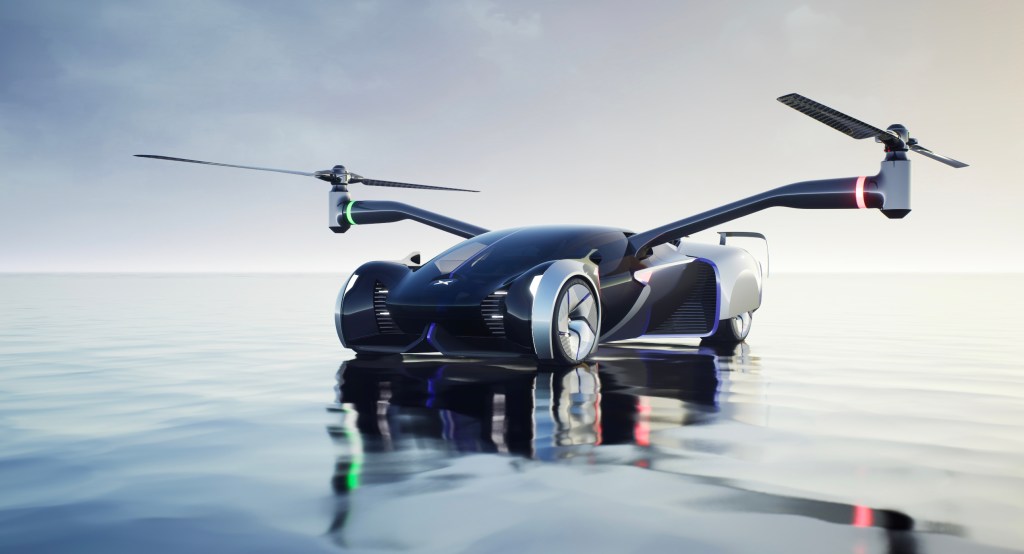
Sixth-gen flying car from HT Aero. (Image: XPeng)

But what is arguably a more interesting development is the road-capable flying car developed by affiliate company HT Aero.

The rotors adjust depending on whether the vehicle is in the air or on the highway.

The flying car is scheduled to become available in 2024.

Beyond the Bolt Battery Problem

Yes, it is an issue right now, but it has serious ramifications going forward

By Gary S. Vasilash

The facts of the situation is that General Motors is recalling all of the Chevrolet Bolts that the company has ever built. About 142,000. “Out of an abundance of caution.” There is a manufacturing defect in the batteries that could lead to fires. The batteries are produced for GM by LG Energy Solution.

GM is going to replace the batteries in the vehicles.

All in, the price is going to be on the order of $1.8-billion.

2022 Chevrolet Bolt EV connected to a DC fast charger during the final stage of production at the General Motors Orion Assembly Plant. (Photo by Steve Fecht for Chevrolet)

GM and LG are currently building two battery plants. But these plants are for a different type of battery—“Ultium” is the brand name—than the type of battery found in the Bolt EV and Bolt EUV. It doesn’t have a brand name.

The new GM EVs—which aren’t out yet—will  have the Ultium batteries, not the type found in the Bolt.

This doesn’t mean that there aren’t potential problems with the Ultium battery somewhere down the road. But it does mean that there aren’t issues for those new vehicles—e.g., Cadillac Lyriq, HUMMER EV—right out of the box.

What could be a real problem for GM—no matter how well the recall is handled—is that of the perception of potential consumers.

There needs to be a sell of the whole idea of an EV. This is not easy. Everyone driving today is at least passingly familiar with pulling into a gas station. But charging is something else entirely. First of all, everyone (I know I am using this broad brush broadly, but let’s face it: we live in a transportation environment that is predicated on petroleum) knows where gas stations are. How many people know where charging stations are? (Yes, most haven’t had a need to look for them, but I have, and they aren’t easy to find, even if you know where they are.) So some people are going to be off-put by that. And there are issues like the comfort of plugging in, and the time required to charge a vehicle. (“What if it is raining?”)

These are real challenges. Non-trivial challenges.

GM now has a group of people who are going to be all the more trepidatious to get an EV that it needs to convince to buy EVs. GM wants the EV to be a mass-market vehicle, not something driven just by the rich or enthusiastic.

All OEMs—with the probable exclusion of Tesla—are pretty much faced with the challenge of convincing people about buying EVs.

GM now has a particular problem as a result of this recall.

The EV Infrastructure Issue

Yes, people like fast and free. How do you build a business case on that?

By Gary S. Vasilash

“Public charging infrastructure is a key component in the overall adoption of electric vehicles by the broad population.

“Unfortunately, the availability of public charging is the least satisfying aspect of owning an EV. Owners are reasonably happy in situations where public charging is free, doesn’t require a wait and the location offers other things to do—but that represents a best-case scenario.

“The industry needs to make significant investment in public charging to assure a level of convenience and satisfaction that will lure potentially skeptical consumers to EVs.”–Brent Gruber, senior director of global automotive at J.D. Power.

J.D. Power has launched its first U.S. Electric Vehicle Experience (EVX) Public Charging Study, so Gruber’s observations are predicated on the responses of actual battery electric vehicles and plug-in hybrids.

Think about this:

  • People like free
  • People like fast
  • People like distractions

If energy providers are going to increase the speeds of charging, then this means they’re going to need to spend more money on their equipment.

So free and fast seem to be at odds.

And let’s face it: there is only so long that any business that wants to stay in business is going to be able to offer something for nothing.

As for the distractions, that goes to the point of the amount of time that it takes to recharge an EV.

Again, if the speed goes up, then the need for much in the way of distractions goes down.

(At a local bp station there are video screens on the pumps that play canned content that are high on the annoyance scale and subtractive on the info scale. Thank goodness it takes a brief period of time to recharge.)

Gruber noted: “Building a better infrastructure starts with more collaboration among automakers, charge point operators, site locations, utilities and government at all levels.”

All of which is to say that in order to get more EVs in more garages it is going to take more than having features that allow a vehicle to go incredibly fast or to maneuver like a crustacean.