On February 17, 2023, Fisker’s stock closed at $6.98. (For unrealistic comparison purposes, Tesla, that day: $208.31.)
On February 16, 2024, Fisker’s stock closed at $0.73. (Tesla: $199.95. Certainly not the halcyon number of days of yore, but still pretty damn good.)
On February 15, 2024, Fisker received a notice from the New York Stock Exchange.
In it, the NYSE pointed out that because Fisker’s common stock had traded at less than $1.00 per share for a consecutive 30 trading-day period, it is out of compliance with the rules of the exchange and could be delisted as a result.
This doesn’t mean that that is going to happen.
Fisker will tell the NYSE within 10 business days what its plan is is to get back into compliance.
There is a six-month “cure period” that the company has to get things in order (a.k.a., getting its stock price to at least an average of $1.00 per share for 30 consecutive trading days).
According to Fisker:
“The Company intends to remain listed on the NYSE and is considering all available options to regain compliance with the NYSE’s continued listing standards, including, but not limited to, a reverse stock split, subject to stockholder approval no later than at the Company’s next annual meeting of stockholders.”
It didn’t seem all that long ago that EVs were going to be a market—as in both the consumer and financial variants—winner for those involved.
“Ford has shifted its electric vehicle strategy so it concentrates on smaller, lower priced EVs and electric work vehicles such as pickup trucks and full-size vans, Farley said. Any EV larger than a Ford Escape small SUV ‘better be really functional or a work vehicle.’”
That is from an AP story by Tom Krisher about a presentation Ford CEO Jim Farley gave to the Wolfe Research Global Auto Conference in New York on February 15.
Farley also talked about the relationship between Ford and the UAW in light of last fall’s strike.
Farley said, “Our reliance on the UAW”—it has more UAW members that either GM or Stellantis—“turned out to be we were the first truck plant to be shut down.”
He was referring to the Kentucky Truck Plant, Ford’s largest plant and where the highly profitable F-Series Super Duty, Ford Expedition and Lincoln Navigator are produced.
Ford has pretty much placed its production bets in North America on things like the F-Series.
The only car the company has on offer in the U.S. is the Mustang, not exactly what one would describe as a “family vehicle,” so arguably it is something of a niche at most. Trucks and utes are where it is at, it seems, for the Blue Oval.
In the smallish category there are the Escape and the Bronco Sport, which are both based on the same platform. And the Maverick pickup truck, which is also based on the same C2 platform. This extremely popular pickup is built at a Ford plant in Hermosillo,Mexico, so some of Farley’s USA! USA! USA! chest thumping needs to be adjusted a bit.
But his comment about where the sweet spot for EVs is going to be is somewhat puzzling.
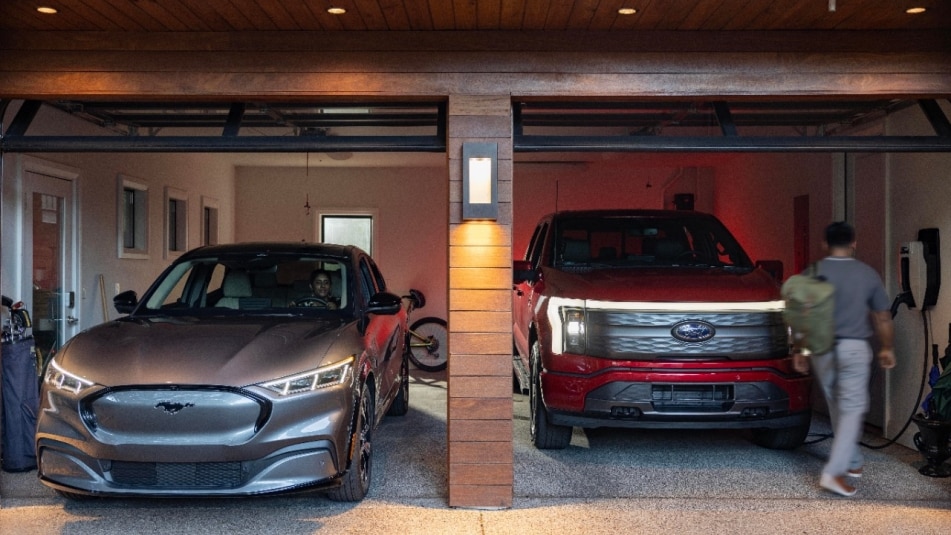
Right now Ford has three EVs, two for consumers and one for vocational use: the F-150 Lightning, Mustang Mach-E and E-Transit.
The Ford EVs for consumers: the Mustang Mach-E and the F-150 Lightning. (Image: Ford)
The first is, of course, a full-size pickup truck. The second trades on the muscle car performance of the Mustang. And the third is a vehicle for contractors.
Ford has been championing larger vehicles for the past few years for the simple reason that it is where it makes more money, so when it went EV it went big with the Lightning (and for power with the Mach-E).
It used to have the Focus to go up against the likes of the Honda Civic and Toyota Corolla, both of which still exist and do quite well in the market. Presumably neither Honda nor Toyota build those vehicles out of charitable impulses.
Ford used to have the Fusion to go up against the likes to the Honda Accord and the Toyota Camry, both of which. . . . Yes, same thing.
Ford—and it isn’t the only company in southeastern Michigan that has done this—has been messaging consumers that Bigger Is Better.
Suddenly Farley is talking about small vehicles.
Don’t get me wrong: small EVs, assuming that they can be made so that they are actually affordable for consumers and that provide a return to the OEMs, are undoubtedly a good idea to increase the number out on the roads.
Regardless of the size of the currently available EV (with the exception of Teslas) need to be sold to a still-skeptical public.
So there is that challenge.
And now Farley is doing a 180 and planning to go to the market with things that are small.
Which means he is going to need to convince people that on roadways populated with large F-150s and Explorers small Ford EVs are a good thing.
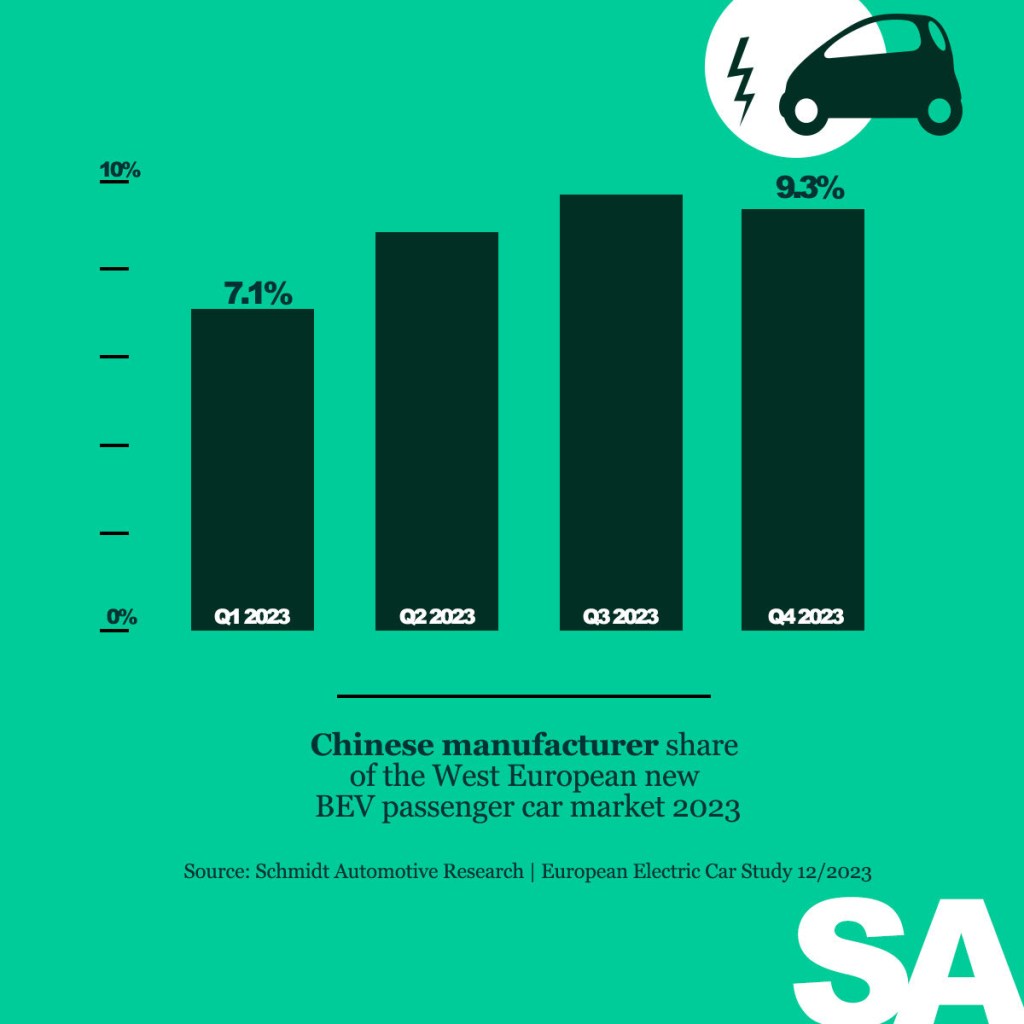
Although there was a seeming step-by-step, vehicle-by-vehicle increase in the under of Chinese battery electric vehicles registered in Western Europe last year, there was a bit of a stumble at the end, and Schmidt Automotive Research wonders whether there will be a cap of under 10% of the EV market in Western Europe for the Sino mobiles.
(Image: Schmidt Automotive Research)
As the chart shows, there was a noticeable decline in registrations in Q4. . .but then there are some reasons why this could be the case, including the increase in the amount of time it takes to ship vehicles from China to Europe while avoiding the Red Sea.
But the Schmidt study also points out some brands are offering discounts of up to €12,000, so you’d imagine that European consumers would be most interested in savings like that. . .especially as there may be higher import tariffs applied to Chinese vehicles coming into Europe this year.
Still, the fact that the Chinese OEMs have managed to gain that much of the European market in a comparatively short period of time says something about the appeal of their products.
Much of the attention given to Ford’s Q4 2023 earnings call last week has been focused on CEO Jim Farley’s comment:
“[W]e made a bet in silence two years ago. We developed a super-talented skunk works team to create a low-cost EV platform. It was a small group, small team, some of the best EV engineers in the world, and it was separate from the Ford mothership. It was a start-up.
“And they’ve developed a flexible platform that will not only deploy to several types of vehicles but will be a large installed base for software and services that we’re now seeing at Pro.”
Somehow the inherent mystery of a “skunk works” has gotten people all excited.
Would they be so excited to know that the skunkworks methodology goes back to 1943 in the aircraft industry?
Yes, an 80-year-old approach.
Well, You’ve Got to Build It. . .
The other thing about this is that it is one thing for an R&D team operating independently to develop something and a whole other thing for that development to be engineered for and launched in production.
Launches have been something that Ford has been finding a bit troubling, so there’s that.
And it should be noted that the company also announced last week that its Ford e operation—as in the electric vehicles—lost $4.7 billion last year and the company anticipates losing $5 to 5.5 billion this year on Ford e.
The excitement of the skunk works project was certainly helpful from diverting some attention to that red ink.
What About This?
But what was largely overlooked was Farley’s comments on hybrids.
As in,
“Our global hybrid sales were up 20% last year, and we expect them to be up 40% this year.”
And:
“We now have the No. 1 and No. 2 best-selling hybrid trucks in the U.S. Maverick is No. 1. And we’re the No. 3 hybrid brand in the U.S. behind Toyota and Honda. But unlike them, our hybrids really sell best on trucks for our side.”
Given that Farley said “And margins on hybrids are closer to ICE, much higher than EV margins,” you’d think hybrids would be the headline going forward if for no other reason than the company can make money on them, something that it is not going to see on the EV side of the business until. . . . Well, that remains to be seen.
Maverick hybrid: Fuel efficiency and the energy to bust out the beats. (Image: Ford)
Not Exactly a Strong Third
While it is nice that Farley is so bullish about the company’s hybrid performance, it is worth really putting that into context.
Of course its hybrids “really sell best on trucks” because with the only hybrid Ford has without a box on the back is the Escape.
And as for it being number three, know that these are the number of hybrid sales for the three companies in 2023:
Toyota: 523,664
Honda: 293,640
Ford: 133,748
In other words, it sold less than half of what Honda did and about a quarter of what Toyota did.*
So while the claim is factually true, one should perhaps not be too chuffed about the Ford hybrid performance.
About a quarter of Toyota and Honda sales are hybrids.
About 7% of Ford’s sales are hybrids.
Did I mention the skunk works. . .?
==
*It is worth noting that until recently Toyota was treated like some technological troglodyte for its continued support of hybrids and its not all-in approach to EVs. Not only do we see that Ford is reconsidering its positioning vis-à-vis hybrids and full EVs, but General Motors, which doesn’t have much of a record in the hybrid space, has announced that it, too, is going to bring hybrids to the U.S. market. Farley pointed out on the earnings call that consumers can quickly do the math on the fuel efficiency benefits of hybrids and, perhaps the most important factor: “they don’t have to change their behaviors.” It is surprising that there seems to be so many auto execs who ignore the long public charging time required for EVs compared with pumping gas: perhaps this is a case that when they get behind the wheel of their company vehicles someone else has done the charging.
Volvo Cars CEO Jim Rowan said on CNBC this morning about Polestar, the EV brand that it has some 44% of the shares of:
“They’ve have got a very exciting future ahead of them, they’ve moved from being a one-car company to a three-car company, they’ve got two brand-new cars coming out very shortly, in fact in the first half of this year, and that’s going to take them to a new growth trajectory.”
Sounds good, right?
But then there’s the fact that the reason Rowan was interviewed on CNBC is because Volvo Cars has announced it is going to reduce its holdings in Polestar.
Volvo Cars and Geely Holding essentially own Polestar.
In a press release from Polestar it says, in part,
“Volvo Cars is evaluating a potential adjustment to its shareholding in Polestar including a distribution of shares to its shareholders, with Geely Sweden Holding being the primary recipient. Volvo Cars will remain a strategic partner in areas across R&D, manufacturing, after sales and commercial.”
Which one could read as:
Geely China and Geely Sweden are going to own the majority of Polestar. So it is Geely, pure and straightforward.
Given that Geely owns Volvo Cars, there are probably just some bookkeeping adjustments being performed in Hangzhou. In Gothenburg the books are getting some line items removed so there can be an increased focus on its vehicles.
One wonders: Is this a further sign that the EV slowdown is having some consequences, especially on new OEMs trying to grow up?
MINI, a quintessentially British brand, is owned by BMW, a company with a German state in its name.
Last fall BMW announced an investment of more than £600 million in the MINI factories at Oxford—yes, as in the place that also has the university—and Swindon—the place where the Wernham Hogg office that merged with the Slough branch in “The Office” was located.
About the investment Milan Nedeljković, Member of the Board of Management of BMW AG responsible for production, said, “With this new investment we will develop the Oxford plant for production of the new generation of electric MINIs and set the path for purely electric car manufacturing in the future.”
MINI Aceman. No, that isn’t the production paint. It is undergoing final tests–evidently in Arizona, given that license plate–before production starts for the EV in a plant in China. (Image: MINI)
The MINI Cooper 3-door and the MINI Aceman, both EVs, will go into production in the U.K. in 2026.
Going back to the owner of the brand’s HQ country, it isn’t entirely surprising that the MINI Countryman is made in Leipzig.
What may be a bit of a surprise, however, is where the Aceman will soon start production: at a plant in Zhangjiagang, Jiangsu Province, China.
About the Aceman, Stefanie Wurst, head of MINI said, “The all-electric MINI Aceman opens new opportunities for customers who want a smaller crossover than our successful MINI Countryman. The consistent electrification of our product portfolio makes a clear statement about the future of the MINI brand.”
The Aceman is based on a new EV platform developed by BMW and Great Wall Motor.
In GM CEO Mary Barra’s letter to shareholders for the Q4 2023 results it reads, in part:
“In our EV business, we expect our U.S. portfolio will become variable profit positive in the second half of the year based on our current expectations for EV demand and production growth, strong interest in our vehicles, lower commodity prices and other factors.
“It’s true the pace of EV growth has slowed, which has created some uncertainty. But many third-party forecasts have U.S. EV deliveries rising from about 7% of the industry in 2023 to at least 10% in 2024, which would mean another year of record EV sales.
“We believe our competitive position will improve throughout the year, based on higher production of the Cadillac LYRIQ, GMC HUMMER EV, Chevrolet Blazer EV and Silverado EV Work Truck. We’re also excited to have the Chevrolet Equinox EV and Silverado EV RST, the GMC Sierra EV Denali and the Cadillac Escalade IQ arriving in showrooms over the course of the year.”
There is something to be said for optimism. And given that GM is investing billions in EV development and production, optimism is better than the alternative.
In her Q4 2022 letter to shareholders Barra wrote:
“By leveraging U.S.-made battery cells produced by our Ultium Cells joint venture and the scalability and flexibility of the Ultium Platform, we are accelerating production of the Cadillac LYRIQ, GMC HUMMER EV and BrightDrop Zevo 600, and we will launch exciting vehicles like the Chevrolet Silverado EV, Blazer EV and Equinox EV. This keeps us on track to produce 400,000 EVs in North America from 2022 through the first half of next year.”
For the full year of 2023, rather than just the first half, GM sold 75,883 EVs. About 19% of that 400,000. Even if we add in the 2022 EV sales, 39,096, to the full year ’23 sales, that is 114,979, or about 29% of that 400,000.
Yes, GM will sell more EVs in 2024 than it did in 2023.
And it will be a good thing if the EVs it sells are “variable profit positive” by the second half of the year.
But consider: in 2023 GM’s total U.S. sales were 2,594,698 units. That means the 75,883 EVs represented about 3% of total sales.
If industry sales of EVs this year are “at least 10%,” what is the likelihood that GM will come close to reaching that number?
Since the start of the contemporary minivan with the Chrysler Voyager, Dodge Caravan and the Plymouth Voyager in November 1983, that type of vehicle has had its ups and downs in the market. Mainly downs after the notion that it was a vehicle for “soccer moms.” One can imagine that when that meme was established Landon Donovan’s or Mia Hamm’s mothers probably didn’t want to be seen in one.
But from a packaging point of view, it is hard to think of anything better than the configuration of the minivan.
Perhaps the forthcoming VW ID.Buzz electric minivan will change the perceptions of what a minivan is.
In other parts of the world, there is nothing diminutive (i.e., “mini”) about the boxy vehicles (no matter what aero effects are deployed, let’s admit it: these are shaped more like shoeboxes than Stingrays).
Elsewhere they are called “MPVs,” or “multi-purpose vehicles.”
The purposes seem to be carrying people and stuff, so there isn’t a whole lot of multi about them.
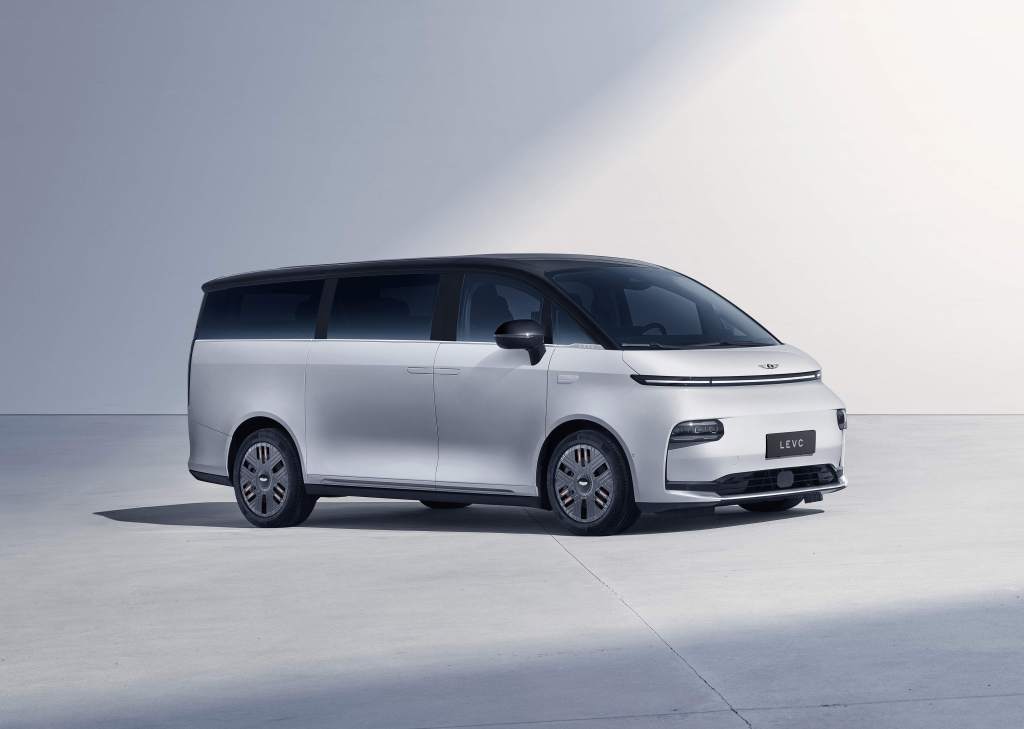
The L380, electric MPV. (Image: LEVC)
LEVC—the London Electric Vehicle Company, the firm that produces the TX, the hybrid-electric (it has a range extender) black cab that is rolling through the streets of London and elsewhere—is extending its transport offerings by putting into pilot production in a plant in Yiwu, China, the L380, a fully electric MPV.
Alex Nan, LEVC CEO, described the vehicle as “the next step forward in the company’s globalization strategy, as we rapidly accelerate our transition from manufacturing the world’s most advanced and iconic taxi, to becoming a leading e-mobility technology company.”
LEVC is a Geely Holding Group company. Which means it is related to Volvo and Polestar, Lotus and Lynk & Co., and others.
The L380 is based on the Geely Space Oriented Architecture (SOA), which is an underpinning that can be deployed for lots of vehicles, including those that aren’t vans.
The L380 will initially launch in China and then is expected to be delivered into the U.K. in about two years.
Although Western European vehicle buyers have consistently been more bullish on buying electric vehicles, even there things are beginning to shift according to analysis by Schmidt Automotive Research.
According to its “European Electric Car Study,” there were 1.96 million battery electric vehicles sold in the West Europe region in 2023, a 28% year-over-year improvement, which means 16.9% of the total automotive market.
But it could it have better, as there was a 25% decline in December 2023 compared with the final month of 2022, which resulted in a decline for 5% for Q4 ’23 compared with ’22.
One of the reasons for the decline: “various purchase subsidies and lower tax incentives being stripped away.”
Looking ahead into 2024, Schmidt Automotive predicts:
“Auto executives will need to wrap up and buckle up as the market begins to see a chill easterly wind arrive, with discounting expected to be the keyword of the year, accompanied by protectionism to defend against an increasingly aggressive attack from Chinese manufacturers, as states hope to buy some time for key regional employers giving them space to restructure their business and become more competitive in the new e-mobility age.”
So let’s break this down:
EV demand fell as consumer subsidies and tax incentives declined
Discounting will be the condition this year, which means an advantage for the consumer and bad news for the manufacturers
The Chinese manufacturers are providing inexpensive products. Yes, they happen to be EVs, but would low-cost ICE vehicles be any less appealing?
At some point the “free money” for EVs is no longer going to be available.
Which leads to a question of what the real demand for the vehicles is.
Perhaps not as much as some OEM execs would like to think.
Admittedly the BYD Seagull (a.k.a., “Dolphin Mini” in Brazil and Latin America) is a small car—98.4-inch wheelbase, 148.8-inch length, 67.5-inch width, 60.6-inch height—there are two other characteristics worth knowing: (1) it is an electric vehicle with a range ranging from about 190 miles to 250 miles, depending on the battery used; (2) it has a starting price that’s approximately $11,000.
The BYD Seagull. Small. Cheap. Electric. Competitive? (Image: BYD)
Which leads to two other considerations:
Good thing Americans don’t like small cars
Good thing it isn’t available in the U.S. because while Americans may not like small cars, they do like low prices
And Kristin Dziczek, policy advisor, Federal Reserve Bank of Chicago, speaking at the 30th annual Automotive Insights Symposium, speaking on her own behalf, not the Fed’s, said that a car like the Seagull is something that worries her.
Dziczek said that BYD could conceivably sell the Seagull in the U.S. market for ~$15K, including the 27.5% tariff that the U.S. imposes on vehicles built in China, and still make money.
Given that the average transaction price for an EV in the U.S. in December was $50,786 according to Kelley Blue Book, given that $48,759 was the average transaction price for vehicles of all types last month, doesn’t well under $20,000 look appealing—even for a small EV?
Let’s say that a Chinese company builds a factory in Mexico. Isn’t it possible that, increased costs compared with China, it could take advantage of the USMCA and avoid the big tariff?
While there are some who argue that people want the amenities that are characteristic of vehicles with higher price points, some people prefer porterhouses over McDonald’s.
Seems as though the traditional domestic OEMs are interested in those who want steak.
Chevy, once the GM brand that was more economical, has a starting price for the Blazer EV at $56,715. . .just $1,875 less than the starting price for the Cadillac Lyriq EV.
Remember when the Chevy Silverado EV was announced and it was said that the starting price would be around $40,000? The actual MSRP is $74,800.
Affordability is a key concern for most people. Sure, there are those who buy far beyond their means for purposes of fashion.
But fashion is fickle.
And in the short and long run for many people, it is about what will get the job done at a price that meets their means.
While politics may impede the entry of Chinese vehicles in high numbers in the American market (the Buick Envision and the Polestar 2 are built in China and you can buy one at a dealer near you right now, but the sales for both are still somewhat small: for 2023 there were 44,281 Envisions sold and 10,350 Polestar 2s) it is going to likely happen at some point.
The question is how competitive the U.S. builders are going to be when that happens. Given that they’ve pretty much abandoned midsize and small cars (Toyota sold 290,649 Camrys last year and 232,370 Corollas, so it is not like there isn’t a market for those types of vehicles), there should be some serious concern.




 shinymetalboxes