“A cumulative national capital investment of $53-$127 billion in charging infrastructure is needed by 2030 (including private residential charging) to support 33 million PEVs.” That’s according to a report from National Renewable Energy Laboratory (NREL), “The 2030 National Charging Network: Estimating U.S. Light-Duty Demand for Electric Vehicle Charging Infrastructure.”
The ”PEV” is for “plug-in electric vehicle.”
The way the NREL figures it, there will be:
26.8 million Level 1 and Level 2 chargers at single-family homes, multifamily properties and workplaces
182,000 fast-charging ports on highways and within local communities
1 million Level 2 ports in high-density neighborhood, office buildings and retail outlets.
That is quite a span in the estimated spend to put in all those chargers.
Note that much of the investment will be made by individual homeowners. There is the cost of the equipment, the cost of an electrician, the cost of things an electrician will find when making the installation, and, if there is Level 2 rather than Level 1, then the probable need to get 240-Volts to the garage, and. . . .
It is likely to be more than a grand.
But let’s say all of that is done. Let’s say that the $53-$127 billion has been spent.
All good, right?
Well, there is something else in the report that probably deserves considerably more attention:
“The cost of grid upgrades and distributed energy resources have been excluded from these estimates. While these excluded costs can be significant in many cases and will ultimately be critical in building out the national charging network, they tend to be site specific and have been deemed out of scope for this analysis.”
“Significant” means “a whole, whole lot” on top of the aforementioned billions.
One thing that Olabisi Boyle, senior vice president, Product Planning & Mobility Strategy, Hyundai Motor North America, points out that is probably something that many people don’t know is this:
On a global basis Hyundai Motor Group (including Genesis and Kia) is the third-largest OEM. Not General Motors. Not Stellantis. Hyundai. Behind Toyota and Volkswagen Group.
In the U.S., the company’s sales have been growing with consistency:
In 2023 it had total sales of 801,000 vehicles, up 11% over 2022 sales (724,000)
Hyundai’s Boyle is working to expand ways that customers interact with the company’s products, well beyond the drive. (Image: Hyundai)
One of the areas that Boyle is keen on is the development of the market for what she terms the “early majority” for electric vehicles, moving beyond the “early adopters.”
Hyundai has long (comparatively speaking) been in the EV space and at present the brand offers the Kona Electric, IONIQ 5 and IONIQ 6.* (It also has the Nexo—which is a fuel-cell based EV.)
Massive & Flexible
Hyundai Motor Group is constructing what it calls “Metaplant America” near Savannah, Georgia, a complex on a 2,923-acre site that includes a vehicle assembly plant as well as a battery plant. Plans call for the $7.59-billion plant to go into production early in 2025. It will build the IONIQ 5, IONIQ 6, Genesis GV60 and Electrified GV70 vehicles, as well as the XCIENT class 8 fuel-cell truck.
Boyle says that the Metaplant, which will have an annual capacity of 300,000 vehicles, is sufficiently flexible such that if the demand dictates, it can also produce combustion engine-equipped vehicles.
Beyond Vehicles
But Boyle’s view of Hyundai’s efforts in the mobility space go well beyond particular vehicles to something that can be thought of as an entire infrastructure. If it’s a gas-powered vehicle, then the ability to pay through the touchscreen of the Hyundai. If it is an electric vehicle, then the ability to work through the Hyundai Home Marketplace to get what’s needed for home charging. If it is a question of obtaining an EV for a short period (e.g., month-to-month), there is Evolve+ that makes this real. If it is a matter of finding and paying for parking, there’s an app for that.
Hyundai Home helps EV customers get what they need to equip their residences for seamless electric vehicle operation. (Image: Hyundai)
In other words Boyle and her colleagues are looking at a consumer’s engagement with Hyundai as something more than a transaction that occurs at a dealership once every few years. Rather, it is something that they are building out so that the company can provide things that are helpful, not intrusive, things that facilitate everyday activities, not complicate them.
They certainly want to grow the number of vehicles that are purchased.
But they recognize that there is a market shift going on, one that they are helping propel.
==
*And it also has “electrified” vehicles including hybrid versions of the Elantra, Sonata and Tucson, with the Tucson also as a plug-in hybrid.
U.S. dealers are not particularly keen on electric vehicles (EVs).
So indicates the Cox Automotive Dealer Sentiment Index (CADSI) released this year.
When asked how EV sales were doing in Q1, the index score was 42. That’s off from 50 in Q1 in 2023.
And while 42 may not be particularly meaningful, know that it is the lowest score since the question was included in CADSI in Q2 2021.
The outlook among dealers regarding EV sales going forward isn’t good, either.
In Q1 2023 the index score was 53. Back then, a majority of dealers saw EV sales growing.
In Q1 2024 that index score is down to 36.
That’s the lowest score for EV outlook since that question was asked.
Seems things are no longer anticipated to be growing for EVs.
It seems as though this is not simply a U.S. phenomenon, either.
While Cox was looking at new vehicle sales, over in the U.K. and outfit that specializes in used vehicles—going from consumers to dealers rather than the more conventional vice-versa—found that sales are not particularly robust.
Compared with last year, HonkHonk found 38.5% of dealers are “much less interested” in EVs and 12.3% are “a bit less interested.”
Or 50.8% of dealers are not all that keen on putting EVs in stock.
Sebastien Duval, CEO of HonkHonk, said, “Right now, dealers can’t get enough small or medium petrol cars, medium diesels and even hybrids, since the market began recovering in 2024. But less than one in ten of them want to snap up a battery EV car more than they did than a year ago.”
That’s right: Diesels are more appealing than EVs in the U.K. used market.
When you see the word challenge in any form in a financial announcement, know that this really means some variant of “we are really struggling but don’t want to make it seem as though we are anything other than in control.”
(Image: VW Group)
When Volkswagen Group announced its 2023 financial results there were:
Oliver Blume, CEO: “Volkswagen Group is entering the long-distance rate of transformation from a position of strength. At the same time, we are aware of our challenges and are tackling them consistently to leverage the enormous potential of Volkswagen Group.”
Arno Antlitz, CFO and COO: “In a challenging environment, Volkswagen Group delivered robust results in 2023.”
While the company has said that it expects 50% of sales to be electric vehicles by 2030, for the full year in 2023 Group EV sales were 8.3%. So essentially it has six years to add 41.7%.
In the release about its earnings there’s this:
“Volkswagen Group is convinced that the future of mobility is electric. While some countries continue to show an impressive pace of transformation, the ramp-up of electric mobility in other regions is unfolding less quickly than expected. Volkswagen Group’s strategy is therefore characterised by flexibility. While extensive investments are being made in the expansion of electric mobility, highly competitive, efficient, and attractive models with combustion engines will remain part of the product range during the transition phase. Improved and new plug-in hybrids complement the range in many markets.”
Which could be restated as:
“We’ve bet big on EVs and are seeing returns in some areas but not like we’d hoped overall. So we figure we’d better be sure to continue to offer things that have internal combustion engines under their hoods, with or without hybrid systems attached.”
Of course, placing bets is about the future.
If VW Group doesn’t ante up on what seems as though it will play out (i.e., at some point there will be a bona-fide acceptance of EVs by a mass market, not the level of acceptance that has been puffed up (take Tesla numbers out of the sales of EVs in the West and see how well they are doing)), then it will be in a bad situation at the point that it does.
But playing is not without a cost.
It, like other OEMs, are investing billions in electrification.
There are a couple of things that are going to make receiving a return somewhat problematic:
Tepid consumer interest
Cheap Chinese EVs
And it isn’t VW Group alone that needs to consider its play in relation to those two factors.
Last year Rivian produced 57,232 vehicles in its assembly plant in Normal, Illinois.
Which made it somewhat curious when it announced last year that it was planning to break ground for a new factory this year for a plant in Georgia that would have the capacity to build 400,000 units.
The Rivian plant in Illinois began its production existence in 1988 when it was the Diamond-Star Motors factory.
Diamond-Star? It was a joint venture between Chrysler and Mitsubishi.
Chrysler had had a bit of a financial fix in 1991, so it sold its half of what was the Diamond-Star plant to Mitsubishi.
Being the sole owner, it changed the name of the plant to “Mitsubishi Motor Manufacturing of America” (MMMA). Things didn’t work out so well, so Mitsubishi stopped making cars there in 2015, when 38,186 vehicles were built.
Here’s the thing: As originally configured the plant had a production capacity of 240,000 vehicles.
The highest number of vehicles produced at MMMA was 222,414. Nearly full production.
Rivian bought the then-2.6-million square-foot plant in January 2017. And set about on an expansion.
But according to Rivian, the annual capacity at the factory is 150,000 vehicles. Presumably making R1Ts, R1Ss and EDVs is somewhat more complicated than iMEVs (which are arguably much smaller than any of those Rivians).
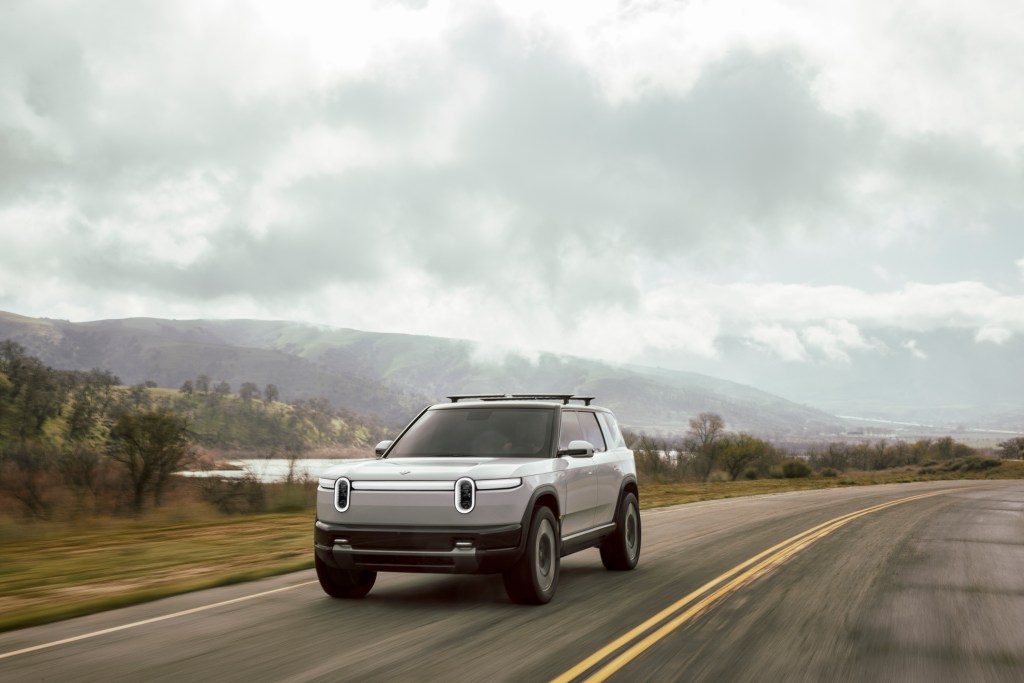
Rivian R2 is supposed to go into production in Illinois in 2026. (Image: Rivian)
When it announced the R2 and R3 models yesterday it was announced that rather than waiting for the factory to be built in Georgia for the production of the new models, it is putting the R2 into the Normal plant which will have, by R2 launch time in 2026, an expansion of capacity to 215,000 vehicles.
Here’s the thing. Whether the capacity is 150,000 units or 215,000, that’s an awfully big delta between either and ~60,000 vehicles.
It is a rule of thumb in automotive manufacturing facilities capacity utilization has to be at from 70% to 80% to be cost effective.
Seventy percent of 215,000 is 150,500.
Rivian has a long way to go to get there and not a whole lot of time.
“While technologically advanced, the extent that BEVs can contribute to GDP growth is limited by the maturity of the motor vehicle industry, with passenger car sales having peaked in 2017. This is a restraining factor as BEVs do not represent an innovation that creates new demand, like the introduction of personal computers or cell phones. Instead, they’re a new version of a familiar product whose sales may not grow much beyond current levels.”—Thomas Klitgaard, Federal Reserve Bank of New York
In other words, electric vehicles are not a disruptive tech that is going to bring in new buyers who otherwise wouldn’t buy an SUV, car or truck.
So even if we get to 100% EV buyers (not likely anytime soon), this is simply replacement, not buyers who would otherwise not buy a means of transportation.
Which is not what vehicle manufacturers want to think about.
While some people may continue to associate Kia with small(ish) vehicles—sedans and CUVs—the company has not only transformed itself into a leader when it comes to styling, but it has increased the size of what it has on offer.
An excellent example of this change is its EV9, which is not merely an electric vehicle, but a three-row EV. While you can find three-row crossovers at your local Ford (Explorer) and Chevy (Traverse), you can’t find a model with an electric propulsion system.
(And it is worth noting that the EV9, in its debut year, bested an array of other crossovers to be named the North American Utility Vehicle of the Year by NACTOY, no small feat.)
Kia PV5 in a ride-hailing configuration. (Image: Kia)
But even those who are familiar with the Kia lineup were undoubtedly taken by surprise at this year’s CES when the company introduced its “Platform Beyond Vehicle” (PBV) strategy, which is predicated on purpose-built EVs that are essentially commercial vehicles. (Which explains why it is showing off two of its PBV concepts—the PV5 and the PV7—at the Work Truck Week event that is occurring this week in Indianapolis.)
While commercial vehicles of the configuration of the Kias are common (though the styling of the Kias are uncommon), what’s interesting is that the company is proposing that there is a driver’s fixed cab on a platform and behind it a flat surface upon which upper bodies can be attached, depending on the use case.
Again, putting different boxes on the back of truck chassis is common, but Kia is proposing the “life modules” are attached with hybrid electromagnetic and mechanical coupling such that they can be readily replaced to take on different tasks.
Steve Center, COO and EVP of Kia America, said of the PBV approach: “Kia’s exciting foray into this important segment of the overall industry represents our steadfast commitment to the electrification of transportation and aligns perfectly with our Plan S strategy to become a global leader in sustainable mobility.”
Mobility that goes beyond moving people.
While still concepts, the company says the PV5 could hit the U.S. market in 2026.
78.81% of vehicle purchases in the U.S. in 2023 were for vehicles with gasoline engines, according to Experian’s “State of the Automotive Finance Market, Q4 2023.”
The number that will is:
8.55% of the vehicles purchased were electric vehicles.
But of that “purchase,” 30.7% of the EVs were leased, which is essentially renting with the option to buy, not outright obtaining (i.e., according to the Oxford English Dictionary, the verb purchase means “To acquire in exchange for payment in money or any equivalent; to buy.” And the way the Inflation Reduction Act is constructed, for many OEMs leases are the only way that consumers can get a $7,500 purchase incentive).
A number that also won’t get large type:
9.83% were hybrids.
That number alone is about 13% greater than the EV number.
But arguably the 2.02% of vehicles purchased in 2023 that were plug-in hybrids could be added to the hybrid number, which would go to 11.85%.
Odds are that hybrid number is going to continue to grow, as will the EV number, but even though it will continue to be higher than the EV number for the next several years, you can bet every rise in EV sales will continue to get outsized attention—until the novelty passes.
Although the folks at Consumer Reports are finding increased interest in and performance of electric vehicles (EV), it seems as though plug-in hybrids (PHEVs) are really something of a sweet spot based on its annual top-10 vehicle list.
CR’s Jake Fisher, senior director of Auto Testing, points out that there are four key elements that go into the determination of what vehicles make the list—and make it to the top of the list, which are:
Road testing
Active safety and crash testing
Owner satisfaction
Predicted reliability
While the first two are objective and the last two are subjective, know that the nonprofit consumer organization bases the last two on more than 300,000 member surveys, so there are solid metrics behind them.
The Results
So here are the top 10:
Subcompact SUV: Subaru Crosstrek
Compact SUV: Subaru Forester
Small car: Mazda3
Midsize car: Toyota Camry Hybrid
Small pickup: Ford Maverick/Maverick Hybrid
Midsize SUV: Toyota Highlander Hybrid
Luxury SUV: BMW X5/X5 PHEV
Hybrid/PHEV car: Toyota Prius/Prius Prime
PHEV SUV: Toyota RAV4 Prime
Electric vehicle: Tesla Model Y
The PHEV Challenge
One of the challenges vis-à-vis people going to a PHEV rather than a conventional hybrid (HEV) or a full EV is, Fisher explains, their understanding of what a PHEV is and how it would fit into their driving regime.
RAV4 Prime: hybrid with a plug. (Image: Toyota)
To simplify things, CR has modified the way it provides information about fuel economy for PHEVs by treating the all-electric range provided as a “bonus” added to the results when the vehicle is operating in its “charge-sustaining mode” (a.k.a., simply driving on its engine).
A fascinating comparison that CR made is to put like-to-like vehicles up against one another with the differences being in their propulsion system—PHEV vs. ICE, HEV and full EV—and then how much it will cost the consumer based on both the vehicle price and the cost of energy. The assumptions are that the owners will plug in their vehicles that have plugs, drive 40 miles per day, and take four 500-mile trips annually.
While it may not be a surprise that the PHEV version of the BMW 330 is more cost-effective than the gasoline-only version, there are a couple of surprises:
The Hyundai Tucson HEV saves more money than the PHEV version.
And while it seems to be accepted wisdom that owning an EV means far less cost for energy, the Kia Niro PHEV is actually better for the pocketbook than the Niro EV.