Mitsubishi Has an EV Coming Soon

Perhaps not propitious timing in the US, but needs must. . .

By Gary S. Vasilash

According to research conducted by IPSOS NVCS for Mitsubishi Motors North America:

  • 96% of compact CUV owners who shopped for a Mitsubishi Outlander purchased one.
  • 94% of subcompact CUV owners who shopped for a Mitsubishi Eclipse Cross purchased one.
  • 97% of small CUV owners who shopped for a Mitsubishi Outlander Sport purchased one.
  • 92% of plug-in hybrid owners who shopped for a Mitsubishi Outlander Plug-in Hybrid purchased one.

Which seem like awfully good numbers.

But the thing is, the people who shopped those vehicles must have been specifically shopping those vehicles because sales of Mitsubishi in Q1 2026 were fairly underwhelming, with a total of 26,884 vehicles sold.

Clearly it could have used more shoppers for its four vehicles.

It is somewhat surprising that Mitsubishi doesn’t do much, much better in the US market because this is not only a company with a long pedigree (its first vehicle, the Model A, was launched in Japan in 1917), but over the years has made some notable vehicles (e.g., the Lancer EVO) and according to the most-recent JD Power Vehicle Dependability study, with 208 points, is four points below the industry average, but tied with Genesis.

Mitsubishi announced today that it will introduce the Eclipse Sportback EV in North America in the second half of this year.
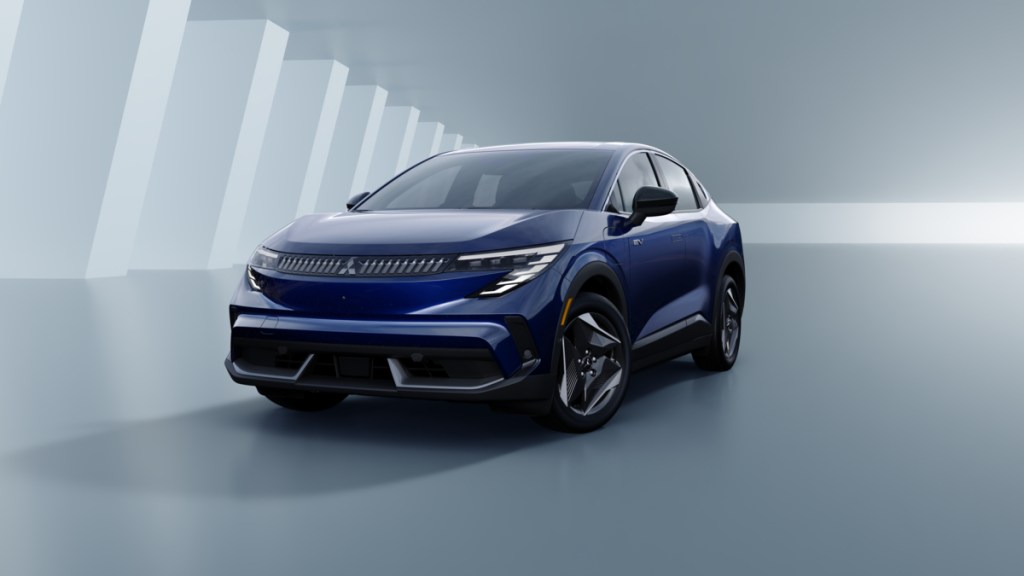
Mitsubishi Eclipse Sportback EV. Mitsubishi is nothing if not stylish with its vehicle designs of late. (Image: Mitsubishi Motors North America)

Yes, an electric vehicle.

Mitsubishi is no stranger to EVs having produced the i-MiEV, which some consider to be the first highway-capable, mass-produced EV. It appeared in Japan in 2009. It made it to America in 2011.

“Highway-capable” must be taken with a grain of lithium. It produced 66 hp and had a range of 62 miles. Presumably that range was severely reduced when people were hard on the throttle to get up to highway speed.

Arguably the i-MiEV didn’t do any favors to Mitsubishi or electric vehicles.

There were only some 2,100 sold in the US between introduction in 2011 and discontinuation in 2017.

The Eclipse Sportback EV is based on the current Nissan LEAF. Mitsubishi and Nissan are alliance partners, so platform sharing makes sense, especially for EVs that desperately need to achieve production scale.

The new LEAF is well-regarded, which means this is likely a good way to go for Mitsubishi.

But what isn’t particularly good is that in Q1 2026 Nissan sold just 668 LEAFs in the US.

Still, Mitsubishi needs more product, and this will give them that.
Rivian and Capacity Utilization

By Gary S. Vasilash

Last year Rivian produced 57,232 vehicles in its assembly plant in Normal, Illinois.

Which made it somewhat curious when it announced last year that it was planning to break ground for a new factory this year for a plant in Georgia that would have the capacity to build 400,000 units.

The Rivian plant in Illinois began its production existence in 1988 when it was the Diamond-Star Motors factory.

Diamond-Star? It was a joint venture between Chrysler and Mitsubishi.

Chrysler had had a bit of a financial fix in 1991, so it sold its half of what was the Diamond-Star plant to Mitsubishi.

Being the sole owner, it changed the name of the plant to “Mitsubishi Motor Manufacturing of America” (MMMA). Things didn’t work out so well, so Mitsubishi stopped making cars there in 2015, when 38,186 vehicles were built.

Here’s the thing: As originally configured the plant had a production capacity of 240,000 vehicles.

The highest number of vehicles produced at MMMA was 222,414. Nearly full production.

Rivian bought the then-2.6-million square-foot plant in January 2017. And set about on an expansion.

But according to Rivian, the annual capacity at the factory is 150,000 vehicles. Presumably making R1Ts, R1Ss and EDVs is somewhat more complicated than iMEVs (which are arguably much smaller than any of those Rivians).

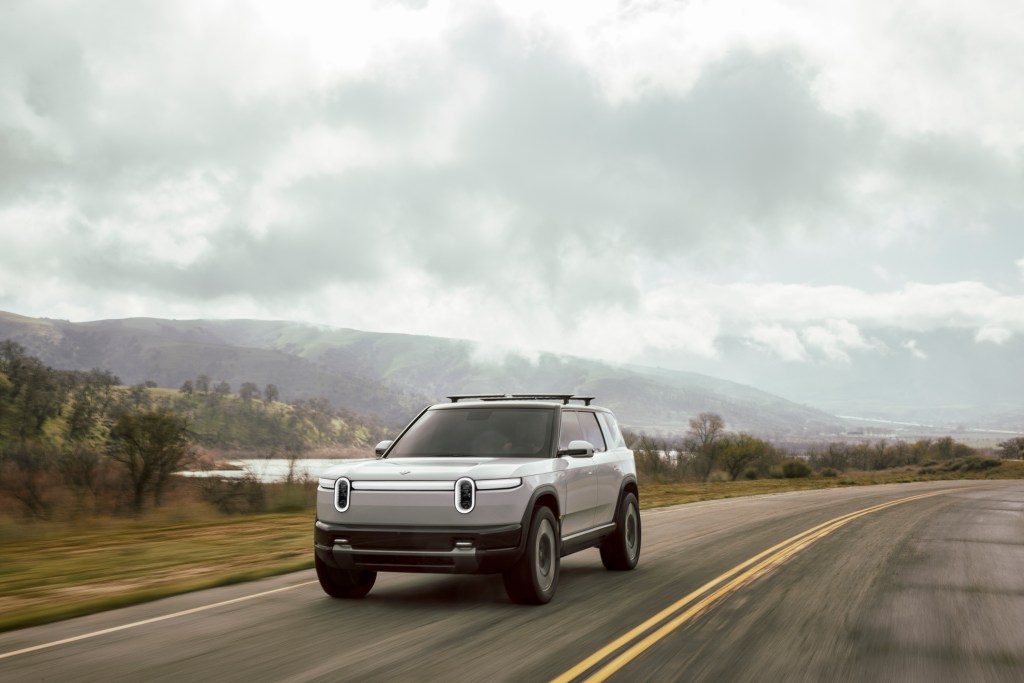
Rivian R2 is supposed to go into production in Illinois in 2026. (Image: Rivian)

When it announced the R2 and R3 models yesterday it was announced that rather than waiting for the factory to be built in Georgia for the production of the new models, it is putting the R2 into the Normal plant which will have, by R2 launch time in 2026, an expansion of capacity to 215,000 vehicles.

Here’s the thing. Whether the capacity is 150,000 units or 215,000, that’s an awfully big delta between either and ~60,000 vehicles.

It is a rule of thumb in automotive manufacturing facilities capacity utilization has to be at from 70% to 80% to be cost effective.

Seventy percent of 215,000 is 150,500.

Rivian has a long way to go to get there and not a whole lot of time.

Mitsubishi and Amazon: An Intro Platform, Not a Sales Channel

If there is any company that really needs its next launch to go off well it is Mitsubishi Motors North America. The vehicle in question is the 2022 Outlander, an SUV.

For 2020 its sales were down in the U.S. by 28%–a big hit to any company—but what makes matters worse, the total number is just 87,387, or about the number of Lincoln SUVs sold in 2020 (87,893)—and let’s face it, Lincoln SUVs have better margins than the Mitsubishi models so the Mitsubishi number is less good than it might be. (Or to be more apples-to-apples, Ford sold 178,496 Escapes in 2020.)

The Outlander has a lot riding on it.

As there seems to be a growing interest in vehicles with off-road cred, Mitsubishi is in good shape given its experience in rally racing, including the Dakar. Kentaro Honda, segment chief vehicle engineer, said of the new Outlander, “We took everything we know about on- and off-road driving from the rally experiences to apply the latest Super All-Wheel Control technology in our newly developed platform. We also specifically developed a new drive mode selector to provide confident driving at all times and in all weather conditions. We hope that many customers will have great experiences with the enhanced driving performance of the all-new Outlander.”

Presumably, this means the vehicle will be off-road worthy—and yet make it simple enough for the likely intended buyer (think someone living in the snowbelt—but in the suburbs, not some mountain top) to be able to dial-in what’s needed without having had a training course at Moab.

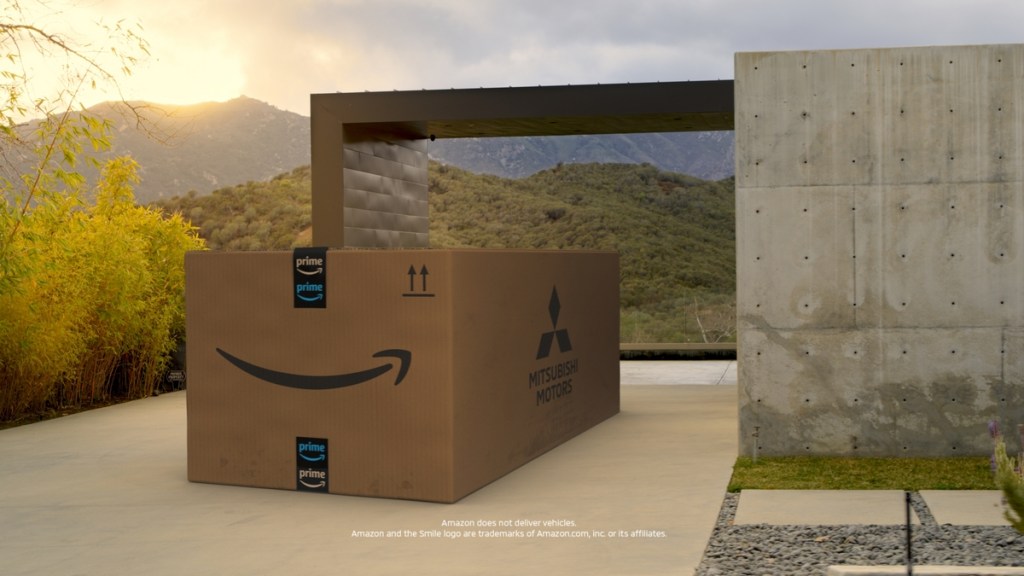
2022 Mitsubishi Outlander to be revealed on Amazon Live February 16. But no, they won’t deliver one to your house with Prime. (Image: Mitsubishi Motors North America)

To address that demographic, the global reveal will occur on Amazon Live, Tuesday, February 16 at 6 p.m. EST.

Despite the venue, you cannot get a 2022 Outlander through Amazon Prime.

(Although I’m betting that in the not-too-distant future, Amazon will someone work its way around dealer franchise laws and. . .)