GM to Spend More Billions on EVs (and AVs)

Why spend $20 billion when you can spend $35 billion?

By Gary S. Vasilash

Yesterday General Motors announced that spending $20 billion between 2020 and 2025 on electric and autonomous vehicular tech, as it said it had intended to in March 2020, isn’t enough.

It announced that spending $27 billion during the same period, as it said it had intended to in November 2020, just doesn’t cut it.

So now GM says that it will spend $35 billion by 2025.

In other word, a 75% increase in spend from what it originally intended just 15 months ago.

Why?

Said Mary Barra, GM chair and CEO: “We are investing aggressively in a comprehensive and highly integrated plan to make sure that GM leads in all aspects of the transformation to a more sustainable future.

“GM is targeting annual global EV sales of more than 1 million by 2025, and we are increasing our investment to scale faster because we see momentum building in the United States for electrification, along with customer demand for our product portfolio.”

The Bolt EV is presently the GM electric vehicle. In the first quarter GM sold 9,025 of the compact electric vehicles.

Yes, that is a 53.7% increase over Q1 2020, but that was Q1 2020.

The increase in Corvette sales Q1 to Q1 was 73.1%. While only 6,611 of those vehicles were delivered, odds are GM makes more on each Corvette than Bolt.

GM does have more EVs coming, like the HUMMER EV pickup and the Cadillac LYRIQ crossover. And there will be an electric Silverado and other vehicles to boot.

GM will be building two EVs for Honda, one for Honda brand and one for Acura. And it is supplying Navistar with its HYDROTEC hydrogen power fuel cells for heavy trucks that are to be launched in 2024.

And while it doesn’t get a whole lot of attention compared to EVs, Cruise is continuing its efforts to achieve higher levels of autonomy. It has been given the go-ahead to provide a public service sans driver in California. It has been named the exclusive autonomous rideshare provider in the city of Dubai. It will be receiving Cruise Origin vehicles—jointly developed by GM and Honda, and scheduled for production in GM’s Factory ZERO Detroit-Hamtramck Assembly Center in 2023.

No question that GM is making a huge commitment.

A thought

Here’s something that needs to be taken into account. According to the U.S. Dept. of Energy, as of approximately right now there are 42,664 charging stations in the U.S. and 103,654 charging outlets available to the public.

People who live, say, in southeast Michigan tend to travel up I-75 to northwest Michigan every holiday in numbers that make a chain out of the vehicles, trailers, boats, etc. Somehow, unless there is access to chargers that are going to allow recharges in minutes, not large fractions of an hour (or more), it is going to take one EV-intensive holiday weekend to have some exceedingly sour people.

When people are used to spending a quick time at a gas station, sitting in a long line waiting for access to a plug may have a big effect on the overall acceptance of EVs.

Another Electric Pickup

Not everyone is going to be getting an F-150 Lightning. . .

By Gary S. Vasilash

Those who spend time on golf courses are undoubtedly familiar with the golf cars—not carts—from Club Car, the company makes a variety of other vehicles for low-speed operations.

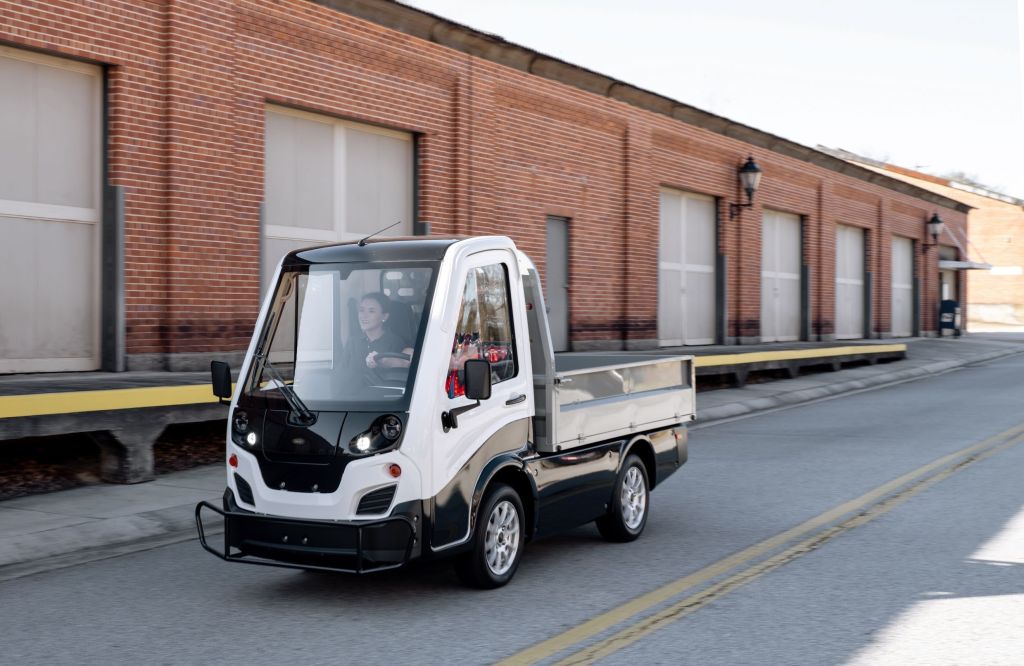
The company, working with AYRO, which produces purpose-built electric vehicles (EVs) for such things as microdistribution, has launched the Club Car Current, an EV that can be configured as a flat bed, pickup or van.

It offers a range of up to 57 miles.

(Image: Club Car)

As a certified low-speed vehicle (LSV), it operates at up to 25 mph.

It is powered by a VRLA (valve regulated lead-acid) gel battery.

It is certified as a Zero Emissions Vehicle by the California Air Resources Board.

And perhaps the most important factor for users: the cup holders are designed to accommodate larger containers.

Will Buying a Car Change?

Does Gen Z really want to kick tires?

By Gary S. Vasilash

On April 14, 2021, an “Open Letter by Academics in Favor of Direct EV Sales and Service” was published, with the signatories being current or emeritus professors at U.S. universities who “specialize in economics, competition policy, market regulation, industrial organization” and other disciplines.

The primary point:

“We write to argue that any state laws still prohibiting car companies from selling their cars directly to consumers, or opening service centers for those vehicles, be amended to permit direct sales and service of electric vehicles (‘EVs’).”

There is an acknowledgement that this has largely been a case of Tesla hitting up against franchise laws. But they go on to note: “it is equally important to a new crop of American EV start-up companies including Rivian, Lordstown, Lucid, Bollinger, and others about to enter the market. It is also important to the legacy automobile companies like General Motors, Ford, and Chrysler, which should be allowed to compete with the start-ups on a level playing field.”

The academics argue the dealer franchise laws generally go back to the mid-20th century when “car dealers were mostly ‘mom and pop’ sole proprietorships. By contrast, the ‘Big Three’ auto companies were hegemonic firms that faced relatively little domestic or foreign competition.”

So, in effect, to protect the little guy, the franchise laws were put in place. This meant that OEMs couldn’t sell (or service) vehicles directly to the consumer, as it was thought that were they able to, they would be able to undercut the small proprietorships that were selling vehicles.

The letter points out that today there are massive dealership groups responsible for moving a whole lot of vehicles, not one’s next-door neighbor who operates a dealership down the street. They write: “there are at least 15-20 major manufacturer groups selling cars in the U.S.”—which account for, they say, billions of dollars in revenue. You can buy a whole lot of jerseys for the local softball team with that kind of money.

The academics put forth a number of reasons why direct sales should be permitted for EVs (one suspects that were it permissible for EVs it would be difficult to stop this happening for vehicles with other propulsion systems). One of the salient points is: “Traditional dealerships earn low profit margins on new car sales, and make it up on service. EVs have a much smaller service component since they don’t have service needs like oil changes or engine tune-ups. Traditional dealerships therefore lack much of an incentive to sell EVs.”

In addition to arguments like that, there is the simple fact that since the franchise laws were enacted there have been an array of developments that allow people to obtain goods and services that were not even imagined back then.

Like the Internet.

Which facilitates things like Amazon.

Which has created a generation of consumers who want to get things on their schedules.

Which has given rise to things like Carvana.

And on it goes.

Dave Zuchowski is the chief strategy officer at Unite Digital. The mission of Unite Digital is “To drive significant growth for our customers by creating seamless customer experiences that Unite and differentiate a manufacturer and their distribution network.” The “customers” in that sentence are “automotive, powersports, automotive groups and other franchised industries.”

Zuchowski, who is a former president and CEO of Hyundai Motor America and senior vice president of Dealer Operations at Mazda North America, has seen the business from several perspectives.

He thinks that what will be the case going forward will be more of a “hybrid” than a case where in order for someone to get a new vehicle—EV or otherwise—they will have to go to a dealership. Rather, it will be a blend of digital and personal interactions, something more seamless than obstreperous.

On this edition of “Autoline After Hours” Zuchowski provides his insights on not only the changing face of automotive retail, but overall changes that are facing various aspects of the industry. He talks with “Autoline’s” John McElroy, automotive writer Steve Findlay, and me.

And you can see it here.

2021 Niro EV Launched

The what?, you, perhaps, wonder

By Gary S. Vasilash

When you think of an electric vehicle (EV), odds are that the first thing that comes to mind is something from Tesla.

Then, given the recent buzz, the forthcoming Ford F-150 Lightning.

Then after that maybe the Chevy Bolt EV.

And then any number of things, be it an Audi e-tron or a Porsche Taycan or something from a startup company that you’ve heard about (e.g., a Lucid Air).

K2021 Niro EV

How about the Niro EV?

(Quick: What is the name of the manufacturer who produces the Niro EV?)

The 2020 Niro EV was the number-one mass-market vehicle in the first J.D. Power Electric Vehicle Experience Ownership Study.

Number one.

The 2021 version is being launched.

The crossover from Kia has a starting MSRP of $39,090 and with its 64 kWh battery provides an estimated range of 239 miles.

It has a whole suite of standard driver assistance tech (from forward collision warning to smart cruise control with stop and go). Its got the goods, and then some.

And it is a functional compact crossover with 18.5 cubic feet behind the second row or 53 cubic feet with the second row folded. Usefulness meets technology at a very reasonable price.

Surprising how a competitive EV gets lost in the noise.

What’s In a Name?

Ford is transforming what it going on in what was once a traditional transmission plant

By Gary S. Vasilash

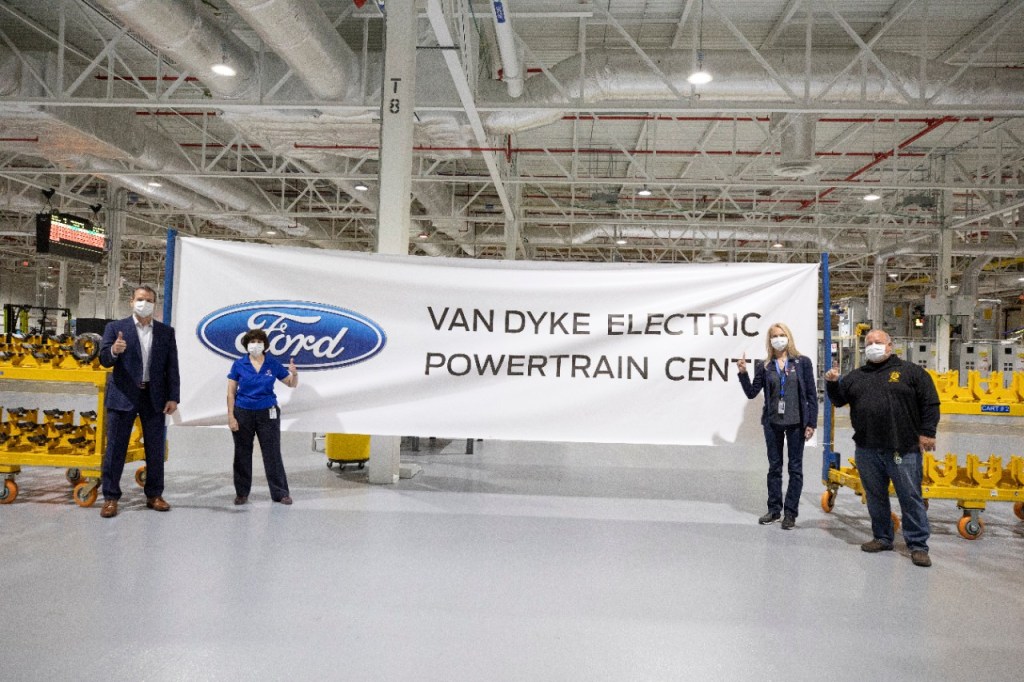
While what has long been known as the “Ford Van Dyke Transmission Plant,” a 2-million square-foot factory in suburban Detroit, didn’t make a transmission until 1993, even though it had been established in 1968 (when it was a suspension components plant), the sign visible on Van Dyke Avenue, after a generation is undergoing a change.

Now it is the “Van Dyke Electric Powertrain Center.”

Sign of change. (Image: Ford)

Inside they are going from just making the classic step-gear (a.k.a., “automatic”) transmission to electric motors and electric transaxles for full electric and hybrid vehicles.

Production of the Ford eMotor will begin at the plant this summer. Early next year the electric transmission (“eTrans”) manufacture will commence.

Ford spent $150-million in the plant to prepare it for its new role.

Things are clearly changing.

Why OEMs Build EVs and Other Things You Think You Know That Probably Aren’t the Case

A lively discussion of things from why Americans don’t buy small, cheap cars and why OEMs aren’t likely to get a big revenue stream from sending data to vehicle head-units

By Gary S. Vasilash

Although there is a whole lot of development going on in the electric vehicle (EV) space, as OEMs announce products and plans with what seems to border on giddiness, maybe things aren’t what they seem.

Consider, for one example, the F-150 Lightning reveal. While it might seem as though every person on your street is likely to replace their gasoline-powered F-150 with an electric one as soon as is practical (even though there is a starting MSRP of $40,000, and even though $40,000 is pretty much the average cost of a vehicle, it is still $40,000), even though people are touting the frunk that will allow them to fill it up with ice and beverages and the power outlets that will permit the audio equipment to be plugged in for parties and picnics, when you listen to Eric Noble, founder and president of The Car Lab, what seems to be the case may not be the case.

The F-150 Lightning in what is a natural environment: a work site. (Image: Ford)

That is, Noble points out that largely because of EV batteries—“They are expensive, huge, very heavy and don’t store very much energy”—especially the cost part, OEMs don’t make money on EVs unless these EVs are priced so highly that the cost of the battery can be buried in the MSRP.

Noble argues that because of the zero-emissions mandate of California and the other states that follow California’s lead in emissions regulations, OEMs that want to sell vehicles in those states—including vehicles with a 5.0-liter V8 under the hood—need to sell zero-emissions vehicles: EVs.

What is the number on the sales forecasts that OEMs have for EVs, he rhetorically asks.

Pretty much what the number of EVs required by the ZEV states are for that particular OEM.

However, he points out that there could be some real business for OEMs when it comes to selling to fleets. (“Ford is good at fleets,” Noble says.)

In other words, Teslas and Mustang Mach Es notwithstanding (and I don’t know whether the champagne need be busted out for the Mach E quite yet because in April Ford sold 1,951 Mach Es and 8,000 regular Mustangs), things like the Lightning are likely to be more oriented toward places where they can do the OEM the most good, which very well may be in fleet applications.

Noble talks about this on this edition of “Autoline After Hours.” And many of his arguments are bolstered by observations by Sam Fiorani, vice president of Global Vehicle Forecasting, AutoForecast Solutions.

Also on the table are other subjects of the moment, like over-the-air updates (not likely to be a revenue stream for OEMs because customers don’t want to have a monthly charge to their credit cards, why tech companies won’t become auto companies and vice versa, and a whole lot more.

Per usual, “Autoline’s” John McElroy and I are engaged in the conversation with these guests, and it is one of the livelier discussions you are like to see about the state of the industry—the reality versus the proclamations.

And you can see it here.

The Cost of “Refueling”

Turns out that EVs are significantly less expensive to power

By Gary S. Vasilash

Although electric vehicles tend to be more costly than comparable gasoline-powered vehicles, when it comes to “refueling,” EVs can save a whole lot of money compared with gasoline-powered vehicles, according to the U.S. Department of Energy.

As much as about 60%.

The agency developed what it calls an “eGallon.”

That is a comparison of what it would cost to buy equivalent energy to power an EV the same amount as it would cost a gasoline powered vehicle to travel on one gallon of gas.

So, based on the national average of $2.85 for a gallon of gas (as of March 31) and the equivalent price of electricity at a national average of $1.16 for an eGallon, this means the average fuel savings of approximately 60%.

In Washington state the difference was much larger: the cost of a gallon of regular was $3.13 and the cost of an eGallon was $0.89, so the fuel cost savings was about 72%.

So for those who pay attention to what they’re paying for their miles per gallon, it appears that EVs may be advantageous.

Of course, it takes longer to recharge an EV than it does to fill up a tank with liquid fuel.

So if time is money. . . .

GM Gets Ahead of the Curve on EV Battery Recycling

“GM’s zero-waste initiative aims to divert more than 90 percent of its manufacturing waste from landfills and incineration globally by 2025,” said Ken Morris, GM vice president of Electric and Autonomous Vehicles. This is one effort toward that end.

By Gary S. Vasilash

No one can say that General Motors and its partner LG Energy Solution aren’t being proactive.

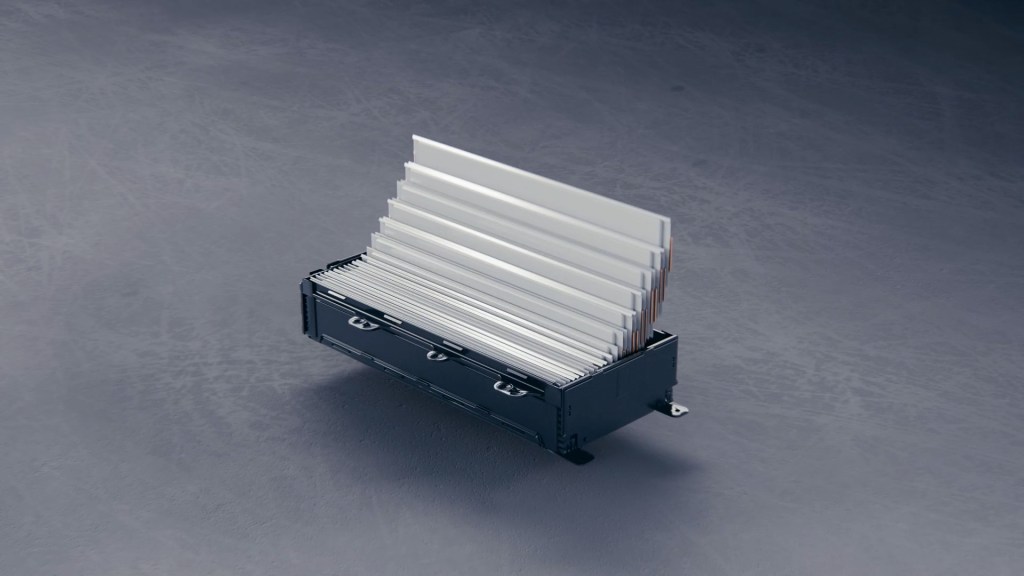
The two companies operate a joint venture, Ultium Cells LLC. Ultium Cells will build the Ultium batteries that GM will use in its forthcoming electric vehicles (EVs).

Ultium battery for the GMC HUMMER EV Pickup. Those white slats slot into that container. (Image: GM)

GM’s current EVs—the Chevrolet Bolt EV and Bolt EUV—have lithium-ion batteries, but not Ultium batteries. That’s because the vehicles were developed pre-Ultium.

However, vehicles like the forthcoming Cadillac LYRIQ, which is to become available the first half of 2022, will have Ultium batteries on board.

Ultium Cells announced that it will be working with L-Cycle, a battery recycling company, to, well, recycle the material scrap from battery cell manufacturing.

Cobalt. Nickel. Lithium. Graphite. Manganese. Aluminum.

According to GM, 95% of the reclaimed materials can go into things like new batteries.

Li-Cycle says that the hydrometallurgical process it uses to recycle the materials is more energy efficient than other methods, like high-temperature “smelting” processes.

Which is fitting to what Ultium Cells is up to, as Thomas Gallagher, the company’s COO, said, “We strive to make more with less waste and energy expended.”

And at the very least, it undoubtedly beats the heck out of mining those materials.

The recycling process is scheduled to go on line later this year.

After all, they need to develop batteries so they can develop scrap.

How Many EV Chargers in the U.S.?

If you live in California, there is a reasonably large number. Of course, there is also a reasonably large number of electric vehicles. Chicken or egg?

By Gary S. Vasilash

According to the U.S. Department of Energy, there are now 25 states that have at least 1,000 non-residential electric vehicle charging units. This means that if you had an electrician come over to your garage and wired it up for a Level 2 charger, it doesn’t count.

Yet for some reason, public and private chargers are counted.

No surprise that California has the most. 36,913 chargers.

Alaska has the least: 69.

Large yet comparatively out-of-the-way states have low numbers, too: 116 in North Dakota and 134 in South Dakota.

Even a small out-of-the-way state, Hawaii, has more than those two continental states combined: It has 784 chargers.

While the number of chargers is on the increase, the whole charging infrastructure is still a challenge for the acceptance of electric vehicles.

And this isn’t even taking the amount of time it takes to charge the average EV in relation to how long it takes to fuel a vehicle that runs on gasoline.

Arrival: The Cleverest EV Company on the Planet?

Making electric commercial vehicles seems to be what several companies are doing. But the approach of this U.K.-based company is unlike what those other companies are doing.

By Gary S. Vasilash

One of the more interesting companies in the electric vehicle space is Arrival, a firm that was founded in London in 2015, where it has its HQ, and which has also established a North American HQ in Charlotte, North Carolina.

Arrival is in the business of developing electric vehicles.

Arrival Automotive CEO Mike Ableson. (Image: Arrival)

Initially a bus (start of production: Q4, 2021). Then a commercial van with a payload up to 4,400 pounds (start of production: Q3, 2022). Then a larger van with a payload up to 8,800 pounds (start of production: Q3, 2022). And eventually a small consumer vehicle (start of production: Q3, 2023).

Here’s one thing that makes these vehicles notable: There is a modular structure so the vehicles can be tailored to the specific user and application. While “special builds” generally drive costs, starting with this design approach helps minimize that.

Here’s one thing that makes the Arrival approach notable: Rather than building these vehicles in conventional automotive assembly facilities that have a stamping plant and paint shop, as Mike Ableson, CEO of Arrival Automotive (and 35-year vet of GM, where his last position was vice president of EV Infrastructure, with a variety of advanced technology, strategy and engineering positions before that), points out on this edition of “Autoline After Hours,” the Arrival approach, known as “microfactories,” is predicated on establishing a manufacturing facility within what would ordinarily be considered a warehouse.

This is low-volume, regional manufacturing.

It will put its first U.S. microfactory, which will start producing buses later this year, in York County, South Carolina. There will be a second in West Charlotte, North Carolina, where as many as 10,000 electric delivery vans will be built, with production starting in the third quarter of 2022. It has another microfactory in Bicester, UK.

The vehicles have proprietary composite body panels so there is no stamping plant needed. The colors are molded in the material so there is no paint shop. The factory utilizes robotic transport vehicles that move from cell to cell so there are no traditional assembly lines. The assembly is done with mechanical fasteners and adhesives so welding equipment isn’t required.

Ableson points out that batteries are a big cost component of all electric vehicles. He also notes that essentially all OEMs are faced with the same type of battery costs. So, he explains, that the way to keep costs down is not only in establishing production capabilities, but also in designing and engineering the vehicles is such a way that they can minimize overall cost.

The company uses the term “radical impact” in relation to what it is doing.

Arguably, if they pull off what they are undertaking, that won’t just be corporate rhetoric but a true statement.

Ableson talks on the show with Joe White of Reuters, Mike Austin of Hemmings and me.

Then White, Austin and I discuss a variety of other subjects, most of which have to do with vehicle electrification claims and efforts being undertaken by companies including Honda, Volkswagen, Ford and General Motors.

And you can see it all here.