It is down in Q1 by a big number. A very big number.
By Gary S. Vasilash
Although there are plenty of headlines about Tesla sales dropping 37.2% in Europe during the first quarter of 2025 compared to Q1 2024, it is actually a bit worse than that.
The European Automobile Manufacturers’ Association (ACEA), which reports the numbers, has two charts for new car registrations by manufacturer.
One is for the European Union.
One is for the European Union, the European Free Trade Association (EFTA) countries (Iceland, Liechtenstein, Norway, and Switzerland), and the United Kingdom.
The 37.2% drop is for the EU + EFTA + UK market.
While that combined market is bigger than the EU alone, the EU market alone had EV sales of 412,997 EVs in Q1 and the EFTA and the UK added only 160,503.
Obviously that EFTA + UK number can change the overall percentage.
But the trend in the EU itself is the one that is the more important.
The EU-only chart shows that Q1 2025 Tesla sales are down 45% compared with Q1 2024.
While there may be excuses about changeovers and Q1 not being great for sales, and it is true that there are negative numbers for several OEMs in the EU—for example, Stellantis -14%, Toyota -4.8%, Hyundai Group -7.2%, Mercedes -6.2%–but no OEM is off as much as Tesla.
Not All Red Ink
What’s more (truly more) is that the ACEA finds that Volkswagen Group for Q1-Q1 is +4.8%, Renault Group +9.5%, and BMW Group +0.4%.
Of all the countries in Europe—including the EFTA and the UK—the single biggest market in Germany. Where Tesla has a plant. And where Elon Musk became involved in politics.
Germany’s Robust EV Sales
During the first quarter of 2025 sales of battery electric vehicles in Germany were up 38.9% compared with Q1 2024.
There were 112,968 EVs sold in Germany in Q1. It is the dominant factor in all of the numbers.
While it is probably impossible to know precisely why Tesla sales were down 45% in the EU in a period when EV sales were up 38.9%, it isn’t hard to imagine why.
Although you have likely not seen the vehicle in person yet, it is likely to become something that you see a lot of. And Cadillac has now announced a performance variant
By Gary S. Vasilash
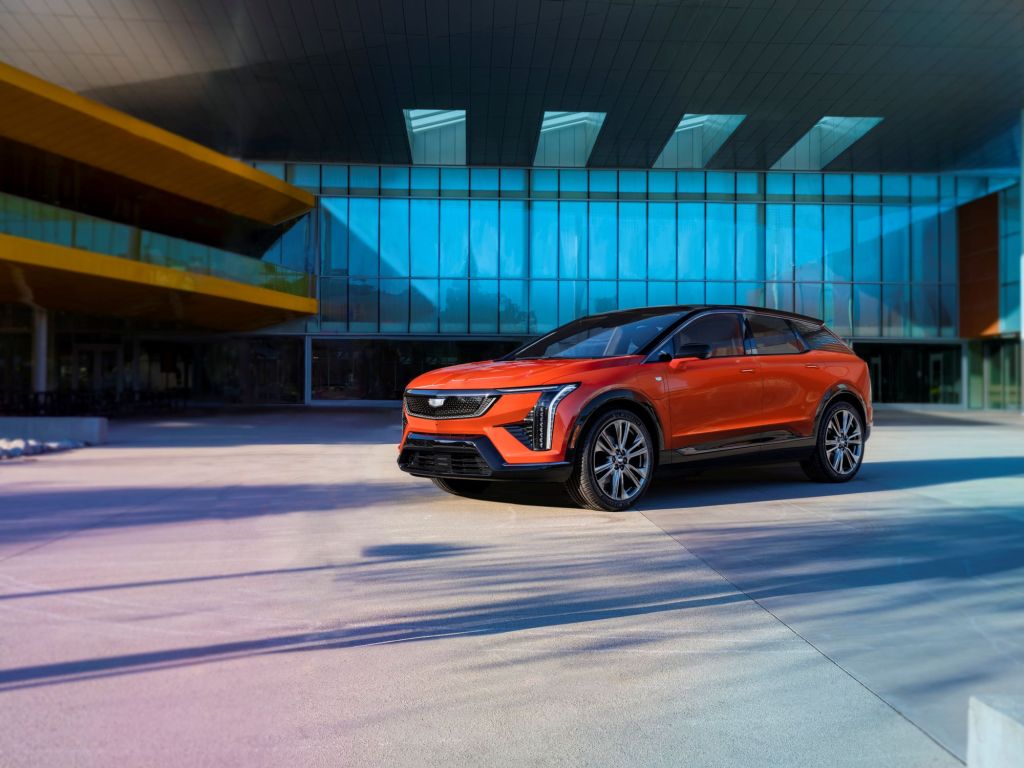
In the compact luxury EV crossover segment Cadillac has an exceedingly fine entry in its Optiq. (One problem it may have, however, is the name: might some people not find its pronunciation troubling and so as not to embarrass themselves, go to the Audi store that’s next door and ask about the Q4, instead?)
2025 Cadillac Optiq: a stylish compact crossover. (Photos: Cadillac)
The vehicle has a powertrain that provides 300 hp and an EPA estimated range of 302 miles.
It has an interior with an innovative freshness that undoubtedly will help skew Cadillac’s mature ownership numbers far lower.
And with the second row up it provides 26 cubic feet of cargo capacity—57 with it down—so there is actually more than a modicum of utility provided, an important consideration for one’s daily existence with a vehicle.
Right out of the box there were 1,716 Optiqs sold in the first quarter—502 more than the Cadillac CT4, so that’s saying something (although it is a bit of an apples-to-oranges comparison, as the CT4 is a sedan with an internal combustion engine).
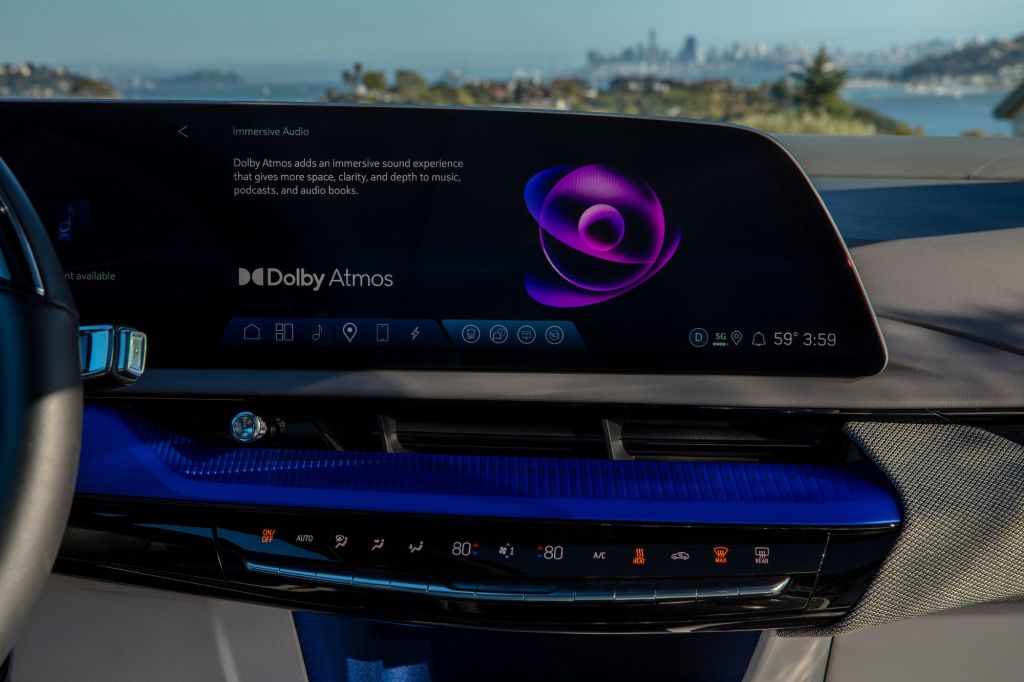
The interior is fashion-forward. Yes, it has a big screen (33-inches, diagonal) but the color and materials are much more impressive.
Undoubtedly planning to juice that number, today Cadillac announced there will be a 2026 Optiq-V series vehicle.
Details are, well, non-existent (beyond “Cadillac engineers delivered a unique package prioritizing precision, dynamic suspension and tight steering,” which is pretty much marketing-speak).
One thing that is likely the case is that the 2026 Optiq-V will have a non-trivial bump in its starting MSRP (according to Cadillac.com, the starting price for a 2025 Optiq is $52,895), not only because of what the Cadillac engineers have done, but because the Optiq is produced at a GM plant in Ramos Arizpe, Mexico.
Seems that gasoline is still reasonably popular. . .
By Gary S. Vasilash
The good news for companies in the European Union that make things like con rods and pistons is that according to the most recent vehicle registration figures from the European Automobile Manufacturers’ Association (ACEA) people are still buying vehicles that use internal combustion engines.
Its figures for January 2025 show that 29.4% of EU new vehicle registrations in January were for “petrol” powertrains.
The number in January 2024 was 35.4% petrol power, so clearly things are moving in the wrong direction for those in the business of making engines and the components thereof.
However, looking at the numbers for hybrids, things appear in a different way.
In January 2024 hybrids represented 28.7% of the new registrations in the EU.
But in January 2025 hybrids are at 34.9%.
So while there was a 6% decline in petrol registrations between the two months, there was a 6.2% increase in hybrid registrations.
And hybrids, of course, use internal combustion engines, too.
So if we sum the figures, 64.3% of the new vehicle registrations in the EU in January have internal combustion engines.
If the plug-in hybrids are added (7.4%), that gets to 71.7% of the market.
Electric vehicles?
They’re 15% of the January 2025 new vehicle registrations, which is a move toward the upside compared to January 2024, when EVs were at 10.9%.
However, EU regulations regarding CO2 emissions are such that 20% of the vehicles sold by automakers must be zero emissions.
If the ~37% increase from January 2024 to January 2025 for EVs holds, there is not going to be a problem reaching that figure.
Still, presumably when the 20% rule was written it was a stretch goal but not one thought to be wholly unattainable.
At the end of the day, the Market will decide on what powers its vehicles.
I suspect there is really nothing that “sells itself.” Sure, there are things that someone might need and go out and buy because of current conditions—like the people who make a run on snowblowers at Home Depot both before and after storms: no one needs to sell that equipment to the buyers.
But when it comes to things like automobiles, the number of people who have a sudden need and are capable of dropping a few grand to accommodate that need is probably quite small.
As is often pointed out, a vehicle is generally the second biggest purchase that someone makes, so consideration is involved in the process.
Still, if there is any type of vehicle that “sells itself” today, it is a hybrid.
Even though there is massive attention paid to electric vehicles, in 2024 hybrids (including the plug-in versions) had 11.9% of the total US light-duty market while EVs accounted for 8.1%.
And when is the last time you heard anything about a new hybrid? And compare that with the paid-for advertising or earned media (coverage in various outlets, including this one, often predicated on the loan of a vehicle by an OEM for assessment) for electric vehicles.
If not “selling themselves,” then people are becoming more interested in going hybrid.
The first Prius was available in the US market in July 2000. Which means it is coming up on its 25th anniversary.
Through the years the Prius has been both lauded and chastised. And it seems more the latter than the former.
There has always been the claim that because there are two powertrains (the internal combustion engine and the electric motor(s)) in a hybrid, it is too expensive for regular consumers—and the knock is often made by companies that were rolling out with electric vehicles that were significantly expensive, far more than the price of a Prius.
Consistently, Prius sales have been by mass manufacturing metrics “meh.”
Last year 44,711 were sold, and 38,052 the year before.
But it should be noted that in 2024 Toyota brand sold 546,738 hybrid vehicles in the US as the company now offers vehicles ranging from the Corolla to the Sienna to the Tundra with a hybrid powertrain.
Toyota seriously has the hybrid power and the consumers have a lot of choice.
The Prius, while having styling that has ranged from the dowdy to the bizarre, currently has an appealing look.
Looks good and you can drive and drive and drive before you need a fill-up. (Image: Toyota)
When the current body style was launched in 2023 in the US it was so striking that it was named the 2024 North American Car of the Year by the jury of the North American Car, Truck and Utility of the Year Awards, besting both the Honda Accord and the Hyundai Ioniq 6.
The last time the Prius won was in 2004, besting the Mazda RX-8 and Cadillac XLR, neither of which exist in contemporary production.
People have consistently wanted to get a Prius, and Toyota has consistently provided them.
The vehicle driven here is a plug-in hybrid. (The “Prime” moniker goes away for MY 2025 vehicles, at which point it simply is Prius Plug-in.)
If you’re not familiar with what that means, know that in the case of the Prius, on the rear quarter panel on the driver’s side you pop the door to fill the car with gas and on the opposite side there is an outlet to plug the car in either at home or at a Level 2 charging station.
This means there is full-electric range for the vehicle—up to 44 miles (based on ideal conditions).
It should be noted, however, that if you’re plugging it in on a standard 120-V outlet at home, it is going to take 11 hours to fully charge the battery. If you stop at a commercial Level 2 charger, then it will take about four hours.
When you go to the gas station, it will take you about five minutes to fill the tank. The Monroney sticker says you’ll get 52 mpg city/highway combined, so with about 11 gallons in the tank that means over 500 miles from the liquid fuel.
But perhaps (1) you have a daily commute that is 40 miles or under and you don’t like visiting gas stations and you do have an outlet in your garage or (2) you are exceedingly environmentally conscious and don’t like combusting gasoline if you don’t have to. Which would make the plug-in version right for you.
The Prius (powertrain notwithstanding) now has a sporty look on the outside and a low seating position signifying sportiness on the inside. While this is appealing to some people, it will probably turn off others. But Toyota has more than a dozen other hybrids to choose from, so that’s covered.
There is a Prius with FWD, a Prius with AWD and the plug-in with FWD.
The first provides system (i.e., engine and motor(s)) horsepower of 194. The AWD version delivers 196 hp. And the plug-in has 220 hp.
There is a discernable difference with the +20 hp for those who are so inclined.
The SE is the base model. Cloth. Eight-inch screen. Manual seats. But a sticker under $33K.
But were you to go for the less powerful but base non-plug-in FWD Prius, you’d get 5 mpg more and spend a few grand less.
While the increased horsepower is nice, I think the 57 mpg is nicer.
However, some people want an EV but don’t have the money to buy one.
The Prius plug-in could be the answer. If the average American drives 40 miles per day and the plug-in provides approximately that range, there you go.
What’s more, when you need to drive from, say, Detroit to Chicago, you can do that, too, without having to think about making a long stop along the way for recharging because the gasoline engine will get the job done—in fact, you could drive there and more than three quarters of the way back without needing to stop for any kind of fuel.
As the Grand Transformation to Electric Vehicles seems to be somewhat less transformative than we might have been led to believe by industry executives who were “all in” with varying levels of commitment (e.g., “We will be all electric by ____,” a date that is no longer uttered), there is a move back to hybrids.*
The knock on hybrids, since the Toyota Prius showed up on American roads in 2000, was that there are two powertrains (the regular engine and electric motor(s)), so that wasn’t going to be acceptable.
Except they were accepted.
And that two powertrain quibble gave rise to the “too expensive” mantra.
Now there is a move by some of the hybrid-skeptical companies to say, “Hey, we’ve got them, too! We’ve been behind them all along!”
(Insert polite coughing sound here.)
Hyundai has been offering a Sonata Hybrid since model year 2011.
Consistently.
But if there’s anything to know about Hyundai, the company is consistently producing vehicles that are stylistically and functionally advanced.
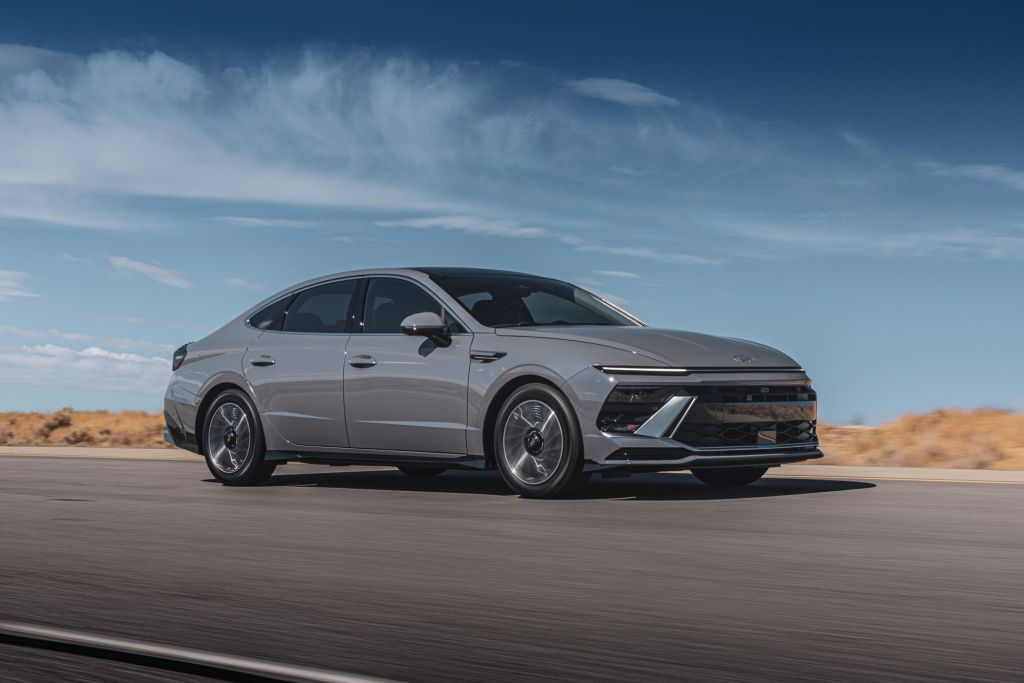
Although the 2025 Sonata Hybrid is a carryover from model year 2024, it still looks 10 years more innovative than anything out there.
Looks sensational and sips gas. (Image: Hyundai)
And it should be pointed out that the Limited trim driven here is the top-of-the-line (there is also the entry SEL trim).
So, going back to that “hybrids are too expensive,” know that this hybrid has a starting MSRP of $37,450. The one driven had a single option: $210 for floor mats.
Before looking at the Monroney for the car I guesstimated it would cost $50,000.
Not because of the “two powertrains are too expensive” schtick.
But because (1) it looks lux and (2) it is loaded.
Let’s roll through just some of the features on the vehicle:
Blind-spot and surround-view monitors
Parking collision-avoidance assist (for example: you can see on the 12.3-inch screen where the vehicle is in real space when you are backing out of a parking space, which is incredibly handy in lots that are designed to maximize the number of spaces and minimize the amount of space between them)
Panoramic sunroof
Leather seats
Heated and ventilated front seats
LED interior lights (this is something that needs to be seen because the difference between the illumination from them and the traditional incandescent lights is remarkable)
Bose premium audio
Power closing trunk (which really seems a bit too much, but when you look at how the trunk hinges, something that most people pay approximately zero attention to, are designed and integrated, you know that this is something that is conceivably beyond my $50K estimate to lux space)
And this list could go on to the extent that your eyes will glaze over, so as there are a few more things to say, I’ll stop
The vehicle has a 2.0-liter four-cylinder engine that is mated to a permanent magnet synchronous motor. The engine provides 150 hp. The motor 51 hp. And the way these things work, the sum of the two is not 201 hp but a combined 192 hp. The whole hybrid give-and-take is a tricky business.
Now this is a large-ish four-door sedan. It is 193.3 inches long, 73.2 inches wide, 56.9 inches high, and has an 111.8-inch wheelbase. It has a passenger volume of 104.4 cubic feet (i.e., it is roomy) and the aforementioned trunk has a 15.6-cubic foot capacity.
Its curb weight is 3,687 pounds.
All of which is to say that given the capacity of the engine and the size and weight of the vehicle, it is capable of propelling you when you drive—surface streets or freeways—as you probably normally drive. No head-snapping when you stand on the throttle, because 99.9% of the time—give or take a 0.1%–you are not feeling that you have to prove something when you are in a four-door midsize sedan, type of powertrain notwithstanding.
The reason people drive hybrids is not to sate their need for speed but because they don’t have a need to spend a whole lot of time at a gas station. The EPA numbers for the Sonata Limited Hybrid are 44 mpg city, 51 mpg highway, for a combined 47 mpg.
Hard to quibble with what it is or how it delivers the kind of fuel economy people are looking for.
==
*It should be noted that Hyundai does have EVs, including the Kona Electric, the Ioniq 5 and the Ioniq 6. But it also offers hybrids in the Elantra, Santa Fe and Tucson.
One of the ways that Rivian hasn’t become one of those EV companies that has either gone out of business, is teetering on the edge of going out of business, or is in some weird statis that has people wondering how the heck it seems to exist, is through support of Amazon.
Back in 2019 Amazon invested $1.3 billion in the EV company and ordered 100,000 delivery vans.
And now companies of all sizes can get their own Rivian Commercial Van.
Rivian cargo vehicle: You, too, can get one for your delivery needs. (Image: Rivian)
The vehicle comes in two sizes.
The 500 measures 248.5 inches long, 114.7 inches tall, and 96.4 inches wide (with mirrors).
The 700 is 278 inches long, 114.7 inches high, and 103.5 inches wide (with mirrors).
The 500 has a cargo volume of 487 cubic feet and a payload capacity of 2,663 pounds.
The 700 has a volume of 652 cubic feet and capacity of 2,258 pounds.
The 500 has an estimated range of 161 miles.
The 700’s is 160 miles.
The starting price for the 500: $79,900.
The starting price for the 700: $83,900.
Tom Solomon, senior director, Business Development, Rivian, said:
“Amazon currently has more than 20,000 in its fleet and delivered over a billion packages from its Electric Delivery Vans in 2024 alone.”
He added: “We’re excited to now be able to open sales to fleets of all sizes in the US, whether they want one van or thousands.”
Clearly they’d be happy were a fleet to go for the latter.
Of course, business being business, one would be helpful, too.
Here’s what the dealers sold in the state in 2024. It may surprise you
By Gary S. Vasilash
If someone asked what the best-selling automotive brand was in California in 2024, odds are “Tesla” would leap to mind as the leader.
Close, but no whatever the alternative to a cigar is.
Tesla, which has 3.9% of the total U.S. market, with 11.6% in California, is in second place.
Toyota is the top seller in California according to the California New Car Dealers Association (CNCDA).
In 2024 it had 16.4% of the California market. 12.8% in the U.S.
Coming in third in the Golden State is Honda, with 10.9% of the market. Nationally it is at 8.1%.
So far as California numbers go, after third place the rest of the brands have single-digit (not including the bit to the right of the decimal) shares of the market:
• Ford 7.4% • Chevy 6.2% • Kia 4.8% • Hyundai 4.5% • Nissan 3.9% • Mercedes 3.9% • BMW 3.7% • Lexus 3.6% • Subaru 3.4% • Mazda 2.3% • GMC 2.1% • Audi 1.9%
Although some have chastised Toyota for its limited EV offering, odds are Toyota dealers are happy with the approach.
Note how Toyota has a 4.8% advantage over Tesla. Tesla has just a 0.7% advantage over Honda.
You may note what’s missing from the top 15 brands: any Stellantis brand.
They didn’t do particularly well in the California market in 2024.
Compared to 2023 new car registrations in the state:
• Ram -21.5% • Jeep -28.6% • Chrysler -32.1%
The good news is that apparently people like muscle cars in California because Dodge registrations were up 6.9%. (What’s interesting is that on the list of those in the positive territory, Toyota’s increase was just 4.4%, which indicates that having 16% of the total market is probably about as good as you can get.)
What is notable is how Ford and Chevy play so very well on the national level.
While Ford, as mentioned, has 7.4% of the California market, it has 11.8% of the U.S. market.
And Chevy, with 6.2% in California, is at 10.9% nationally.
While it probably has a lot to do with pickups, Californias do buy a number of those, too: 37,655 Chevy Silverados and 36,546 F-Series trucks were registered in 2024.
Here’s something to consider:
According to the CNCDA:
“New light vehicle registrations in California declined a slim 0.3 percent from 2023 to 2024. The U.S. market improved by 3.4 percent last year.
“All of the decrease in the state market last year was attributable to Tesla, which had an 11.6 percent decline. Registrations for all other brands increased 1.4 percent.”
If Musk didn’t seem to be so occupied elsewhere you might think he be thinking long and hard about that non-trivial decline in California.
California has some 1.1-million EVs registered. If you take the next four states with high levels of EV registrations—Florida, Texas, Washington, and Arizona—combined they have 520,000 EVs rolling around.
One part of the decline for Tesla in California could be saturation and aging models. Another could be politics, but if that’s an issue, it will really come to the fore in the results for 2025.
Yes, it is about “Vorsprung durch Technik” (Advantage through Technology), but. . . .
By Gary S. Vasilash
While portal axles are usually used in things that are used by military vehicles or vehicles that go way off road, there are some like the Mercedes G500 that use them, too.
A key difference between a portal axle and a conventional one is that the portal axle is offset above the center of the wheel hub. There is a gear mechanism on the hub that transfers the power to drive the wheels.
The reason for the portal axle is to provide increased ground clearance.
Remember when Audi concept vehicles were sexy? (Image: Audi)
Audi says it has developed new portal axles that it is using on a prototype Q6 e-tron offroad vehicle.
The prototype is based on the automaker’s Premium Platform Electric (PPE).
According to the company while conventional portal axles can increase torque from 20 to 30% at the wheels, Audi’s increases it by 50%.
Audi CEO Gernot Döllner said of the vehicle: “The model shows the potential that our platform for all electric vehicles already has today. This vehicle can claim new ground. We look forward to seeing our customers’ reactions to this highly emotive car.”
Presumably more than a few customers are going to think it looks like something that has undergone massive suspension tuning for display at a venue like SEMA, not as something that is, well, an Audi.
Somehow the “Premium” part is overwhelmed by the engineering of the axles.
One of the questionable Christmas presents that car companies doing business in the UK happened just before the holiday, when the country’s Department of Transport, which has on the books a mandate that by 2030 there will be no new vehicles sold with gasoline or diesel engines under their hoods, announced an eight-week period during which the OEMs would have the opportunity to weigh in on how this can be achieved.
Note this is not an “If.”
As things stand, there are annual targets that must be achieved in terms of zero-emission vehicle—a.k.a., electric vehicles—by the companies.
The UK government is committed to this, apparently, although one wonders if the auto industry begins to crumble because of the penalties associated with not meeting the targets.
Penalties in the form of a fine of £15,000 for every vehicle sold that doesn’t meet the target.
For example, consider Ford, which has been part of the UK’s automotive structure since 1911.
The mandate has it that 22% of a carmaker’s sales in 2024 are electric.
How did Ford do? Apparently 6.8% for the first 11 months, so unless there was some massive change, it will be well below the government bogey.
Which means serious fines.
This is sort of an insult-to-injury situation in that the company has been investing billions of dollars/pounds/euros—pick your currency—in EVs, and because people aren’t as interested in buying them as they are other products, it costs Ford (and other companies that don’t meet the mandate) more.
“Aside from the billions invested in new technologies and products, it has cost manufacturers in excess of £4 billion in discounting in the UK this year alone. This is unsustainable and, with the 2025 market looking under even greater pressure, it is imperative we get an urgent resolution, with a clear intent to adapt the regulation to support delivery, backed by bold incentives to stimulate demand.”
Which probably means that the government is going to have to pony up more money in order to generate demand.
And Ford isn’t the only company with the lack-of-demand situation. It is estimated EVs will represent 18.7% of the UK car market in 2024, not the mandated 22%.
In 2025 that goes up to 28%.
Hawes’ “unsustainable” is an understatement.
This isn’t just a UK issue.
In the US, where EV sales in 2024 were on the order of 9%, currently standing EPA greenhouse gas regulations have it that more than 50% will need to be EVs by 2030.
They’re concerned that people don’t know what they should about EVs. . .
By Gary S. Vasilash
In order to keep U.K. customers interested in the possibility of buying an electric vehicle, Auto Trader (a vehicle purchase platform), ChargeUK (an organization consisting of EV charging companies), and the Society of Motor Manufacturers and Traders (a trade association representing OEMs and suppliers) have gotten together to combat misinformation about EVs.
This past February the House of Lords’ Environment and Climate Change Committee came out with a report that indicated there was a need for “clear and balanced information” regarding EVs for consumers.
And Auto Trader discovered that the number of retailers offering EVs on its site was at 35% for both 2023 and 2024. It had been 57% in 2022.
So this is what the three groups have come up with:
One of the interesting points is the 71,459 available chargers.
In the U.S., as of late August, there were over 192,000 publicly available chargers, according to the U.S. Federal Highway Administration.
To put that into context, the U.S. is 40 times larger than the U.K.; it has five times as many people, and nine times as many automobiles. Yet it has just 120,500 more public chargers.
According to the U.K. group there is one charger per four miles of road in the U.K.
The U.S. federal infrastructure plan is building out one charging station on the Interstate Highway System—per every 50 miles.
If there is concern about the lack of a significant uptake of EVs it should be in the U.S. far more than in the U.K.





 shinymetalboxes