One of the questionable Christmas presents that car companies doing business in the UK happened just before the holiday, when the country’s Department of Transport, which has on the books a mandate that by 2030 there will be no new vehicles sold with gasoline or diesel engines under their hoods, announced an eight-week period during which the OEMs would have the opportunity to weigh in on how this can be achieved.
Note this is not an “If.”
As things stand, there are annual targets that must be achieved in terms of zero-emission vehicle—a.k.a., electric vehicles—by the companies.
The UK government is committed to this, apparently, although one wonders if the auto industry begins to crumble because of the penalties associated with not meeting the targets.
Penalties in the form of a fine of £15,000 for every vehicle sold that doesn’t meet the target.
For example, consider Ford, which has been part of the UK’s automotive structure since 1911.
The mandate has it that 22% of a carmaker’s sales in 2024 are electric.
How did Ford do? Apparently 6.8% for the first 11 months, so unless there was some massive change, it will be well below the government bogey.
Which means serious fines.
This is sort of an insult-to-injury situation in that the company has been investing billions of dollars/pounds/euros—pick your currency—in EVs, and because people aren’t as interested in buying them as they are other products, it costs Ford (and other companies that don’t meet the mandate) more.
“Aside from the billions invested in new technologies and products, it has cost manufacturers in excess of £4 billion in discounting in the UK this year alone. This is unsustainable and, with the 2025 market looking under even greater pressure, it is imperative we get an urgent resolution, with a clear intent to adapt the regulation to support delivery, backed by bold incentives to stimulate demand.”
Which probably means that the government is going to have to pony up more money in order to generate demand.
And Ford isn’t the only company with the lack-of-demand situation. It is estimated EVs will represent 18.7% of the UK car market in 2024, not the mandated 22%.
In 2025 that goes up to 28%.
Hawes’ “unsustainable” is an understatement.
This isn’t just a UK issue.
In the US, where EV sales in 2024 were on the order of 9%, currently standing EPA greenhouse gas regulations have it that more than 50% will need to be EVs by 2030.
They’re concerned that people don’t know what they should about EVs. . .
By Gary S. Vasilash
In order to keep U.K. customers interested in the possibility of buying an electric vehicle, Auto Trader (a vehicle purchase platform), ChargeUK (an organization consisting of EV charging companies), and the Society of Motor Manufacturers and Traders (a trade association representing OEMs and suppliers) have gotten together to combat misinformation about EVs.
This past February the House of Lords’ Environment and Climate Change Committee came out with a report that indicated there was a need for “clear and balanced information” regarding EVs for consumers.
And Auto Trader discovered that the number of retailers offering EVs on its site was at 35% for both 2023 and 2024. It had been 57% in 2022.
So this is what the three groups have come up with:
One of the interesting points is the 71,459 available chargers.
In the U.S., as of late August, there were over 192,000 publicly available chargers, according to the U.S. Federal Highway Administration.
To put that into context, the U.S. is 40 times larger than the U.K.; it has five times as many people, and nine times as many automobiles. Yet it has just 120,500 more public chargers.
According to the U.K. group there is one charger per four miles of road in the U.K.
The U.S. federal infrastructure plan is building out one charging station on the Interstate Highway System—per every 50 miles.
If there is concern about the lack of a significant uptake of EVs it should be in the U.S. far more than in the U.K.
This is a vehicle that more people than you might imagine have been waiting for—even if they didn’t know it. . .
By Gary S. Vasilash
“GeekWire is unique among technology and business news sites, in that we look at the world through the lens of Seattle and the Pacific Northwest, where we’re based.” So the outlet describes itself.
The site has an “intense global interest in technology, ideas and innovation emerging from our backyard. Our motto is, ‘What happens here matters everywhere.’ Microsoft and Amazon are classic examples, but countless startups, research organizations, educational institutions and others based in the Seattle region also have an outsized impact on the world.”
So while the coverage is generally about the tech and the people related to Microsoft, Amazon and an array of outfits and organizations that you’re likely not to have heard of unless you are deep in the digital tech space, it also covers other things on occasion.
“As I pulled away from the Seattle International Auto Show on Thursday during a test drive of the highly anticipated Volkswagen ‘ID. Buzz’ electric van, a driver in a Tesla Cybertruck offered a thumbs up.
“It was all the confirmation I needed that the Buzz was going to be the buzzworthy vehicle at the annual show at Lumen Field Event Center.”
Yes, it is the type of vehicle that gets love whether it is in Seattle or Detroit.
Cost Consideration?
Which is absolutely appropriate for the rebirth of the VW Microbus: while in its heyday in the 1960s the Microbus was largely associated San Francisco scene, this new EV is somehow more appropriate for places like Seattle than Silicon Valley, south of San Francisco. That is, there is an income-based accessibility to the ID. Buzz, with a starting MSRP of $59,995, which is more in line with the median household income in Seattle ($129,715) than Silicon Valley ($146,143): the former probably is more concerned with sticker prices than the latter.
However, given that the median household income in the U.S. is more along the lines of $78,046, the ID. Buzz may not be for every household budget—but that won’t matter. Those who can probably will.
VW Germany Builds. U.S. Will Buy
At least for the first couple years every ID. Buzz available in the U.S. (it is built in a VW plant in Hannover and has been available in the Europe market since the latter half of 2022) will be purchased. People are drawn to the vehicle in a way few other vehicles of any configuration command.
And not just the type of people who read GeekWire.
It looks familiar. And fresh. Quite a feat. (Image: VW)
Of all of the vehicles I have driven in the past few years the ID. Buzz has had considerably more attention than any other.
Lots of Love
A 20-something HVAC technician who came to check my furnace, who says he’s thinking about buying an Accord: “That is really a cool vehicle.”
My 30-something Alfa Giulia Quadrifoglio-driving next-door neighbor: “I LOVE it!”
A 60-something man who walked over to the ID. Buzz when I was in a Barnes & Noble parking lot: “I remember the Microbus from when I was young. This is quite nice.”
And there were many others who were walking by who stopped and stared and drivers giving me a thumb’s up when I cruised by.
The thing is, none of the people that I talked with about the ID. Buzz brought up the fact that it is an electric vehicle. They didn’t care whether it was based on the MEB platform, which is meaningless to them. They didn’t know if it was a rear-drive vehicle (the one in question is) or whether there is a low center of gravity by having the 91-kWh lithium-ion battery located beneath the floor.
They weren’t overthinking it.
They simply thought it looks great.
And evidently VW found that design is the #1 reason why people are interested in it.
The Definition of “Capacious”
Of course, if you’re going to buy something like the ID. Buzz, you’re probably going to be interested in its cargo capacity, whether that’s in the context of having three rows of seats for people (depending on the types of seats selected, it handles six or seven people, and there is considerable third row legroom: 42 inches, which is 10 inches more than that offered in the roomy Kia EV9) or a whopping 146 cubic-feet of cargo capacity—and I use the word “whopping” advisedly: its capacity bests the Chevy Suburban—which is 2.6 feet longer (the ID. Buzz is 195 inches; the Suburban 226 inches)—by one cubic foot, and on more of an apples-to-apples comparison, it bests the Chrysler Pacifica PHEV minivan by five cubic feet (about the size of an average microwave oven).
(However, a word about cargo capacity. The aforementioned 282-hp electric motor that provides rear-wheel drive isn’t located in the front of the vehicle with a drive shaft traveling back to the rear axle, as would be the case of a vehicle with an internal combustion engine up front, but it is in the rear of the vehicle, below the location of the third row. So while other minivans provide more manipulation of the third row because they’re not restricted by a motor, to get the maximum cargo capacity from the ID. Buzz the third row needs to be removed, not exactly the sort of thing you’d want to do on a regular basis. Still, the second and third rows do fold flat. It is just that the third row can’t go into the floor, like the “Magic Seat” in the Honda Odyssey.)
Because this is an EV, the range must be stated: the rear-drive ID. Buzz provides a range of an estimated 234 miles. And to put that into context, according to the EPA, the 2025 Kia EV9 Standard Range RWD has a range of 230 miles, so the ID. Buzz is certainly in the mix.
Final Thought
The VW ID. Buzz has something most vehicles nowadays lack: Character.
That’s what its predecessor had, which explains why there is a resonance—even for those who may not be aware of it—that carries on in this reimagining.
No, that’s not a problem with the caps-lock on the keyboard…
By Gary S. Vasilash
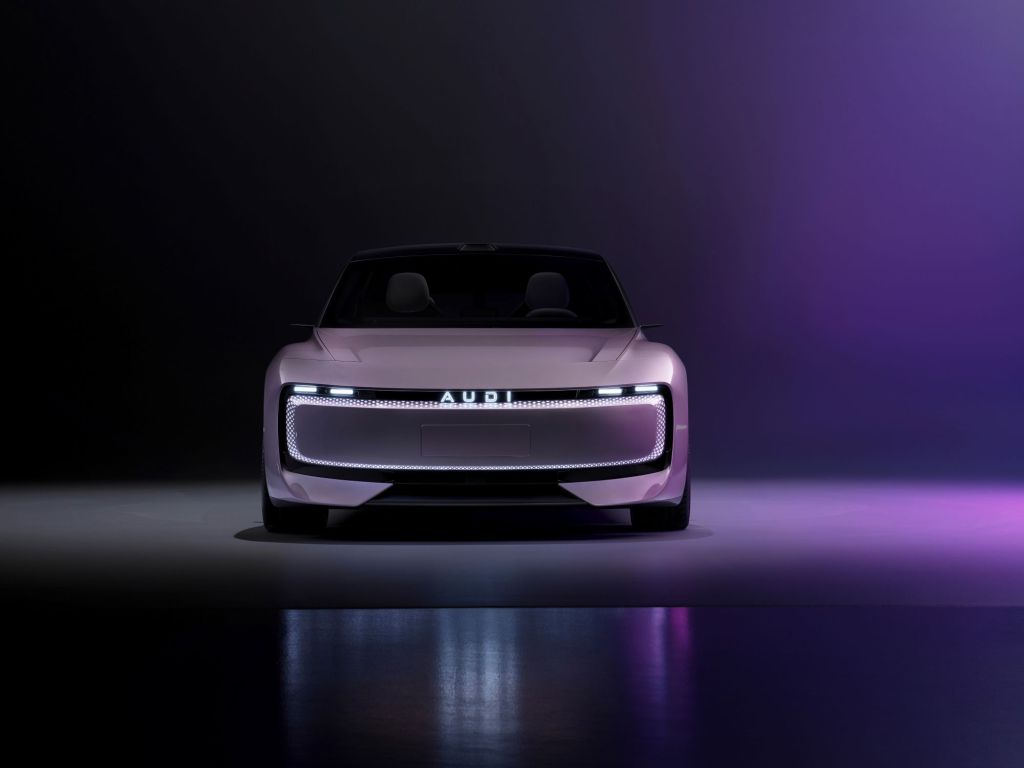
Like many Western brands, Audi is having a bit of a struggle in China, a market it has been in since 1988.
After all, not only are native Chinese brands offering an array of compelling vehicles at all price points, including the upper end where Audi resides, but there is probably something of a bit of nationalism, as Chinese consumers are turning toward Chinese brands.
Consequently Audi is making a shift in its strategy in China and has developed the “Advanced Digitized Platform” with Chinese company SAIC.
AUDI E concept introduced at the Shanghai Motor Show. All caps. No rings. Is it going to shift perceptions of the brand in China? (Image: Audi. Or maybe AUDI)
According to Audi CEO Gernot Döllner: “The joint platform will be the basis for a new generation of state-of-the-art intelligent connected vehicles exclusive to China. The upcoming models are aimed at a promising and simultaneously demanding new customer segment. The cooperation will further expand the Audi portfolio of battery electric vehicles in China and accelerate the company’s transformation in the world’s largest market.”
The platform will be used to develop three models that fall within the midsize and full-size segments, with the first model becoming available next year.
Audi says the collaboration with SAIC allows a >30% decrease in the time required to get a model in market.
In addition to which, Audi has created a new brand for the China market:
AUDI
That’s right: an all-cap version of the existing name.
Also, the famous four-right logo is jettisoned.
Döllner:
“By launching this new brand for electric and intelligent models in China, Audi is breaking new ground to tap into new and more tech-savvy customer segments.”
Seems like Audi in China becoming AUDI is China is the sort of change that a company that is afraid of making a major change would do.
Given that the average price of a Bentley is on the order of $300,000, when the company announces that it is going to “create an entirely new segment, the world’s first true Luxury Urban SUV,” you’ve got to give it to them.
After all, while we may think of “luxury” in the context of something from Mercedes—which, of course, has SUVs—it is that rarefied air that Bentley is in that Mercedes—even with its Maybach brand—is without.
The new SUV, which is to launch in 2026, is a battery electric vehicle. Presumably that explains the “Urban” part, as in the company figures this will not be a vehicle to take on some sort of grand tour.
Bentley plans to be fully EV by 2035.
Presently its Continental GT coupe, convertible and Flying Spur models are plug-in hybrids; the V8-based propulsion system replaces the W12 engine that had once been under the bonnets of the cars coming out of Crewe.
One of the things that European companies are superlative at is developing mopeds. Presumably this is because whether it is London, Paris or Rome, there tends to be considerable congestion so zipping through the gridlock on a scooter is ideal.
A new scooter was announced this week, the E-Moped 500, which is built by Platum, a company that focuses on micromobility solutions, and was designed by Pininfarina with the cooperation of Centro Stile FIAT.
The Fiat 500e is cute, but the E-Moped 500 is cool. (Image: Pininfarina)
The scooter has a range of 115 km (71 miles) and a top speed of 80 km/h (50 mph).
One of the features of the E-Moped 500 is a large front wheel that is described as being “a good ally against potholes and cobblestones.”
Certainly the former is familiar in U.S. cities, but cobblestones not so much.
The E-Moped 500 is influenced by the styling of the Fiat 500e electric vehicle.
Presumably Platum is hoping that the scooter does better than the car is doing: the Mirafiori plant in Turin where the car is built has been idled for several weeks given lack of demand for the 500e.
EV company is launching a second brand. . .perhaps
By Gary S. Vasilash
If there was an ROI for persistence, Faraday Future would have a market cap that would rival Tesla’s.
The company—which says it is developing AIEVs, as in “advanced intelligent electric vehicles”—first showed off a vehicle at CES, the FFZERO1, in 2016.
The following year, again at CES, the FF 91, its first “production” model was shown.
Apparently, what happens in Vegas really does stay in Vegas, because it has taken a long time for there to be any Faraday Future product on roads not associated with a glitzy intro.
In 2023 the company reportedly sold four FF 91s and leased six.
For the entire year.
The Faraday Future website allows the preordering of the FF 91 2.0 Futurist Alliance, a name that sounds like it comes out of some Star Wars knockoff.
It has a range of 381 miles, a top speed of 155 mph, and there will be just 300 produced. Globally.
The base price?
$309,000.
Although it is not an AIEV, I suspect that the Rolls-Royce Wraith might be an even more exotic expenditure of ~$300K.
But back to persistence.
Faraday Future has announced that it is hiring for a second brand, Faraday X.
Positions including production planning director and head of vehicle engineering.
The second brand is meant to create vehicles that offer “twice the performance at half the price”—but half the price of things that aren’t the FF 91 2.0 Futurist Alliance.
The FX 5 model will have an “expected price range” of $20,000 to $30,000. The FX 6 will be at $30,000 to $50,000.
There will be two powertrain types: a range-extended EV and a battery electric.
Faraday Future anticipates the vehicles will be in production by the end of 2025—“subject to securing necessary funding.”
At some point will it be analogous to buying Duracell, Eveready or Kirkland. . . ?
By Gary S. Vasilash
Compared with GM and Ford, the other company in the “Detroit 3,” Stellantis North America, which is still simply referred to as “Chrysler” in southeastern Michigan, is behind the curve when it comes to electric vehicles.
You can buy or lease an EV from GM or Ford.
But so far, with the exception of the exceptionally limited Fiat 500e (limited as in having a range of 149 miles, which is about half of what many people are interested in when thinking about an EV), there is no mainstream EV available from Chrysler, Dodge, Jeep, Ram, or Alfa Romeo.
But earlier this week it announced that NextStar Energy, a joint venture between Stellantis and LG Energy Solution, has started battery module production in its plant in Windsor, Ontario. Next year it plans to launch cell manufacturing.
The Dodge Charger, electric version. (Image: Dodge)
And the company also announced that it will be operating a demo fleet of Dodge Charger Daytona EVs with solid-state batteries from Factorial, a battery company that it has invested $75-million in.
What is interesting about the Factorial battery is that the company claims they’re working for a range of 600+ miles from a battery that is 33% smaller and 40% lighter than a conventional lithium-ion battery.
However, that fleet won’t go into operation until 2026.
So presumably if all goes well, it would still take some time before the Factorial tech makes its way into production vehicles, which explains why there is the production at NextStar Energy: they’re going to need something sooner rather than later.
Factorial is also working with Mercede-Benz. The two companies announced last month the development of a new solid-state battery technology, about which Markus Schäfer, Chief Technology Officer and Member of the Board of Management at Mercedes-Benz Group AG, said: “The Solstice solid-state battery technology represents another landmark milestone in our partnership with Factorial, which is a cornerstone of Mercedes-Benz’s strategy and commitment to leading the charge in battery development. Solstice offers further improvements in energy density and safety features that will help us develop electric vehicles that set new standards in range, cost, and performance.”
Note the future tense of “will.” Not now. But sometime.
In the meantime Mercedes gets batteries from companies including LG Energy Solution and CATL.
Mercedes, like Stellantis, has had a joint-development arrangement with Factorial since 2021.
So at some point in the future will the situation be that multiple OEMs will have access to the same battery technology and so there will be differentiators required other than charging time and range?
Carvana, the purveyor of used vehicles, has discovered that EV investigators are spending more time searching based on a 226% increase in the number of page views on its site for the vehicles compared to Q3 2023.
The top five vehicles, according to its “EV Trends Report,” searched for are:
Tesla Model 3
Ford Mustang MACH-E
Hyundai IONIQ 5
Kia EV 6
Nissan LEAF
Given that there are hundreds of thousands of Model 3s out there right now, it shouldn’t come as much of a surprise that people are looking, perhaps, to score a deal on a pre-owned one.
The LEAF’s long time in market probably helps explain its presence.
But it is somewhat surprising that given that the IONIQ 5 and EV 6 are comparatively new (the Hyundai came out in December 2021 and the Kia in January 2022), they are on the list, not the Chevy Bolt, which was launched in December 2016, so there are undoubtedly more of them available on the used market.
But that is clearly ICE thinking.
Carvana found that the average model year search range for EVs was from 2020 to 2023. The average search range for ICE vehicles was 2018 to 2023.
So potential used EV buyers are interested in what’s newer.
What are the features EV searchers are interested in?
Third-row seat
Heated steering wheel
Apple CarPlay
Sunroof
Adaptive cruise control
Features that indicate EVs are being generally perceived as being a “regular vehicle”: ICE searchers were also interested in third-row seating and a sunroof. Rather than a heated steering wheel, it is heated seats. And Apple CarPlay and adaptive cruise are replaced by a rear-view camera and a tow hitch. (Perhaps the last-named has something to do with why the F-150 Lightning was knocked off the list and the MACH-E on it: towing with an EV is not particularly good, so EV intenders probably are no longer interested in that possibility.)
Often EVs are made with steel. And steel production means CO2 emissions. . .
By Gary S. Vasilash
When people think about reducing vehicular emissions, the first—and likely only—thought is about either what comes out of the tailpipe or whether there is a tailpipe (i.e., the first in the hybrid category and the second in the EV category).
But consider what most cars, crossovers and trucks are made with: steel.
And steelmaking is a carbon-intensive process. It is estimated that steel-making accounts for about 8% of global CO2 emissions, which is just a couple of percentage points behind the auto industry (though that’s both production and use: steel is calculated on the basis of just production).
Volkswagen Group in Germany is doing something to reduce its Scope 3 (things it buys from the supply chain emissions).
It signed a memorandum of understanding with Thyssenkrupp Steel under which the latter will provide the former with low-carbon steel.
Thyssenkrupp Steel is to open a direct reduction steel plant in 2027 that will use hydrogen and green electricity to produce what it calls “bluemint Steel.”
This will be certified under various organizations as being low carbon.
Volkswagen group calculates that 15 to 20 percent of an EV’s CO2 emissions are related to the steel used in its production.
So in order to reach carbon neutrality by 2050 it has to start vigorously reducing its CO2 emissions across the board.