Opens recycling plant in Germany. But given the longevity of its vehicles, it may take a while for there to be an ROI, even with the cost of battery materials. . .
By Gary S. Vasilah
As is well known the battery in an electric vehicle is the priciest part of the vehicle.
That’s because of the raw materials that the battery is made of. Things like lithium, nickel and cobalt.
Contrast that with an internal combustion engine, which has a block made out of an aluminum alloy or an iron variant. The cost of a pound of nodular iron to produce an engine block is about 10 cents and an aluminum alloy for a block about twice that.
The cost of the aforementioned battery materials are much, much higher.
So while recycling of iron and aluminum is common—after all, there are literally billions of light-duty vehicles that have been built in the last 20 years alone, so there’s a lot of recycle—it is still early stages for recycling electric vehicle batteries.
To that end, Mercedes-Benz has just opened a battery recycling plant in Kuppenheim, Germany.
Inside the Mercedes battery recycling plant in Germany. (Image: Mercedes-Benz)
It is based on something called “an integrated mechanical-hydrometallurgical process” that is said to have a material recovery rate of >96%.
Apparently the mechanical part includes shredding, sorting and separating. The hydrometallurgical process separates out the cobalt, nickel and lithium.
Compared to the pyrometallurgic process that is used by others in Europe, the Mercedes’ approach is said to be less energy-intensive and because green electricity is used to power the plant, it is also net carbon-neutral.
The plant has an annual capacity of 2,500 tonnes that results in materials that can be used to produce 50,000 battery modules.
According to Mercedes it has invested “tens of millions of euros” to build the plant.
In reporting its 2024 third-quarter earnings the company noted: “The market environment for battery electric vehicle (BEV) sales remained subdued with competitive pricing in important markets.” Globally, the group has sold 148,500 electric vehicles so far this year.
Clearly this integrated mechanical-hydrometallurgical process is part of the long game, because it will take a while for the Mercedes EVs to be taken to the scrap yard in considerable numbers.
Its passenger vehicle competitors make big rigs. BMW doesn’t. . .
By Gary S. Vasilash
Although Mercedes and Audi (well, as in its owner, Volkswagen Group) make semitrucks, BMW doesn’t.
BMW announced that to bring components to its battery production operation at BMW Group Plant Leipzig, it is using two trucks to shuttle between the factory and a logistics center.
To make this appropriate, the trucks are electric.
BMW uses e-truck to deliver e-components. (Image: BMW)
The company was founded in 2008. Its first vehicle launched in 2009: a three-wheel mail delivery vehicle.
It began work on commercial trucks in 2018 and now has models ranging from 18 to 44 tons.
However, the trucks are based on Volvo FM, Volvo FMX and Volvo FH series chassis.
Designwerk also offers one based on “the low-entry chassis of the Econic from Daimler Trucks AG.”
The trucks in the BMW application are based on the Volvo chassis.
An interesting thing: Volvo Group—the company that builds commercial vehicles, not the Volvo that makes passenger vehicles—bought 60% of Designwerk in 2021.
Honda and Acura Go Electric with Ultium and Then Some. . .
By Gary S. Vasilash
As is widely known, when it comes to the contemporary electric vehicle, Honda was a bit late to the party. Given that the company has extensive experience in electrified vehicles. It is often forgotten (or unknown), for example, that the first hybrid on the U.S. market wasn’t the Toyota Prius, but the Honda Insight, which was launched in December 1999, edging out the Prius by a few months.
(This gives rise to another consideration. Toyota has also been criticized for its approach to the EV market, being tagged as a laggard. One could argue that this isn’t a mistake, given the still rather small number of EVs being sold in the U.S. market. According to Kelley Blue Book, for Q3 2024 there were 346,309 EVs sold, a number that will undoubtedly help the number of EVs sold in the U.S. to exceed the 1.2-million sold in 2023. But here’s something to think about: if you take away the Tesla sales from the Q3 numbers this means that 27 brands cumulatively sold 179,386 vehicles. That would be 6,644 if the number was evenly distributed. But no matter how you look at it, there is a long way to go in order to achieve the necessary scale to have a profitable production operation.)
Anyway, I’ve just been driving the Honda Prologue and the Acura ZDX, the two contemporary EVs from the company.
A sign of the times is that in order to get these vehicles on the market, Honda worked with a company that it has been collaborating on for some time (on things ranging from the engine for the Saturn Vue Red Line to hydrogen fuel cells).
The two vehicles are based on the GM Ultium platform (yes, even though GM is going to stop calling them “Ultium,” the platforms were Ultium when the Prologue and the ZDX were developed).
Just as the Saturn Vue Red Line was a Saturn through and through, not a Honda, the Prologue isn’t a Chevy Blazer EV, which it shares the platform with, just as the ZDX isn’t a Cadillac LYRIQ.
In the case of the Prologue—which is available with a single-motor (212 hp) front-drive setup that provides a range of up to 296 miles or as a dual motor (288 hp) with a 281-mile range (although there is the Elite trim package that goes 273 miles); all have an 85-kWh battery pack—the design inside and out are characteristic of the brand.
The design-speak for the exterior design—which was executed in L.A.—is “Neo Rugged.” It is, after all, an crossover. Arguably, it is a simple, straightforward design with a sufficient number of creases in the sheet metal to keep it from looking innocuous or as something that it isn’t (i.e., like something you’d take on the Rubicon).
Inside there is the clean, straight-forward Honda approach to ergonomic instrumentation. However, I have two quibbles with the interior design:
An excessive use of piano black plastic on the IP. Whereas the Civic Hybrid (a hatchback was recently released) has an interior that looks of the moment, the piano black in the Prologue is dated.
The distance from the top front edge of the instrument panel to the bottom of the windshield is a tremendous amount of real estate. Someone had better have a Swiffer on a long handle to be able to keep that surface clear because it is a reach.
But while on the inside it should be noted that there is as much as 57.7 cubic feet of cargo space, so it can handle a reasonable haul.
Of the two cars, the ZDX is the one that I find to be most impressive. (Of course, the starting MSRP for the Prologue is $47,400 and it is $64,500, so there has to be some bandwidth there.)
The ZDX comes as a rear-drive vehicle with 358 hp and a range of 313 miles from its 102-kWh battery. Or there is an all-wheel drive version (A-Spec) that provides 490 hp and 304 miles of range from the same battery pack. Or there is another AWD version (Type S) that generates 499 hp and will take you 278 miles with some alacrity.
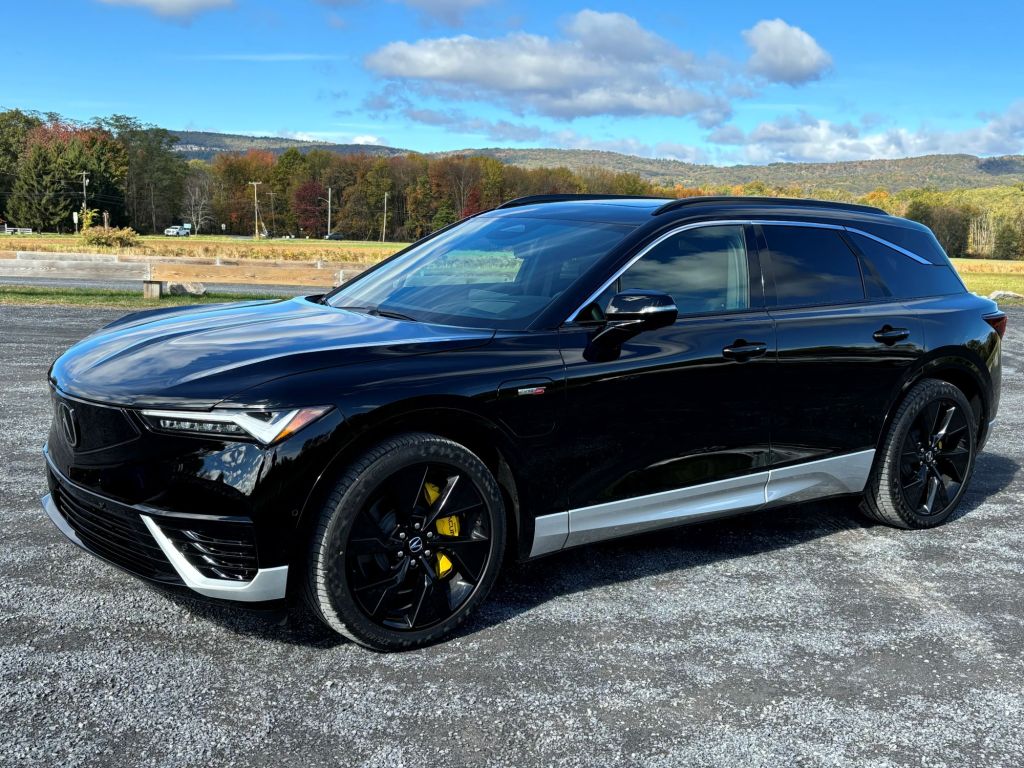
2024 Acura ZDX Type S. Wicked quick. And you can shop for groceries with it, too. (Image: gsv)
Although Acura does have two cars in its lineup—the TLX and Integra—its two crossovers—the MDX and RDX—are focal points. In terms of powertrain performance, the ZDX smokes the other crossovers (or maybe that should be it “ozones the other crossovers”).
It, too, was styled in LA. And although it is a crossover, its exterior body style resembles for me more of a contemporary station wagon, with a lower, longer, more angular sideview than many other crossovers.
While it seems as though all vehicles today have some sort of light signature up front, credit should be given to the Acura designers for the sharp styling they’ve brought to the lighting of this vehicle.
On the inside the seats in the front are bolstered in keeping with the type of vehicle it is, and the layout of the instruments and gauges are intuitive. A cowl over the gauge screen provides something of a cockpit feeling when sitting behind the wheel.
Both are solidly engineered vehicles that go well beyond the propulsion systems.
The Prologue seems like a Honda (presumably because it is) and the response from the market is good: According to numbers from KBB, through the third quarter there have been 12,644 Prologues sold—more than the 7,998 Blazer EVs sold, and closing in on the popular Mustang Mach-E, which had sales of 13,392.
The ZDX, which is essentially a new nameplate (yes, Acura built a ZDX until 2013, but its sales were so tiny that it isn’t likely remembered by many (outside those who smacked their heads getting into or out of the rear seat on the C-pillar)) has had sales through Q3 of 2,647—which is not far from the Lexus RZ’s 2,742, which has been available for longer.
In 2026 Honda will roll out its 0 Series, which it is developing sans GM.
But neither the Prologue nor ZDX are placeholders until then.
Renewables are nice, but petroleum provides the profits, it seems. . .
By Gary S. Vasilash
In defining its purpose, energy company bp states, “Our purpose is reimagining energy for people and our planet.”
Apparently there’s not a whole lot of imagination at the company because it seems, according to reporting from Reuters, that said reimagination is going to be more of the same.
“BP has abandoned a target to cut oil and gas output by 2030 as CEO Murray Auchincloss scales back the firm’s energy transition strategy to regain investor confidence, three sources with knowledge of the matter said.”
The whole notion of cutting oil and gas output by 40% by 2030 was announced in 2020. But that 40% was ratcheted back to 25% in February 2023.
That “abandoned” seems to indicate it is now closer to 0, if not all the way there.
As you may recall, bp came up with a moderately clever “Beyond Petroleum” slogan to play upon its name.
Seems like it is more like “Bullish (on) Petroleum.”
Meanwhile, over at ExxonMobil, when it announced its Q2 2023 financials, Darren Woods, chairman and CEO, stated, “We delivered our second-highest 2Q earnings of the past decade as we continue to improve the fundamental earnings power of the company.
“We achieved record quarterly production from our low-cost-of-supply Permian and Guyana assets, with the highest oil production since the Exxon and Mobil merger.”
Yes, oil is not going away anytime soon, EV investments notwithstanding
And while there are regulations around the world regarding the reduction of carbon emissions, how long are they going to stand if the market isn’t interested in those vehicles?
One thing that doesn’t get a whole lot of attention in discussions about EVs are the volumes in the factories where they are built. . . .
By Gary S. Vasilash
In announcing its Q3 performance, General Motors did the typical approach of accentuating the positive. As the company’s sales were down 2.2% in the quarter compared with Q3 ’23 and are down 1% year-to-date compared with ’23, that wasn’t going to be it.
Rather, as Rory Harvey, GM executive vice president and president of Global Markets is quoted:
“GM’s EV portfolio is growing faster than the market because we have an all-electric vehicle for just about everybody, no matter what they like to drive.”
While in Q1 ’24 GM’s U.S. share of the EV market was 6.5%. It reached 9.5% in Q3.
Clearly its EV sales are on an upward trajectory. But multiple models can drive up production costs.
The Models
Taking BrightDrop commercial vehicles out of the picture, since January GM has sold 70,450 EVs.
Specifically:
20,318 Cadillac LYRIQs
15,232 Chevy Blazer EVs
8,582 Bolt EV/Bolt EUVs
10,785 Equinox EVs
5,252 Silverado EVs
8,902 GMC HUMMER EVs
387 Sierra EVs
The LYRIQ is built in Spring Hill, Tennessee.
The Blazer EV is built in Ramos Arizpe, Mexico.
The Bolts are built in Orion, Michigan.
The Equinox EV is built in Ramos Arizpe.
The Silverado EV, HUMMER EV and Sierra EV are made in Detroit-Hamtramck.
Seven vehicles.
Three factories.
And some 70,450 have been built over a nine-month period.
While there is certainly some sharing of components, there are things like body stamping that aren’t common, which means dies. And the interiors of the three vehicles built at the Factory ZERO plant are different executions, though, again, there are some common parts.
But the point is, there are different costs associated with these vehicles’ production.
Capacity Utilization
Let’s say that the production capacity of an assembly plant is 250,000 vehicles per year.
A rule of thumb is that such a plant must operate at 80% capacity in order to be profitable, so that would be 200,000 units.
Even if the production of EVs doubles from the end of Q3 to the end of Q4, that’s 140,900 vehicles, or 70.45% of a 250,000-unit-capacity plant.
Now in the case of the Ramos Arizpe plant, in addition to the Chevy EVs it is producing the ICE Blazer and the Honda Prologue EV. The former has sales through Q3 of 40,545 vehicles and the latter 14,179.
So with all four of the vehicles being built there, there is an output through Q3 of 80,741.
If that number is doubled by the end of the year to 161,482 (which, of course, won’t happen), that would be about 65% capacity utilization of a 250,000-vehicle plant.
But let’s go back to the 70,450 units of GM EVs sold through Q3.
It is worth noting that during the same period there were 70,710 Chevy Colorados sold.
One model. One plant.
And it shares Wentzville Assembly with the GMC Canyon (26,956 sold through Q3, or 6,638 more vehicles than the best-selling GM EV. In fact, you could add the sales of the Silverado EV and the Sierra EV onto that LYRIQ number and it would still be short of the Canyon: 25,957.)
Profitability in EVs is going to take GM and some of its competitors a bit more than reduced battery costs.
Ford makes it easier for EV buyers to charge at home. What do Bronco buyers get?
By Gary S. Vasilash
Earlier this year the Boston Consulting Group released a report that says, in part, “perhaps the biggest challenge for OEMs is to produce the next generation of EVs profitably. We estimate that most OEMs currently lose around $6,000 on each EV they effectively sell for $50,000, after accounting for customer tax credits.”
Given that the current generation of EVs is what’s presently on dealer lots, that’s lots of money that the legacy OEMs are spending to move the metal.
But because of the billions of dollars they have spent on building out the capacity to produce EVs, they want to keep the production lines running.
Consequently, they are coming up with things that will make EVs more appealing to customers, the $6,000 be damned.
Buy an EV. Get a charger. (Image: Ford)
Earlier this week Ford CEO Jim Farley wrote, “Cheap lease deals on electric vehicles are popping up everywhere. Ford believes it will take more than jumbo rebates to truly break through with the estimated 19 million people in the U.S. interested in electric vehicles.”
Note that he writes “it will take more”—something additive. The rebates and incentives are still part of the game.
Farley goes on to provide details on how Ford is addressing this, through what they call the “Ford Power Promise.”
To provide ease of mind for people, this includes such things as complementary roadside assistance, expanded 24/7 advisor support, and the ability to use its Plug and Charge service that allows a driver to plug in at a charging station and have the electricity charged to the driver’s FordPass account.
But perhaps most significantly, Farley writes: “Buy or lease a retail Ford Mustang Mach-E, F-150 Lightning or E-Transit and take a complimentary home charger with you or have it delivered, and when you’re ready, an expert comes out to install it at no charge for a standard install.”
That’s right: Ford is paying for customers to have home charging capability, something that costs, on average, $1,000.
This could be a clever marketing approach to getting more people in Ford EVs now (the offer expires on January 2, 2025) and presumably next-gen EVs—after all, if the charger is there, people probably figure they might as well use it.
Consider that both the Mach-E and the E-Transit qualify for the IRA tax credit of $3,750 and the F-150 Lightning the full $7,500.
Go buy an Explorer or Bronco and the only tax-related thing will be the sales tax that you’re paying.
Seems that this EV transition is not only costing the OEMs an enormous amount of money, but let’s face it: the government isn’t magically making those credits appear, so all tax payers are kicking in, as well.
A few thoughts from the Cox Automotive Q3 assessment. . .
By Gary S. Vasilash
While new EV sales are growing—remember, this is from a small base, so the growth in total numbers is not all that impressive—used EV sales are really doing quite well, or so the numbers from Stephanie Valdez Streaty, director of Industry Insights, Cox Automotive, who has a keen focus on EVs, indicate.
That is, year over year there is an increase of 64.4% for used EVs while new ones year-over-year it is up 12.6%.
In August there was a 90-day supply of new EVs. There was a 38-day supply for used EVs.
Still Pricey
One likely reason for the increased used EV sales is that the average transaction price in August was $35,937, compared with $56,574 for new EVs.
Realize that the now-used EVs probably had an ATP north of $56,574 when purchased new, so the buyer of a used EV is undoubtedly getting quite a well-loaded vehicle for the money.
I wonder whether a second used buyer will be all that interested in a vehicle, given concerns about battery longevity.
Leases Matter
In the new EV market leasing continues strong, Valdez Streaty noted. At 39% she says it is almost double the industry average. This probably has something to do with the ability to get IRA tax credits for EVs assembled in the U.S. And luxury vehicles, of which there are still plenty with EV powertrains, tend to have more leases than mainstream vehicles, so it makes sense to lease.
Overall Numbers
Looking at the powertrains in vehicles in August, ICE vehicles are at 81.6%, EVs at 8%, hybrids at 8.5% and PHEVs at 1.9%.
If you think about it, as OEMs began to pour money into EVs they subtracted from hybrids (e.g., the Ford Explorer had been offered with a hybrid, but the ’25 model doesn’t have one).
The company that didn’t pull back on hybrids—which actually continued to expand its offerings—is Toyota. Valez Streaty says that in Q2 2024 Toyota had 47% market share for hybrids—more than twice Honda’s second-place 20%.
Ford, it is worth noting, came in third at 14%, undoubtedly thanks to the F-150 PowerBoost Hybrid model.
Hybrids are typically referred to as a “transitional technology.”
Seems that that transition is going to take a whole lot longer than those outside Toyota anticipated.
How it is going to leverage manufacturing to advantage
By Gary S. Vasilash
Ostensibly the briefing was to see up-close-and-personal the Acura Performance EV Concept which had only otherwise been shown during Monterey Car Week.
Who doesn’t want to see what is likely to be very similar to the electric vehicle that is going to go into production in Ohio in late 2025?
Acura Performance EV Concept. (Image: gsv)
Two points about the concept:
It is a concept vehicle, something that is becoming less and less common in the industry today—because of the time, effort, energy, and investment made in these full-scale models. Sure, there could be the argument made that this can all be done digitally. But Honda and Acura have those digital tools, too, and there is something to be said for a physical model.
Dave Marek, who is executive advisor for Design for Honda R&D and Global Honda (which essentially means he’s the go-to guy for design considerations across the company), points out that Honda and Acura typically hew rather closely to their concepts when it comes to production vehicles, so the Acura Performance EV Concept, which he says features “hydrodynamic design” principles—think “superyacht”—may be something rolling off the line at what is being called the “Honda EV Hub.”
Which brings us to the second part of this, which is an explanation of the strategy and the tactics of the EV Hub by Mike Fischer, who is the lead on the project and an executive chief engineer to boot.
First of all, the “Hub” is not a singular place.
Rather, Honda is retooling the Marysville Auto Plant, the East Liberty Auto Plant, and the Anna Engine plant to have the capabilities to produce EVs in a highly efficient manner that produces high quality, consumer-valuable products, processes that are both human- and environmentally-friendly.
But here’s the thing, and not something that Fischer and his colleagues just came up with during the past few months when EV sales softened.
Fischer explains that this “reimagining of Honda manufacturing” is something that is predicated on flexibility.
So they are developing production capability that will allow them to build EVs, hybrids, and ICE-vehicles all on the same line.
(One way this will be accommodated is by having feeder lines that will do the subassemblies for the varying types of vehicles that then feed into the main line.)
Yes, they are developing a dedicated EV platform that will allow various models to be derived from it.
Yes, they are installing 6,000-ton high-pressure diecasting machines—there will be six of them—in the Anna plant to perform “megacasting” of the Intelligent Power Unit (IPU) case; the case houses the battery and associated electronics and functions as part of the vehicle platform.
But what’s notable is that in this undertaking, which the company is investing more than $5-billion and which will serve as a model for Honda facilities around the world, Honda is getting back to its manufacturing roots in essentially taking a clean-sheet approach to the way things are done.
While product certainly matters, the ability to produce those products so that they meet customer demands—cost, quality, availability—is something that Honda has shown itself to be superb at over the years, so while some argue that it is comparatively late to the game in terms of EVs, the flexible manufacturing capability Fischer and his team are developing will more than make up for any delay—and will provide Honda and Acura with the powertrain options that its customers are looking for.
That will put it not merely in the game, but quite possibly ahead of it.
You might recognize the building in the background. BMW headquarters in Munich. The four cylindrical towers (partially obscured here) that are meant to resemble the four cylinders in a combustion engine.
Then you look at the vehicles. The one on the left and the center are from Toyota, a Hilux and a Mirai; the one on the right a BMW iX5.
All of these vehicles are powered by hydrogen.
The two gents are Oliver Zipse, Chairman of the Board of Management of BMW AG (left) and Koji Sato, President and Member of the Board of Management (Representative Director) Toyota Motor Corporation.
The two are shaking on their further partnership in the development of fuel cell electric vehicle (FCEV) technology.
Toyota has had FCEVs available to consumers.
Soon—or at least by 2028—the same will be said of BMW.
Zipse:
“This is a milestone in automotive history: the first-ever series production fuel cell vehicle to be offered by a global premium manufacturer. Powered by hydrogen and driven by the spirit of our cooperation, it will underscore how technological progress is shaping future mobility. And it will herald an era of significant demand for fuel cell electric vehicles.”
Whether that demand is going to become real remains to be seen.
Sato makes a solid point, one that other OEM execs probably wish they could make, even though they were probably feeling really good when Toyota was being criticized for not going all-in on battery electric vehicles:
“In our long history of partnership, we have confirmed that BMW and Toyota share the same passion for cars and belief in ‘technology openness’ and a ‘multi-pathway’ approach to carbon neutrality.”
For the foreseeable future, there isn’t going to be one approach to reducing carbon and those legacy OEMs that recognize that will be the market leaders.
When it was first launched in October 1998 the smart Fortwo was small. 2,540 mm (yes, millimeters) long and with a 1,810-mm wheelbase. The name of the car explained the number of people who could fit.
But with time there has been significant inflation.
Speaking of the vehicles offered by the company that is a joint venture between Geely and Mercedes, that is.
(Mercedes designs what are now EV-only models from the marque; Geely does all of the development and engineering.)
And now this. . .
smart has introduced a new model, the #5, a mid-size SUV.
The smart #5. The once innovative purveyor of small city cars is now producing mid-size SUVs like every other company. (Image: smart)
It is 4,705 mm long and has a 2,900-mm wheelbase.
Or nearly twice as long as the original smart.
That increased size is handy in one regard—if you plan to sleep in the #5.
According to smart, the seats can be folded so that there is the ability to create a “king-size, queen-size or single mode sleeping space.”
The #5, which has a range of 740 km (460 miles)—on the China Light Duty Vehicle Test Cycle—could be the ideal choice for Uber drivers who essentially live in their cars.
Given that with the exception of things that have undergone shrinkflation increased size seems to be desirable, perhaps a larger smart is a smart idea. (The necessity of another midsize SUV, however. . .)