2024 Toyota bZ4X Limited AWD

You’ve got to start somewhere. . .

By Gary S. Vasilash

This is the interior of the first-generation Toyota Prius (2000):

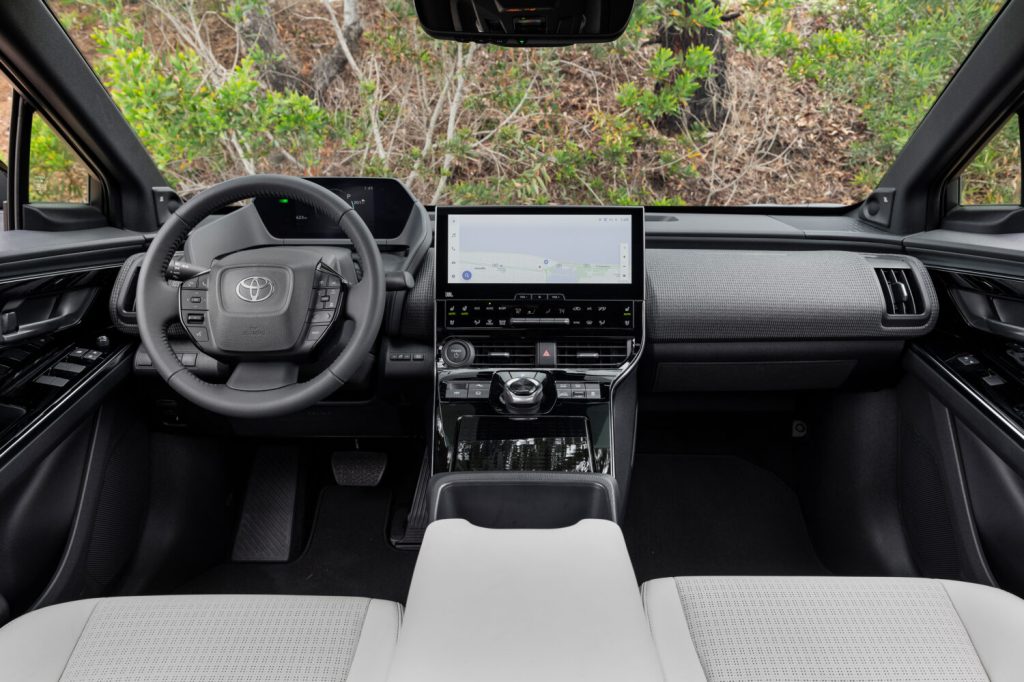
This is a similar shot of the first-gen Toyota bZ4X (2024):

Yes, there is nearly a full demographic generation separating the two.

But the bZ4X makes me think of that Prius.

If you look closely in front of the steering wheel on that early Prius you’ll note that there is no conventional gauge cluster.

That info is displayed in the horizontal slot in the middle of the instrument panel.

There is a more-conventional gauge cluster in the bZ4X in a more-conventional location.

But it is in a binnacle, set further back than is the norm for gauge clusters.

The rationale for both executions is arguably the same: the driver should keep eyes on the road.

While the Prius execution left something to be desired on that account—as in if the driver keeps eyes on the road, then there is the possibility that because there is no ready check of the speed, that could be problematic in terms of potential speeding tickets (although that risk was ameliorated by the lack of pep when you got on the throttle)—the bZ4X approach requires but a slight downward adjustment of one’s eyes to check the speed, a better approach.

The first-gen Prius instrument panel was completely different.

And while the bZ4X’s is more conventional, centered on the standard 12.3-inch touchscreen, there is something of a uniqueness to the interior, such as the use of a fabric on the interior even in places where some polymer would ordinarily be placed and the lack of a glove compartment.

Ten years after the first-gen Prius was released, in a retrospective Toyota acknowledged:

“Not all early reviews were flattering. One car magazine said, ‘With a real-world 35 mpg, this is a car that neither enthusiasts nor greenies can fully embrace.’”

And so far as the bZ4X goes, not all reviews are flattering because the electric vehicle doesn’t go particularly far vis-à-vis competitive electric crossovers:

  • XLE grade has an estimated 252-mile range in a front-drive setup; 228 miles for AWD
  • Limited grade is 236 miles FWD and 222 AWD

So here’s the thing about the bZ4X that needs to be taken into account: This one is the first Toyota EV, just as that Prius was the first back then.

People liked the first-gen Prius sufficiently well that they bought it and did so in sufficient numbers that there were the second generation and beyond.

People who buy the first-gen bZ4X will probably like it sufficiently well—and there is good reason to, mainly that it is a Toyota, and so it comes with all of the confidence that that brand brings to one’s driveway—and it will lead to future Toyota EVs.

And while they will be better, the current one isn’t bad.

(all images: Toyota)

EV Public Charging Isn’t Doing Much Better

J.D. Power sees improvement. But were we grading on the usual scale. . .

By Gary S. Vasilash

The J.D. Power 2024 U.S. Electric Vehicle Experience (EVX) Public Charging Study is out, and the research firm finds improvement in that experience.

Sort of.

Said Brent Gruber, executive director of the EV practice at J.D. Power, “While the customer satisfaction scores for public charging continues to prompt concern, the results offer reasons for optimism.”

He’s undoubtedly an optimistic individual.

The study found that on a 1,000-point scale, the satisfaction with speed at Level 2 chargers has dropped 4 points to 451.

DC fast charger speed is more satisfying, up from 588 in 2023 to 622.

While that 34 point bump is good, remember Power is using a 1,000-point scale, so if you were in school and got that 622 on a test. . . .

And then there is the issue of non-charging. As in showing up at a charging station and not being able to charge.

Power found 19% of the surveyed EV owners had that problem. A one-point improvement over 2023.

The researchers found that nationwide 61% said the reason there was a wasted visit was because the charger was out of service or didn’t work.

Huh?

The average transaction price for an electric vehicle in July was $56,520, according to the latest figures from Kelley Blue Book.

So someone buys an EV for that price, glides into a charging station—and nearly one out of five times has to leave because the damn thing doesn’t work.

Yes, some 80% of EV owners charge at home, but that means some 20% of EV drivers don’t.

In addition to which, some of the 80% of EV drivers who charge at home are likely to take trips at some point—vacation or business—which could likely mean they need to charge along the way.

And they’re likely to find some 20% of those chargers out of order.

Owls and EVs

Nature meets AI for an EV deployment

By Gary S. Vasilash

(Image: MAHLE)

Is this some sort of artwork in the style of Louise Nevelson?

No.

It is a section of a fan-blade developed by automotive supplier MAHLE for fuel cell and electric commercial vehicles.

About the design of the “bionic fan blade,” Dr. Uli Christian Blessing, Head of Thermal Management Development at MAHLE, said:

“We learn from nature, it inspires us in many areas! . . . With the help of AI, we analyzed the peculiarities of bats, swordfish and many other ideas from nature and finally ended up with the owl, the silent hunter, as the main template for our new fan.”

The fan is said to provide a 4 dB(A) reduction in noise compared with a conventional fan. That’s a cut of about 50%.

In addition, it is 10% more efficient and 10% lighter than a typical fan.

The company plans to extend the fan deployment to passenger cars.

Apparently one of the times when the noise abatement is key is during charging. MAHLE says the quieter operation “increases comfort for drivers and residents alike.”

As well as people taking a stroll through the Walmart parking lot, where plenty of charging occurs.

2024 Genesis GV60 Performance AWD

It can cause envy. . .

By Gary S. Vasilash

I had the interior designer from another car company in the 2024 Genesis GV60.

He looked at that glowing orb embedded in the center console of the vehicle that recently won the J.D. Power U.S. Automotive Performance, Execution and Layout (APEAL) study in the small premium SUV category.

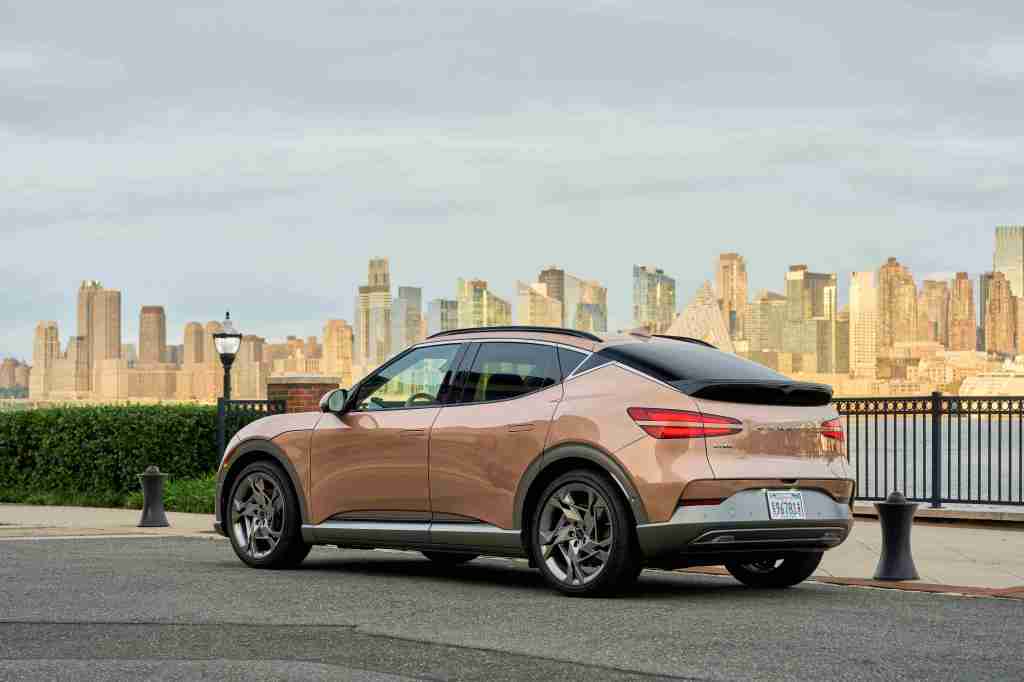
Yes, that is a glowing orb in the center console. (Images: Genesis)

That orb is actually called the “Crystal Sphere.”

It glows.

When the vehicle is started the sphere rolls over and exposes a dial that allows the gear selection (which is perhaps not as accurate a term given that the GV60 is an electric vehicle, and while EVs do have gears, they don’t have traditional transmissions with multiple gears that have to be run through for motive power, which explains, in part, why EVs have that torque from the get-go and why they are more efficient than ICE vehicles because there aren’t the mechanical losses).

The designer was intrigued by the Crystal Sphere, which I suppose is why it exists in the vehicle, although I think that the fit and finish—as well as execution and layout—of the rest of the interior is sufficiently interesting in and of itself, as in things like the patterns on the seating surfaces (which, like other items in the interior, are made from eco-friendly materials, but materials that seem like they are leather, for example).

Intriguing, all.

He told me that he thought that it was quite cool.

But then he began wondering aloud about the level of difficulty of fixing it were it to go wrong.

And then going back and forth, weighing the pluses and minuses, he finally concluded:

“We would never be able to use anything like that.”

And I could detect a bit of regret in his tone.

Elementary. . .

It’s the first dedicated EV model from Genesis.

When it was introduced, Luc Donckerwolke, chief creative officer of Genesis, said: “The GV60 is a symbolic model that materializes the unique values and the sensibilities that Genesis stands for. It offers a satisfying experience to our customers who want something valuable, but different.”

It can be opened with your face. (There is a near infrared camera in the B-pillar.)

It can be started with your fingerprint. (Further underscoring the notion of this is more than a crossover, but a highly sophisticated, comfortable, computer on wheels.)

It has two 160 kW motors, one in the front, one in the back. Which means 320 kW or 429 hp.

It has a 77.4-kWh battery that can be charged on a fast charger (>250 kW) from 10 to 80% in 18 minutes.

It—as in the model in question here—does have eco-friendly, but the seats are Nappa leather, which comes from things with four legs.

It has a 14-way power adjustable driver seat that not only has power lumbar (four-way), but even a cushion extension. (Notably, all trims have this seat.)

It has an infotainment system accessed via a 12.3-inch LCD display. The “tainment” portion is predicated on a 17-speaker Bang & Olufsen sound system.

It can tow. 2,000 pounds.

It has 101.1 cubic feet of passenger volume (think five people but two happier ones if they’re not joined by a third in the back seat).

It has 24 cubic feet of cargo volume behind the second row.

It has a 0.71-cubic foot frunk (think small microwave oven).

It has an EPA estimated range of 235 miles.

It has a starting MSRP of $69,550.

EVs Here & There

Still small(ish) numbers. . .

By Gary S. Vasilash

The European Union is ahead of the U.S. in the acceptance of electric vehicles. That is, according to Cox Automotive, in 2023 the EV share of the U.S. vehicle market was 7.6%.

The European Union has just reported that in 2023 the number of EVs registered represents 14.6%.

What’s interesting about the 2023 number in the U.S. is that Cox Automotive reckonings show that Tesla sales represented 55% of all EV sales in the U.S.

There are now 30 brands offering EVs in the U.S., including Tesla, yet the company that seems to be going out of favor through the first half of 2024 has 49.7% of the market.

Taking out its estimated (it doesn’t provide clarity about sales in particular countries, including the U.S.) 304,451 vehicles from the 2024 first half total of 599,372, that means there were a total of 294,921 EVs sold in the U.S. in the first half of 2024.

To put that into perspective, in the first half of 2024 there were 248,295 Toyota RAV4s sold in the U.S.

So this means that 29 vehicle brands sold 46,626 more vehicles than a single model.

Questions

It is easy to get excited about percentage increases until they are contextualized.

Will the number of EVs on offer continue to grow? Yes.

Will the number of EVs sold increase as they become available in different segments? Yes.

Will growth in EV sales continue should there be a change in Washington that eliminates the incentives to buy an EV?

There’s the question that doesn’t have an answer.

But there’s something that provides perhaps of a hint in Germany.

Cautionary tale?

Meanwhile, back in Europe, EV growth continues, primarily because of government support and/or regulations.

According to T&E, “Europe’s leading advocates for clean transport and energy,” during the first half of 2024 EV sales were up in the EU by 9.4%–but that’s by leaving out the largest car market, Germany.

With Germany, the EV sales grew in the EU by 1.3%.

The organization’s Lucien Mathieu, cars director, said, “Germany is the sick man of Europe when it comes to electric cars. Meanwhile, markets which have strong, predictable incentives for EV adoption are reaping the rewards.”

At the end of 2023 Germany stopped providing a subsidy for the purchase of an electric vehicle. T&E calculates that that caused a 16.4% decrease in EV sales in Germany in the first half of 2024.

According to T&E:

“In the first half of 2024, EV sales grew in markets with supportive regulatory environments:

  • In France, which has a social leasing scheme to provide cheap electric cars to low-income households, BEV sales increased by 14.9% in H1 2024;
  • In Italy, BEV sales increased by 7.0% in the first half of the year, with a sales peak in June 2024 when new EV incentives were launched;
  • In Belgium, the company car segment drove the BEV market with a 47.8% increase in the first half of the year;
  • In the UK, the ZEV mandate has driven the BEV market, with sales increasing by 9.2% in H1 2024.”

Which raises a question: are “markets which have strong, predictable incentives” real markets or artificial ones?

Germany has some appealing EVs from small VWs to generally lauded BMWs to Mercedes lux.

And it is not like no one is buying EVs in Germany: T&E has EV sales in the first half representing 12.5% of the market.

Still, given the amount of investment and attention paid to EVs, the numbers seem somewhat small.

There. And here.

The Young & the Electric

They’re probably good looking, too. . .

By Gary S. Vasilash

When it comes to customers, auto companies like them young and well-heeled.

Young because if they get the customers early and they do a good job in at least meeting and ideally exceeding expectations, this increases the possibility that they’ll stick with the brand or go up a level (i.e., from Chevy to Cadillac; from Toyota to Lexus; from VW to Audi).

And as for having plenty of disposable income—well, that’s obvious. After all, those Platinum and Unobtainium trims don’t come cheap.

This is borne out by a study conducted by research firm Numerator on electric vehicles.

As for comparative youth, it found that 42% of EV owners are Gen Z’ers or Millennials. That’s in the context of those two cohorts representing only 30% of all vehicles.

As for wealth, there are at least a couple of indicators: 44% are said to be from high-income households. Only 30% of the average vehicle owners are in that stratum.

And 77% of EV owners live in households with two or more vehicles. This is compared to 68% of all households with vehicles.

What seems somewhat odd, however, is that EV owners are twice as likely to walk or bike to get around and are four times as likely to take public transit than the non-EV owners.

While it might be thought that these Gen Z and Millennial EV owners are all about the environment, Numerator found that only 48% of them cited the environment as why they opted to go electric.

Seventy-four percent said it was for cost savings on fuel.

To put some numbers around that:

According to the EPA, the average cost of a gallon of regular was $3.48 in 2023. Also, the average miles per gallon achieved in new vehicles in 2023 was 26 mpg. In its “Fuel Economy Guide” it estimates the average driver racks up 15,000 miles per annum.

So, 15,000 divided by 26 is 577. And multiplying that by 3.48 gets us to an annual outlay of $2,008, or $38.61 per week.

Not a whole lot, but evidently even the wealthy watch their wallets.

U.K., MG, EV

The past isn’t necessarily prologue. . .

By Gary S. Vasilash

According to the British trade association the Society of Motor Manufacturers and Traders (SMMT), through the first half of 2024 the car brand MG had 4.38% of the UK market.

While that may seem, at first blush, somewhat trivial, it should be noted that MINI was a 2.11%, Land Rover 3.26%, and Ford at 5.64%–and as for that last-named, I’ve been told by people who live there that Ford has been on the scene so long that it is considered indigenous to the U.K., and that Ford’s U.K. showroom has a breadth of offerings that dwarfs MG’s.

MINI is owned by BMW. Land Rover by Tata Motors. And MG SAIC Motor.

MG was established in Oxford in 1930 and had a run until 1972, when its then-owner British Leyland, which itself no longer exists, stopped using the marque.

SAIC has owned the brand since 2005. (It was purchased by Nanjing Automobile Group that year, then SAIC acquired Nanjing in 2007.)

Presently MG offers 11 models in the U.K. of which only four are pure ICE vehicles, with the remainder hybrids or EVs.

But next month a British company, Frontline Cars, is going to be bringing its MGB-based LE60 to Monterey.

The Frontline LE60. An MGB brought up to date with a V8. (Image: Frontline Cars)

Interestingly, this restomod is powered by a 375 bhp 4.8-liter V8. Frontline points out that this is “almost quadruple the power of the original MGB.”

But one wonders: while the company now selling vehicles carrying the MG badge are mainly non-ICE, doesn’t a V8-powered sportscar that is returned and updated from the past seem like some sort of curio?

A Thought About the Corvette ZR1

Something to make Corvettes even more popular among the enthusiasts. . .

By Gary S. Vasilash

In the first half of 2024 Chevrolet sold 16,661 electric cars and crossovers. That includes the Blazer EV, Bolt EV/Bolt EUV and Equinox EV.

What is notable is that during the same period there was a vehicle in the dealership that outsold all of those EVs combined: The Corvette.

There were 17,914 Corvettes delivered in the first half.

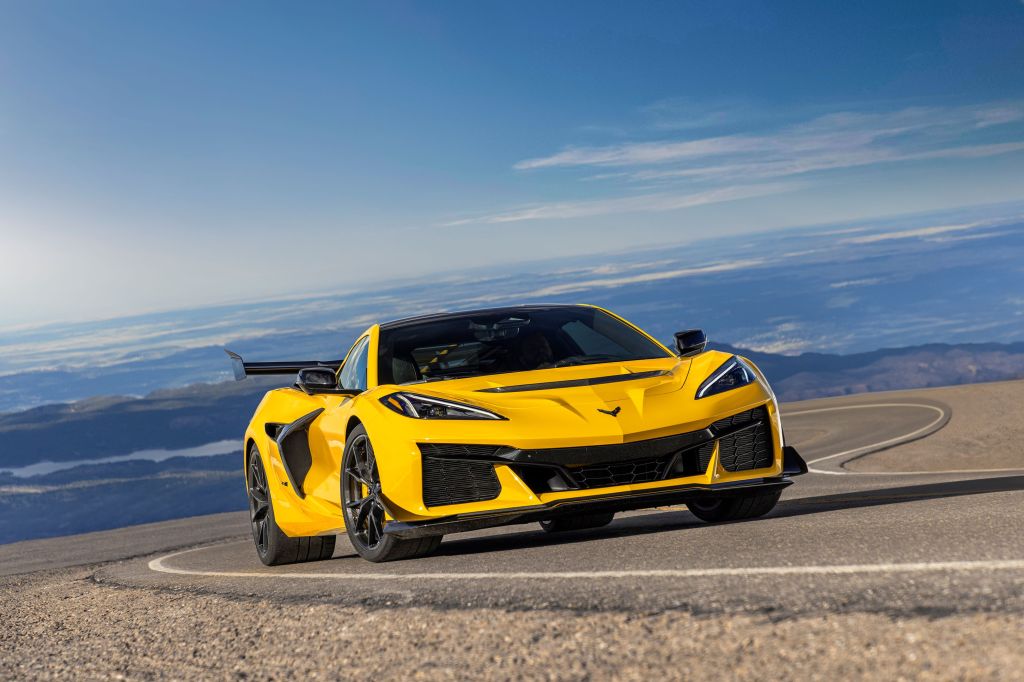
Corvette ZR1 Coupe: wicked fast. (Image: Chervolet)

And while it won’t be launched until next year—and “launched” is a good word for this vehicle, the ’25 Corvette ZR1, while undoubtedly something that will be produced in limited numbers, will likely drive interest in the more readily available Corvettes.

The ZR1 is a special model, with its 1,064-hp 5.5-liter, twin turbocharged, DOHC flat-plane crank V8.

The car will have a top speed of over 215 mph.

And while it looks and certainly is fast, it won’t launch to the sky as there is a carbon fiber aero package that produces in excess of 1,200 pounds of downforce when the ZR1 hits top speed.

Now there are electric vehicles that have higher top speeds, though not many, and not readily accessible as at a Chevy dealer.

And the instant torque of an EV may be more impressive than the impressive 828 lb-ft that the ZR1 LT7 generates—at 6,000 rpm.

But the ZR1 will provide a visceral experience as well as the one predicated purely on acceleration.

This sensory suite of sound and vibration is simply something that cannot be as genuinely obtained in an electric vehicle.

At some point, after a sufficient number of enthusiasts, the type of people who would consider paying what is estimated to be on the order of >$180,000 for a car, haven’t driven combustion-powered vehicles, things like the ZR1 will fall out of fashion, undoubtedly being perceived as having insufficient refinement because of the very characteristics that make it so exhilarating to drive.

But that is well ahead of us.

GM, ICE & EV

One is making money. One is making progress. Slight progress.

By Gary S. Vasilash

In her Q2 2024 earnings letter to shareholders released yesterday, GM CEO listed the “four key drivers” of the company’s performance—and that performance includes record revenue in both Q1 and Q2—and it is interesting what the first item on the list of four is:

  • In North America, we have a consistently high performing portfolio of ICE trucks and SUVs on a volume, share and margin basis.

Now because the company is in the process of spending billions of dollars on EV technology, the second point on the list goes to EVs, although it doesn’t exactly sound robust:

  • Our EV portfolio is scaling well, and we’re encouraged by the early sales results, including record second-quarter deliveries and improving market share.

To put some data to that “scaling well,” in Q2 the company delivered:

  • 7,294 Cadillac LYRIQs
  • 6,634 Blazer EVs
  • 1,374 Bolt EV/Bolt EUVs
  • 1,013 Equinox EVs
  • 2,196 Silverado EVs
  • 2,926 HUMMER EVs

and to throw in for good measure a commercial product:

  • 490 BrightDrop Zevo 400/600s

That is a total of 21,927 EVs sold in Q2.

Yes, there are increases in numbers.

The GMC HUMMER EV SUV (Image: GMC)

The LYRIQ was at 1,348 units in Q2 2023. And the HUMMER was at a mere 47 in Q2 2023.

But to put things into some context: the Chevrolet Malibu, which is going out of production later this year, had Q2 2024 deliveries of 36,360 units, or 14,433 more than all the EVs combined.

And isn’t the accepted wisdom that “Nobody buys sedans anymore?”

If we look at ICE truck or SUV numbers. . . well at this point it isn’t even a fair comparison.

But Barra goes on to write:

“To unleash the next cycle of EV growth, we’re scaling production of the Chevrolet Equinox EV. . . . Then over the next several months, GMC will launch the Sierra EV and the Cadillac LYRIQ will be joined by the OPTIQ, Escalade IQ and CELESTIQ.”

On the one hand, this is completely understandable for at least a couple reasons.

For one, there are those billions spent on getting capacity, so they need to use it.

For another, regulations are going to require the sale of more EVs, especially to offset the sales of things like trucks and large SUVs (e.g., in Q2 there were 151,112 Silverados sold).

That said, one wonders: Given the increasing popularity of hybrids, why is there no discussion of that in the forthcoming product portfolio?

2024 Volvo C40 Recharge Single Motor Ultimate Extended Range

A stylish small SUV. . .

By Gary S. Vasilash

The Volvo C40 Recharge is, as its name implies, a vehicle that needs recharging because it is an electric vehicle. A small SUV. But a stylish small SUV, as it has what is, for SUVs, a coupe-like roofline, sloping back. In fact, arguably it is the most stylish among the Volvo SUVs, of which there are numerous (XC90, XC90 Recharge, XC60, XC60 Recharge, XC40, EX90, XC40 Recharge, and the forthcoming EX30.)*

The XC40 Recharge is the C40 Recharge with a different top on it. It is what is historically the more Volvoesque of the two, meaning it is boxier. And style comes with a bit of a price, and not just in terms of MSRP, although there is that, too (C40 Recharge starts at $53,600; XC40 Recharge starts at $52,450).

Dimensionally the two vehicles are the same with the exception of one thing.

They are both 174.8 inches long and have a 106.4-inch wheelbase. They are both 80.1 inches wide.

But the C40 Recharge is 62.6 inches high and the XC40 Recharge is 64.8 inches high.

A consequence of that difference is that the C40 Recharge has a cargo capacity of 49 cubic feet and the XC40 Recharge has 57.5 cubic feet back there, so it is a non-trivial difference.

Volvo C40 Recharge: Charge and go. (Image: Volvo)

Still, it is not like the C40 Recharge is lacking in capacity. And sometimes you just have to sacrifice a bit to standout with more style.

And speaking of styling, the vehicle has great-looking 20-inch wheels, which add presence to the exterior. I must confess that I am not wholly engaged yet with the replacement of a grille with a solid slab with the badge affixed in the middle.

One of the interesting things about this vehicle is that it comes with a four-year subscription to the Digital Services Package. While some OEMs want to have their own digital setup, Volvo is working with Google so that this vehicle has Google built-in, as it were, so that there are native Google Maps, Google Play Store and Google Assistant. And that four-year package provides all these.

(And perhaps not entirely coincidentally, there is 48-month/50,000-mile limited warranty coverage (48 months = 4 years), and complementary factory scheduled maintenance for the first four years or 40,000 miles. Four years evidently is a key metric vis-à-vis the C40 Recharge.)

The C40 Recharge is Volvo’s first leather-free vehicle. One of the available material options is a wool blend seating fabric that is an exceedingly nice alternative even were leather to be available. In fact, it speaks to the style of the vehicle: A man’s suit in leather looks, well, goofy (or creepy) in most wearings (sure, some guys can get away with it, but they are few and far between); a good wool suit is stylish and classic regardless of the person inside.

Of course, as this is an electric vehicle, we’ve got to get to the battery-related things.

The “Extended Range” in the name of the vehicle goes to the 82-kWh battery that provides an estimated range of 297 miles on a single charge. And on the subject of charging, on a Level 2 (11 kW) charger, such as you might get installed in your garage, it can be charged from 10% to 90% in eight hours; with a DC fast charger, 20 minutes will take the battery from 10% to 80%.

This vehicle has a single 248-hp motor driving the rear wheels. Although people talk about a benefit of EVs is their ability to go quickly quickly, there is another characteristic that is beneficial for driving: their comparatively sizable mass provides a sense of solidity, which combined with the power means a feeling of improved control.

Having said plenty of positive things about the style I do need to point out something that I found understandable but unusual.

Because the rear glass (a.k.a., backlight) is at a somewhat fast angle, the view from the rearview mirror is truncated. Yes, there are 360-degree cameras when maneuvering, say, out of a garage, and there are highly noticeable blind-spot detector warnings in the side mirrors. But still, a glance in the mirror to see what’s going on back there is not fully informative.

The usual part is that the C40 Recharge has a “panoramic” roof—essentially, with the exception of what amounts to a frame, the whole roof provides a fulsome view of, well, the sky. Not exactly handy, of course, when you’re driving.