EVs: Just You Wait

Those Skeptics will change their outlook

By Gary S. Vasilash

Of the 100% of people who are planning to purchase a new or used vehicle in the next two years, Cox Automotive finds that 55% are “Considerers,” as in considering an electric vehicle and the remaining 45% are “Skeptics,” as in interested only in internal combustion engines.

From a demographic point of view, the Considerers are probably more appealing to dealers in that they have a higher average income than the Skeptics ($71,756 v. $60,625) and are younger (42 v. 46), which means they may have more vehicles in their future.

However, speaking of the future, Cox Automotive personnel expect that within the next three to five years 54% of the Skeptics will become Considerers, then an additional 26% in 10 years, meaning there will just be 20% remaining dedicated to combustion.

It is interesting to note that as for now, when it comes to barriers to EV adoption Considerers rank as 1 and 2 “Too expensive” and “Lack of charging stations,” while Skeptics flip the order of those two.

What is an interesting difference in barrier rankings is that for the Skeptics “Inability to charge EV at home” is in third place (tied with “Concern about battery losing charge”) while it is in fifth (or last) place for the Considerers.

Which presumably means home charging is acutely important for EV sales.

There are some potentially concerning numbers regarding the Considerers, however.

For example, in 2023 the EV Buyer was 41 years old, had an average household income of $139,00 and 84% of them had excellent/very good credit.

In 2024 the Considerer is 42, has an average household income of $72,000 and 53% of them have excellent/very good credit.

Still, according to Isabelle Helms, vice president of Research and Market Intelligence at Cox Automotive, “We remain bullish on the long-term future of EV sales in America, as many Skeptics today will be carefully considering an EV by the end of the decade. With more infrastructure, education, and technological innovation and improvements, we believe electric vehicle sales will continue to grow in the long term.”

One thinks about Keynes’ quote regarding the long run. . . .

Not All the Sounds in Auburn Hills Are Fratzonic

Keeping the business card printers busy. . .

By Gary S. Vasilash

Recently Tim Kuniskis announced his retirement. Or, well, Stellantis announced his retirement. Kuniskis was the CEO of both Dodge brand at Stellantis and Ram.

The ’24 Dodge Charger: a muscle car with a motor, not an engine. Things change. So do execs. (Image: Dodge)

Having had the opportunity to chat with him on several Dodge-related occasions I concluded that the man was really into the Dodge brand in a way that wasn’t a “This is my job so I’ll do what I need to do in order to fulfill what needs to be done, period.” There was evident commitment.

Over the past several years Dodge has become an enthusiast niche brand, one predicated on high-octane muscle cars. Dodge has made an art of creating cars that are pretty much unlike anything else—anymore.

It once was that there were the Dodge Challenger, Ford Mustang and the Chevy Camaro that would line up at stoplights on Telegraph or Woodward in metro Detroit like something out of the Fast and the Furious. (There was also the Pontiac GTO, but given the non-existence of that marque as a going concern, we’ll let that pass.)

The Mustang still has serious muscle in some of its trim packages, but arguably it has become something more “continental,” as the vehicle is also being sold in markets where drivers are more interested in roads that curve than going in a straight line for a quarter mile.

The Camaro has been put on a shelf.

So that pretty much leaves the Challenger and its four-door stablemate, Charger.

Muscle cars—the Dodge slogan is “Brotherhood of Muscle”—probably isn’t an optimal space to be in right now given concerns with emissions.

So Dodge is going to offer a car that will produce 670 hp and do a quarter mile in 11.5 seconds. An electric car.

About it Kuniskis said: “The electrified 2024 Dodge Charger Daytona Scat Pack delivers Charger Hellcat Redeye levels of performance and announces its presence through the world’s first Fratzonic Chambered Exhaust.”

Even that car though it is a coupe not a sedan, the name “Charger” for an EV is just too good to pass up.

According to Dodge, the ’24 Charger battery has a nickel cobalt aluminum chemistry that is, in effect, “the battery-electric version of high-octane fuel.”

The Fratzonic Chambered Exhaust is said to produce “Hellcat levels of sound intensity”—or that should be generates that sound because while the Hellcat’s rumble is a consequence of combustion, there’s no combustion going on in the new car.

While there will also be versions of the ’24 Charger with a 3.0-liter twin-turbo Hurricane engine that produces up to 550 hp, and while that will probably handily outsell the electric version in the long run (i.e., there will probably be a whole lot of early adopters of the electric version because it is, well, cool, but then that number will be satisfied and the sales will go down as quickly as they went up), the corporate attention will be focused on the electric version because that’s what good corporate citizens do.

While it might seem that there is a correlation between Kuniskis’ retirement and the electrification of Dodge, it may simply be that after 30 years in a tough business the man needs a break.

But wait, there’s more. . .

Or it may be that things are really changing at Stellantis North America.

Kuniskis’ job is being split. Christine Feuell, who is running Chrysler, is taking on the Ram assignment.

Matt McAlear, who was running Dodge sales, is now CEO of the brand.

Earlier this year Carlos Zarlenga replaced Mark Stewart as chief operating officer for Stellantis North America. Zarlenga has been with Stellantis since 2022, which is certainly not a long time. (Stewart took over Goodyear: regardless of the propulsion system, vehicles need tires.)

Last week Matt Thompson was named senior vice president of Stellantis U.S. Retail Sales “effective immediately” because Jason Stoicevich, who had been named to that position in February, having been the chairman and CEO of Stellantis Canada before that, has left the company. Suddenly.

Something is evidently going on in Auburn Hills.

When there are changes like these, when the industry itself is in flux, you’ve got to wonder just what is going on. .

Why You Want to be Friends with a Car Mechanic

Let’s face it, as things age they need more work. . .

By Gary S. Vasilash

Although there is considerable attention paid by the industry and industry observers on new vehicle sales—for the former it is simply because that is where their money is made (or not) and for the latter, new things tend to be more interesting than things that have been around the block more than a few times—turns out that so far as the public is concerned, the vehicle they’ve had in their garage is probably going to continue to serve them for some time to come.

S&P Global Mobility has run the numbers based on registration information and discovered that the average age of cars and light trucks is at an all-time high: 12.6 years.

This means that the new-car smell that was wafting through the interior in 2011 may be gone but the set of wheels isn’t.

As of this past January, according to S&P Global Mobility, there were 286 million vehicles on the roads of the U.S. They term it “vehicles in operation” (VIO).

Of that, some 70% are between 6 and 14 years old. And that percentage will hold, it is calculated, for about the next five years.

And no vehicle analysis would be complete without looking at electric vehicles.

S&P Global Mobility says the average age of EVs in the U.S. is 3.5 years.

However, there is still some bullishness:

“We started to see headwinds in EV sales growth in late 2023, and though there will be some challenges on the road to EV adoption that could drive EV average age up, we still expect significant growth in share of electric vehicles in operation over the next decade.”– Todd Campau, aftermarket practice lead at S&P Global Mobility

But there is something that provides some perspective about the number of EVs on the road vis-à-vis the total VIO.

There are 3.2 million EVs in operation in the U.S.

That means 1.1% of the total VIO.

Given the amount of attention garnered you’d think that at the very least the decimal point would be shifted one place to the right.

Something to Know About Na-ion Batteries

While the attention to developments in the arena of high-voltage batteries that can power vehicles is considerable and understandable, turns out that low-voltage batteries—along the lines of the batteries under the hoods of ICE vehicles—shouldn’t be overlooked.

According to Clarios, a Wisconsin-based producer of batteries and battery systems, the low-voltage network in EVs and hybrids support such things as steer-by-wire, brake-by-wire, and cabin infotainment, and the number of things being supported is only expected to grow.

It has signed a Joint Development Agreement with Altris, a Swedish developer and prototype manufacturer of sodium-ion (Na-ion) batteries, for these low-voltage applications.

Why is this interesting?

Because according to the companies the Na-ion batteries:

  1. Provide a power density equivalent to LFP (lithium iron phosphate) batteries
  2. Are environmentally friendly: the materials used to produce Na-ion batteries include salt, wood, iron, and air

Clearly there’s some remarkable chemistry going on in those cells.

2024 Volvo XC40 Recharge

A charming electric crossover. . .

By Gary S. Vasilash

One of the things that EV proponents promote about EVs and why someone would want to drive one is the fact that they are, by and large, peppy.

Unlike internal combustion engines (ICEs), which build torque over time—and torque is what causes the tires to bite into the pavement and propels the vehicle forward—electric motors provide that torque from the proverbial get-go.

Think only of a food blender with its row of buttons from slow to fast. You can hit the fast button at the start and the blades whir at that speed.

More Power

One of the ways that EV producers are able to provide vehicles that seem to be the same but which have different performance characteristics is analogous to what ICE vehicle producers do: add something.

In the case of the ICE, it is generally the addition of cylinders (from four to six, say, as eight or more seem to be disappearing) or turbochargers.

In the case of an EV, it is generally the addition of another motor.

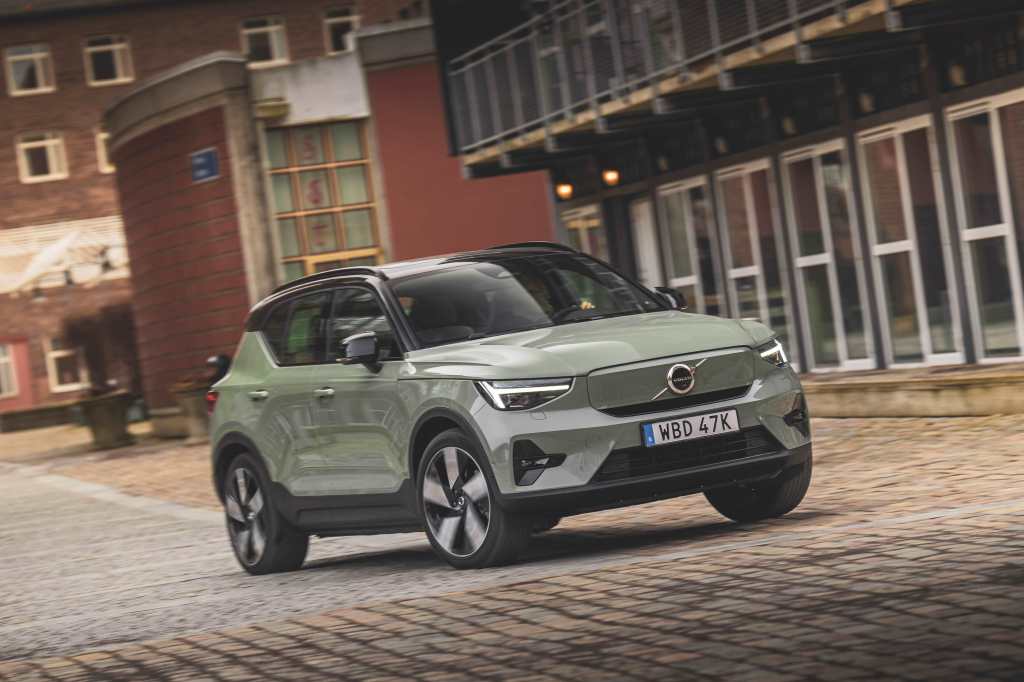
Volvo XC40 Recharge: a charming EV. (Image: Volvo)

So in the case of the Volvo XC40 Recharge, there is one available as a rear-drive vehicle and another as an all-wheel drive vehicle.

The former has one motor that provides the vehicle with 248 hp. The latter has two motors, which brings the output up to 402 hp.

So while the single-engine propels the compact crossover from 0 to 60 mph in 6.9 seconds, the dual-engine model goes from 0 to 60 mph in 4.6 seconds.

Now that reduction of 2.3 seconds comes at a cost.*

As in $1,750 to the cost of the vehicle.

Range and Charging

And as in a range reduction from 293 miles for the single motor to 254 miles for the dual motor, or about a 13% reduction in range. That reduction could have been greater had Volvo not deployed an asynchronous motor on the front axle: it operates only when required.

However, the extra motor doesn’t reduce the 57.5 cubic feet of cargo capacity, nor does it increase the 2,000 pounds of towing capacity.

And overall to help improve range, there are 19-inch wheels used. These not only look better, but they help with aerodynamics. Every little bit counts.

The XC40 Recharge has an 82-kWh battery pack that allows charging at up to 200 kW at a DC fast charger. This means a battery can go from 10% state-of-charge to 80% in less than a half hour.

Compact Charm

The XC40—pre-EV—was introduced as a model year 2018 subcompact luxury SUV. It is a vehicle that was part of putting Volvo on more consideration lists as it combines exterior style (and even an extra bit of charm as it was offering a different color roof from the body color at a time when that was still limited in auto-dom) and interior execution that one would associate with a Scandinavian furniture store: superb execution combining attractive looks with function.

The SUV features Google Maps, Google Assistant and Google Play for additional apps—which is to say that the folks at Volvo undoubtedly figure that the folks in Mountain View are a bit better at software than the folks in Gothenburg. They’re right.

==

*On the subject of the 2.3 seconds: according to research from the University of Idaho, when it comes to the amount of time a driver reacts to suddenly seeing something that requires braking and braking, “An alert driver may react in less than 1 second, while other drivers may require up to 3.5 seconds.” Consequently, “Extensive research has shown that 90% of the driving population can react in 2.5 seconds or less. The brake reaction time normally used in design, therefore, is 2.5 seconds.” Which is to say, drivers of all vehicles need to pay attention, but particularly those who can go from A to B tout suite.

What Does Six Minutes Get You?

When it is an EV charge, not far. . .

By Gary S. Vasilash

Six minutes is the amount of time that AMCI Testing calculates the average driver spends refueling an gasoline-powered vehicle.

So the company established a rating designated “MP6” for EV charging.

Stated simply: How much range does an EV get in six minutes of charging.

The testing is performed on the Tesla Supercharger network. For the non-Tesla EVs in the study the Tesla Magic Dock is used (it is an adapter that allows non-Teslas to be charged just like Teslas).

The most-recent test puts the 2024 Tesla Model 3 Highland in first place. It bested what had been in first, the Toyota bZ4X (which is, given the fairly general criticism of the bZ4X, probably the only first prize it has ever won).

Before looking at the results from AMCI Testing, it is worth keeping something in mind:

The average light vehicle in the U.S. in 2023 achieved 26 miles per gallon.

Let’s say for the sake of argument that the average size of the fuel tank is 14 gallons.

So 26 x 14 = 364.

Or, in six minutes of refueling, the average vehicle with a thermal engine obtains 364 miles of range.

How About Them EVs. . .?

So, onto the MP6 results:

Tesla Model 3 RWD                                                60.5 miles

Toyota bZ4X                                                           35

Ford Mustang Mach-E                                           32.5

Mercedes-Benz EQE                                             31.5

Hyundai IONIQ 5                                                    28

Kia EV6 GT-Line RWD                                           23

Ford F-150 Lightning                                              21.2

Rivian R1S                                                             20.5

David Stokols, CEO of AMCI Testing’s parent company, AMCI Global:

“Although probably not unexpected, these definitive AMCI Testing results show just how significant Tesla’s charging advantage is in the real world. Other OEMs competing in the EV space will certainly need to increase their charging performance, convenience and ease of use now that every BEV can use the same charger; the Tesla Supercharger.”

Also in the real world, when the best EV gets just 17% of the range with a six-minute stop as the average gasoline-powered vehicle, there is quite a disconnect when it comes to transportation functionality.

Another Electric Audi

This time, it requires a little more effort from the driver. . .

By Gary S. Vasilash

The bicycle industry is in some ways like the auto industry in the context of electrification.

On the one hand, there are the traditional human-powered bicycles, which are analogous to vehicles with internal combustion engine.

On the other, there are electric bikes, just as there are electric cars.

In both bikes and autos the traditional dominates by a considerable amount.

And in both there is growth in the sales of electrified versions.

But what seems to be a bit of a difference is that electric bikes are still moving upwards on the sales charts while in autos there is a considerable moderation.

Audi EVs in Q1

Audi, like any good European luxury brand, has a full suite of EVs.

Audi of America announced that its Q1 2024 sales were down 16% year over year, but its EV sales were up 29%.

However, the combined sales of the e-tron GT, Q4 e-tron, Q4 Sportback e-tron, Q8 e-tron, and Q8 Sportback e-tron is 5,714 vehicles.

While sales of the Q5 were down 33% year-over-year, it still sold 11,473 of them, considerably more than the five EV models.

Two-Wheelin’

Ride electric with Audi. (Image: Audi of America)

Audi has added a new model to its lineup: the Audi eMTB.

It is an electric mountain bike.

Audi worked with Italian motorcycle and e-bike manufacturer Fantic on the bike, which features an aluminum frame, full suspension (Öhlins shocks in the back and fork up front), off-road tires, Sunstar Braking’s F.I.R.S.T. calipers and S3 Batfly rotors, and other elements.

There is a 720-Wh, 36-volt lithium-ion battery pack that powers a Brose S-MAG 250-watt motor, which delivers up to 90 Nm of torque.

The electrical setup provides four levels of assistance at speeds up to 20 mph.

The battery range is between 12 and 90 miles. Yes, quite a spread there, but how far one will go depends on such things as the terrain, amount of assistance used and rider weight.

Like an Audi with four tires, the engineering comes at a price: MSRP for the eMTB is $9,795.

The bike is being sold through Audi Genuine Accessories.

Maybe if the EVs aren’t moving at the dealership the eMTB will.

Ferrari’s New V12 (Yes, not an EV)

By Gary S. Vasilash

Although people have not stopped buying electric vehicles, there is an inverse relation between the amount of proclamations about the electric future and the purchase of the vehicles.

It sounded as though by now everyone would own an EV or be on a waiting list to get one.

Which is leading some automotive executives to mumble their way through excuses about “choice” and “listening to the customer.”

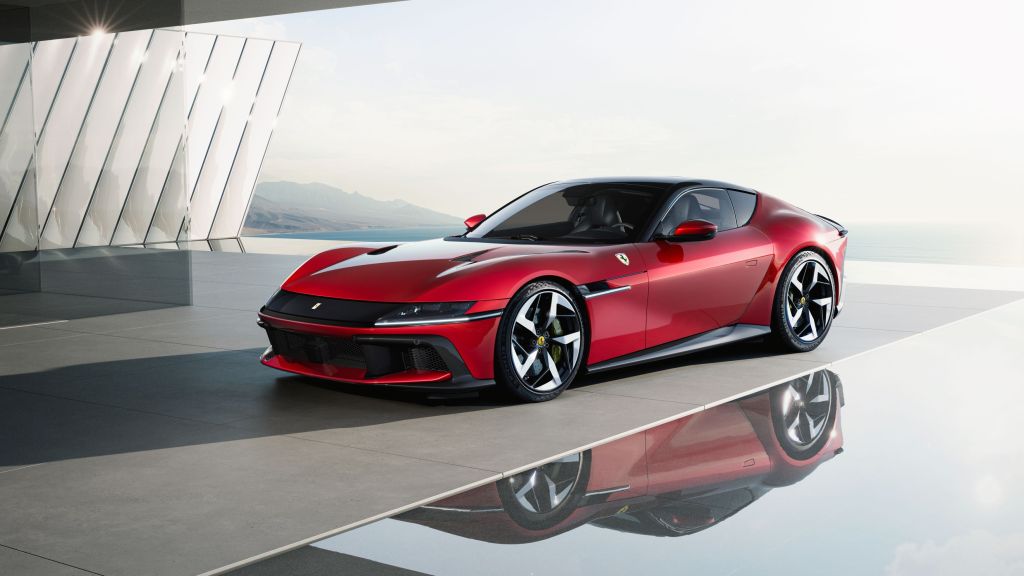
The folks at Ferrari are not shy about their continued development of vehicles powered by gasoline as evidenced by the Ferrari 12Cilindri.

Ferrari 12Cilindri: yes, 12 cylinders. (Image: Ferrari)

About this new two-seater the company says:

“The Ferrari 12Cilindri is aimed at driving enthusiasts, but also at those who demand new standards of performance, comfort and design: long-standing Ferraristi, loyal to the unique emotions that only the Ferrari V12 can deliver, as well as new clients dreaming of combining comfort and Italian design with exhilarating driving pleasure. The Ferrari 12Cilindri is designed for connoisseurs with a very clear vision of what Ferrari’s DNA has always been, truly making it a car for the few.”

That’s right, here is a car with a naturally aspirated V12 engine that powers a vehicle that provides a “clear vision of what Ferrari has stood for in the motoring world since 1947.”

Last year Ferrari announced that by 2026 some 60% of its vehicles will be either EVs or hybrids.

Which leaves 40% for things like the 12Cilindri.

And it is fairly clear they’re not making any excuses about their offerings.

Can an EV Save You Money? (Maybe.)

By Gary S. Vasilash

The average price of a new gasoline-powered vehicle in March (the latest figure available) was $47,218.

That according to Kelley Blue Book.

The average price of a new electric vehicle in March was $54,021.

So quick math has it that there is about a $6,800 difference.

Energy Savings?

Researchers at Argonne National Laboratory have done some calculations regarding the amount of money that an EV can save a driver versus the same driver in a gas-powered vehicle.

They estimate that an EV can provide a savings of “up to $2,200 annually.”

Which essentially means, in effect, that in year four of owning the $54,021 EV rather than the $47,218 ICE the savings would start to accrue. (Yes, this would assume the unrealistic outright purchase of the vehicles, though an argument could be made that with comparative financing rates, the comparison works.)

Expensive Gas, Cheap Electricity. . .

However, the researcher found: “The largest fuel savings were found in areas with high gasoline prices, low electricity prices, preferences for larger vehicles and high annual mileage driven.”

So this sounds like the stars need to be aligned for that $2,200 to be achieved.

There’s Another Shoe to Drop

What’s more (or less), according to the National Association of Insurance Commissioners, “On average, EVs cost up to $44 more to insure per month than gas-powered vehicles, with the most expensive to insure being Tesla’s Model Y and Model 3.”

That would be an additional $528 per year, which would reduce the $2,200 to $1,672. Not trivial. But not as robust.

DIY Cost Check

The folks at Argonne have developed a web-based calculator that allows you to figure out how much you’d save based on the size of vehicle, annual mileage, fuel prices, electricity prices, and other parameters.

You can find that here.

All that said: How many people make a decision about what vehicle to buy predicated on how much they’ll save at the pump or socket?

I’m guessing not a whole lot.

EVs and the Power Shortage

By Gary S. Vasilash

Although U.S. Congress approved $7.5 billion for the construction of EV chargers a couple years ago—the Biden administration has a target of 500,000 by 2030—things aren’t going particularly well in that regard.

The Washington Post reported in late March that the number of charging stations that have been opened as a result of that funding is. . .seven.

Those seven stations provide a combined 38 chargers.

However, private companies are installing chargers at a more rapid pace.

According to the most recent report from the National Renewable Energy Laboratory (NREL):

“In Q3 2023, the number of electric vehicle supply equipment (EVSE) ports in the Station Locator grew by 7.7%, or 12,986 EVSE ports, bringing the total number of ports to 181,026.”

However, the NREL estimates that if there are 33 million EVs on the road in the U.S. by 2030 that will require 28 million EV charging ports.

Which is a far cry from that 181,026 number.

But the NREL figures that of the 28 million charging ports, 25.7 million of them will be at private residences. That’s right: 92% of the chargers will be in garages and car ports across the land.

So consumers who are going to buy an EV ought to save up some more money to hire electricians.

However, the Inflation Reduction Act has money in it for people who install equipment in their garages.

According to the U.S. Dept. of Energy:

“If you purchase EV charging equipment for your principal residence, you may be eligible for a tax credit for the charging station. This credit is generally 30% of the item’s cost, up to $1,000.”

Those tax credits are supposed to be good until 2032.

Meanwhile, over in the European Union, the number of chargers is severely lagging the number of vehicles.

The European Automobile Manufacturers’ Association (ACEA) has released a report showing that while slightly over 150,000 public charging points were installed in the EU last year, or about 3,000 per week, in order to reach the 8.8 million charging points that will be needed overall by 2030, the pace of installation would have to be more than 22,000 per week—some eight times the current rate.

ACEA Director General, Sigrid de Vries:

“Easy access to public charging points is not ‘nice to have’, but an essential condition to decarbonize road transport, in addition to market support and a competitive manufacturing framework in Europe. Investments in public charging infrastructure must be urgently ramped up if we are to close the infrastructure gap and meet climate targets.”

Of course, as the available billions of dollars for public charging infrastructure in the U.S. shows, it will take more than money to get the necessary chargers installed.