To be sure, the future is uncertain, but these numbers should chill some EV product planners. . .
By Gary S. Vasilash
In 2024 in the U.S. Ford delivered 1,793,541 light vehicles powered by internal combustion engines.
In 2024 the total number of light vehicles delivered in the U.S. was some 15.9 million units.
If we take the number of Ford ICE vehicles sold, that’s about 11% of the whole market.
According to AutoPacific, in 2024 the total number of electric vehicles (EVs) delivered in the U.S. represented 8% of the market.
That would be 1,272,000 vehicles.
While that is not a trivial number, it is still about half-a-million shy of the number of vehicles that Ford alone sold with internal combustion engines.
You’d think with the billions invested in the vehicles and attendant technology the numbers would be somewhat larger for EVs now.
They aren’t.
AutoPacific has some new numbers that adjust the number of EVs to be sold in the U.S. market, an adjustment that the Federal tax credit of $7,500 that expires on September 30 plays no small roll in.
Or, as Ed Kim, AutoPacific president and chief analyst puts it: “The EV market in the U.S. is headed for a rough patch with market share growth stalled due to multiple factors related to lack of affordability.”
And the elimination of the tax credit will make the vehicles less affordable.
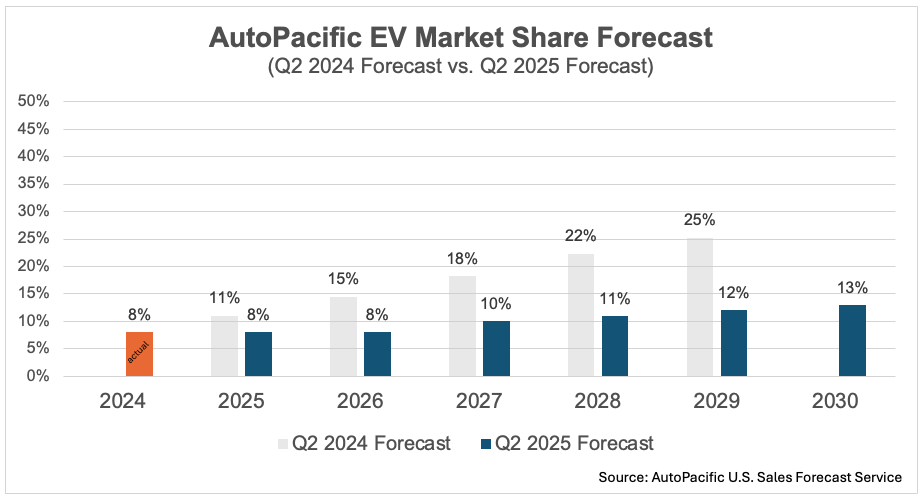
Last year AutoPacific made projections of what it anticipated the size of the market would be.
And across the board, they are adjusted in a downward direction. And not a trivial decline:
Even with all of the claims of less-expensive, longer-range and quicker-charging EVs coming within a few years’ time, going forward the AutoPacific forecast shows serious declines.
“Many families have seen their savings go toward higher mortgage rates and summer travel costs. They want a new vehicle but also want options that allow them to forgo an upfront down payment,” said, Rob Kaffl is Ford director, U.S. sales and dealer relations.
So the company has decided it will not only continue with its employee pricing for everyone, but has initiated a summer sales event: “0-0-0.”
Which means zero down payment, zero percent interest for 48 months, and zero payments for 90 days.
Since starting its “From America, For America” campaign in April that provides the employee pricing approach, Ford second quarter sales grew well over the rate of the rest of the industry.
Kaffl: “Momentum matters, and in the past few months we have had plenty of it.”
They want to keep it going with this 0-0-0 program.
What’s more—and it is more—Ford is providing a two-year maintenance program that covers things like oil changes and tire rotations. Certainly a nice benefit.
While there is undoubtedly some small print involved in signing those papers at the dealership, there is some you should know about if you have your eye on a 2025 Bronco Sport, Bronco, Expedition, Maverick, Ranger, Transit, Super Duty, or Lincoln Navigator.
They are excluded from the program.
So that leaves Escape, Mustang Mach-E, Explorer, F-Series, E-Series, and Mustang for Ford brand and Corsair, Nautilus, and Aviator for Lincoln.
Clearly Ford wants to continue to move metal before more tariffs kick in and people are faced with more than high mortgage rates and travel costs.
One of the questionable Christmas presents that car companies doing business in the UK happened just before the holiday, when the country’s Department of Transport, which has on the books a mandate that by 2030 there will be no new vehicles sold with gasoline or diesel engines under their hoods, announced an eight-week period during which the OEMs would have the opportunity to weigh in on how this can be achieved.
Note this is not an “If.”
As things stand, there are annual targets that must be achieved in terms of zero-emission vehicle—a.k.a., electric vehicles—by the companies.
The UK government is committed to this, apparently, although one wonders if the auto industry begins to crumble because of the penalties associated with not meeting the targets.
Penalties in the form of a fine of £15,000 for every vehicle sold that doesn’t meet the target.
For example, consider Ford, which has been part of the UK’s automotive structure since 1911.
The mandate has it that 22% of a carmaker’s sales in 2024 are electric.
How did Ford do? Apparently 6.8% for the first 11 months, so unless there was some massive change, it will be well below the government bogey.
Which means serious fines.
This is sort of an insult-to-injury situation in that the company has been investing billions of dollars/pounds/euros—pick your currency—in EVs, and because people aren’t as interested in buying them as they are other products, it costs Ford (and other companies that don’t meet the mandate) more.
“Aside from the billions invested in new technologies and products, it has cost manufacturers in excess of £4 billion in discounting in the UK this year alone. This is unsustainable and, with the 2025 market looking under even greater pressure, it is imperative we get an urgent resolution, with a clear intent to adapt the regulation to support delivery, backed by bold incentives to stimulate demand.”
Which probably means that the government is going to have to pony up more money in order to generate demand.
And Ford isn’t the only company with the lack-of-demand situation. It is estimated EVs will represent 18.7% of the UK car market in 2024, not the mandated 22%.
In 2025 that goes up to 28%.
Hawes’ “unsustainable” is an understatement.
This isn’t just a UK issue.
In the US, where EV sales in 2024 were on the order of 9%, currently standing EPA greenhouse gas regulations have it that more than 50% will need to be EVs by 2030.
The company just keeps refining it year after year, making it all the better for truck buyers
By Gary S. Vasilash
You’ve got to hand it to the men and women at Ford who have been mightily working for 48 years, dedicated to making the F-Series trucks the best-selling truck models in the U.S. for all those years running.
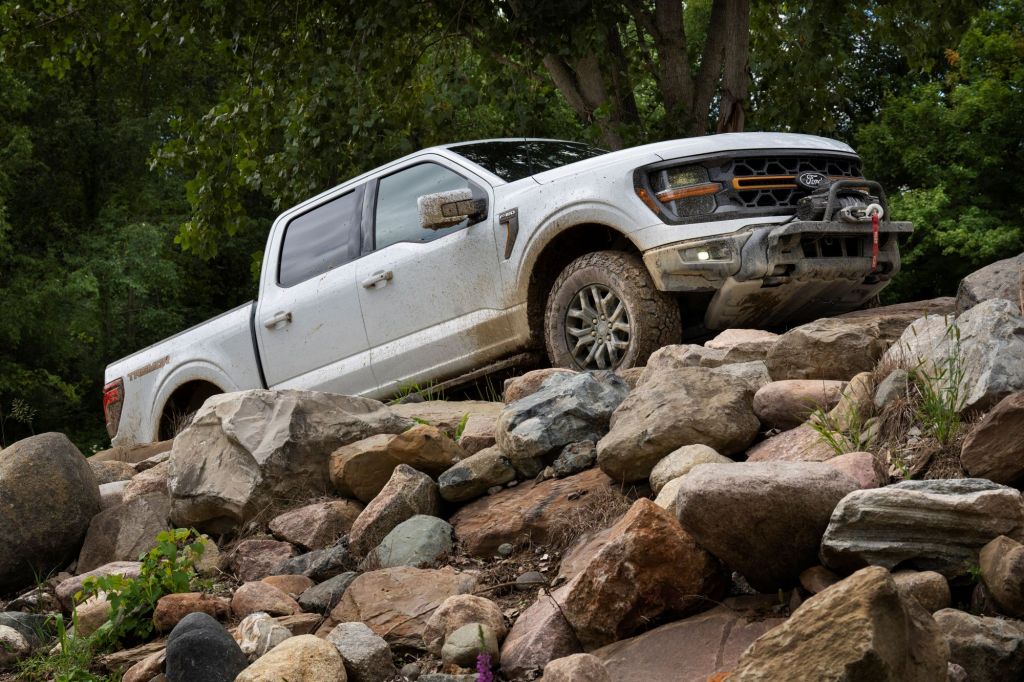
Ford F-Series: It climbs to the top and stays there. (Image: Ford)
Realize that of all of the segments in the showroom the pickup is the one where there is absolutely intense competition, especially with General Motors in the form of the Silverado and Sierra pickups and Stellantis with the Ram offerings.
Toyota keeps hanging in with its Tundra full-size, which racks up about a quarter of what a Ford or Chevy does in a given quarter.
Nissan realized its Titan wasn’t as mighty as it had hoped, so it has left the scene.
GM, in particular, has been working hard to take some of the luster off of the Ford crown. It often sums the Silverado and Sierra sales so that it can show as a corporation it is selling more pickups. But when someone goes into a showroom to buy a truck, they probably don’t want to have to go to visit the store of another brand to check its offerings (i.e., going from a Chevy dealer to a GMC outlet).
Ford with the F-Series simply checks more of the boxes on the needs and wants lists.
In addition to being the best-selling truck for 48 years in a row, the F-Series sets another record: It is the best-selling vehicle of any type in the U.S. and has been since the Gerald Ford administration (43 years running).
One of the interesting things about the F-Series is that while the F-150, the truck that you probably imagine when someone uses the term “F-Series” (I do), seems to have been around for approximately forever, is actually celebrating its 50th year in 2025.
Ford makes it easier for EV buyers to charge at home. What do Bronco buyers get?
By Gary S. Vasilash
Earlier this year the Boston Consulting Group released a report that says, in part, “perhaps the biggest challenge for OEMs is to produce the next generation of EVs profitably. We estimate that most OEMs currently lose around $6,000 on each EV they effectively sell for $50,000, after accounting for customer tax credits.”
Given that the current generation of EVs is what’s presently on dealer lots, that’s lots of money that the legacy OEMs are spending to move the metal.
But because of the billions of dollars they have spent on building out the capacity to produce EVs, they want to keep the production lines running.
Consequently, they are coming up with things that will make EVs more appealing to customers, the $6,000 be damned.
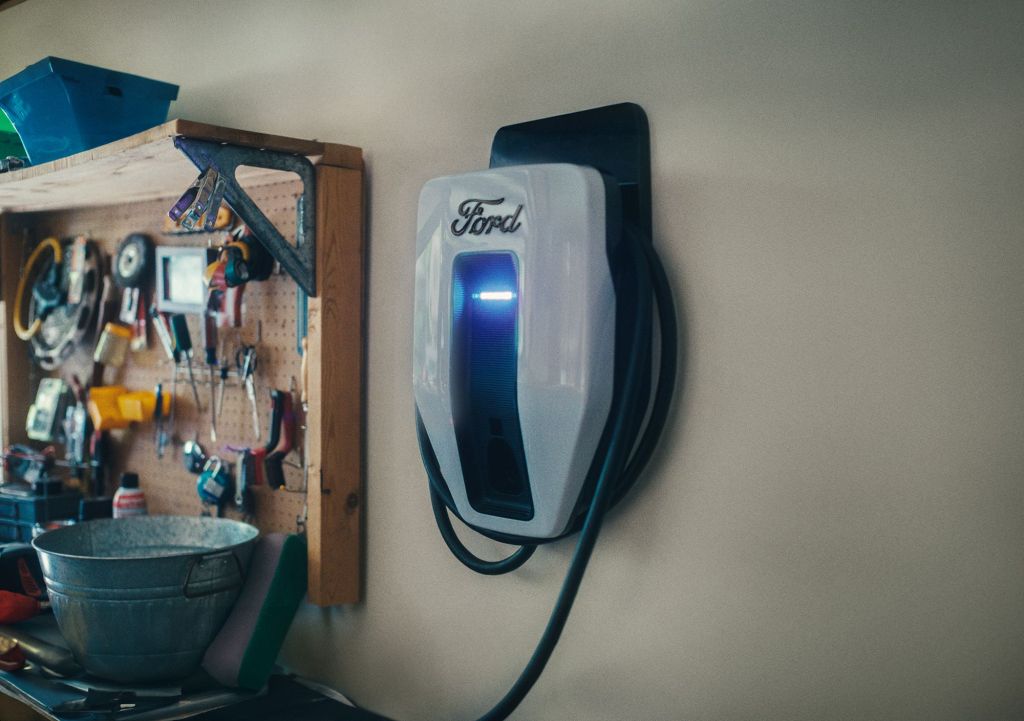
Buy an EV. Get a charger. (Image: Ford)
Earlier this week Ford CEO Jim Farley wrote, “Cheap lease deals on electric vehicles are popping up everywhere. Ford believes it will take more than jumbo rebates to truly break through with the estimated 19 million people in the U.S. interested in electric vehicles.”
Note that he writes “it will take more”—something additive. The rebates and incentives are still part of the game.
Farley goes on to provide details on how Ford is addressing this, through what they call the “Ford Power Promise.”
To provide ease of mind for people, this includes such things as complementary roadside assistance, expanded 24/7 advisor support, and the ability to use its Plug and Charge service that allows a driver to plug in at a charging station and have the electricity charged to the driver’s FordPass account.
But perhaps most significantly, Farley writes: “Buy or lease a retail Ford Mustang Mach-E, F-150 Lightning or E-Transit and take a complimentary home charger with you or have it delivered, and when you’re ready, an expert comes out to install it at no charge for a standard install.”
That’s right: Ford is paying for customers to have home charging capability, something that costs, on average, $1,000.
This could be a clever marketing approach to getting more people in Ford EVs now (the offer expires on January 2, 2025) and presumably next-gen EVs—after all, if the charger is there, people probably figure they might as well use it.
Consider that both the Mach-E and the E-Transit qualify for the IRA tax credit of $3,750 and the F-150 Lightning the full $7,500.
Go buy an Explorer or Bronco and the only tax-related thing will be the sales tax that you’re paying.
Seems that this EV transition is not only costing the OEMs an enormous amount of money, but let’s face it: the government isn’t magically making those credits appear, so all tax payers are kicking in, as well.
Because more than 50% of Ford Bronco Sport owners have been known to take their small SUV off the tarmac, according to Mike Weller, brand manager for the vehicle, for 2025 the vehicle is being upgraded, taking that adverturousness into account. While this is across the board for the vehicle, it is particularly germane for the 1.5-liter Outer Banks and 2.0-liter Badlands models, which can be equipped with the Sasquatch off-road package.
Eddie Khan, Bronco Sport vehicle engineering manager, notes that some other small SUVs have the appearance of ruggedness, but “Bronco Sport is engineered rugged from the inside out and top to bottom.” (According to Ford, Bronco Sport drivers go off road 3.5 time more often than competitive vehicles, so that engineering is important for go, not just show.)
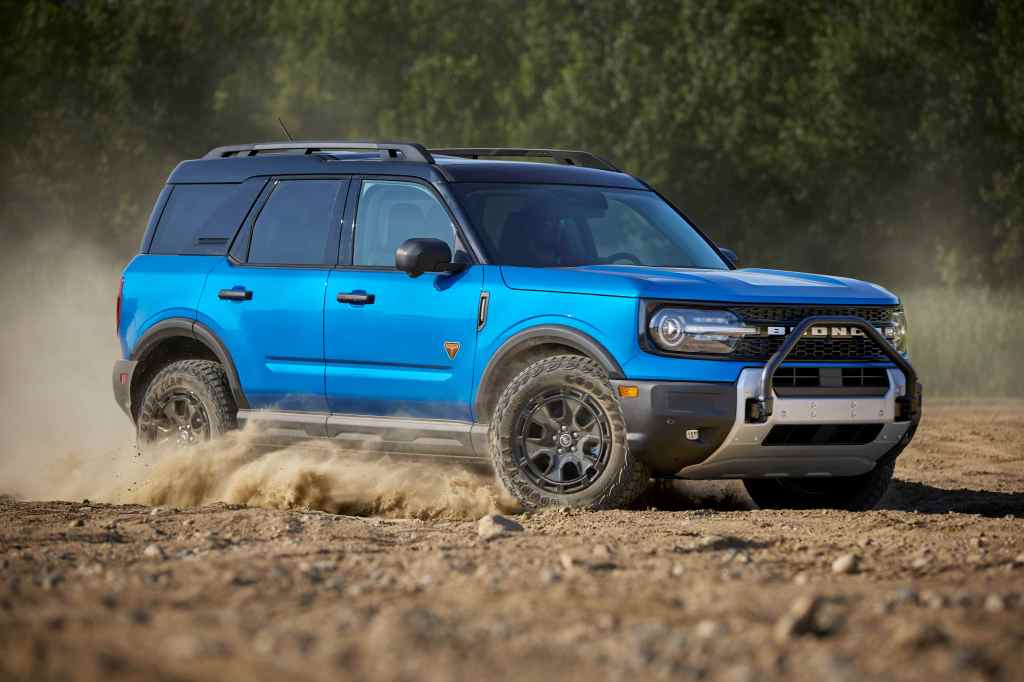
The 2025 Bronco Sport. Some people drive them to the grocery store. Some people drive them over rocks and sand and such to get to the grocery store—or just because they can. (Image: Ford)
Designed to Perform
It must be admitted, however, the Bronco Sport Sasquatch has functional features that make it look rugged, as in a standard front brush guard, steel skid plates, and front and rear bumpers that are fitted with steel bash plates. There are two cast two hooks in the front and a pair of cast D-rings in the back that serve as recovery points.
But beyond those visible modifications there are several things that make the ’25 Sasquatch-fitted vehicles more capable.
Bilstein rear shocks with position-sensitive damping and piggyback reservoirs
New front and rear springs to provide additional suspension travel (8.3 inches in the front and 8.7 inches in the rear)
For both the standard Bronco Sport Badlands and the Badlands Sasquatch models there is a new Rally G.O.A.T. (Goes Over Any Type of Terrain) mode that allows the vehicle to be driven on sand at higher speeds via holding gears longer, improving throttle demand, and increasing steering feedback.
Off Road Aides
Another borrowing from the bigger Bronco there is the addition of Trail One-Pedal Drive to the Bronco Sport, which allows the vehicle to be driven with the accelerator pedal alone during rock crawling.
Also available is a 360° camera that have Trail View. When put in Off-Road or Rally G.O.A.T. modes, the camera is activated. The Badlands and Sasquatch Badlands models also have a “Split View” for the camera system that shows the front tires of the vehicle.
On the inside of the 2025 Bronco Sport (all models) are features including a 13.2-inch center display that runs the SYNC 4 system (wireless Apple CarPlay and Android Auto are standard) and a 12.3-inch digital instrument display. Recognizing that people like to accessorize their vehicles, there is an abundance of “Bronco Bolts” inside and out, fasteners specifically engineered for users who may want to add lightbars up front or mount cameras inside.
When?
The 2025 Bronco Sport Big Bend, Outer Banks and Badlands models will be available at dealers in November. The Sasquatch models will arrive in Q1 2025.
Here’s something you probably don’t want to experience: aspects of the standard features offered in the new 2025 Police Interceptor Utility:
Police Perimeter Alert. . . Police Engine Idle. . . Police Dark Car Feature. . . Rear Camera on Demand. . . H8 AGM Battery. . . Blind Spot Monitoring with Cross-Traffic Alert . . .Manual Police Pursuit Mode – Steering Wheel Switch Execution. . . Red/White Dome Lamp – Cargo Area. . . Rearview Camera with Washer Viewable in 8″ Center Stack Screen. . . Ford Pro Upfit Integration System. . . Keyless Entry with 4 Manual Keys. . . 6-Way Power Passenger Seat. . . Police Accessory Independent Timed-Release Output (PAITRO) – Output Tied to Liftgate Release Switch. . . Climate Control – Rear Aux A/C System. . . Updated Police Grade Cloth Trim Seat Material. . . 12.3″ Digital Instrument Cluster with Certified Calibration. . . Keyless Entry – Key FOB Only (Less PATS). . . Simple Fleet Key (w/o microchip, easy to replace: 4-keys). . . Two 50-amp power distribution junction box
The 2025 Ford Police Interceptor Utility. Departments looking for fuel economy can opt for a hybrid powertrain. (Image: Ford)
Seems like the only thing you’d really be interested in were you to find yourself in the back of one is that rear aux A/C system. And perhaps the seating material.
The rest of the stuff is germane to the professionals.
The Police Interceptor is based on the Explorer that you can find in a dealer near you.
But this vehicle isn’t simply an Explorer with additional lights and a profoundly different paint scheme.
It is engineered to be a police vehicle. It is being offered through Ford Pro, underlining that this is a commercial, not consumer, vehicle.
There are three powertrain options. There is a 3.3-liter V6 that produces 285 hp. A 3.0-liter EcoBoost V6 that produces up to 400 hp—but that’s if the vehicle is using Premium gas, which is probably not something that municipalities are in favor of.
And there is a 3.3-liter V6-based hybrid that produces a system output of 318 hp.
One of the arguments that Ford makes for the hybrid is that the onboard equipment operates even when the engine shuts off. This, it is calculated, means a savings of up to 838 gallons of gas per year because the engine isn’t idling so that various things in the vehicle work.
So, if gas is at $3.50 per gallon, this can translate into a savings of $17,500 over a six-year period.
Which matters as budgets at municipalities are stretched.
(Here’s something interesting: the new consumer version of the Explorer is not offered with a hybrid, something that had been available before the recent midcycle refresh. Given the popularity of that powertrain—as consumers budgets are being stretched—it seems likely Ford may rectify that. After all, they like fuel efficiency, too.)
OK. The images give it away. But still: who would have thought?
By Gary S. Vasilash
Tyler Hill, Ford global brand licensing manager: “These new _______ will allow more people to experience the adventurous spirit of a Bronco and the exhilaration of a Mustang from the moment they grip the __________.”
That would be:
e-bikes
handlebars
That’s right, a Bronco e-bike and a Mustang e-bike.
These bikes, developed with N+, are not for the causal rider.
Both feature 750-W hub motors that can allow the rider up to 28 mph.
To help stop, there are four-piston hydraulic brakes.
(Images: Ford)
The Bronco bike has a dual-suspension system that is said to allow the bike to handle “any type of terrain,” just like the SUV that inspires it.
The Mustang comes in a special 60th anniversary model. A little quick math indicates that were someone in 1964 able to afford a Mustang that person would have probably been at least 20 years old, so that person is likely not to be in the intended customer for the e-bike.
And speaking of customers, the Bronco bike has an MSRP of $4,500 and the Mustang $4,000.
One of the most significant vehicles that Ford has launched during the past few years—arguably more significant than the Mustang Mach-E, which people seem to get excited about—is the Maverick, a midsize pickup truck that is smaller than the Ford Ranger, another midsize pickup truck, which has seemingly lost its mojo.
So let’s put some numbers to the “significant” claim.
Through the first half of 2024 the respective U.S. sales for the vehicles:
Mustang Mach-E: 22,234
Maverick: 77,113*
And for good measure:
Ranger: 15,175
So why is the Maverick, which went on sale in late 2021 as a model year 2022 vehicle, so successful?
Because it is small, fun, funky, functional, and economical.
As for the last item: the starting MSRP for a 2024 Maverick XL with a 2.0-liter EcoBoost engine, is $23,920. For those interested in a 2.5-liter hybrid version, that’s $25,420.
The functional part is that it is a bona-fide truck. As in something with the ability to handle a 1,500-pound payload and tow up to 4,000 pounds (with the 2.0-liter).
And the really clever bit that Ford designers and engineers did was to embrace the fact that they were creating something that would have a low price point.
Typically there seems to be a tendency for them to pretend that whatever it is they’re putting on the road is more expensive than it is, which leads to faux execution inside (in particular) and out.
In the case of the Maverick, while the materials may not be the stuff of an F-150 King Ranch edition, those materials are treated with an honesty and an innovative spin such that they make the truck all the better because there is an authenticity to it.
Now, for model year 2025, the Maverick is getting a refresh.
And a new model.
“One of the first things you’re going to notice is a slimmer, more modern headlight profile,” says Josh Blundo of the design team.
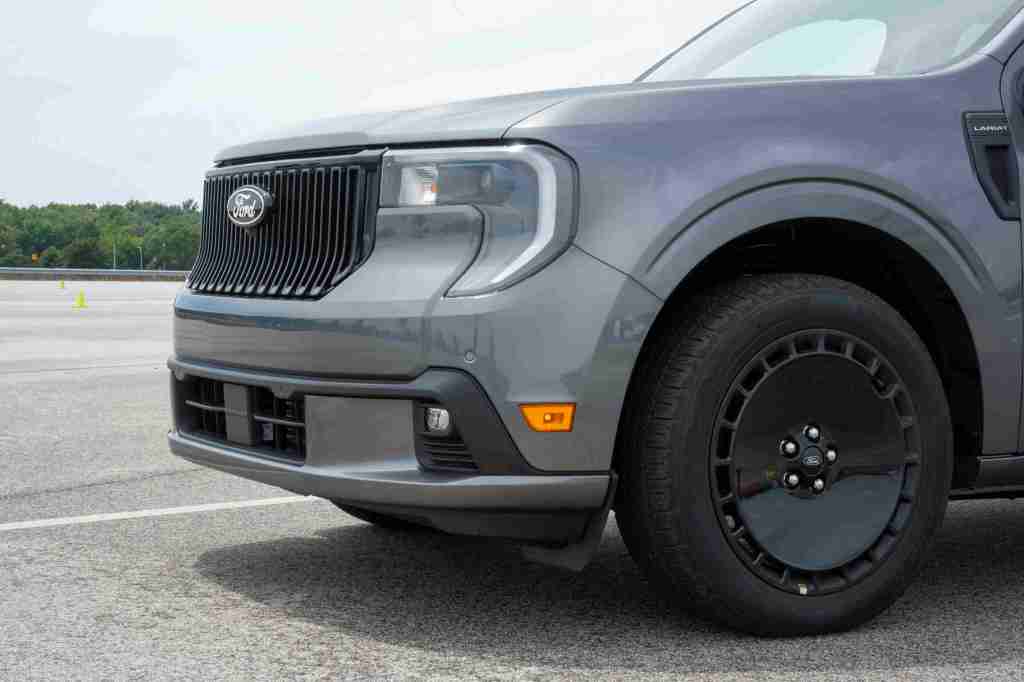
The front fascia for the ’25 Maverick Lariat features “chicklets” on the grille. The front ends of each of the available models—XL, XLT, Lariat, Tremor, and Lobo—has a differentiated look. (Images: Ford)
The primary change for the Maverick trims across the board—and there is a new trim added, the Tremor—is in the front, not only in terms of the headlights, but the fascias, which are specifically designed for each trim (e.g., the Lariat trim has a grille featuring what Blundo refers to as “chicklets,” small metallic rectangles that pop on the black grille).
Inside the most obvious change is the 13.2-inch touchscreen—standard across the lineup—which Blundo says is as big as the screen in any Ford model. Yes, as big at one in an F-150.
Kirk Leonard from the engineering team—who has been with Maverick since just after the launch of the ’22 MY vehicle, and who came to it from Super Duty, which goes to show that this is a serious truck—points out, “Just because we’re a small truck doesn’t mean we get a pass on the capability, durability and toughness that customers expect from our vehicles.” So while the Maverick may be fun, it is not a poseur.
Leonard says “The number-one thing customers have been asking for is all-wheel drive for the hybrid.”
So the ’25 Maverick is available with a AWD system for the hybrid.
Leonard adds, “They wanted all-wheel drive but they didn’t want to give up on fuel economy.”
So, he says, they’re estimating that the AWD Maverick with the 2.5-liter hybrid system will deliver 191 hp, 155 lb-ft of torque, and 40 mpg city.
Those who are even more interested in fuel economy but not interested in all-wheel drive can get the front-drive version, which Leonard says will provide an estimated 42 mpg in the city, and a 500-mile range on a tank of gas.
The Maverick is also available with a 2.0-liter EcoBoost engine that provides 238 hp and 277 lb-ft of torque.
And There’s This. . .
Josh Blundo is one of those guys who is a quintessential “car guy.” While a teen in New Hampshire he was sketching cars, which really wasn’t a thing that his peers were doing. He went to the College for Creative Studies in Detroit and found that car culture was everywhere.
Which is evidently an environment he thrives in.
He says that when the Maverick was first launched he saw that it had a certain minimalism that he finds appealing. And something to use as a launch pad for creation.
Which lead to the design of the Maverick Lobo model.
Lobo. Lowered and with a look that combines street truck and tuner cultures, says designer Josh Blundo.
Although this fits within the “street truck” modified niche, Blundo says, “Street trucks really represent a broad culture. A lot of people think ‘muscle’ trucks—full-size trucks with V8s.”
Then, at the other end of the spectrum, he says, are tuner vehicles. In this case they’re mainly sedans and hatches—Civics and Golfs and the like.
“Maverick, because of where it sits in the truck space, unibody and more focused on handling than straight-line performance, sits in the middle ground,” Blundo says.
So for the Lobo aesthetic they lowered the truck ½ inch in the front and 1.12 inches in the rear, which results in a roof height that’s 0.8 inches lower. And that roof is painted black, as are the 19-inch wheels. (Speaking of the roof: there are two available configurations, Standard and High. High, among other things (e.g., heated steering wheel and seats; spray-in bedliner) includes a moon roof.)
There are a Lobo-specific front fascia and painted rear bumper.
Kristen Keenan and her colleagues in Color + Materials provided the Lobo with a unique interior execution. Keenan, who had worked designing performance footwear at Nike, says that that experience helped inform what they did inside the Lobo, such as using ActiveX, a high-end synthetic that looks good and wears well.
Because this truck is not just about show but also go, there are things like a twin-clutch rear drive unit that provides torque vectoring and an upgraded cooling system.
The truck offers the “Lobo mode,” a drive mode that essentially minimizes the intervention of the stability control system so that the truck can be thrown around on a track—a closed track, notes Keith Daugherty, an engineer who worked on the Lobo and deployed elements from the European and U.S. Ford parts bins (brakes from the Euro Focus ST; strut mounts from the Mach-E).
And, yes, as a daily driver the Lobo has available, like other Mavericks, things like Pro Trailer Hitch Assist, because at the end of the day, it’s a truck.
==
*While some may quibble that this is an unfair comparison, given that one is an EV and the other is a pickup truck, the Maverick is a pickup truck that is available as a hybrid, and according to James Gilpin, Maverick brand manager, about half of all Mavericks sold are hybrids. This means about 38,550 Mavericks sold are electrified, still greater than the 22,234 EVs.



 shinymetalboxes