
Ford Keeps the Pickup Crown

The company just keeps refining it year after year, making it all the better for truck buyers

By Gary S. Vasilash

You’ve got to hand it to the men and women at Ford who have been mightily working for 48 years, dedicated to making the F-Series trucks the best-selling truck models in the U.S. for all those years running.
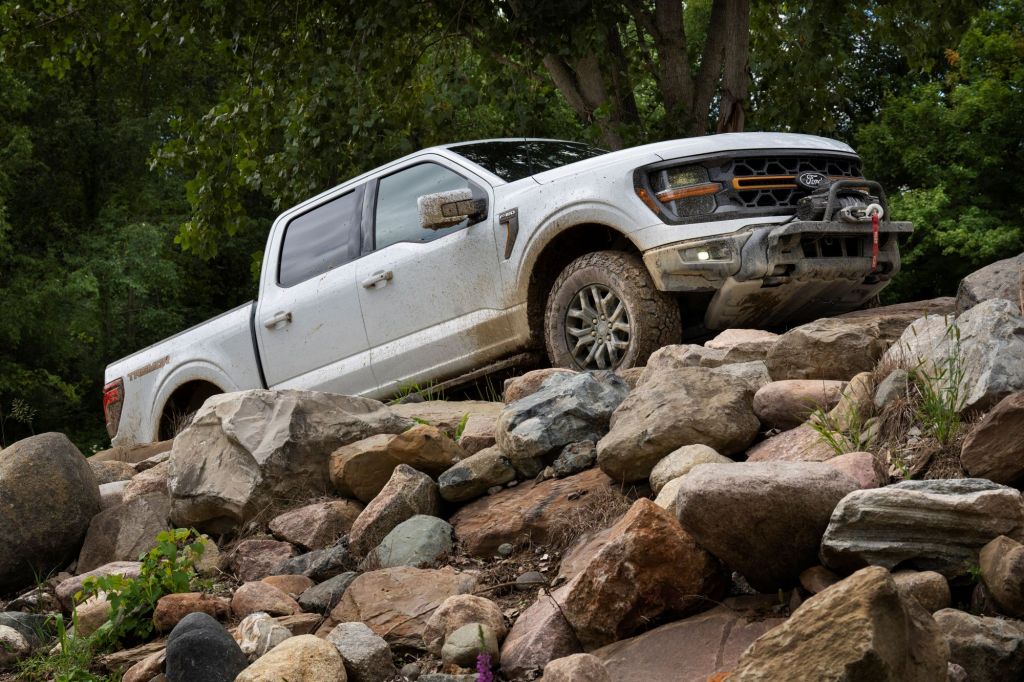
Ford F-Series: It climbs to the top and stays there. (Image: Ford)

Realize that of all of the segments in the showroom the pickup is the one where there is absolutely intense competition, especially with General Motors in the form of the Silverado and Sierra pickups and Stellantis with the Ram offerings.

Toyota keeps hanging in with its Tundra full-size, which racks up about a quarter of what a Ford or Chevy does in a given quarter.

Nissan realized its Titan wasn’t as mighty as it had hoped, so it has left the scene.

GM, in particular, has been working hard to take some of the luster off of the Ford crown. It often sums the Silverado and Sierra sales so that it can show as a corporation it is selling more pickups. But when someone goes into a showroom to buy a truck, they probably don’t want to have to go to visit the store of another brand to check its offerings (i.e., going from a Chevy dealer to a GMC outlet).

Ford with the F-Series simply checks more of the boxes on the needs and wants lists.

In addition to being the best-selling truck for 48 years in a row, the F-Series sets another record: It is the best-selling vehicle of any type in the U.S. and has been since the Gerald Ford administration (43 years running).

One of the interesting things about the F-Series is that while the F-150, the truck that you probably imagine when someone uses the term “F-Series” (I do), seems to have been around for approximately forever, is actually celebrating its 50th year in 2025.

That is arguably the defintion of iconic.

Buy a Truck or a BMW

Turns out the prices are fairly close. . .

By Gary S. Vasilash

When you think of the quintessential full-size pickup truck, the sort of thing that you imagine farmers loading with bales or hay or contractors carrying loads of gravel, it is probably the Ford F-Series.

With good reason, given Ford sells those trucks the way McDonald’s sells hamburgers. The numbers are staggering.

But odds are, those images of the F-Series are probably not entirely accurate.

BMW 5 Series. Or you could consider a pickup truck. (Image: BMW)

Listen to Erin Keating, executive analyst for Cox Automotive, talking about vehicle transaction prices in May.

First she notes: “The popularity of fully loaded, full-size pickup trucks that are more luxurious than many luxury vehicles is unique to the U.S. market.”

Which can be understood that (1) there aren’t a lot of full-size pickup trucks sold in other markets around the world* and (2) those trucks are probably used as utility vehicles (e.g., the opening examples).

Keating does on: “The Ford F-Series outsold BMW 2-to-1 in May, and BMW’s ATP [average transaction price] was only marginally higher than the F-Series.”

Whereas the average transaction price for a BMW in May was $72,946, the ATP for an F-Series was $67,837.

Now that’s about a five-grand difference, which isn’t exactly trivial.

But somehow a Bimmer seems as though it is in another category all together compared with something that you probably once saw with a decal of Calvin relieving himself on a Chevy bowtie on the back window of the truck.

Of course, not a $68,000 truck, but nonetheless. . . .

//

*That full-size pickups are pretty much indigenous to the U.S. market is something that makes the development of EV versions of the trucks somewhat problematic in the long run. That is, on a global basis something like the Ford Mustang Mach-E has more applicability than an F-150 Lightning. While it seems to have been thought by some OEM execs that because customers in the U.S. buy lots and lots of trucks, then if a somewhat sizable percentage of them buy electric versions then everything will be great. For reasons including cost and/or performance, that is not proving to be the case. This means that scale isn’t being achieved, and if there is something that is necessary for an OEM, it’s that. So by spending lots of engineering and manufacturing resources on making a type of vehicle that has a limited domestic market and a nearly non-existent global market, achieving scale is anywhere is not particularly likely.