Try to Buy a “Car”

By Gary S. Vasilash

Let’s say that you are interested in buying a car.

A car as a sedan. Not a crossover. A bread-and-butter car. (Yes, maybe you want to add some spicy tomato jam to it—spoiler, alloy wheels, etc.)

You go to the local Ford dealer.

And discover that the only car is a Mustang, which doesn’t qualify (i.e., two doors).

There happens to be a Lincoln store across the parking lot.

There are no cars, only crossovers of stair-step sizes.

You visit a Chrysler dealership and learn that Stellantis has stopped production of its long-in-the-market 300 at the end of last year, but they’ve got a Pacifica minivan, if you’re interested.

Buick perhaps? Again, no. Only crossovers.

Over at Cadillac things are better: of its seven models, two are sedans, the CT4 and the CT5. Given that the Q1 2024 sales for those are down 36.1% and 34.2%, respectively, how long they’ll be around may be in some question.

Chevy? An impressive array of crossovers and trucks. And one car, the Malibu.

The point is, buying a car is not as easy as it once was.*

Which leads to a thought about electric vehicles.

What if you went into one of these dealerships and discovered that they didn’t have anything on the showroom floor that didn’t have a plug?

What if that was pretty much the case up and down the street of the auto mall?

Clearly there would be an increase in the number of EVs sold out of those dealerships.

Maybe the numbers would be that good.

But they would be better.

Just as they’ve increased the number of models that aren’t cars and so have made buying a car tough, it could be that to help recoup some of the billions being spent on EVs they make buying an ICE tough.

Something’s got to move more of that lithium-powered metal.

(Of the 593,997 vehicles GM sold to customers in Q1, 16,169 were EVs. Not much of a business case there. And it sold twice as many Malibus ((32,749).))

*Interestingly, the Asian and European brands, in general, all have cars in their lineups.
Mercedes USA Q1 & EVs

“Mercedes-Benz EVs accounted for 13% of our total group sales volume in Q1,” Dimitris Psillakis, president and CEO of Mercedes-Benz USA, said, reporting how the marque is doing so far in 2024.

Which, on a percentage basis, is quite good.

Ford, which describes itself as “America’s No. 2 electric vehicle brand,” had Q1 EV sales of 3.9%.

Mercedes has three EVs in its U.S. showrooms:

  • EQB, of which it sold 671
  • EQE, 5,113
  • EQS, 2,552

That is a total of 8,336 of the 66,570 passenger vehicles it sold in Q1.

(To be fair to Ford, it sold 508,083 vehicles in Q1, of which 20,233 were EVs.)

But here’s something interesting about the Mercedes sales: It sold 15,096 GLE SUVs.

That’s about 23% of total sales.

The Ford 180

By Gary S. Vasilash

“Ford has shifted its electric vehicle strategy so it concentrates on smaller, lower priced EVs and electric work vehicles such as pickup trucks and full-size vans, Farley said. Any EV larger than a Ford Escape small SUV ‘better be really functional or a work vehicle.’”

That is from an AP story by Tom Krisher about a presentation Ford CEO Jim Farley gave to the Wolfe Research Global Auto Conference in New York on February 15.

Farley also talked about the relationship between Ford and the UAW in light of last fall’s strike.

Farley said, “Our reliance on the UAW”—it has more UAW members that either GM or Stellantis—“turned out to be we were the first truck plant to be shut down.”

He was referring to the Kentucky Truck Plant, Ford’s largest plant and where the highly profitable F-Series Super Duty, Ford Expedition and Lincoln Navigator are produced.

Ford has pretty much placed its production bets in North America on things like the F-Series.

The only car the company has on offer in the U.S. is the Mustang, not exactly what one would describe as a “family vehicle,” so arguably it is something of a niche at most. Trucks and utes are where it is at, it seems, for the Blue Oval.

In the smallish category there are the Escape and the Bronco Sport, which are both based on the same platform. And the Maverick pickup truck, which is also based on the same C2 platform. This extremely popular pickup is built at a Ford plant in Hermosillo,Mexico, so some of Farley’s USA! USA! USA! chest thumping needs to be adjusted a bit.

But his comment about where the sweet spot for EVs is going to be is somewhat puzzling.

Right now Ford has three EVs, two for consumers and one for vocational use: the F-150 Lightning, Mustang Mach-E and E-Transit.

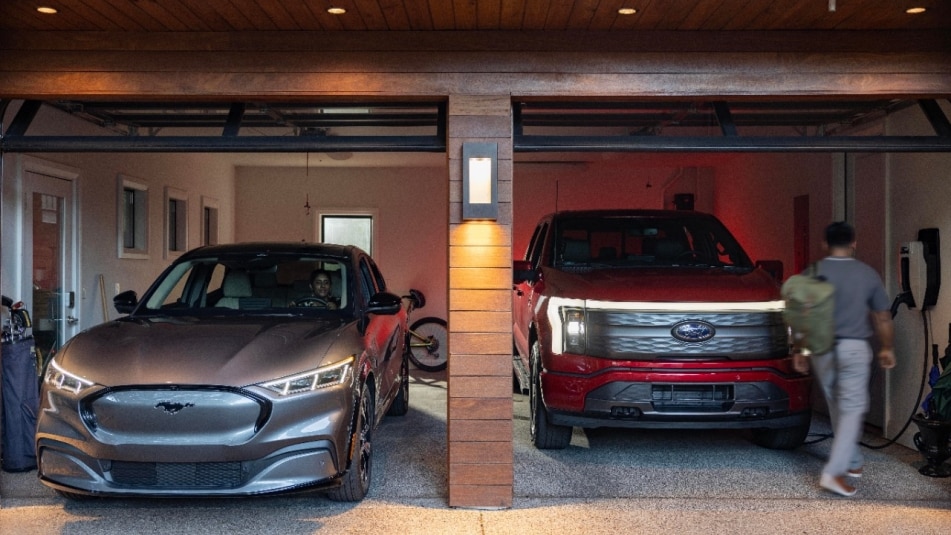
The Ford EVs for consumers: the Mustang Mach-E and the F-150 Lightning. (Image: Ford)

The first is, of course, a full-size pickup truck. The second trades on the muscle car performance of the Mustang. And the third is a vehicle for contractors.

Ford has been championing larger vehicles for the past few years for the simple reason that it is where it makes more money, so when it went EV it went big with the Lightning (and for power with the Mach-E).

It used to have the Focus to go up against the likes of the Honda Civic and Toyota Corolla, both of which still exist and do quite well in the market. Presumably neither Honda nor Toyota build those vehicles out of charitable impulses.

Ford used to have the Fusion to go up against the likes to the Honda Accord and the Toyota Camry, both of which. . . . Yes, same thing.

Ford—and it isn’t the only company in southeastern Michigan that has done this—has been messaging consumers that Bigger Is Better.

Suddenly Farley is talking about small vehicles.

Don’t get me wrong: small EVs, assuming that they can be made so that they are actually affordable for consumers and that provide a return to the OEMs, are undoubtedly a good idea to increase the number out on the roads.

Regardless of the size of the currently available EV (with the exception of Teslas) need to be sold to a still-skeptical public.

So there is that challenge.

And now Farley is doing a 180 and planning to go to the market with things that are small.

Which means he is going to need to convince people that on roadways populated with large F-150s and Explorers small Ford EVs are a good thing.

To which I say: Good luck.

Ford: Hybrids Should Be the Story

By Gary S. Vasilash

Much of the attention given to Ford’s Q4 2023 earnings call last week has been focused on CEO Jim Farley’s comment:

“[W]e made a bet in silence two years ago. We developed a super-talented skunk works team to create a low-cost EV platform. It was a small group, small team, some of the best EV engineers in the world, and it was separate from the Ford mothership. It was a start-up.

“And they’ve developed a flexible platform that will not only deploy to several types of vehicles but will be a large installed base for software and services that we’re now seeing at Pro.”

Somehow the inherent mystery of a “skunk works” has gotten people all excited.

Would they be so excited to know that the skunkworks methodology goes back to 1943 in the aircraft industry?

Yes, an 80-year-old approach.

Well, You’ve Got to Build It. . .

The other thing about this is that it is one thing for an R&D team operating independently to develop something and a whole other thing for that development to be engineered for and launched in production.

Launches have been something that Ford has been finding a bit troubling, so there’s that.

And it should be noted that the company also announced last week that its Ford e operation—as in the electric vehicles—lost $4.7 billion last year and the company anticipates losing $5 to 5.5 billion this year on Ford e.

The excitement of the skunk works project was certainly helpful from diverting some attention to that red ink.

What About This?

But what was largely overlooked was Farley’s comments on hybrids.

As in,

“Our global hybrid sales were up 20% last year, and we expect them to be up 40% this year.”

And:

“We now have the No. 1 and No. 2 best-selling hybrid trucks in the U.S. Maverick is No. 1. And we’re the No. 3 hybrid brand in the U.S. behind Toyota and Honda. But unlike them, our hybrids really sell best on trucks for our side.”

Given that Farley said “And margins on hybrids are closer to ICE, much higher than EV margins,” you’d think hybrids would be the headline going forward if for no other reason than the company can make money on them, something that it is not going to see on the EV side of the business until. . . . Well, that remains to be seen.

Maverick hybrid: Fuel efficiency and the energy to bust out the beats. (Image: Ford)

Not Exactly a Strong Third

While it is nice that Farley is so bullish about the company’s hybrid performance, it is worth really putting that into context.

Of course its hybrids “really sell best on trucks” because with the only hybrid Ford has without a box on the back is the Escape.

And as for it being number three, know that these are the number of hybrid sales for the three companies in 2023:

  1. Toyota:         523,664
  2. Honda:         293,640
  3. Ford:            133,748

In other words, it sold less than half of what Honda did and about a quarter of what Toyota did.*

So while the claim is factually true, one should perhaps not be too chuffed about the Ford hybrid performance.

About a quarter of Toyota and Honda sales are hybrids.

About 7% of Ford’s sales are hybrids.

Did I mention the skunk works. . .?

==

*It is worth noting that until recently Toyota was treated like some technological troglodyte for its continued support of hybrids and its not all-in approach to EVs. Not only do we see that Ford is reconsidering its positioning vis-à-vis hybrids and full EVs, but General Motors, which doesn’t have much of a record in the hybrid space, has announced that it, too, is going to bring hybrids to the U.S. market. Farley pointed out on the earnings call that consumers can quickly do the math on the fuel efficiency benefits of hybrids and, perhaps the most important factor: “they don’t have to change their behaviors.” It is surprising that there seems to be so many auto execs who ignore the long public charging time required for EVs compared with pumping gas: perhaps this is a case that when they get behind the wheel of their company vehicles someone else has done the charging.

Hybridized CUVs Matter

By Gary S. Vasilash

Here’s a fun fact: the Honda CR-V hybrid was the best-selling hybrid vehicle, bar none, in the U.S. market in 2023.

197,317 were delivered.

Honda CR-V Hybrid under its skin. (Image: Honda)

Meanwhile, over at Toyota, 161,125 RAV4 Hybrids were sold and an additional 26,073 RAV4 Primes, the plug-in hybrid, for a total of 187,198 hybrids.

GM has zero hybrids.

Ford has hybrid versions of the Escape, Maverick, Explorer, and F-150.

Combined, it delivered 133,743 hybrids.*

Ford sold 140,986 Escapes in 2023. That’s with all powertrain options.

Fewer than the Honda and Toyota hybrids.

Chevy sold 212,701 Equinoxes—none of which are electrified, and not all that many more than the CR-V hybrid (15,384, non-trivial, but when you take into account that Honda sold 361,457 CR-Vs in 2023, well. . . ).

Clearly, compact CUV hybrids are appealing.

Surprising GM is ignoring the market and Ford probably needs to ramp up its output.

Dodge has a hybrid version of the Hornet available, a crossover that launched last Spring, so its efforts are still nacent in this space. It sold a total 9,314 Hornets in 2023, of which 3,591 were the hybrid version, so there’s evidently some traction.

(Jeep has the Wrangler 4xe plug-in and the Grand Cherokee 4xe plug-in, of which it sold 67,429 and 45,684, respectively. Neither, of course, is likely cross-shopped with a CR-V or RAV4, but still nice numbers.)

*Here’s a big number–the electrified Toyotas sold in 2023: 565,800. With the exceptions of 2,737 Mirai fuel cell electric vehicles and 9,329 bZ4X BEVs, all hybrids.

BMW and EVs

By Gary S. Vasilash

When it comes to discussions of electric vehicles, the topics seem to be, in order of frequency:

  1. Tesla. Anything. Mileage recalculations. Musk’s recreational habits. Labor issues. Massive number of vehicles being sold (which actually doesn’t get the attention that it should: when you subtract Tesla vehicle sales from electric vehicle sales, things don’t look quite as bullish as one might think).
  2. GM. Mainly its failure to produce notable volumes. For 2023 it delivered 9,154 Cadillac LYRIQs, 483 Chevy Blazer EVs, 461 Silverado EVs, 3,244 HUMMER EVs, 14 Zevo 400s, and 483 Zevo 600s (the last two are commercial vehicles). That is a total 13,838 vehicles. Out of 2,594,698 sold.
  3. Ford. One thing is the refocus on hybrids. The other thing is the changing prices for the F-150 Lightning, with the recent notable rise in MSRP. You might have imagined that when the vehicle launched the perceived demand was such that they would have quickly hit economies of scale that would cause prices to, well, not rise. For 2023 it sold 24,165 Lightnings, which is excellent in the context of GM. But when you take into account the total 750,789 F-Series trucks sold, that’s about 3%.

A company that gets little attention is BMW when it comes to EVs.

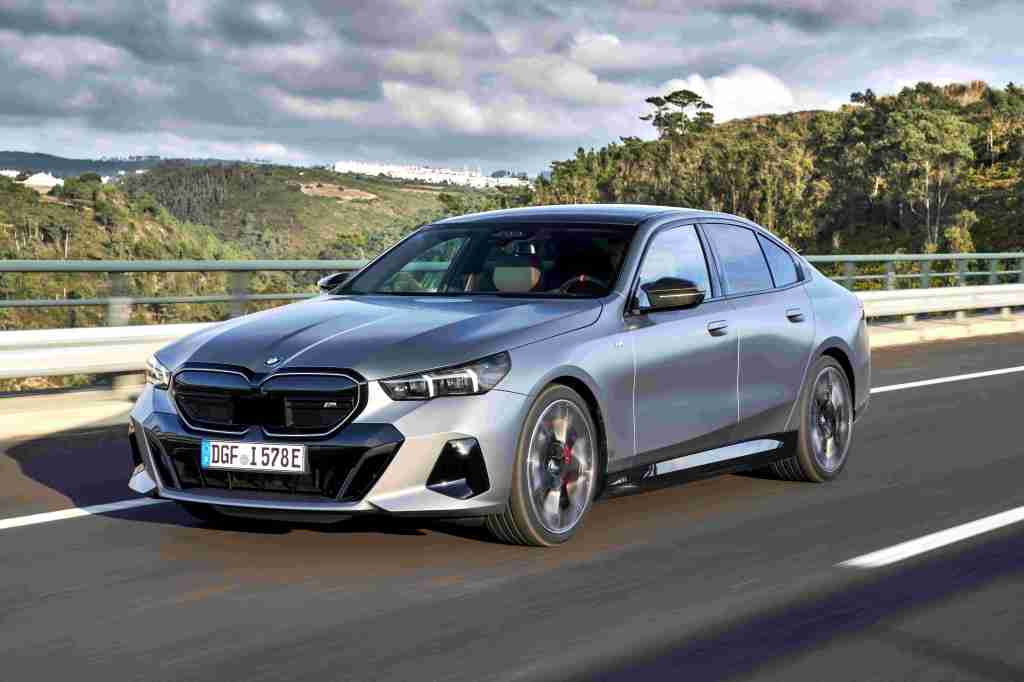
BMW i5: one of the electric vehicles in the company’s offerings–there are also the i4, i7 and iX. (Image: BMW)

Which is surprising given that in 2023 it delivered 45,417 EVs into the U.S. market.

That’s more than the GM EV sales and the Ford Lightning sales combined (38,003).

BMW 2023 EV sales account for 12.5% of its total sales.

If the number of plug-in hybrids BMW sold in 2023 (25,318) are added in to the EV number (so the number of “electrified vehicles”), it is 70,735 or 19.5% of BMW’s total sales in the U.S.

Those are some big numbers for BMW.

Seems like the lack of discussion isn’t keeping people from buying the company’s EVs.

Ford Sells a Lot of Trucks. Again.

By Gary S. Vasilash

For those of you still humming Mariah Carey’s “All I Want For Christmas Is You,” here’s a bit of context for an announcement Ford made this morning:

The year that the Ford F-Series started making its consecutive run as the best-selling truck in the U.S., Ms. Carey was seven.

The F-Series has taken the lead for 47 years in a row.* They’re looking at more than 700,000 of them driven off of dealer lots in 2023.

2024 Ford F-150 Platinum. So nice that you probably wouldn’t want to use it as. . .a truck (Image: Ford)

And underscoring the curious popularity of trucks in suburban driveways as well as on work sites (curious because I rarely see my pickup truck-owning neighbors doing anything with the boxes on the back of those vehicles that they couldn’t manage with a trunk), the F-Series has been the best-selling vehicle in the U.S. for 42 years running.*

There is, of course, the question of whether “the most” means “the best.”

After all, McDonald’s has sold more hamburgers than any other company in the world and there is probably no one who doesn’t know whether they can get a better burger.

But one thing it certainly means is that the F-Series provides an unparalleled level of value for more people than any other pickup.

While there may be specific attributes of trucks from other OEMs that are more appealing or necessary for some purchasers, which means those trucks are more valuable for those people, on an overall basis Ford is consistently delivering.

Credit where credit is due. (And you’ll probably need good credit to get a full-size pickup: according to Kelley Blue Book, the average transaction price (ATP) for one in November 2023 was $66,590. You could get an entry-level luxury car for an ATP of $57,889.)

(On a related-unrelated subject, the tremendous number of trucks sold by Ford—closely followed by GM and Ram—in the context of vocational or functional (i.e., towing, hauling) uses of the vehicles might indicate that people are less environmentally keen than might be expected. After all, light-duty pickups aren’t exactly fuel-economy leaders, so were people concerned about carbon, they’d be buying more efficient vehicles for their daily drives. Yes, there are an electric F-150 and Chevy Silverado and one coming from Ram, but from the point of view of resource utilization, as in the massive batteries that have to be constructed, if those trucks aren’t being used as, well, trucks, then that isn’t exactly the most-environmental choice.)

*As the announcement was made a couple days before the actual end of the year, it is a bit of estimation on behalf of Ford. A small bit.

Another List With Some Missing Names

By Gary S. Vasilash

Kelley Blue Book, an outfit with plenty of folks who know a whole lot about vehicles, their value and what consumers like or don’t about those vehicles, has come up with its list of “Best Buy Awards.”

In other words, the vehicles that were launched last year (or which underwent a redesign) that, based on a variety of criteria, KBB thinks people will be happier to acquire than competitive vehicles not on the list.

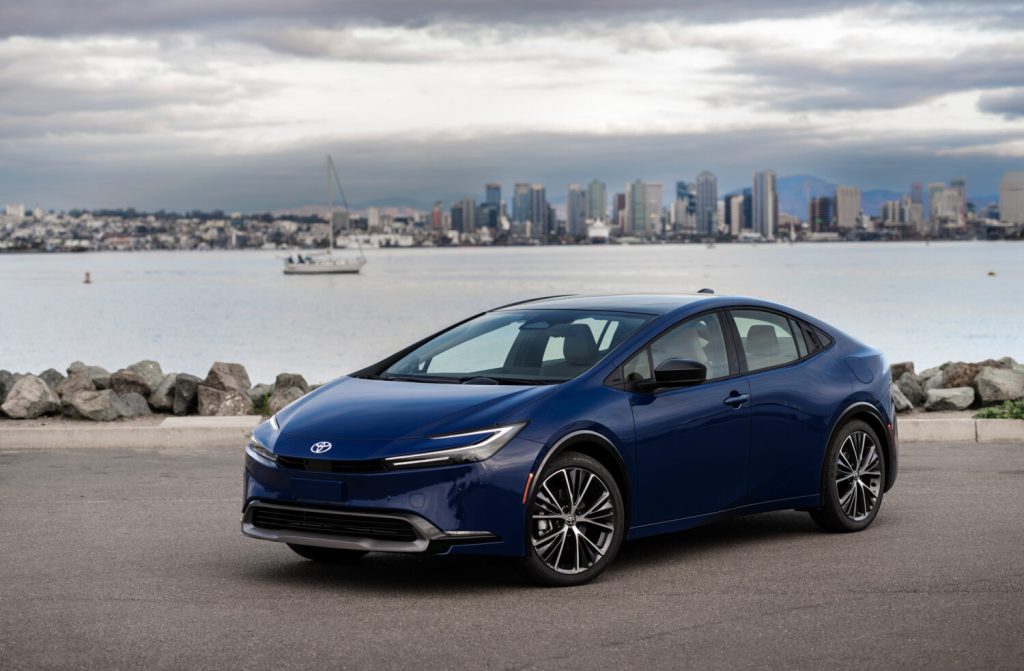
2024 Toyota Prius (Image: Toyota)

So without further ado, here are the winners of the 2024 Kelley Blue Book Best Buy Awards (all model year 2024 vehicles):

  • Best New Model: Toyota Prius
  • Best Compact Car: Honda Civic
  • Best Midsize Car: Honda Accord
  • Best Subcompact SUV: Hyundai Kona
  • Best Compact SUV: Honda CR-V
  • Best Midsize SUV: Kia Telluride
  • Best Full-Size SUV: Ford Expedition
  • Best Compact Truck: Ford Maverick
  • Best Midsize Truck: Toyota Tacoma
  • Best Full-Size Truck: Ford F-150
  • Best Minivan: Toyota Sienna
  • Best Electric Vehicle: Hyundai Ioniq 5
  • Best 3-Row Electric Vehicle: EV9
  • Best Electric Truck: Ford F-150 Lightning

One of the things that is evident from this list is that Ford is a superlative truck company.

Which leads to a question: Where’s anything from General Motors? No Cadillac? Chevy? Buick? GMC? Not one?

Or the company formerly known as Chrysler? Nothing from the Stellantis cadre (Chrysler, Jeep, Dodge, Ram, Alfa Romeo, Fiat)? The company that invented the minivan doesn’t make the Best Buy minivan?

And there is also the noticeable lack of anything with a European pedigree.

Looking into the Ford wins, in the Compact Truck category, there is really only the Maverick, so Ford gets a bonus there because it competes with nothing.

And the only other electric full-size truck that would qualify would be the Chevrolet Silverado EV, though it probably came out too late in the year to be assessed by KBB, so Ford Lightning by default (although it is a bit odd, given that the Lightning was launched in April 2022, not 2023).

But credit where credit is due.

EVs and the Middle Class

By Gary S. Vasilash

Electric vehicles aren’t cheap.

According to the most-recent figures from Kelley Blue Book, the average transaction price for an EV in October was $51,762. (Silver lining? Down 7.4% compared to the price in October 2022.)

The average transaction price for a non-luxury vehicle—arguably the type of vehicle that the average person buys—was $44,331 in October.

That’s a difference of $7,431. Or to go from the non-lux vehicle to the EV a ~17% increase.

Non-trivial.

The big cost in an EV is the battery. It can represent 40% or more of the sticker.

So one thing vehicle manufacturers are working on is reducing the price of the battery.

One of the ways they’re doing this is by using batteries with less-costly materials.

Right now the (more or less) standard type of battery chemistry is NMC, or lithium nickel manganese cobalt oxide. The key things to know are the nickel and the cobalt, as these are the pricey ones.

There is another chemistry, LFP, or lithium iron phosphate. Iron and phosphorus are a lot cheaper than nickel and cobalt.

What’s more, the manufacturing process to make LFP batteries is simpler, which also contributes to a lower price.

However, LFP batteries have less energy density than NMC batteries. Which means less range for the same-size battery.

Additionally, LFP batteries don’t charge as readily in cold environments.

But there’s a price difference of about 30%, so perhaps the downsides of LFP are not a concern for those who are looking for affordability.

Stellantis and CATL, the leading producer of batteries for EVs, have signed a strategic memorandum of understanding (MoU) for the supply of battery cells and modules to the vehicle manufacturer’s operations—in Europe.

For LFP battery cells and modules.

The interesting thing is this:

Carlos Tavares, Stellantis CEO, rationalized the arrangement by saying, “This MoU with CATL on LFP battery chemistry is another ingredient in our long-term strategy to protect freedom of mobility for the European middle class.”

Have you ever heard a U.S. automotive exec specifically say they’re developing EVs for the middle class?

Until that is the stated objective, odds are it’s not going to happen. And there will continue to be that double-digit percentage difference between the cost of an EV and a non-luxury car.

Yes, Ford, for example, is working with CATL on the now-reduced-scope battery plant that will be built in Marshall, Michigan, and yes, Ford has said that the LFP batteries that will be built there will be less expensive than the NMC batteries it offers, but the market is still waiting for a true middle class EV from Ford (i.e., the least-expensive F-150 Lightning that a consumer can buy right now is $54,995 and the median price for a Mustang Mach-E is $46,995).

Perhaps the cooling in the EV market is explained by the simple fact that the vehicles available, for the most part, are simply too expensive for the middle class buyer.

EV (Dis)interest

By Gary S. Vasilash

One of the things that isn’t talked about much is the fact that electric vehicles really aren’t that popular unless they come from Tesla.

Flying in the face of that is a finding of Kelley Blue Book that in Q3 2023 EV sales in the U.S. hit 313,086 units, a 49.8% increase over Q3 2022. Such a jump means interest, right?

Well, the total number of EVs sold in Q3 represents 7.9% of total industry sales.

In other words, 92.1% of the vehicles people bought in Q3 weren’t electric.

And to the point of Tesla’s sway over the market—even though KBB saysTesla’s share of market tumbled to 50%–is that KBB acknowledges“Tesla’s price cuts have moved the market, pushing electric vehicle prices down more than 22% year over year, from $65,295.”

That’s right: a single company moves the entire segment.

(And in case you’re wondering, in October, according to KBB, the average transaction price for an EV was $51,762 while the ATP for a non-lux vehicle was $44,331.)

Drilling down a bit more, it is bracing to discover that in terms of share of the EV segment, the mainstream brands really don’t have much in Q3.

  • Chevrolet, 5.1%
  • Ford, 6.7%
  • GMC, 0.4%
  • Hyundai, 6.3%
  • Kia, 3%
  • Nissan, 1.9%
  • Subaru, 0.9%
  • Toyota, 0.9%
  • VW, 3.4%

And know that the 6.7% for Q3 Ford racked up represents 20,926 vehicles: 14,842 Mach-Es, 3,503 F-150 Lightnings and 2,617 E-Transits.

Ford sold 23,931 Mavericks in Q3, of which 56.5% were hybrids. Somehow that 20,926 EVs sold—encompassing three models, one of which is based on the best-selling pickup Since Time Began—seems more than anemic.

So even before Ford started talking about having to make adjustments as a result of the salary and benefit increases in the proposed agreement with the UAW, the auto company suddenly found things like the F-150 Hybrid more interesting.

When I ask knowledgeable people about the subject, they point out that much of the EV development and promotion is predicated on government regulations, more than organic customer demand. Look at those puny percentages up there, slices of the 313,086 vehicles sold by companies ranging from Audi to Volkswagen.

There’s not much there there.

Yes, there will be more EVs offered. More EVs sold.

But—again, absent Tesla—the market demand isn’t at all what it sounds like it should be.

Another example of this not-big demand is something that some point to as a real success story: the Chevrolet Bolt EV.

Here are the sales figures for the past five years:

  • 2018: 18,019
  • 2019: 16,418
  • 2020: 20,754
  • 2021: 24,828
  • 2022: 38,120

Whoa! you might think. From 2018 to 2022 the sales of the Bolt EV doubled! Remarkable.

But there are a couple of elements that need to be considered.

For one thing, Chevy added a (slightly) different body style, the more ute-like Bolt EUV in 2021, which certainly added some interest to the model(s).

And in June 2022 General Motors cut the price of the Bolt to persuade customers to buy one—sort of like what Elon has been doing.

Had Dodge made a substantial price reduction to the SRT Hellcat Redeye Widebody, the Brotherhood of Muscle would exponentially increase its membership of all genders and municipalities throughout the country would have a sharp uptick in revenues from speeding tickets.

If there is a change in the political situation, those regulations that are driving EV development and sales and those incentives that do the same (what if the government offered $7,500 tax credits for the purchase of a Hellcat?), the question of actual market demand is really going to matter.