
Hybridized CUVs Matter

By Gary S. Vasilash

Here’s a fun fact: the Honda CR-V hybrid was the best-selling hybrid vehicle, bar none, in the U.S. market in 2023.

197,317 were delivered.

Honda CR-V Hybrid under its skin. (Image: Honda)

Meanwhile, over at Toyota, 161,125 RAV4 Hybrids were sold and an additional 26,073 RAV4 Primes, the plug-in hybrid, for a total of 187,198 hybrids.

GM has zero hybrids.

Ford has hybrid versions of the Escape, Maverick, Explorer, and F-150.

Combined, it delivered 133,743 hybrids.*

Ford sold 140,986 Escapes in 2023. That’s with all powertrain options.

Fewer than the Honda and Toyota hybrids.

Chevy sold 212,701 Equinoxes—none of which are electrified, and not all that many more than the CR-V hybrid (15,384, non-trivial, but when you take into account that Honda sold 361,457 CR-Vs in 2023, well. . . ).

Clearly, compact CUV hybrids are appealing.

Surprising GM is ignoring the market and Ford probably needs to ramp up its output.

Dodge has a hybrid version of the Hornet available, a crossover that launched last Spring, so its efforts are still nacent in this space. It sold a total 9,314 Hornets in 2023, of which 3,591 were the hybrid version, so there’s evidently some traction.

(Jeep has the Wrangler 4xe plug-in and the Grand Cherokee 4xe plug-in, of which it sold 67,429 and 45,684, respectively. Neither, of course, is likely cross-shopped with a CR-V or RAV4, but still nice numbers.)

*Here’s a big number–the electrified Toyotas sold in 2023: 565,800. With the exceptions of 2,737 Mirai fuel cell electric vehicles and 9,329 bZ4X BEVs, all hybrids.
BMW and EVs

By Gary S. Vasilash

When it comes to discussions of electric vehicles, the topics seem to be, in order of frequency:

  1. Tesla. Anything. Mileage recalculations. Musk’s recreational habits. Labor issues. Massive number of vehicles being sold (which actually doesn’t get the attention that it should: when you subtract Tesla vehicle sales from electric vehicle sales, things don’t look quite as bullish as one might think).
  2. GM. Mainly its failure to produce notable volumes. For 2023 it delivered 9,154 Cadillac LYRIQs, 483 Chevy Blazer EVs, 461 Silverado EVs, 3,244 HUMMER EVs, 14 Zevo 400s, and 483 Zevo 600s (the last two are commercial vehicles). That is a total 13,838 vehicles. Out of 2,594,698 sold.
  3. Ford. One thing is the refocus on hybrids. The other thing is the changing prices for the F-150 Lightning, with the recent notable rise in MSRP. You might have imagined that when the vehicle launched the perceived demand was such that they would have quickly hit economies of scale that would cause prices to, well, not rise. For 2023 it sold 24,165 Lightnings, which is excellent in the context of GM. But when you take into account the total 750,789 F-Series trucks sold, that’s about 3%.

A company that gets little attention is BMW when it comes to EVs.

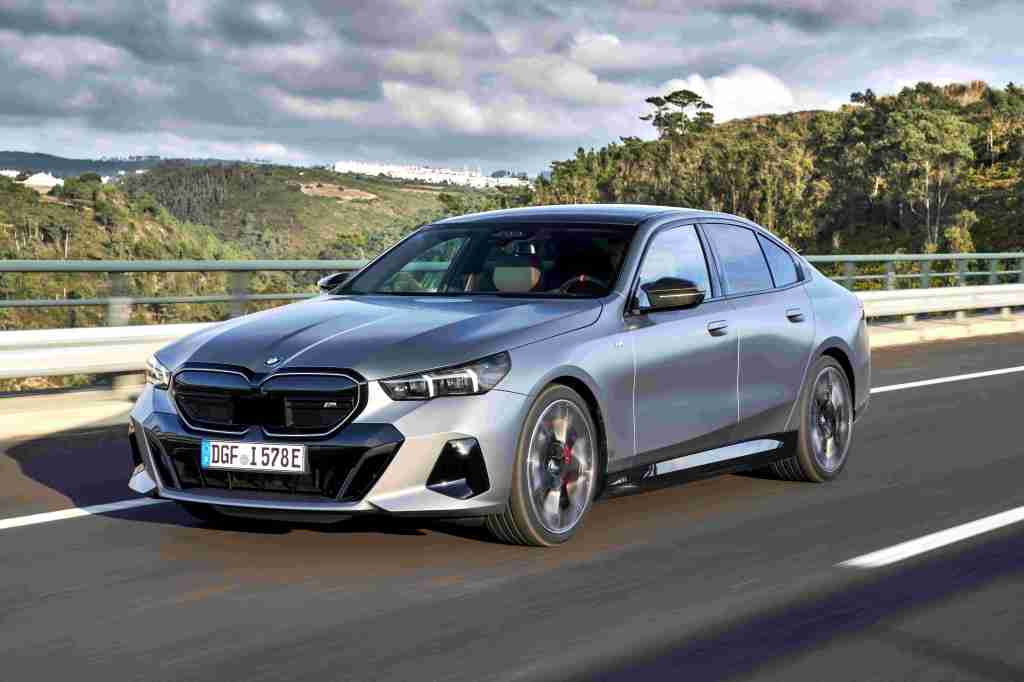
BMW i5: one of the electric vehicles in the company’s offerings–there are also the i4, i7 and iX. (Image: BMW)

Which is surprising given that in 2023 it delivered 45,417 EVs into the U.S. market.

That’s more than the GM EV sales and the Ford Lightning sales combined (38,003).

BMW 2023 EV sales account for 12.5% of its total sales.

If the number of plug-in hybrids BMW sold in 2023 (25,318) are added in to the EV number (so the number of “electrified vehicles”), it is 70,735 or 19.5% of BMW’s total sales in the U.S.

Those are some big numbers for BMW.

Seems like the lack of discussion isn’t keeping people from buying the company’s EVs.

GM’s Hydrogen Tech Going to Heavy-Duty Tools (a.k.a. “Vocational Trucks”)

By Gary S. Vasilash

Although it seems as though GM execs can’t talk enough about the Ultium platform for battery electric vehicles (there seems to be an inverse relation, however, between talking about it and delivering vehicles based on it: through Q3 it delivered 5,334 Cadillac LYRIQs, 1,216 HUMMER EVs, and 18 Silverado EVs, for a cumulative 6,568 vehicles: you could park all of them at the Mall of America and still have 6,182 parking spaces left over), there is another electric vehicle technology that the company is pursuing that deserves more attention: HYDROTEC, its fuel cell technology.

It has developed what it calls “power cubes.” A cube contains >300 individual hydrogen fuel cells that combined produce 77 kW. (The cube also contains the necessary thermal and power management systems and controls.)

GM HYDROTEC fuel cell “power cube.” (Image: General Motors)

Today GM announced that it has signed a development agreement with Autocar Industries.

Autocar Industries doesn’t build cars. It builds trucks—although its tagline is:

“Some Build Trucks. We Build Tools.”

As in tools that are trucks that are used in vocational applications such as hauling trash or hauling trailers around freight yards.

Charlie Freese, GM executive director, Global HYDROTEC:

“EV propulsion systems like GM’s Ultium Platform are great solutions for electrifying passenger vehicles,* but larger vehicles like Autocar’s class 8 trucks, refuse trucks and terminal tractors require robust solutions that enable significant energy carrying capacity and fast refueling times.”

So they’re going to be developing, along with Triz Engineering, which specializes in commercial vehicle engineering, hydrogen fuel cell-powered vehicles that Autocar will manufacture in its plant in Birmingham, Alabama. The power cubes will be produced at a GM facility in Brownstown, Michigan.

The first vehicles to be built are cement mixers, roll-off trucks and dump trucks. The power cubes can be combined, so if 77 kW isn’t enough, then there can be 154 kW or 231 or. . .

If there is any question about the viability, capability and durability of fuel cells, applications like this one should put it to rest. Freese said that they put the systems through all manner of demanding tests—G-loads, temperature extremes, crashes—and the carbon fiber hydrogen tanks have been subjected to small-arms fire. (There are also military applications; the Autocar trucks aren’t likely to be taking fire.) These things are meant to get the job done.

(The thing about hydrogen for vehicles is that whereas people talk about the lack of infrastructure for electric vehicles, the infrastructure for hydrogen refueling is essentially non-existent except for some places in California. Consequently, building vehicles for the mass market doesn’t make a whole lot of sense now. Building vehicles for specfic applications–like what Autocar does–makes a whole lot of sense because users can create dedicated refueling without having to worry about pumps dotting a highway: they know where their equipment is going to be at the end of the day, so they can put the refueling equipment there. Still, perhaps when people start realizing that even fast-charging EVs will take about 20 minutes to get the battery charged 80% and hydrogen refueling is functionally and temporally the same as that at one’s local gas station (i.e., fill it up in <5 minutes), perhaps the demand for fuel cells for passenger vehicles will grow.)

*See?

Underwhelming Domestic OEM EV Sales

If you listen to the pronouncements of traditional OEMs about their EV efforts, you’d think that there is probably some sort of parity vis-à-vis their internal combustion engine business.

As in GM (remember: “All in” on EVs) selling plenty of EVs, and the Ford F-150 Lightning being in demand the same way the ICE versions of the truck are.*

So it comes as a surprise how few EVs the traditional OEMs are selling in the U.S.

According to the just-released Kelley Blue Book “Electric Vehicle Sales Report” for Q3, when it comes to General Motors, year-to-date it has sold:

  • 49,531 Chevrolet EVs
  • 5,334 Cadillacs
  • 1,216 GMCs

That’s a total of 56,081 EVs over nine months. If we include Brightdrop commercial vehicle sales, it boosts the number to 56,414.

The GMC HUMMER EV was introduced in October 2020. During the past three years, there have been 2,071 of them sold. (Image: GMC)

GM sold 65,255 Chevy Trax models, or 15,761 more units than sales of the Bolt EV/Bolt EUV sold through Q3.

Meanwhile, over at Ford:

  • 46,671

To put that in perspective: during the first three quarters of 2023 it sold 56,427 of its giant Expedition SUVs. So the Mustang Mach-E, Lightning and E-Transit commercial van summed are nearly 10,000 fewer.

And while adding things together: GM and Ford combined sold 103,085 electric vehicles.

Meanwhile, according to KBB Tesla sold 493,513 EVs.

Think about that: two of the biggest, most legendary OEMs in the U.S. together sold about a fifth of a company that was established 20 years ago.

*To be fair, Stellantis brands (Chrysler, Dodge, Jeep) sold 0 EVs.

GM Making Money—Thanks to Trucks

By Gary S. Vasilash

General Motors reported exceedingly good earnings for Q2: non-adjusted net income attributed to stockholders of $2.57 billion. It was $1.69 billion last year.

The company thinks it will make a lot more this year than it previously expected:

  • $9.3 billion to $10.7 billion is the new target
  • $8.4 billion to $9.9 billion was the previous target

Getting Deluxe for Bucks

A big part of this: full-size truck and SUV sales, especially the high-trim trucks.

  • At GMC 70% of Sierra HD trucks were lux. Some 50% of Sierra light-duty trucks were. And 74% of Canyons were loaded.
  • At Chevy, about 75% were top trim models.

Nine Chevy SUVs—One Economical

Of course, GM points out that the Chevy Trax, an “affordable SUV” (starts at $20,400) had an increase in sales of 115%. (Last year it sold a total of 26,597 Trax models so if the sales were to double this year compared to last, it would still be fewer than Blazer 2022 sales, 67,246.)

Where’s the Money Going?

And regarding trucks, GM noted it is investing to “strengthen our industry-leading full-size truck and SUV business.”

With:

  • $1-billion invested in a plant in Flint, Michigan for next-gen heavy-duty trucks
  • $0.5-billion in Arlington, Texas for next-gen full-size SUVs
  • $0.6-billion for next-gen light-duty trucks

Maybe not the crazy money being thrown at electric vehicles, but clearly there are plans in place for next-gen trucks and SUVs that will continue to haul in the money.

EV Issues

As for EVs, the company built 50,000 in the first half and plans to build 100,000 in the second.

What’s interesting is that in Q2 it sold 15,700 EVs, which is down from the 20,700 it sold in Q1 ’23 and the 16,300 it sold in Q4 2022.

Clearly, not the right direction.

In terms of EV sales, the Chevy Bolt has been making the biggest difference. Through the first half there were 33,659 sold.

The Bolt Will Be Back

However, GM had announced that the Bolt, which doesn’t use the company’s Ultium battery technology, was going out of production. . .until today, when it announced there will be the development of a new Bolt, that will use the battery tech.

GM chair and CEO Mary Barra said, “Our customer’s love today’s Bolt. It has been delivering record sales and some of the highest customer satisfaction and loyalty scores in the industry.”

Starting at $26,500, it is also one of the most cost-competitive EVs in the market, which undoubtedly accounts for more than a slight amount of that popularity.

As long as GM can keep the price low, the Bolt should continue to do well.

If GM ups the price significantly, then its EV sales numbers will grow, but at an anemic pace.

General Motors: About Those EV Sales. . .

By Gary S. Vasilash

General Motors was rather chuffed with its U.S. sales results for Q2 2023 as well as for the first half of the year.

It delivered 691,978 vehicles in Q2, up 18.8% from the same period last year. And for the first half it has delivered 1,295,186, or 18.3% more than in the first half of 2022.

Drilling into the electric vehicle space, the company sold in Q2 13,959 Chevy Bolt EV/Bolt EUV models, up an impressive 101%. Even more impressive, with Bolt sales of 33,659 for the first half, that’s a 360.9% increase. However, due to a problem with battery fires that occurred in the summer of 2022 General Motors stopped production of the vehicles as it handled a recall, so there were fewer vehicles available last year. What’s more, when it brought the vehicles back on the market it did so making the pricing exceedingly attractive—even for people who otherwise wouldn’t have considered an EV.

Then there are two other EVs in the GM portfolio:

  • Cadillac Lyriq
  • Hummer EV

As for Cadillac, it delivered 1,348 Lyriqs in Q2 and a total of 2,316 during the first half. The vehicle wasn’t available during the first half of 2022 so there is no comparison.

As for the Hummer EV, there were 47 deliveries in Q2 and a total of 49 for the first half. Yes, two were delivered in Q1 2023. Those numbers are down 82.7 and 86.8%, respectively. There were 185 days between January 1 and June 30. 49 Lyriqs.

All in, General Motors sold 36,024 electric vehicles during the first half of 2023.

To put that number in perspective, know that it sold 78,169 Chevy Malibus during the same period, and while nary a word is pronounced about the importance of that midsize sedan to its future portfolio, for the past few years there have been more pronouncements about how EVs are going to be transformative to the company’s fortunes than mere mortals can imagine.

Of course, “Past performance is no guarantee of future results.”

But there are two factors that need to be kept in mind.

  1. GM has announced Bolt production will end in November. On the Chevrolet shopping site it is able to proclaim that the Bolt is “America’s Most Affordable EV.” Strike that from the books.
  2. When the Chevy Silverado EV was first announced the company talked about the WT (as in “work truck”) trim starting at about $39,900. However, it recently said that when the first WTs roll off the line, they will be 4WT trim, capable of 450 miles and featuring AWD, for a price of . . .$79,800

Hard to see how the company is going to have sustainably large EV sales numbers as it goes into the future.

It may have the capacity–lots of capacity–but there are another two factors that come into play:

  1. Execution
  2. Market demand for vehicles that aren’t necessarily leading in affordability.

Jeep? Ram? Huh?

By Gary S. Vasilash

The first half (H1) 2023 results for FCA US LLC—that part of Stellantis that is often referred to by the shorthand “Chrysler”—are out.

And look odd.

It is generally considered to be the case that the real U.S. crown jewels that the company based in the Netherlands obtained when Fiat and PSA merged were Jeep and Ram, the brands that don’t offer things that in any way, shape or form resemble cars.

For the U.S. sales for the first half of 2023 there is only one Jeep model that has actually had greater sales compared with H1 2022, the Compass. And arguably the Compass is, by and large, the least Jeep-like Jeep of all Jeeps in the showroom.

Wrangler sales are off by 15% and the Grand Cherokee is down 7%. Those two vehicles are essentially the bookends of the brand.

There was great hope for the Wagoneer and the considerably more expensive Grand Wagoneer, but they are off 21% and 26%, respectively.

An argument could be made that Jeep had the segment to itself for a long, long time and now things like the Bronco Sport and Bronco are taking away sales. Which could, indeed, be the case because for H1 Bronco Sport is up 7.8% and Bronco 6.8%.

Another thing might be that post-pandemic the whole “overlanding” phenomenon is waning and those who are more likely to use their Wranglers as Wranglers are still buying Wranglers and the rest have moved on to something else.

As for the Grand Cherokee, it is possible that some of its sales have gone to the Dodge Durango. Its sales for H1 are up 82%. Realize that there are plenty of dealerships that have Jeep, Ram, Chrysler, and Dodge under the same roof, so someone shopping could easily see a Durango and opt for it because, say, a Grand Cherokee with the sought configuration isn’t available.

Overall Jeep brand sales are off by 12% compared with the same period last year.

Meanwhile, over at Ram, it is only off 2%–but it would seem that it should be up.

For example, Ford truck sales are up 23.1%. GM also shows black ink for truck sales, with all flavors of Silverado being up 1.6% in H1 and the Sierra portfolio up 20.2%.

What is strange about the Ram numbers is that the Ram pickup is down 9% for H1 and the only reason why the brand isn’t down more is because the two commercial trucks on offer—the ProMaster Van and the ProMaster City—are both up, 50% for the Van and 70% for the City.

As for the other FCA US brands, that Durango has really boosted Dodge H1 results: up 31%.

Even Chrysler brand is up 23% thanks entirely to the Pacifica minivan, which is up 26%. The only other vehicle in the Chrysler showroom is the 300, which is (a) down 5% for H1. And given that for the first half there were 73,845 Pacificas sold and 7,197 300s. . .well, it makes one wonder about the on-going value of the Chrysler brand.

So maybe a few years from now that shorthand identifier for the company will be something else. But what that is isn’t entirely clear at this point.

EV Trucks & Three-Card Monte

By Gary S. Vasilash

When Chevrolet announced the Silverado EV last year, it said that the price for the initial work truck version would have an “Estimated MSRP staring around $39,900.”

That was for the work truck version. Get the contractors in and those who are simply looking to look cool will follow. Possibly in droves.

What does the Silverado EV 4WT work truck, which is presently in production, cost?

$79,800.

There is a forthcoming 3WT version with a decreased range from the 4WT. The 4WT has an EPA rating of 450 miles per charge.

The 3WT will be tagged at $74,800.

What is shocking is that people aren’t more shocked by this estimation being off by some 50%.

When the 2024 Chevy Equinox EV was introduced last fall, the claim Chevy made was “a starting price of around $30,000.”

Mary Barra, GM chair and CEO, said, “With the flexibility of GM’s Ultium Platform, we are bringing to market vehicles at nearly every price point and for every purpose.”

Really?

The Cadillac Lyriq is on the Ultium platform. It starts at $58,590.

The GMC Hummer EV uses it, too, and good luck finding a price for it on gmc.com. The 2022 Edition 1 model started at $112,595, and while the subsequent models are less expensive, odds are that’s a relative reduction.

Every price point for Thurston Howell III, perhaps.

Kelley Blue Book has it that the average transaction price for an electric vehicle in May was down $9,370 from the price paid in May 2022. Now it is $55,488, or a 14% decrease.

There’s the Silverado EV 4WT 50% increase.

And what expectation should there be that there will be a $30K Equinox, and if there is a $30,000 Equinox will there be a sufficient number such that it won’t be like sightings of the Loch Ness Monster (“I think I saw one. . .”)?

This just isn’t a GM phenomenon.

Ford launched the F-150 Lightning Pro in May 2022 with a starting MSRP of $39,975. By August it was $55,974. At ford.com right now it starts at $59,974.

Of course, at the top of the page for the Lightning it says in a bright blue box:

“Select Models Currently Eligible for $7,500 in Potential Federal Tax Credits.”

Let Uncle Sam mitigate the price increases.

The EV Outlook: How Many People Taking Buyouts Are Likely to Buy One?

By Gary S. Vasilash

Last week GM announced that in its efforts to “permanently bring down structured costs” it would request that its salaried employees in the U.S. seriously consider taking a buyout. In January GM execs said that their goal is to reduce $2-billion in spending. By taking a number of its 58,000 of salaried employees off the books, it reckons it will get closer to its goal.

Given that in 2022 its full-year revenue was $156.7 billion, net income attributable to stockholders $9.9-billion and EBIT-adjusted was a record $14.5 billion, it would seem to be in good shape.

But there is something that GM and all other OEMs are grappling with, and that’s the billions of dollars that need to be invested in developing electric vehicles as well as creating the means by which the vehicles and the batteries used to store the energy for those vehicles can be produced.

It is a huge—and expensive—undertaking.

And so when they look at their books and see that one non-trivial number is salaries, product trumps people in order to maintain profit.

(To be sure there are a number of people who probably have a skillset that is not particularly relevant to automobility going forward and it would probably be tenuous from a legal standpoint to single them out, which may make casting a larger net better from a corporate point of view.)

But the point is: EVs are (1) costly to develop and (2) not making money for corporations the way that gasoline-powered vehicles are (yet).

So, in order to keep earnings up and costs down, there will be people who will have to find something else to do with their working hours.

The state of EVs is the topic on this edition of “Autoline After Hours.” Joining me are Greg Migliore, editor of Autoblog and the newly launched Autoblog Electric; Chris Paukert, director of Video for Edmunds; and Matt DeLorenzo, long-time auto journalist and author of How To Buy an Affordable Electric Car.

The discussion delves into an array of EV-related topics, from affordability to charging to how long it will be until EVs are the norm and internal combustion engines are the exception.

And as for that last topic, it may be longer than you might think.

You can see the show here.

China Notable Number

There were 572,000 Wuling Hong Guang Mini EV vehicles sold in China in 2022, according to analyst firm Inovev.

The vehicle is produced by SAIC-GM-Wuling. A joint venture company. With that middle bit being General Motors.

South America, Inovev says, is GM’s third-largest market (after China and the U.S., respectively).

In 2022 GM sold 350,000 vehicles in South America.

572,000 of one model in one country.

350,000 of a show room on a continent.

Sort of puts the China market in perspective.