2026 Toyota Corolla Cross XSE

Considering the Corolla. . .

By Gary S. Vasilash

Although people who live in places like southeastern Michigan would probably answer the question “What is the best-selling automotive nameplate of all time?” with “Ford F-150” because there are so many of them evident on the roads and in the driveways (in fact, it almost seems as though the “most people” have one), that is not the right answer.

The right answer is “Toyota Corolla,” the compact car that can.

Even though the F-Series has been available since 1948 and the Corolla since 1966, the Corolla has about 20% more sales (~50 million v. ~40 million), even with the 18-year difference in availability.

That’s largely because whereas there is a huge concentration of F-150s (and yes, Chevy SIlverados and Ram 1500s) in places like southeastern Michigan, the Corolla is available on five continents. (There is yet to be a Toyota dealership in Antarctica.)

Even though many people maintain there is waning interest in cars—especially compact cars—because everyone wants trucks or crossovers, there is still immense interest in cars.

Consider: through Q3 2025 Toyota sold 179,983 Corollas. GM’s Buick Div., which offers only crossovers, had sales of 156,835.

But this is not to say that the folks at Toyota don’t recognize a couple of things, like the value of the Corolla badge and the interest in crossovers.

So it has on offer the Corolla Cross which, too, is doing well in the U.S. market. Through Q3 it outsold the F-150’s little brother, the Ranger: 73,341 to 48,278.

Now there’s another aspect to the Toyota approach to the market, which in its case is a global market. (Yes, the Corolla Cross is available around the world, too.)

Toyota has not only maintained its hybrid offerings, but it has expanded them throughout most of its lineup, including to things like the Corolla Cross. While there have been some people who were critical that the company wasn’t going “all-in” on electric vehicles in a way some of its competitors seemed to be, because Toyota does have more of a global view than some of its competitors, it recognizes that EV charging isn’t as everywhere convenient as gasoline, so hybrids are a sensible alternative.

2026 Corolla Cross Hybrid XSE. Note the available Cavalry Blue body color and Jet Black roof. Also the hexagonal pattern of the upper grille is specific to the hybrid trim. (Image: Toyota)

And the U.S. market is certainly interested in the hybrid powertrain offerings. Of the Corollas Crosses sold through the first quarter 24,594 are hybrids, which is more than the Chevy Blazer EV, at 20,825 or the F-150 Lightning, 23,034 (not that anyone is likely to cross-shop a pickup with a compact crossover).

The Corolla Cross is categorized as a crossover. Presumably that has a lot to do with ground clearance. That is, a Corolla sedan has 5.3 inches of ground clearance and the Corolla Cross 8 inches, which is just 0.1 inch less than that of a RAV4, which is clearly a crossover.

But the Corolla Cross and the Corolla sedan are both built on the same platform, TNGA-C, whereas the RAV4 is based on the TNGA-K, which goes to the point that the Corolla Cross really drives, well, like a car, albeit with a higher seating position for better visibility.

The Corolla Cross Hybrid (it is also offered with no electrification of the 2.0-liter engine) provides a system horsepower of 196 net, which is reasonably peppy for the vehicle. What is more to the point of it vs. the standard is its superior fuel economy: 46/39/42 city/highway/combined miles per gallon for the hybrid and 31/33/32 mpg for the standard engine.

It is also worth noting the Hybrid—available in three trim levels—are all all-wheel drive, using Toyota’s 5th Generation Hybrid System. (The whole Toyota “continuous improvement” approach is something it has been applying to its hybrid systems, which can certainly provide consumers with a sense of confidence.)

The 2026 Corolla Cross Hybrid XSE has a base MSRP of $33,330 and with the $1,450 delivery, processing and handling fee (which gets you out the door), it is up to $34,780.

Exterior-wise, the XSE trim brings things like 18-inch black-finished alloy wheels, and black rocker panels, over-fenders and badging. There is a special grille design that has intimations of electrification.

On the inside there are a 12.3-inch digital gauge cluster and a 10.5-inch infotainment setup. There’s a heated steering wheel and heated front seats (good for those in southeastern Michigan this time of year).

There is Toyota Safety Sense 3.0 (Pre-Collision System with Pedestrian Detection, Proactive Driving Assist, Full-Speed Range Dynamic Radar Cruise Control, Lane Departure Alert with Steering Assist, Automatic High Beams, Lane Tracing Assist, and Road Sign Assist)—again, going to the point of continuous improvement.

All in, it is a competent package that, because in large part of its global footprint, has the kind of build quality and amenities that are a consequence of this massive scale.
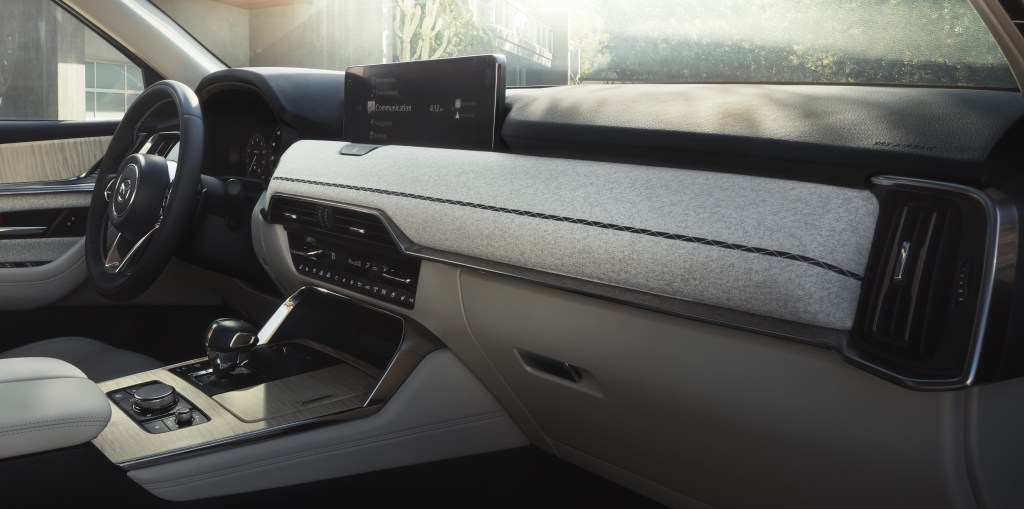
2025 Mazda CX-90 S Premium Plus

In which we wonder a bit about engine nomenclature. . .

By Gary S. Vasilash

As everyone doesn’t know, a Newton is the force required to accelerate a one-kilogram object one meter per second second. So a Newton meter is essentially the measurement of a forward push.

Another way of looking at it (which is similarly less helpful for understanding because unless you have a master’s degree. . .in Science! you are likely not to get this, either) is that a Newton-meter is the unit of torque in the International System of Units (SI).

In this part of the world, where we don’t much cotton to things of an international nature, we use foot-pounds instead when it comes to torque.

One Newton-meter is equal to 0.73756215 pound-force-feet.

Got that?

In March 2019, when internal combustion was still the thing and people weren’t concerned about kWh and the like, Cadillac, undoubtedly wanting to get its international bona fides in order, decided on a new nomenclature system for its vehicles predicated on torque figures in Newton-meters. But because some of those numbers can be somewhat awkward, a decision was made to round up to the nearest 50 so there would be a nice round number used on the exterior badging.

Guess it is hard to come up with things to name the various vehicles in your showrooms.

Generally speaking, there has been the use of engine names on vehicles with varying levels of success over the years. Ford using “EcoBoost” had its moment. GM’s “Ecotec” didn’t have much in the way of resonance.

The all-time champ, one that can still achieve knowing nods, is the Dodge HEMI.

Someone can have absolutely no idea of what a horsepower is, to say nothing of a Newton-meter, and still know that the HEMI badge means bad-ass performance.

Which is a roundabout way of getting to the Mazda CX-90 S Premium Plus, a three-row SUV built on Mazda’s electrified Large Platform.

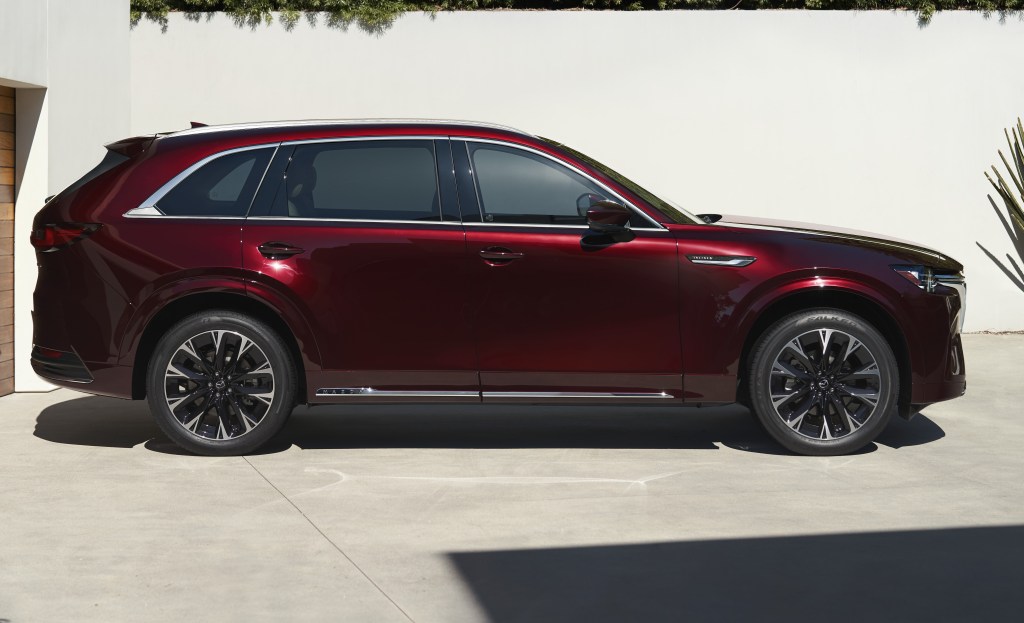
And if you think “Mazda” and something diminutive like the Miata (officially known as the MX-5), then the CX-90 may come as something of a surprise because it is nothing if not sizable: 122.8-inch wheelbase; 200.8 inches long; 78.5 inches wide; 68.2 inches high.

It provides 57 cubic feet of space for those in the front row; 51 cubic feet for those in the middle; 35 cubic feet for those in the rear (OK, a bit tight, but. . .).

And in terms of cargo capacity, there is 75 cubic feet with the second and third rows folded and 16 cubic feet if the seat backs are vertical.

But you’re wondering what all of that engine stuff at the start of this piece has to do with this vehicle. . . .

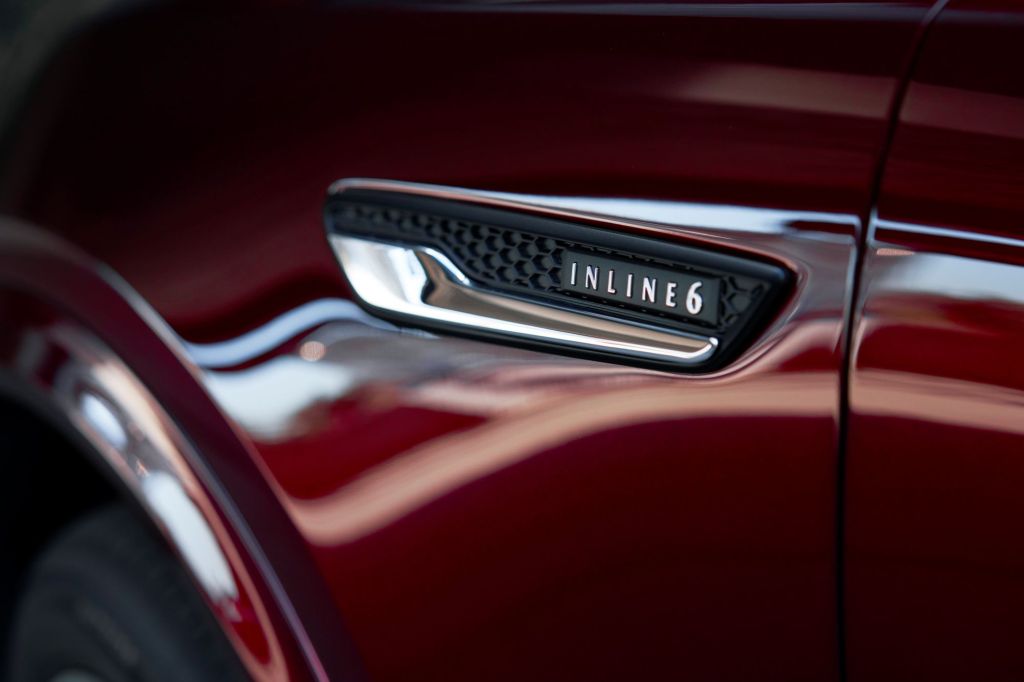
It’s this: For some reason known probably only to the marketing team, on the front quarter panel of the CX-90 there is a black and chrome badge that reads: “INLINE 6.”

That’s what’s under the hood. Does it matter? (Images: Mazda)

That’s right: the vehicle has a 3.3-liter, turbocharged, inline six-cylinder engine. Perhaps this is to differentiate the Mazda from something like a Chevy Traverse, which has an INLINE 4. (Though it doesn’t indicate that.)

From a performance point of view, the Mazda powertrain produces 340 hp and 369 lb-ft of torque (or, for those of you who are now SI mavens, 500 Nm, which is a fairly impressive number on its own, so maybe that would be a good moniker: CX-90 500).

The use of the word “powertrain” rather than “engine” is deliberate, for you may still recall the word “electrified” above.

The vehicle is fitted with what is called the “M-Hybrid Boost.” This is a 48-volt mild hybrid system, which means that it serves as a, well, boost, especially at starting from low speeds. It also helps with the overall efficiency, which is what I noticed in driving, as the low-speed boost was “meh,” but getting a combined 27 mpg for a vehicle weighing some 4,900 pounds with three rows and all-wheel drive is certainly satisfying.

Somehow I think it would have been cooler, if no more meaningful, to have “M-Hybrid Boost” on an exterior badge rather than INLINE 6. At least it would seem more future-oriented if no more clear to consumers.

Because the CX-90 is the top-of-the-line, the interior is well appointed with Nappa leather, streamline-design metal trim pieces, and a large piece of fabric on the IP with intricate stitching which appears as though it has more to do with high-fashion than Newton-meters.

That large surface is covered with an intricately stitched fabric.

All, in, however, this model is an interesting alternative to the vehicles in this category that have been available for a longer period of time, especially as Mazda seems to be making a serious effort to get its foot in the proverbial door in the three-row SUV space so it is over indexing.

To the benefit of the buyer.

EU Powertrain Picture

Seems that gasoline is still reasonably popular. . .

By Gary S. Vasilash

The good news for companies in the European Union that make things like con rods and pistons is that according to the most recent vehicle registration figures from the European Automobile Manufacturers’ Association (ACEA) people are still buying vehicles that use internal combustion engines.

Its figures for January 2025 show that 29.4% of EU new vehicle registrations in January were for “petrol” powertrains.

The number in January 2024 was 35.4% petrol power, so clearly things are moving in the wrong direction for those in the business of making engines and the components thereof.

However, looking at the numbers for hybrids, things appear in a different way.

In January 2024 hybrids represented 28.7% of the new registrations in the EU.

But in January 2025 hybrids are at 34.9%.

So while there was a 6% decline in petrol registrations between the two months, there was a 6.2% increase in hybrid registrations.

And hybrids, of course, use internal combustion engines, too.

So if we sum the figures, 64.3% of the new vehicle registrations in the EU in January have internal combustion engines.

If the plug-in hybrids are added (7.4%), that gets to 71.7% of the market.

Electric vehicles?

They’re 15% of the January 2025 new vehicle registrations, which is a move toward the upside compared to January 2024, when EVs were at 10.9%.

However, EU regulations regarding CO2 emissions are such that 20% of the vehicles sold by automakers must be zero emissions.

If the ~37% increase from January 2024 to January 2025 for EVs holds, there is not going to be a problem reaching that figure.

Still, presumably when the 20% rule was written it was a stretch goal but not one thought to be wholly unattainable.

At the end of the day, the Market will decide on what powers its vehicles.

2024 Toyota Prius Prime SE

The Prius just keeps going. . . .

By Gary S. Vasilash

I suspect there is really nothing that “sells itself.” Sure, there are things that someone might need and go out and buy because of current conditions—like the people who make a run on snowblowers at Home Depot both before and after storms: no one needs to sell that equipment to the buyers.

But when it comes to things like automobiles, the number of people who have a sudden need and are capable of dropping a few grand to accommodate that need is probably quite small.

As is often pointed out, a vehicle is generally the second biggest purchase that someone makes, so consideration is involved in the process.

Still, if there is any type of vehicle that “sells itself” today, it is a hybrid.

Even though there is massive attention paid to electric vehicles, in 2024 hybrids (including the plug-in versions) had 11.9% of the total US light-duty market while EVs accounted for 8.1%.

And when is the last time you heard anything about a new hybrid? And compare that with the paid-for advertising or earned media (coverage in various outlets, including this one, often predicated on the loan of a vehicle by an OEM for assessment) for electric vehicles.

If not “selling themselves,” then people are becoming more interested in going hybrid.

The first Prius was available in the US market in July 2000. Which means it is coming up on its 25th anniversary.

Through the years the Prius has been both lauded and chastised. And it seems more the latter than the former.

There has always been the claim that because there are two powertrains (the internal combustion engine and the electric motor(s)) in a hybrid, it is too expensive for regular consumers—and the knock is often made by companies that were rolling out with electric vehicles that were significantly expensive, far more than the price of a Prius.

Consistently, Prius sales have been by mass manufacturing metrics “meh.”

Last year 44,711 were sold, and 38,052 the year before.

But it should be noted that in 2024 Toyota brand sold 546,738 hybrid vehicles in the US as the company now offers vehicles ranging from the Corolla to the Sienna to the Tundra with a hybrid powertrain.

Toyota seriously has the hybrid power and the consumers have a lot of choice.

The Prius, while having styling that has ranged from the dowdy to the bizarre, currently has an appealing look.

Looks good and you can drive and drive and drive before you need a fill-up. (Image: Toyota)

When the current body style was launched in 2023 in the US it was so striking that it was named the 2024 North American Car of the Year by the jury of the North American Car, Truck and Utility of the Year Awards, besting both the Honda Accord and the Hyundai Ioniq 6.

The last time the Prius won was in 2004, besting the Mazda RX-8 and Cadillac XLR, neither of which exist in contemporary production.

People have consistently wanted to get a Prius, and Toyota has consistently provided them.

The vehicle driven here is a plug-in hybrid. (The “Prime” moniker goes away for MY 2025 vehicles, at which point it simply is Prius Plug-in.)

If you’re not familiar with what that means, know that in the case of the Prius, on the rear quarter panel on the driver’s side you pop the door to fill the car with gas and on the opposite side there is an outlet to plug the car in either at home or at a Level 2 charging station.

This means there is full-electric range for the vehicle—up to 44 miles (based on ideal conditions).

It should be noted, however, that if you’re plugging it in on a standard 120-V outlet at home, it is going to take 11 hours to fully charge the battery. If you stop at a commercial Level 2 charger, then it will take about four hours.

When you go to the gas station, it will take you about five minutes to fill the tank.  The Monroney sticker says you’ll get 52 mpg city/highway combined, so with about 11 gallons in the tank that means over 500 miles from the liquid fuel.

But perhaps (1) you have a daily commute that is 40 miles or under and you don’t like visiting gas stations and you do have an outlet in your garage or (2) you are exceedingly environmentally conscious and don’t like combusting gasoline if you don’t have to. Which would make the plug-in version right for you.

The Prius (powertrain notwithstanding) now has a sporty look on the outside and a low seating position signifying sportiness on the inside. While this is appealing to some people, it will probably turn off others. But Toyota has more than a dozen other hybrids to choose from, so that’s covered.

There is a Prius with FWD, a Prius with AWD and the plug-in with FWD.

The first provides system (i.e., engine and motor(s)) horsepower of 194. The AWD version delivers 196 hp. And the plug-in has 220 hp.

There is a discernable difference with the +20 hp for those who are so inclined.

The SE is the base model. Cloth. Eight-inch screen. Manual seats. But a sticker under $33K.

But were you to go for the less powerful but base non-plug-in FWD Prius, you’d get 5 mpg more and spend a few grand less.

While the increased horsepower is nice, I think the 57 mpg is nicer.

However, some people want an EV but don’t have the money to buy one.

The Prius plug-in could be the answer. If the average American drives 40 miles per day and the plug-in provides approximately that range, there you go.

What’s more, when you need to drive from, say, Detroit to Chicago, you can do that, too, without having to think about making a long stop along the way for recharging because the gasoline engine will get the job done—in fact, you could drive there and more than three quarters of the way back without needing to stop for any kind of fuel.

Bugatti: From W16 to the V16

Yes, the company is going hybrid. . .

By Gary S. Vasilash

The Bugatti W16 Mistral, said to be the world’s fastest-ever roadster (453.91 km/h; 282 mph), is the last hurrah for the W16 engine, and the first of the last Mistrals has just been built at the Bugatti Atelier in Molesheim, France.

As the car produces 1,577 hp and has a starting price of about $5-million, most people on planet Earth won’t notice its absence.

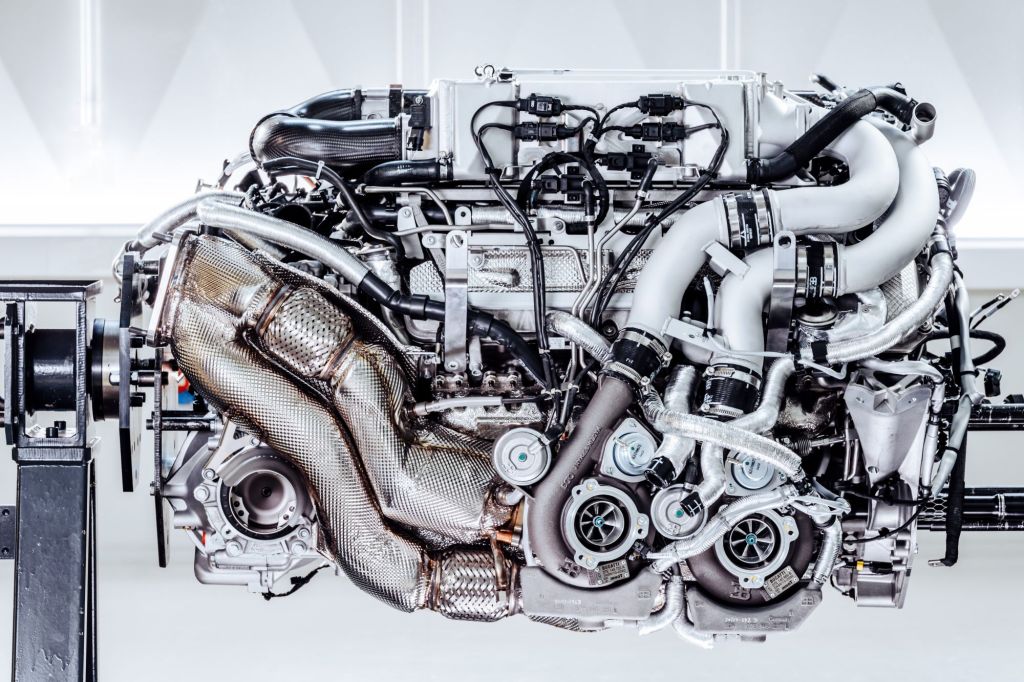
This is what the W16 engine looks like:

You might want to bookmark this because it is a Bugatti W16 engine, which will soon be a memory for most but otherwise housed in the garages of a handful of really rich people. (Image: Bugatti)

You might think that something with 16 cylinders and four turbochargers would be enormous, it is because of the W configuration—think of two Vs (as in V8s) side-by-side, but with the Vs having a very narrow angle. But in point of fact the engine is comparatively compact.

It has to be, given that the two-seater is 179 inches long, 80 inches wide, 47.6 inches high and has a 106.7-inch wheelbase.

So what follows the W16?

The Bugatti Tourbillon with a normally aspirated V16.

The output of that car is 1,800 hp.

It is a hybrid.

There are two 250-kW motors on the front axle and another 250-kW on the rear.

According to Bugatti it will accelerate from 0 to 62 mph in two seconds.

How fast is that?

Well, it is estimated that reading speed is 250 words per minute.

This sentence has been read in approximately two seconds.

2025 Hyundai Sonata Limited Hybrid

The future is now. . .

By Gary S. Vasilash

As the Grand Transformation to Electric Vehicles seems to be somewhat less transformative than we might have been led to believe by industry executives who were “all in” with varying levels of commitment (e.g., “We will be all electric by ____,” a date that is no longer uttered), there is a move back to hybrids.*

The knock on hybrids, since the Toyota Prius showed up on American roads in 2000, was that there are two powertrains (the regular engine and electric motor(s)), so that wasn’t going to be acceptable.

Except they were accepted.

And that two powertrain quibble gave rise to the “too expensive” mantra.

Now there is a move by some of the hybrid-skeptical companies to say, “Hey, we’ve got them, too! We’ve been behind them all along!”

(Insert polite coughing sound here.)

Hyundai has been offering a Sonata Hybrid since model year 2011.

Consistently.

But if there’s anything to know about Hyundai, the company is consistently producing vehicles that are stylistically and functionally advanced.

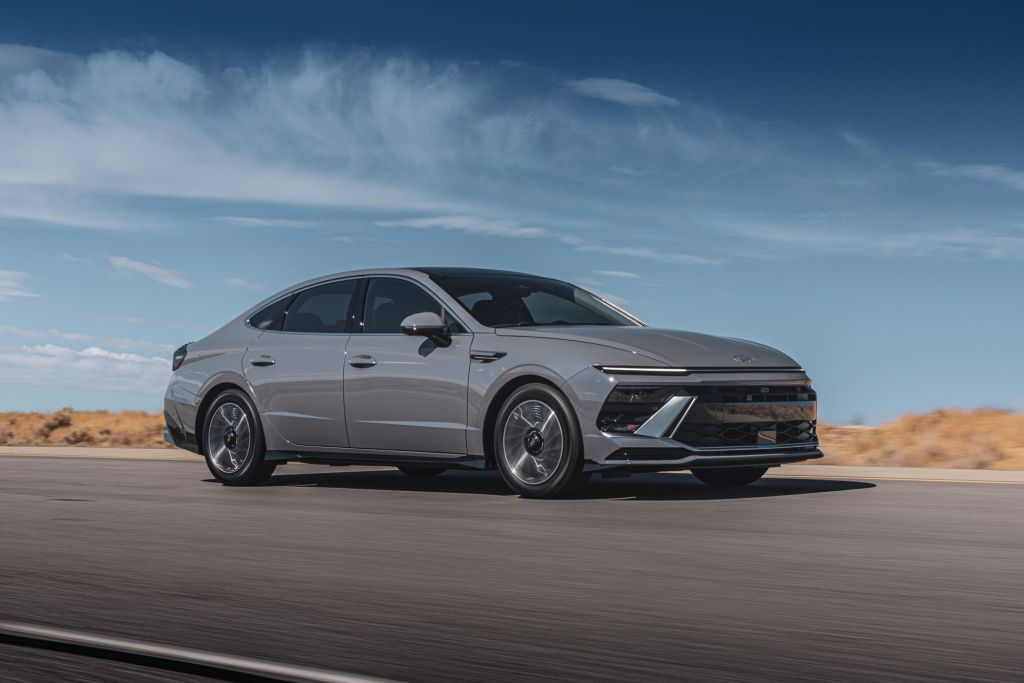
Although the 2025 Sonata Hybrid is a carryover from model year 2024, it still looks 10 years more innovative than anything out there.

Looks sensational and sips gas. (Image: Hyundai)

And it should be pointed out that the Limited trim driven here is the top-of-the-line (there is also the entry SEL trim).

So, going back to that “hybrids are too expensive,” know that this hybrid has a starting MSRP of $37,450. The one driven had a single option: $210 for floor mats.

Before looking at the Monroney for the car I guesstimated it would cost $50,000.

Not because of the “two powertrains are too expensive” schtick.

But because (1) it looks lux and (2) it is loaded.

Let’s roll through just some of the features on the vehicle:

  • Blind-spot and surround-view monitors
  • Parking collision-avoidance assist (for example: you can see on the 12.3-inch screen where the vehicle is in real space when you are backing out of a parking space, which is incredibly handy in lots that are designed to maximize the number of spaces and minimize the amount of space between them)
  • Panoramic sunroof
  • Leather seats
  • Heated and ventilated front seats
  • LED interior lights (this is something that needs to be seen because the difference between the illumination from them and the traditional incandescent lights is remarkable)
  • Bose premium audio
  • Power closing trunk (which really seems a bit too much, but when you look at how the trunk hinges, something that most people pay approximately zero attention to, are designed and integrated, you know that this is something that is conceivably beyond my $50K estimate to lux space)
  • And this list could go on to the extent that your eyes will glaze over, so as there are a few more things to say, I’ll stop

The vehicle has a 2.0-liter four-cylinder engine that is mated to a permanent magnet synchronous motor. The engine provides 150 hp. The motor 51 hp. And the way these things work, the sum of the two is not 201 hp but a combined 192 hp. The whole hybrid give-and-take is a tricky business.

Now this is a large-ish four-door sedan. It is 193.3 inches long, 73.2 inches wide, 56.9 inches high, and has an 111.8-inch wheelbase. It has a passenger volume of 104.4 cubic feet (i.e., it is roomy) and the aforementioned trunk has a 15.6-cubic foot capacity.

Its curb weight is 3,687 pounds.

All of which is to say that given the capacity of the engine and the size and weight of the vehicle, it is capable of propelling you when you drive—surface streets or freeways—as you probably normally drive. No head-snapping when you stand on the throttle, because 99.9% of the time—give or take a 0.1%–you are not feeling that you have to prove something when you are in a four-door midsize sedan, type of powertrain notwithstanding.

The reason people drive hybrids is not to sate their need for speed but because they don’t have a need to spend a whole lot of time at a gas station. The EPA numbers for the Sonata Limited Hybrid are 44 mpg city, 51 mpg highway, for a combined 47 mpg.

Hard to quibble with what it is or how it delivers the kind of fuel economy people are looking for.

==

*It should be noted that Hyundai does have EVs, including the Kona Electric, the Ioniq 5 and the Ioniq 6. But it also offers hybrids in the Elantra, Santa Fe and Tucson.

EVs: Still Waiting for that Moment

A few thoughts from the Cox Automotive Q3 assessment. . .

By Gary S. Vasilash

While new EV sales are growing—remember, this is from a small base, so the growth in total numbers is not all that impressive—used EV sales are really doing quite well, or so the numbers from Stephanie Valdez Streaty, director of Industry Insights, Cox Automotive, who has a keen focus on EVs, indicate.

That is, year over year there is an increase of 64.4% for used EVs while new ones year-over-year it is up 12.6%.

In August there was a 90-day supply of new EVs. There was a 38-day supply for used EVs.

Still Pricey

One likely reason for the increased used EV sales is that the average transaction price in August was $35,937, compared with $56,574 for new EVs.

Realize that the now-used EVs probably had an ATP north of $56,574 when purchased new, so the buyer of a used EV is undoubtedly getting quite a well-loaded vehicle for the money.

I wonder whether a second used buyer will be all that interested in a vehicle, given concerns about battery longevity.

Leases Matter

In the new EV market leasing continues strong, Valdez Streaty noted. At 39% she says it is almost double the industry average. This probably has something to do with the ability to get IRA tax credits for EVs assembled in the U.S. And luxury vehicles, of which there are still plenty with EV powertrains, tend to have more leases than mainstream vehicles, so it makes sense to lease.

Overall Numbers

Looking at the powertrains in vehicles in August, ICE vehicles are at 81.6%, EVs at 8%, hybrids at 8.5% and PHEVs at 1.9%.

If you think about it, as OEMs began to pour money into EVs they subtracted from hybrids (e.g., the Ford Explorer had been offered with a hybrid, but the ’25 model doesn’t have one).

The company that didn’t pull back on hybrids—which actually continued to expand its offerings—is Toyota. Valez Streaty says that in Q2 2024 Toyota had 47% market share for hybrids—more than twice Honda’s second-place 20%.

Ford, it is worth noting, came in third at 14%, undoubtedly thanks to the F-150 PowerBoost Hybrid model.

Hybrids are typically referred to as a “transitional technology.”

Seems that that transition is going to take a whole lot longer than those outside Toyota anticipated.