
The Loyalty Lag

Seems that people are less inclined to stick with a brand than they were a year ago. . . .

By Gary S. Vasilash

While it may seem like a long while ago, it was just a few years back, in 2021, during the lingering COVID crisis, made all the more trying by the semiconductor crisis, when people were buying vehicles from the transporters that arrived at dealer lots.

This was an issue of wanting a vehicle and probably not doing a whole lot of—if any—due diligence vis-à-vis the attributes of the brand or model.

Clearly, brand loyalty was not top of mind for most of those consumers. A new set of wheels was, and they were willing to pay a premium if that’s what it took. (And it did.)

However, since then things have more or less balanced such that consumers not only have choice, but they don’t have to rush into a purchase. (They still need a lot of money, though that’s a separate issue.)

So this is a case where they are probably more rational in their decision making.

If you have a good experience with a vehicle from a particular company you are likely inclined to stay within that company. Brand loyalty.

Having a loyal customer base makes it easier for OEMs to move product than if they have to convince many in a market of their attributes.

From the consumers’ point-of-view, says Tyson Jominy, senior vice president of data & analytics at J.D. Power, “Brand loyalty matters to vehicle buyers because it’s often associated with higher residual values, making vehicles from trusted brands a more financially sound choice over time.”

But there can be reasons why someone might switch from one brand to another, like the availability of the particular type of vehicle being looked for (e.g., if you’re looking for a car, then unless you want a Mustang you are out of luck at your Ford dealer because all of the other cars have been discontinued).

J.D. Power just released its 2025 U.S. Automotive Brand Loyalty Study. It indicates that brand loyalty is, in effect, under water.

Specifically, according to Jominy, “Brand loyalty averages 49% across all nameplates and segments in this year’s study.”

Or, 51% of consumers will buy something else.

What is somewhat surprising is the not-exceedingly-high levels of loyalty.

That is, the number-one brand in the premium vehicle category is Porsche, with 58.2% loyalty.

For premium SUVs, the leading brand is Lexus, with 57.4%.

In the mass market, it is Toyota at 62%, which at least gets out of the 50%s, which is more positive.

And for mass market SUVs it is Honda, also at 62%. (It is worth noting that in the overall mass market Honda, at 55.5%, is second to Toyota, so it evidently has above-average brand loyalty.)

When it comes to trucks, for the fourth time in as many years, Ford is first, at an impressive 66.6% loyalty rate. (And to be fair, noting Honda’s performance, second in loyalty in the truck category is Toyota, at 61.2%.)

But back to that overall 49%.

Last year’s study had the overall loyalty at 51%. A two-point decline may not seem like a big deal, but (1) it is directionally not good and (2) it shows that more consumers are going to follow something other than tradition.

Neither is good for OEMs.

//

Note: J.D. Power conducted the study based on transaction data from September 2024 through August 2025 and included all model years traded in for a new vehicle.
OEM Websites Need Work

If car companies want to convince consumers they are cool, the site is a place to start

By Gary S. Vasilash

Auto manufacturers are seemingly hell bent on making sure everyone understands that they are not just purveyors of transportation equipment but tech wizards, as well.

After all, they don’t want to be seen as digital luddites compared to, say, Tesla.

But the recent J.D. Power 2025 U.S. Manufacturer Website Evaluation Study—Winter indicates that consumers aren’t seeing them as particularly advanced so far as the OEM websites go.

“The auto industry is falling short on modernization and organization of their websites. Consumer expectations are high and having an updated, organized and aesthetically pleasing site is one of the most important things manufacturers can do to drive site satisfaction,” says Kristen Coffin, analyst of digital solutions at J.D. Power.

Guess what OEM website in the Premium category is the most satisfying?

Tesla.

On a 1,000-point scale it scored 752 among the surveyed.*

The average for the segment is 708.

The companies below the line are Cadillac (704), Jaguar (702), Porsche (700), Genesis (699), Volvo (688), and Alfa Romeo (641).

Over on the Mass Manufacturer side of things, the numbers across the board are lower, with the segment average at 692.

Ford has the highest ranking, at 719.

Mitsubishi, which needs all the help it can get in the market, ranks lowest at 661.

Arguably it is harder to convince people that the vehicles on offer by an OEM are as up to date as they can possibly be if they see better websites for home improvement tools or running shoes.
//
*11,406 people who indicated they’d be in the market during the next 12 months. The study was conducted in October-November 2024.

The So-So Sales Experience

You may be surprised at brands that aren’t making new-vehicle buyers all that chuffed. . . .

By Gary S. Vasilash

Maybe it has something to do with comparatively low numbers.

The J.D. Power 2024 U.S. Sales Satisfaction Index (SSI) Study ranks Porsche, for the second year in a row, as having the most satisfying sales experience. It has a score of 851 out of 1,000.

Industry average is 818.

In the first nine months of 2024 Porsche delivered 61,471 vehicles in North America (so this is the U.S. and Canada and Mexico).

The brand that arguably built itself on customer satisfaction, Lexus, is below average in SSI, at 812 (putting it in a tie with Mercedes, and putting those two above only Alfa Romeo at 810 and Genesis at 781).

In the first nine months of 2024 Lexus delivered 248,200 vehicles in the U.S. (just U.S.)

(And Mercedes sold 264,600 in North America.)

There are 202 Porsche dealers in the U.S.

There are 244 Lexus dealers in the U.S.

So, assuming (unrealistically, of course) that each dealership sold the same number of vehicles during the first nine months:

• Porsche dealer: 304 vehicles
• Lexus dealer: 1,017 vehicles

Needless to say, the people working at the Lexus dealership is a whole lot busier.

According to J.D. Power: “Buyer satisfaction is based on six factors (in order of importance): delivery process; dealer personnel; working out the deal; paperwork completion; dealership facility; and dealership website.”

You know: the regular routine of going in to buy a car, which is often not unlike going to an endodontist for some serious work.

Now certainly there probably isn’t a tremendous amount of cross-shopping between a Lexus store and a Porsche facility: the least expensive Lexus is a UX, which starts at $37,515 and the least expensive Porsche is a Macan, starting at $62,900.

But the SSI puts Lexus behind (in order): Infiniti, Jaguar, Acura, Land Rover, Lincoln, Volvo, Cadillac, BMW, and Audi, which are cross-shoppable.

What is also surprising is that Toyota brand, which competes in the “Mass Market” SSI category, is also third from the bottom, above only Mitsubishi and Chrysler—and with 777 points, it is well below the segment average of 798 and remarkably below the leading marque, MINI at 829.

Of course, MINI had sales of just 17,552 in the first nine months of 2024, which is a fraction of Toyota’s 1,481,319. Still, that puts Toyota well behind other mass market brands like Ford (805 points), which sold 1,473,642 vehicles through Q3.

Product, which Lexus and Toyota certainly have, is one thing.

Getting people to buy those products while feeling good about the experience is another thing entirely.

Seems like the folks in the sales department of Toyota Motor North America have some work on their hands.

The Mixed Signals on Robotaxis

Those who have been in them like them, but then there is consumer readiness, which isn’t much. . .

By Gary S. Vasilash

Although Waymo vehicles are transporting people in places like San Francisco and Phoenix with vehicles that are without a driver in command and while Tesla showed off its steering wheel- and pedals-free Cybercab, presumably for any of these to be commercially viable (i.e., allow the operators to make money), then there has to be a significant number of people taking advantage of the autonomous rides.

The J.D. Power 2024 Robotaxi Experience Study showed that those who have taken a ride in a self-driving vehicle feel good about the experience: 76% are confident in the vehicles after they’ve been in one compared with 20% who haven’t had the experience feeling confident about them.

However, another study—the J.D. Power 2024 U.S. Mobility Confidence Index Study, shows that on a 100-point scale, the score for “consumer automated vehicle readiness” is at 39. That’s two points better than in 2023, but it is where it had been in 2022.

One of the interesting findings this study goes to the point of insurance. While 71% of consumers say they don’t expect to acquire insurance on a pay-per-ride basis when using a robotaxi (did you ever think about acquiring insurance when getting in an Uber or on a bus?), 57% say they expect the vehicle owner to have liability coverage for the self-driving vehicle.

And while the Cybercab is designed without a steering wheel or pedals, 86% of the people surveyed by J.D. Power say they want the ability to take control of the vehicle if required. . .which seems to indicate the requirement for a steering wheel and pedals.

How Will February Look Sales-Wise?

By Gary S. Vasilash

J.D. Power and GlobalData project that February sales will come in a smidge—1.4%–more than they were in February 2023, or 1,214,600 vehicles

Taking out non-retail transactions, the number is 981,300, which is the important number because that reflects individual consumers.

So using that as the basis of comparison, there is an increase of 3.8% compared to the same month last year.

One of the reasons for the rise this year is something that happens once every four years: an additional day of sales, February 29.

According to Thomas King, president of the data and analytics division at J.D. Power, the increase in sales is facilitated by:

  • Higher inventory levels (when there are cars on the lot, then there is less pressure to have to select whatever is available from a paltry number)
  • Higher manufacturer incentives (turns out that there is a need to provide a boost to get the sheet metal moving)
  • Lower dealer profit margins (seems that the profits that were rolling in when choice was minimal so prices were maximal are now trending back to normal—but it is worth noting that about 17% of vehicles are still selling above MSRP, although last year it was nearly 32%)

What this means is that people are getting bullishly back in the market.

King:

“Transaction prices in February are trending towards $44,045, down $1,919 or 4.2%—from February 2023. However, despite the significant decline in average transaction prices, higher sales volumes mean consumers are on track to spend nearly $40.8 billion on new vehicles this month—the highest on record for the month of February, and 4.1% higher than February 2023.”

Could be a case of the proverbial “making it up on volume.”

Nowadays, it is impossible not to look at how things are going in terms of EV sales.

Elizabeth Krear, vice president, electric vehicle practice at J.D. Power, said, “In 2023, EV sales and leases accounted for a larger percentage of retail auto industry growth than gas-powered vehicles.”

Presumably that has something to do with the fact that there is a stable number of gas-powered vehicles so the growth would not be as big as that of EVs, which start from a comparatively smaller number.”

She acknowledged what is now frequently heard: EV sales are slowing.

Putting some numbers to it:

“In January, battery electric vehicle sales fell 1.6 percentage points from 9.2% in December 2023. Further, upper-funnel EV shopper interest declined for a fourth consecutive month. New-vehicle shoppers who are ‘very likely’ to consider purchasing an EV for their next vehicle dropped to 25.6%, a full percentage point lower than in December.

Krear said that a big blockage for EV buyers: charging access.

While she noted that the opening of the Tesla Supercharger network will go a long way toward addressing that issue, she added, “But this alone is not enough to move the needle. Improvement is needed in terms of the availability of affordable EVs for mainstream customers.”

Yes, it all comes down to an affordable MSRP.

EVs and Oil Investments

By Gary S. Vasilash

Although there seems to be a propulsive inevitability of the electric vehicle such that by the time 2030 arrives we’ll all be rolling around in electron-powered machines, there are a few things that are making this seem less. . .inevitable.

Last week ExxonMobil announced it is acquiring Pioneer Natural Resources, an oil and gas exploration and production company, for $59.5-billion.

As ExxonMobil described this: “Together, the companies will have an estimated 16 billion barrels of oil equivalent resource in the Permian. At close, ExxonMobil’s Permian production volume would more than double to 1.3 million barrels of oil equivalent per day (MOEBD), based on 2023 volumes, and is expected to increase to approximately 2 MOEBD in 2027.”

Or simply put: More access to more oil.

Today Chevron announced it is buying Hess Corp. for $53-billion. Hess “is a leading global independent energy company engaged in the exploration and production of crude oil and natural gas with leading positions offshore Guyana, the Bakken shale play in North Dakota, the deepwater Gulf of Mexico and the Gulf of Thailand.”

Chevron “produces crude oil and natural gas; manufactures transportation fuels, lubricants, petrochemicals and additives; and develops technologies that enhance our business and the industry. We aim to grow our traditional oil and gas business, lower the carbon intensity of our operations and grow new lower carbon businesses in renewable fuels, hydrogen, carbon capture, offsets and other emerging technologies.”

With Hess it will most certainly grow its traditional oil and gas business.

McKinsey & Company just released its “Global Energy Perspective,” which looks at the likelihood of the industrialized world meeting the goal of keeping global warming growth below 1.5°C. There are four scenarios about the energy transition, ranging from “Fading momentum” to “Achieved commitments.”

In all cases they predict that oil will peak in 2030.

But then there is a question of what happens next: what is the angle of decline by 2050?

It could be big: as much as a decrease of barrels of oil by 50%

It could be small: as little as a 3% decline.

Odds are ExxonMobil and Chevron are betting on something closer to 3 than 50.

Which leads to a bit of wonder about the rate of adoption of EVs in the U.S.

As of August, J.D. Power had the share of EV sales in the U.S. at 8.6%. That number is a bit opaque because Tesla accounts for 63% of all of those EV sales, so it is not like EVs that aren’t Teslas are growing in ubiquity. (Even Ford has taken a shift out of the production of the F-150 Lightning, and F-150s (well, with combustion engines) are otherwise produced at such a rate that other vehicle manufacturers can only look on with envy.)

So while the number is easily going to be greater than 3% come 2030, perhaps the idea that EVs will be 50% of the market by 2030 is a bit too optimistic.

Robo Woes

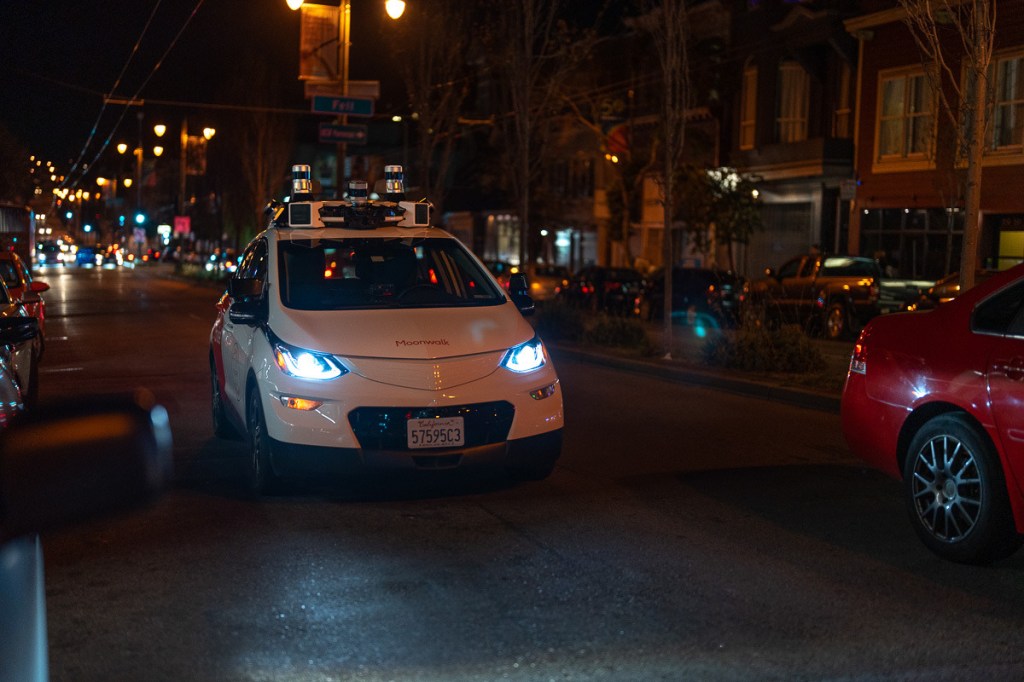
As the National Highway Traffic Safety Administration (NHTSA) begins an investigation into Cruise based on a couple of incidents regarding the self-driving vehicles and their protocols (behaviors?) around pedestrians, there is more not-so-good news for the purveyor of driverless taxis rides.

Cruise driverless vehicle at night. (Image: Cruise)

J.D. Power has released results of a survey, the J.D. Power U.S. Robotaxi Experience Study, the indicates consumers are not all that chuffed with the prospect of driverless rides and aren’t all that keen on having the vehicles rolling around in their neighborhoods.

As in:

  • Only 20% of all consumers are comfortable with automated vehicle tech being tested on the streets and highways in their locale.

What’s more, although Cruise never fails to point out that it maintains its vehicles are safer than humans, J.D. Power found that “nearly 60% of both riders and non-riders say they don’t think a robotaxi drives any better than a human.”

While those who have never taken a ride can be dismissed (e.g., would you believe someone who never ate chocolate ice cream who said it isn’t as good as vanilla?), that even riders are in that cohort isn’t good from a PR point of view.

Kathleen Rizk, senior director of user experience benchmarking and technology, J.D. Power:

“Automated vehicle technology is built on the promise of alleviating distracted driving, impaired driving and collisions attributed to human error.

“However, the benefits result from consumer acceptance, which is why it’s imperative to ensure these first deployments are flawless—not only for the riders but also especially for those who are not early adopters, including non-riders who are experiencing AVs in their community and those learning from a distance through social media and other news outlets.”

When people are learning about things like NTHSA investigations, that can’t be good for Cruise (and to be fair, Waymo).

No Canada: Consumers & EVs

By Gary S. Vasilash

Although there seems to be something of a bandwagon effect in the U.S. when it comes to EVs—one led by the government rolling out cash for EV consumers and cash for companies that are producing batteries (there is a part of the IRA that provides up to $45 per kilowatt hour for battery cell and module production and covers 10% of the critical mineral costs: wonder why there are all those battery plant announcements?)—consumers in Canada, well, let’s quote J.D. Ney, director of the automotive practice at J.D. Power Canada:

“Despite current legislation that is pushing hard for EV adoption, consumers in Canada are still not sold on the idea of automotive electrification. Growing concerns about affordability and infrastructure (both from charging and electrical grid perspectives), have caused a significant decline in the number of consumers who see themselves in the market for an EV anytime soon.”

That is, the 2023 J.D. Power Canada Electric Vehicle Consideration (EVC) Study finds that 66% of those surveyed are “very unlikely” or “somewhat unlikely” to consider an EV as their next vehicle purchase.

Consider. Not buy. Think about. Ponder.

That is a 13% increase in those who are in the unlikely camp from last year’s EVC Study.

Reasons for the lack of interest?

  • 63% say limited range
  • 59% are unhappy with the price of the vehicles
  • 55% cite lack of charging infrastructure

The Canadian government does have a program that provides up to $5,000 for the purchase or lease of EVs or PHEVs, so perhaps this indifference is predicated on practicality.

Let’s face it: unless you get an expensive EV, you are going to have comparatively limited range, and if you have limited range you’re going to want to have charging capability readily at hand. . .

Auto Industry’s Quality Breakdown (You Won’t Necessarily Be Left at the Side of the Road, But. . .)

By Gary S. Vasilash

In the J.D. Power U.S. Initial Quality Study (IQS), researchers use “problems per 100 vehicles” (PP100) as a metric.

A lower number is better.

In an ideal world, 0 PP100.

But in the real world, in the 2023 IQS, it was discovered that the PP100 was up on average by 12 over 2022’s IQS.

And that’s on top of the 18 PP100 increase the year before.

So in two years, there has been a 30-point rise, which means a 30-point quality drop.

Clearly: quality is declining.

While there are things like difficult-to-use infotainment systems, there are also problems with. . .door handles.

Safety systems are certainly a good thing to have in a vehicle. But lane departure warning/lane keeping assistance and forward collision warning/automatic emergency braking both saw considerable increases—meaning, more troublesome.

The industry average is now 192 PP100.

Think of that: every 2023 model vehicle has approximately two problems that rise to the level of notability by those surveyed by J.D. Power.

The brand with the best quality: Dodge. 140 PP100.

The brands at the bottom: Chrysler and Volvo. Both score 250 PP100.

(Although Tesla doesn’t make the “official” list due to restrictions on surveying its owners, J.D. Power calculates that it would be below the bottom: 257 PP100. Which just goes to show there isn’t necessarily a correlation between popularity and quality.)

Would You Consider an EV?

By Gary S. Vasilash

The J.D. Power 2023 U.S. Electric Vehicle Consideration study is sort of a good-news/bad-news report for the global OEMs that are spending billions on the building of plants for vehicles and batteries.

That is, the number of people surveyed who said they’re “very likely” to consider the purchase of an EV increased over the finding in last year’s version.

But the increase is only 2%.

From 24% to 26%.

Pulling back the focus, the number of people who are “overall likely” has also increased.

Here 3%.

From 59% to 62%.

Not exactly a ground swell of consideration.

And while those numbers are on the rise, let’s face it: consideration and likelihood aren’t downpayments.

According to Stewart Stropp, executive director of EV intelligence at J.D. Power, what a consumer owns now has a big influence on what they’ll consider next.

The breakdown of the “very likely” respondents are:

  • EV: 74%
  • PHEV: 63%
  • HEV: 36%
  • ICE: 22%

One way of looking at it is that those who have experience with vehicles they plug in (EV and PHEV) are comfortable with them and EV owners are likely to consider another and PHEV owners are inclined, as well.

However, the owners of hybrids and straight gasoline engines are seemingly reticent to make a switch.

Presumably, it is particularly important to convert those owners of ICE vehicles: 78% is a big number, especially as most people have cars they fill up at gas stations.

And speaking of filling up: Charging is a big hurdle. Some 49% of shoppers say that lack of charging station availability—as in both sites and equipment at those sites that actually charge—is what makes them reject the idea of an EV.