
Try to Buy a “Car”

By Gary S. Vasilash

Let’s say that you are interested in buying a car.

A car as a sedan. Not a crossover. A bread-and-butter car. (Yes, maybe you want to add some spicy tomato jam to it—spoiler, alloy wheels, etc.)

You go to the local Ford dealer.

And discover that the only car is a Mustang, which doesn’t qualify (i.e., two doors).

There happens to be a Lincoln store across the parking lot.

There are no cars, only crossovers of stair-step sizes.

You visit a Chrysler dealership and learn that Stellantis has stopped production of its long-in-the-market 300 at the end of last year, but they’ve got a Pacifica minivan, if you’re interested.

Buick perhaps? Again, no. Only crossovers.

Over at Cadillac things are better: of its seven models, two are sedans, the CT4 and the CT5. Given that the Q1 2024 sales for those are down 36.1% and 34.2%, respectively, how long they’ll be around may be in some question.

Chevy? An impressive array of crossovers and trucks. And one car, the Malibu.

The point is, buying a car is not as easy as it once was.*

Which leads to a thought about electric vehicles.

What if you went into one of these dealerships and discovered that they didn’t have anything on the showroom floor that didn’t have a plug?

What if that was pretty much the case up and down the street of the auto mall?

Clearly there would be an increase in the number of EVs sold out of those dealerships.

Maybe the numbers would be that good.

But they would be better.

Just as they’ve increased the number of models that aren’t cars and so have made buying a car tough, it could be that to help recoup some of the billions being spent on EVs they make buying an ICE tough.

Something’s got to move more of that lithium-powered metal.

(Of the 593,997 vehicles GM sold to customers in Q1, 16,169 were EVs. Not much of a business case there. And it sold twice as many Malibus ((32,749).))

*Interestingly, the Asian and European brands, in general, all have cars in their lineups.
Lincoln Freshens the Aviator

By Gary S. Vasilash

The biggest surprise about the Lincoln Aviator—and as a three-row vehicle that offers 140.6 cubic feet of passenger room or a maximum 78.6 cubic feet of cargo capacity (with the second and third rows folded) it is itself fairly big—is that there aren’t more of them sold.

That is, in all of 2023 there were just 15,551 Aviators sold in the U.S., putting it in last place in the four SUV Lincoln lineup.

Actually, that goes to an even bigger point, which is that Lincoln, for some reason, has become one of the best-kept secrets in the luxury market.

Lincoln, which positioned itself using the design philosophy “Quiet Flight” over the past several years and which uses the term “sanctuary” to describe the interior experience of its cabins, perhaps did too good a job of being stealthy.

Perhaps they should have made more noise.

The exterior designs of the Lincoln vehicles are sophisticated and unostentatious; the interior executions—particularly in the higher trim Black Label variants—are absolutely first rate. Anyone who sits in a vehicle from its crosstown rival and then gets into a Lincoln will be surprised at how well done the Lincoln interior is.

It is nothing short of striking.

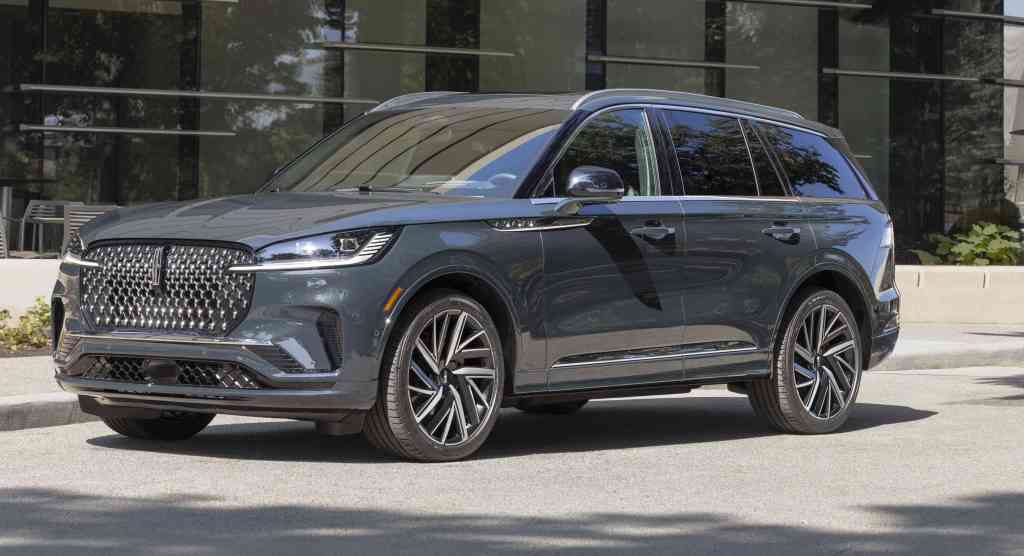
Lincoln has done a refresh for the 2025 Aviator.

Fresher for MY 25: the Lincoln Aviator. (Image: Lincoln)

While there are some exterior modifications—

“The new Aviator looks more planted with a more dynamic presence than ever before. The changes we made to our signature grille shows our laser-focus on details and design that pulls you in. And with our new lighting features which we call ‘jewelry,’ the Lincoln star comes to life and immediately catches your attention.” – Kemal Curic, design director, Lincoln

–the real story for this model is upping the ante on the interior tech—

“With the new Aviator, technology takes an even larger role in helping create a relaxing, luxurious space that our clients have come to appreciate and expect from Lincoln. With advanced, connected features like the Lincoln Digital Experience and BlueCruise hands-free driving technology, we are creating a new, digital sanctuary on the road.” – Heidi Shaffer, director, Lincoln

The Lincoln Digital Experience is accessed through a 13.2-inch touchscreen or via voice, using Google Assistance or Alexa. For those who are part of the Apple ecosystem, there is CarPlay, as well. (An available Revel Ultima 3D audio system, with 28 speakers, makes the SiriusXM or Spotify or other music sound all the better.)

There is a leaning towards Google, however, as there is the ability to download apps from the Google Play store.

The BlueCruise feature, standard, allows hands-free driving on some 130,000 miles of roads in North America. There is Lane Change Assist—which allows the Aviator to switch lanes when safe to do so by simply using the turn signal indicator—and In-Lane Repositioning—which determines where the SUV is in relation to vehicles on either side of it and makes steering adjustments to provide the most room.

The midsize lux SUV category has a number of competitors, many of which (e.g., Genesis, Lexus, BMW) have solid options.

But sit in a Lincoln with a 30-position driver’s seat and then think about what your daily drive will be like.

Even if it is a two-year lease, you’re going to be spending a considerable amount of time in an interior, so it is best to get the one that you’ll be most comfortable with–and it could very likely be in a Lincoln.

Lincoln Approaches 100

Yet it is working to maintain freshness and relevance in the market by paying attention to the market

By Gary S. Vasilash

One of the aspects of vehicle ownership that probably doesn’t receive as much attention as it ought to is the act of ownership itself.

As in purchasing the vehicle. Then the on-going owning of the vehicle.

To be sure, the product itself has to be worth acquiring. Features, functions, capabilities and the like. Style and technology.

Lincoln, which is now predicated on a lineup of SUVs, is going to be launching an electric vehicle next year and will be offering a fully electrified lineup by 2030.

Lincoln is readying the launch of the Lincoln Intelligence System, a cloud-based system that provides extensive capabilities for its vehicles, including over-the-air updates.

Lincoln will soon be launching its Lincoln ActiveGlide hands-free driving system.

And there is more.

But one of the more interesting aspects of what Lincoln has been steadily doing is providing excellent customer—it calls its purchasers “clients”—service. According to a recent J.D. Power survey, Lincoln is number-one in sales satisfaction among luxury brands.

2022 Lincoln Navigator (Image: Lincoln)

It has developed what it calls the “Lincoln Way,” which is a customer-centric approach to the buying and ownership experience, which it is initially launching in China—an important market for the brand—and then will roll out in North America.

Michael Sprague is Lincoln’s North America Director, which means he is in charge of marketing, sales and service for the marque in the U.S., Canada and Mexico.

And on this edition of “Autoline After Hours” Sprague talks to “Autoline’s” John McElroy and me about what Lincoln is doing to help increase the momentum that it is building with not only vehicles like the Navigator, but with its approach to the customer both during and after the sale.

Sprague is one of the most thoughtful and articulate people in the industry, so his observations about the brand—which will be 100 next year (at least will have been part of Ford for 100 years, since it was founded by Henry M. Leland in 1917, and he sold it to Ford in 1922. . .and it is worth noting that Leland had earlier founded another company: Cadillac)—are worthwhile for those with interest in the industry.

In addition to which, McElroy and I talk with Patrick Lindemann, president, Transmission Systems, E-Mobility, Schaeffler, and John Waraniak, CEO, Have Blue, about the Indy Autonomous Challenge, which will be run at the Indianapolis Motor Speedway on October 23.

This race will pit 10 vehicles, all Dallara AV-21s, that have been engineered by student teams from around the world, in a race with $1-million going to the winning team.

No, it will not go to the winning driver, because as the name of the race indicates, there are no drivers, this is an autonomous event.

And you can see all of this right here.