Tough Times for Porsche

China cooling on the cars. The U.S. imposing tariffs. Hard to see a silver lining.

By Gary S. Vasilash

Back in the good old days of 2024, the tariffs on vehicles exported to the U.S. from the E.U.—things like Porsches, for example—were 2.5%.

Today the tariff is 27.5%.

Friday (August 1) that is supposed to drop to 15%.

Still: 2.5% to 15%.

To put that in real numbers:

A 2.5% tariff on an $80,000 vehicle is $2,000.

A 15% tariff on an $80,000 vehicle is $12,000.

Even rich people would notice the difference.

Porsche reported that in the first half U.S. tariffs cost the company $400 million euros (~$459 million).

According to Oliver Blume, chairman of the Executive Board of Porsche AG, there are three factors affecting the company’s business:

“In China, demand in the premium and luxury segment has fallen sharply. In the U.S., import tariffs are also putting huge pressure on our business. Looking ahead, the movement of the dollar could also have an impact. In addition, the transformation to electric mobility is progressing more slowly than expected overall, with consequences for the supplier network.”

And not only the supplier network.

Porsche is undertaking what it calls a “strategic realignment.”

Part of that realignment means it is going to start negotiating with employees, with the objective, says Dr. Jochen Breckner, member of the Executive Board for Finance and IT, “to make Porsche fit for the future.”

Given the present, the future looks like it is going to be less robust than it would have been.

In the first half of 2024 it delivered 155,945 vehicles globally.

In the first half of 2025 it delivered 146,391 vehicles globally.

Roughly a 6% decline.

While Blume’s observation sounds somewhat bland, there is really a lot of sharp edges to it for Porsche (along with other premium German brands).

The China market is increasingly turning more of Chinese brands including BYD and Geely.

The U.S. 15% tariffs are certainly going to cut in the number of Porsches purchased in the U.S. (how many people are going to, say, delay the purchase, hoping that in a few years the number will be reduced?), and the decreased global value of the dollar means it will take more of them to buy something like a 911.

And the “electric mobility is progressing more slowly than expected overall” is something of an understatement.

While you might think that this is an issue only for people with Porsche money, when GM says it took a $1.1-billion hit in Q2 because of the tariffs, this goes throughout the types of consumers.

The So-So Sales Experience

You may be surprised at brands that aren’t making new-vehicle buyers all that chuffed. . . .

By Gary S. Vasilash

Maybe it has something to do with comparatively low numbers.

The J.D. Power 2024 U.S. Sales Satisfaction Index (SSI) Study ranks Porsche, for the second year in a row, as having the most satisfying sales experience. It has a score of 851 out of 1,000.

Industry average is 818.

In the first nine months of 2024 Porsche delivered 61,471 vehicles in North America (so this is the U.S. and Canada and Mexico).

The brand that arguably built itself on customer satisfaction, Lexus, is below average in SSI, at 812 (putting it in a tie with Mercedes, and putting those two above only Alfa Romeo at 810 and Genesis at 781).

In the first nine months of 2024 Lexus delivered 248,200 vehicles in the U.S. (just U.S.)

(And Mercedes sold 264,600 in North America.)

There are 202 Porsche dealers in the U.S.

There are 244 Lexus dealers in the U.S.

So, assuming (unrealistically, of course) that each dealership sold the same number of vehicles during the first nine months:

• Porsche dealer: 304 vehicles
• Lexus dealer: 1,017 vehicles

Needless to say, the people working at the Lexus dealership is a whole lot busier.

According to J.D. Power: “Buyer satisfaction is based on six factors (in order of importance): delivery process; dealer personnel; working out the deal; paperwork completion; dealership facility; and dealership website.”

You know: the regular routine of going in to buy a car, which is often not unlike going to an endodontist for some serious work.

Now certainly there probably isn’t a tremendous amount of cross-shopping between a Lexus store and a Porsche facility: the least expensive Lexus is a UX, which starts at $37,515 and the least expensive Porsche is a Macan, starting at $62,900.

But the SSI puts Lexus behind (in order): Infiniti, Jaguar, Acura, Land Rover, Lincoln, Volvo, Cadillac, BMW, and Audi, which are cross-shoppable.

What is also surprising is that Toyota brand, which competes in the “Mass Market” SSI category, is also third from the bottom, above only Mitsubishi and Chrysler—and with 777 points, it is well below the segment average of 798 and remarkably below the leading marque, MINI at 829.

Of course, MINI had sales of just 17,552 in the first nine months of 2024, which is a fraction of Toyota’s 1,481,319. Still, that puts Toyota well behind other mass market brands like Ford (805 points), which sold 1,473,642 vehicles through Q3.

Product, which Lexus and Toyota certainly have, is one thing.

Getting people to buy those products while feeling good about the experience is another thing entirely.

Seems like the folks in the sales department of Toyota Motor North America have some work on their hands.

About Automotive Loyalty

Put out good products, and people will come back and buy. . .

By Gary S. Vasilash

J.D. Power has a simple way to calculate customer loyalty to a brand.

Not easy.

But simple.

That is, it gets information from some 16,000 dealers about sales.

Then it creates a subset of those sales: Those that included a customer replacing an existing vehicle with a new one.

Then it creates a subset of that: Those transactions in which the old and new are the same brand.

And so it has released its “J.D. Power 2024 U.S. Automotive Brand Loyalty Study” based on sales between September 2023 through August 2024.

The study includes some things that might be expected and some surprises.

As for the expected: Porsche is the highest-ranked Premium Car and Ford has the high-ranked Truck.

But then things get interesting.

As in the top brand for loyalty in the Premium SUV category: Lexus.

And the Mass Market SUV isn’t something from Ford or GM but Honda.

When it comes to Mass Market Car, the top two are Toyota and Honda.

Of course, when it comes to Mass Market Cars you can’t get one from Ford or GM, as they have abandoned the segment.

Here’s the thing: in the first half of 2024

  • Toyota sold 277,233 Camrys and Corollas
  • Honda sold 210,509 Accords and Civics

I suspect that both companies are making some money on those vehicles.

What’s more, as Lexus is a Toyota brand and as Honda is, well, Honda, they are doing well loyalty-wise when it comes to their SUV offerings, too.

Quite a Quarter for the 911

And where is that Corvette SUV. . .?

By Gary S. Vasilash

Porsche Cars North America reported its sales for the first half of 2024, including, of course, the second quarter.

And in Q2 the sales of the 911 being nothing short of impressive.

Porsche 911 Turbo S (Image: Porsche)

That is, for the year it has delivered 6,720 911s, of which 4,790, or about 71%, were delivered in Q2.

Which means that in Q1 dealers had a bit of time on their hands as there were 1,930 911s delivered.

OK. They had other vehicles to sell, but still that number of 911s is notable.

The best-selling Porsche in the U.S. during the first half of 2024?

The Macan, at 12,004 vehicles (though that is down from the 14,306 sold in H1 2023).

Second best-selling?

The Cayenne, at 10,168 vehicles (which is up from the 8,911 in H1 2023).

Together, those two SUV models, with a combined 22,172 vehicles, are some 64% of Porsche’s total 34,733 delivered in H1 2024.

Which sort of begs the question of when there is going to be a Corvette SUV. After all, the car can be an alternative to a 911, but it is highly unlikely that anyone is going to cross-shop a Chevy Equinox or Traverse with a Porsche SUV.

Isn’t this a case of the proverbial “money left on the table”?

Porsche: China and North America Are Important. But So Are Europe and Germany

This seems unlikely.

In reporting its global sales for the first three quarters of 2022 Porsche noted that its ales in China—its largest single market—were down. Only down by one percent, but down.

Still, overall the company is up two percent compared to the same period in 2021.

Sales in North America were also down. By four percent.

So that means the #1 and #2 markets for the sports car manufacturer were down.

The case in China, Porsche said, was largely caused by the COVID-related lockdowns imposed there various times this year.

As for the North America, the company cited logistical challenges.

Turns out that Europe, including the home market in Germany, made the difference.

In Europe minus Germany sales were up 11%, to 42,204.

Germany had a rise of nine percent, to 20,850 vehicles.

China sales were 68,766 units and in North America the number was 56,357.

In total, the company sold 221,512 units.

The electric Taycan deliveries were down by 12%, to 25,452, which Porsche attributes to “supply chain-related bottlenecks and declining parts availability.”

Doesn’t seem all that long ago that the Taycan was really going to take it to Tesla. Even though the Model S, refreshing notwithstanding, is long in the proverbial tooth, doesn’t seem that much of a bite has been taken out of it.

The Amazing Singer Vehicle Design

By Gary S. Vasilash

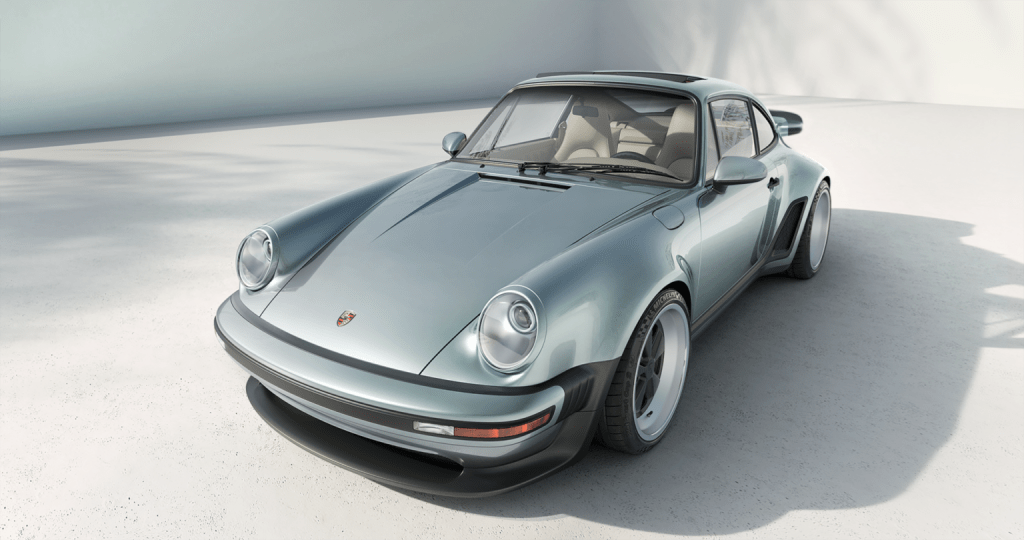
Although the Porsche 911 circa 1989 to 1994 is a beautiful car, the people at Singer Vehicle Design can make it even more stunning.

The team—who are located both in LA and the UK (in Oxfordshire, where you’ll find lots of people who know things about performance vehicles)—do a comprehensive transformation of the vehicle, going down to the bare metal of the chassis and then reconstructing it with everything from new carbon fiber body panels to different seats.

(Image: Singer Vehicle Design)

There is, in effect, a menu that those who are looking to have their Porsches transformed: Classic Study, Turbo Study and Dynamics and Lightweighting Study. The first two, according to Mazen Fawaz, CEO of Singer Group, list for some $800,000 and the last-named $2-million.

Somewhat stunning, right?

But Fawaz notes “Demand is skyrocketing.”

On this edition of “Autoline After Hours” Fawaz, who became CEO in January 2020, explains the method that the company takes in transforming the cars, which takes multiple months (someone who is booking a restoration had better not be in a hurry as there is a long line of orders there already), as well as why there is a focus on the 964 Porsche 911 rather than other models.

(One thing to consider is that there is a finite production run of the vehicles—on the order of 40,000 units—so there is a built-in boundary of what can be recreated by Singer. What’s more, while the demand for Singer’s services is high and the order books in robust shape, presumably there is only a certain number of people who can afford the price of exclusivity.)

Joining “Autoline’s” John McElroy and me is Mike Austin of Hemmings.

Here’s something interesting to know about Singer Vehicle Design: the company was established in 2009 by Rob Dickinson, a car designer turned rock musician, turned back into car designer. Dickinson was the lead guitarist and vocalist for the British band of the ‘90s, Catherine Wheel. Catherine Wheel’s style of music includes audio distortion.

But the thing about the vehicles to roll out of the Singer operations: there is an aesthetic purity to them, the absolute opposite of distortion.

And you can learn all about it here.

Sunk Anticipation

By Gary S. Vasilash

One of the things that hasn’t been mentioned about the burning then sinking of the Felicity Ace cargo ship, the vehicle carrier that caught fire on February 17, then sank this week in the Atlantic, is that there are now some 4,000 customers who are not going to be getting their Bentleys, Audis, Porsches, Lamborghinis, and Volkswagens anytime soon.

While there isn’t a specific brand or model delineation, Porsche has acknowledged that about 25% of the vehicles that are now sunk (possibly the charred husks of said vehicles), let’s face it: When it comes to Bentleys and Lambos, there is an inverse relation between their volume and their MSRP, so even if there are but a few, that is undoubtedly a big chunk of the estimated $438-million worth of cargo on board.

Audis, of course, are not inexpensive, but compared to the other three, not nearly as much. And Volkswagens, of course, are the everyman accessible brand among the group.

But those brands (all, incidentally, under the umbrella of the Volkswagen Group) are, like any right now, be it Ford or Toyota or Kia, still facing the chip shortage. Which means the ability to make vehicles is still restricted.

Which means there are some order-holders who will find their wait has just gotten that much longer.

Porsche Exhibits Product Development

Yes, wrecking cars is part of the process

By Gary S. Vasilash

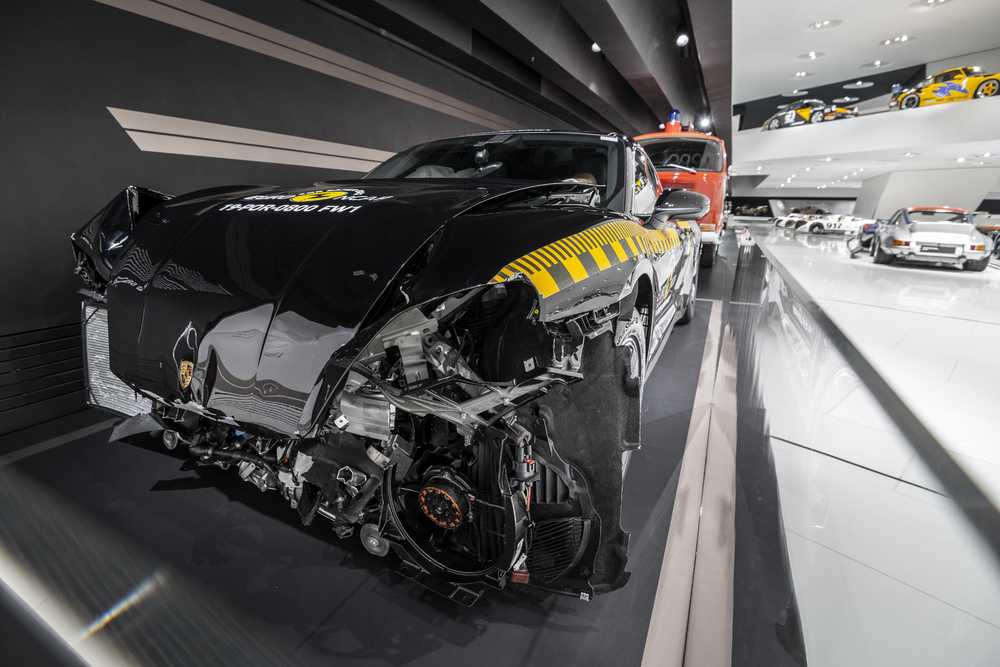
This is a picture of a Porsche Taycan after it hit—under controlled circumstances, not randomly—a barrier while it was going 50 km/h, a.k.a. 31 mph.

(Image: Porsche)

You think that slow-speed accidents aren’t a big deal?

Look at the picture and think again.

Now as you look at the picture you may notice that the setting is not some engineering facility.

Rather, it is the Porsche Museum in Zuffenhausen, where a special exhibition, “50 Years of Porsche Development at Weissach” opened today. It runs through December 5.

The objective of the exhibition is to show various aspects of how vehicles are developed, from concept through design, engineering, and so on.

Said Achim Stejskal, head of Porsche Heritage and Museum, “Sports cars for the road and thoroughbred race cars have been developed in Weissach for half a century. Dreams are designed, created and tested in the middle of idyllic countryside.”

And as that crunched Taycan shows, it is necessary to do unidyllic things during vehicle development to assure that when the vehicles are on the road or on the track the occupants have measures of protection.

Another Surprise from Porsche

An exercise in cognitive dissonance?

By Gary S. Vasilash

If nothing else, the people at Porsche are imaginative when it comes to promoting its brand.

The latest effort is even more surprising than the hiring of the Science Guy:

A 212-page book titled. . .Hip-Hop Culture—A Road Trip through Europe.

The book is based on a pre-COVID trip that Niko Hüls, publisher of a hip-hop magazine, Backspin, took with people from Porsche.


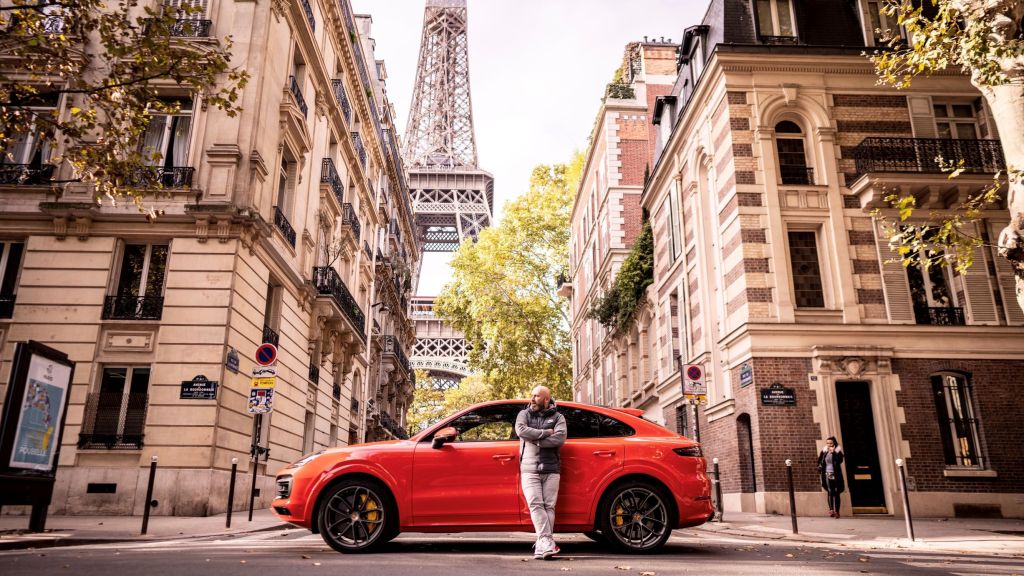
Hüls and a Cayenne. (Image: Porsche)

The travels gave rise to profiles of hip-hop artists including Kool Savas (Berlin), Lord Esperanza (Paris), Edson Sabajo (Amsterdam), Falsalarma (Barcelona), Lars Pedersen (Copenhagen) and the Flying Steps (Berlin).

In what may be the understatement of the year, Sebastian Rudolph, Vice President Public Relations, Press, Sustainability and Politics at Porsche AG, said, “Hip-hop and Porsche – at first glance, this may seem a surprising combination.”

He added, however, “But this pairing stands for diversity and cultural values.”

The book is available from Back to Tape.

All proceeds from the book are being donated to Viva Con Agua.

Bill Nye, Porsche Guy

Guess this means the big time for the quirky science enthusiast

By Gary S. Vasilash

Bill Nye is not a real doctor, nor does he have a master’s degree—in science. (A BS in mechanical engineering from Cornell.)

But he has made science interesting to the young and old alike.

There he is, always wearing a bowtie (and a suit or lab coat) rolling out in an understandable manner the science behind everyday life.

Well, he is wearing the bowtie. (Image: Porsche)

And he does so in a way that he seems to be the lovable everyman teacher from one’s middle school.

One of the things that a lovable everyman teacher from one’s middle school probably could only dream of is a Porsche Taycan.

But Nye has been hired by Porsche to create a YouTube channel for a series of shows that explain what makes the $79,900 electric Porsche special.

For some people what makes it special are:

  1. It is a Porsche
  2. It has a starting price of $79,900 and goes to $185,000.

It is worth noting that Porsche had also hired Keanu Reeves and Alex Winter to star in a video, “Going the Distance,” during which they take a road trip in SoCal in Taycans.

While that is somewhat understandable (e.g., getting on the accelerator really does earn a “Whoa!”), it is somewhat sad that Bill Nye has gone Hollywood.

Of course, were he Bill Nye Math Guy he would be able to explain the likely sudden increase in his bank balance.