One of the ways that Rivian hasn’t become one of those EV companies that has either gone out of business, is teetering on the edge of going out of business, or is in some weird statis that has people wondering how the heck it seems to exist, is through support of Amazon.
Back in 2019 Amazon invested $1.3 billion in the EV company and ordered 100,000 delivery vans.
And now companies of all sizes can get their own Rivian Commercial Van.
Rivian cargo vehicle: You, too, can get one for your delivery needs. (Image: Rivian)
The vehicle comes in two sizes.
The 500 measures 248.5 inches long, 114.7 inches tall, and 96.4 inches wide (with mirrors).
The 700 is 278 inches long, 114.7 inches high, and 103.5 inches wide (with mirrors).
The 500 has a cargo volume of 487 cubic feet and a payload capacity of 2,663 pounds.
The 700 has a volume of 652 cubic feet and capacity of 2,258 pounds.
The 500 has an estimated range of 161 miles.
The 700’s is 160 miles.
The starting price for the 500: $79,900.
The starting price for the 700: $83,900.
Tom Solomon, senior director, Business Development, Rivian, said:
“Amazon currently has more than 20,000 in its fleet and delivered over a billion packages from its Electric Delivery Vans in 2024 alone.”
He added: “We’re excited to now be able to open sales to fleets of all sizes in the US, whether they want one van or thousands.”
Clearly they’d be happy were a fleet to go for the latter.
Of course, business being business, one would be helpful, too.
Last year Rivian produced 57,232 vehicles in its assembly plant in Normal, Illinois.
Which made it somewhat curious when it announced last year that it was planning to break ground for a new factory this year for a plant in Georgia that would have the capacity to build 400,000 units.
The Rivian plant in Illinois began its production existence in 1988 when it was the Diamond-Star Motors factory.
Diamond-Star? It was a joint venture between Chrysler and Mitsubishi.
Chrysler had had a bit of a financial fix in 1991, so it sold its half of what was the Diamond-Star plant to Mitsubishi.
Being the sole owner, it changed the name of the plant to “Mitsubishi Motor Manufacturing of America” (MMMA). Things didn’t work out so well, so Mitsubishi stopped making cars there in 2015, when 38,186 vehicles were built.
Here’s the thing: As originally configured the plant had a production capacity of 240,000 vehicles.
The highest number of vehicles produced at MMMA was 222,414. Nearly full production.
Rivian bought the then-2.6-million square-foot plant in January 2017. And set about on an expansion.
But according to Rivian, the annual capacity at the factory is 150,000 vehicles. Presumably making R1Ts, R1Ss and EDVs is somewhat more complicated than iMEVs (which are arguably much smaller than any of those Rivians).
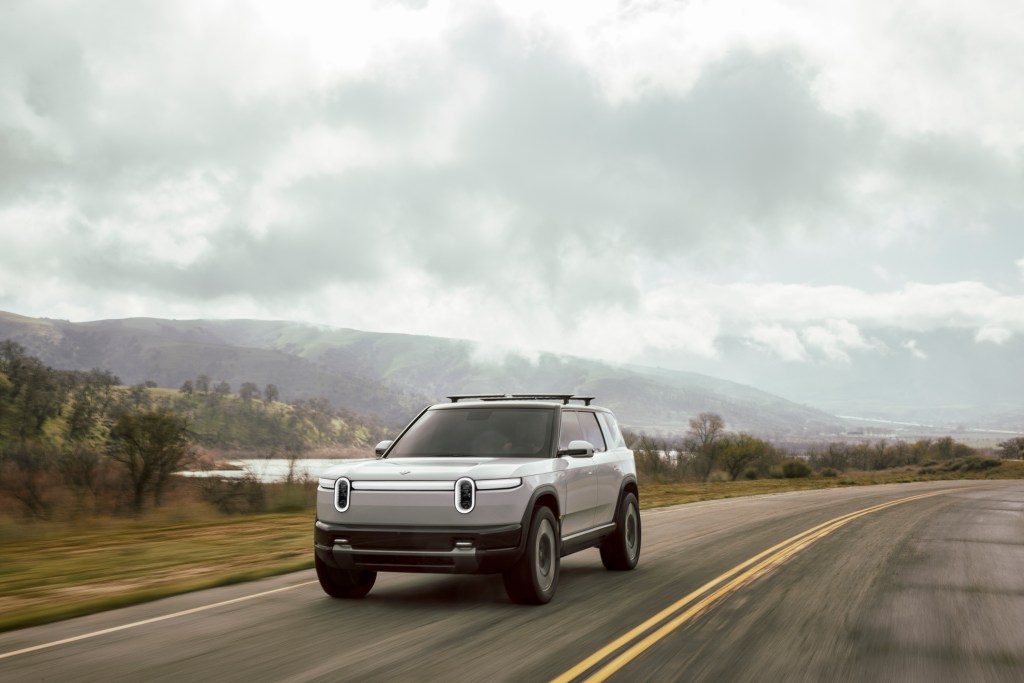
Rivian R2 is supposed to go into production in Illinois in 2026. (Image: Rivian)
When it announced the R2 and R3 models yesterday it was announced that rather than waiting for the factory to be built in Georgia for the production of the new models, it is putting the R2 into the Normal plant which will have, by R2 launch time in 2026, an expansion of capacity to 215,000 vehicles.
Here’s the thing. Whether the capacity is 150,000 units or 215,000, that’s an awfully big delta between either and ~60,000 vehicles.
It is a rule of thumb in automotive manufacturing facilities capacity utilization has to be at from 70% to 80% to be cost effective.
Seventy percent of 215,000 is 150,500.
Rivian has a long way to go to get there and not a whole lot of time.
While John Heywood’s A Dialogue Conteinyng the Nomber in Effect of all the Prouerbes in the Englishe Tongue (c. 1538) isn’t the sort of thing that is likely read outside the walls of Oxford or Cambridge, there is one phrase from that source that is if not commonly used, certainly familiar:
“Rome wasn’t built in a day.”
This came to mind in relation to a comment made by Rivian CEO RJ Scaringe during the announcement of the EV company’s 2023 earnings—or lack thereof (it had net losses of $5.4 billion—which it at least better than 2022’s $6.8 billion).
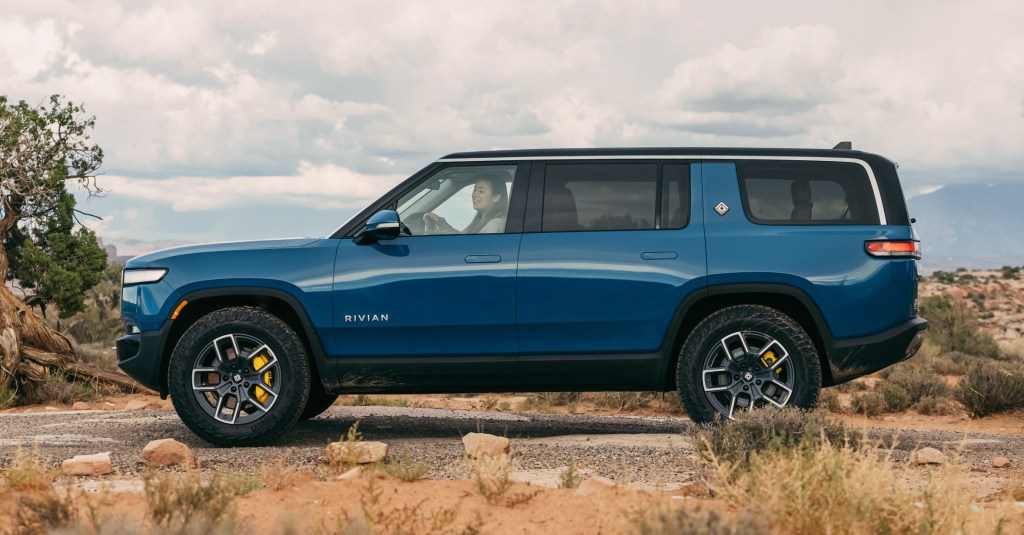
Rivian R1S (Image: Rivian)
Scaringe:
“We firmly believe in the full electrification of the automotive industry, but recognize in the short-term, the challenging macro-economic conditions.”
This in relation to the announcement that approximately 10% of its salaried workers are going to be let go.
Wall Street thinks short term. Technology change can take longer. Much longer.
“The number of active automobile manufacturers dropped from 253 in 1908 to only 44 in 1929, with about 80 percent of the industry’s output accounted for by Ford, General Motors, and Chrysler.”
That means that 41 manufacturers had 20% of the market.
Unfortunately for them, on October 29, 1929 there was Black Tuesday, a.k.a., the Stock Market Crash.
And the number of vehicle manufacturers crashed, accordingly.
We are now in a period that is somewhat analogous to 1908 on its way to 1929, with there being a number of start ups—including Rivian—in the EV market space.
A difference is that Ford, General Motors and Chrysler (yes, yes, Stellantis) don’t have a huge scale advantage in EVs, as they have single-digit shares of the EV market (yes, 0 is a single digit; Stellantis will soon bump that up).
Let’s face it: EVs are still costly to produce, not only because they are a comparatively new thing, but because the things that go into them are more expensive to make (while this is admittedly a trivial example: it is a hell of a lot cheaper to blow mold a gas tank than it is to manufacture an EV battery case).
And because of that, it is going to take time for manufacturers to make money on making vehicles (according to Electrek, Rivian lost $43,372 for every vehicle it delivered in Q4 2023—which is certainly better than the $124,162 per vehicle it lost in Q4 2022).
For some the time will run out because the money will have.
In reporting its 2023 Q4 production numbers, Rivian stated it produced 17,541 vehicles at its factory in Normal, Illinois, and delivered 13,972 during the same period.
Manufacturing Rivians in Normal. (Image: Rivian)
In Q3 it built 16,304 vehicles and delivered 15,564.
In Q2 the numbers are 13,992 made and 12,640 delivered.
And first and numerically least, in Q1 it produced 9,395 vehicles and delivered 7,946.
So for the full year it built 57,232 vehicles and delivered 50,122.
In Q3 Rivian management’s guidance was that it would build 54,000 vehicles during 2023, so there is a 3,232 bonus, apparently.
But doesn’t the ~12% of vehicles that were built in 2023 and not delivered seem like a lot sitting in lots?
One of the things that Tesla is able to do is to have no traditional marketing communications, whether in the form of advertising or public relations activities.
When the CEO is nothing but voluble and he has 76.3-million Twitter followers, the company really doesn’t need a whole lot in the way of traditional comms. In addition to which, many people with Teslas aren’t simply owners but are absolute advocates. The amount of messaging they do dwarfs any conceivable paid media.
Earlier this week Rivian, the nascent EV company, announced that it was boosting the prices for its pickup and SUV. Anyone who has gone to a grocery store or a gas station knows that there are nontrivial price hikes.
But what Rivian did was not only announce the price rise, but said that it was applying it to those who had preordered the vehicles and had a configured price.
Suddenly that expected cost was increased by some 20%.
The backlash was swift and expected. At least expected by everyone who wasn’t in the Rivian executive suite.
Credit, however, must go to CEO RJ Scaringe, who publicly announced the error of their ways in an open letter.
Unlike other many other CEOs he announced that mistakes were made. He wrote:
“I am truly sorry and committed to rebuilding your trust.”
Those who had orders in place prior to the March 1 announcement will have their price honored.
Scaringe acknowledged, “trust is hard to build and easy to break.”
Although these are still comparatively early days in the EV world, the fact that there are a growing number of providers in that space mean that there are more options that consumers can select from.
No company wants to get a customer just once. And no startup company wants to lose a customer that it had.
It will be interesting to see whether Scaringe’s apology is going to not only recover all of Rivian’s pre-order customers but gain new ones.
Word is that Rivian, the company that will be producing an electric pickup—the R1T—and an SUV—the R1S—at its factory in Normal, Illinois (quite a name for a burg, if there ever was one), where it is also producing commercial vehicles for Amazon, which is one of its investors (as are Ford, Cox Automotive and others), is looking for a plot of land upon which to build a second factory with a 200,000-vehicle per year capacity.
Seems like the company has big aspirations.
And on the subject of big, it also seems that Texas has the inside track on the factory.
But here’s the thing: the 2.6-million square foot factory in Normal has capacity of over 200,000 vehicles.
You’d think, perhaps, that they would want to make sure that (1) they have all of the bugs worked out of the processes and (2) that they would have sufficient demand for their vehicles before looking to spend a rumored $5-billion on a second factory.
The Cadillac LYRIQ, which is to become available in the first half of 2022, certainly looks promising as an electric, luxury SUV, one that may help the brand, which, let’s face it, has been struggling in the market for the past few years—here’s something that is not well known: although Acura is generally considered to be having a tough time of it in the U.S. market, in 2020 it outsold Cadillac, 136,983 vehicles to 129,495 vehicles; Acura also outsold Cadillac in 2019.
The Cadillac CELESTIQ, an electric sedan that takes luxury to levels that Cadillac hasn’t had on offer for, arguably, ever, combining hand-crafted materials with technology, such as a four-quadrant glass roof that allows individual selection of the level of transparency, is another arrow in the quiver of a transforming brand. Although it is still a concept vehicle, it is unlikely that General Motors would draw as much attention to it as it has (it was part of Mary Barra’s CES 2021 keynote) were it—or something damn close to it—not going into production.
That said, even though General Motors is investing $27-billion in vehicle electrification and automation, the most important launch, revealed during Barra’s presentation, is of a vehicle that none of us will individually own:
The EV600, an all-electric, purpose-built light commercial vehicle.
The LYRIQ and the CELESTIQ may be sexy, but logistics is where it is at and will drive the proliferation of electric vehicles in a way that it will take the consumer market a long time to catch up to.
The GM EV600, a purpose-built electric delivery van. The company has even started a logistics support business, BrightDrop. (Image: GM)
The owners of fleets of commercial vehicles—like FedEx, which GM worked with on the development of the EV600 (and the EP1, an electric rectangle on wheels that has a capacity of 200 pounds and a top speed of 3 mph)—do the math when it comes to vehicle acquisition. If it is going to be to their financial advantage to get EVs, then they’re not going to worry about things like available infrastructure, because they’ll build their own. They’re not going to have range anxiety, because they know precisely where their trucks are going and when.
(And it probably doesn’t hurt that it provides a green sheen to their brands by going EV.)
Consider:
–Amazon, which owns a piece of it, is having Rivian build electric delivery vans that are to be on the road next year at a number of about 10,000, perhaps going to 100,000 by 2030.
–Ford has announced the 2022 E-Transit delivery van that is going to be available later this year, and emphasized the benefits of the electric propulsion system vs. its own internal combustion offerings (with the scheduled maintenance of the E-Transit being an estimated 40% less over eight years/100,000 miles).
–And there are start-ups like Arrival, which companies including Hyundai and UPS have invested in.
Sure, we pay attention to LYRIQs and CELESTIQs.
But consider this: in an industry that seems to be shedding operations, General Motors has established a new business, BrightDrop, that is dedicated to delivery, not only vehicles like the EV600 and EP1, but even logistical software services.
This is a non-trivial commitment—and likely to be a prosperous one, as Mary Barra and her colleagues know that commercial companies do the math and need a whole lot less persuading to go electric.–gsv




 shinymetalboxes