
EVs: Still Waiting for that Moment

A few thoughts from the Cox Automotive Q3 assessment. . .

By Gary S. Vasilash

While new EV sales are growing—remember, this is from a small base, so the growth in total numbers is not all that impressive—used EV sales are really doing quite well, or so the numbers from Stephanie Valdez Streaty, director of Industry Insights, Cox Automotive, who has a keen focus on EVs, indicate.

That is, year over year there is an increase of 64.4% for used EVs while new ones year-over-year it is up 12.6%.

In August there was a 90-day supply of new EVs. There was a 38-day supply for used EVs.

Still Pricey

One likely reason for the increased used EV sales is that the average transaction price in August was $35,937, compared with $56,574 for new EVs.

Realize that the now-used EVs probably had an ATP north of $56,574 when purchased new, so the buyer of a used EV is undoubtedly getting quite a well-loaded vehicle for the money.

I wonder whether a second used buyer will be all that interested in a vehicle, given concerns about battery longevity.

Leases Matter

In the new EV market leasing continues strong, Valdez Streaty noted. At 39% she says it is almost double the industry average. This probably has something to do with the ability to get IRA tax credits for EVs assembled in the U.S. And luxury vehicles, of which there are still plenty with EV powertrains, tend to have more leases than mainstream vehicles, so it makes sense to lease.

Overall Numbers

Looking at the powertrains in vehicles in August, ICE vehicles are at 81.6%, EVs at 8%, hybrids at 8.5% and PHEVs at 1.9%.

If you think about it, as OEMs began to pour money into EVs they subtracted from hybrids (e.g., the Ford Explorer had been offered with a hybrid, but the ’25 model doesn’t have one).

The company that didn’t pull back on hybrids—which actually continued to expand its offerings—is Toyota. Valez Streaty says that in Q2 2024 Toyota had 47% market share for hybrids—more than twice Honda’s second-place 20%.

Ford, it is worth noting, came in third at 14%, undoubtedly thanks to the F-150 PowerBoost Hybrid model.

Hybrids are typically referred to as a “transitional technology.”

Seems that that transition is going to take a whole lot longer than those outside Toyota anticipated.
Green and Its Opposite

By Gary S. Vasilash

Not surprisingly, opposite to green on the color wheel is red. . . .

The American Council for an Energy-Efficient Economy (ACEEE) has released its annual GreenerCars assessment for 2024.

This is the study that shows the “greenist” car has a T on its hood, but it is not a Tesla.

Rather—based on factors including emissions from manufacturing and disposal of the vehicle, emissions from the vehicle, and the emissions from the production and distribution of the fuel or electricity—the vehicle in question is the Toyota Prius Prime SE, a plug-in hybrid.

(Amusingly, while Toyota has been chastised by some environmental organizations for being insufficiently aggressive in its efforts to develop and sell electric vehicles, the ACEEE list of “Greenist” vehicles includes 12. The entire list is:

  1. Toyota Prius Prime SE
  2. Lexus RZ 300e
  3. Mini Cooper SE
  4. Nissan Leaf
  5. Toyota bZ4X
  6. Toyota RAV4 Prime
  7. Hyundai Elantra Blue
  8. Hyundai Kona Electric
  9. Toyota Camry LE
  10. Kia EV6
  11. Toyota Corolla
  12. Hyundai Ioniq 5

(The RX 300e and the bZ4X are full battery electric vehicles. Like the Prius Prime, the RAV4 Prime is a plug-in hybrid. The Camry and Corolla are conventional hybrids. So not only do Toyota products take the top two positions, it has 50% of the list.

(Which makes it hard to square how it is allegedly a heel dragger, environmentally speaking.)

What is perhaps more fascinating than the Greenist list is the “Meanest” list. The vehicles that are the worst-performing mass-market vehicles from an environmental point of view.

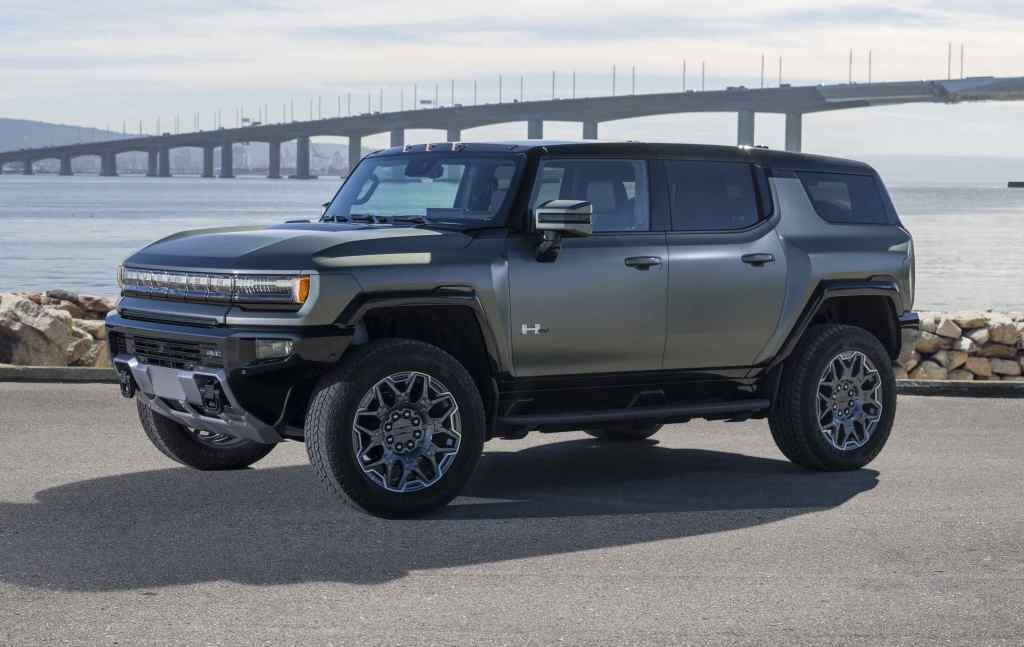
GMC HUMMER EV SUV: and you might have thought that all EVs are “green.” (Image: GMC)

They are:

  1. Mercedes AMG G63
  2. Ram 1500 TRX 4×4
  3. Ford F-150 Raptor R
  4. Cadillac Escalade V
  5. Dodge Durango SRT
  6. Jeep Wrangler 4 dr 4×4
  7. Jeep Grand Wagoneer 4×4
  8. Mercedes G550
  9. GMC HUMMER EV SUV
  10. GMC Sierra
  11. Chevrolet Corvette Z06
  12. Mercedes Maybach S680

Here we see GM brands taking four out of 12, and Stellantis brand doing the same. Mercedes three and Ford one.

Note that, yes, the HUMMER EV SUV—as in electric vehicle—makes the “Meanest” list.

Evidently something weighing some four tons and seats five isn’t exactly environmentally advantageous.