Maybe Electric Big Rigs Are a Good Idea

By Gary S. Vasilash

In 2021 (OK, not the greatest of years to use for data about anything, but still available info for this point) trucks moved approximately 12 billion tons of freight in the U.S.

Although it might be thought that there is a whole lot of long-haul trucking going on, making the run across the I-80 or down I-75—it turns out that there is comparatively little of that.

Rather, shipments of below 100 miles handled 44% of the tonnage carried by trucks.

And 44% of the tonnage was on runs from 100 to 249 miles.

That from the U.S. Department of Transportation, Bureau of Transportation Statistics and Federal Highway Administration.

So with 87% of the tonnage being carried by trucks 249 miles or less, and much of that under 100 miles, perhaps electric trucks make more sense than some might think.

What’s more, even ranges that would be laughably low for passenger vehicles might make economic sense for the trucking industry.

Fisker: Still Small Numbers But Really Big Plans

By Gary S. Vasilash

The folks at Fisker are nothing if not plucky.

Although it had expected—as recently as May—to produce 32,000 to 36,000 vehicles this year (actually, have those vehicles produced for it by supplier Magna at its now-legendary plant [given the array of vehicles it has built for various OEMs there, it is absolutely special] in Graz, Austria), it now predicts the build of its Ocean EV will be more on the order of 20,000 to 23,000 vehicles. A non-trivial drop.

Realize that the Ocean is a global vehicle, not just one destined for the U.S. market, so the distribution of 23,000 vehicles is sparse, to understate the case.

But last night in Huntington Beach, California, chairman and CEO Henrik Fisker announced, “Fisker isn’t standing still,” and announced two new vehicles, to supplement the Ocean and the PEAR, which is to be available in mid-2025, an EV that has—for now—an MSRP of $29,900, before incentives. (If they pull that rabbit out of the hat, it will be truly remarkable.)

There are the Ronin, a four-door sports car with a starting price of. . .$385,000, and the Alaska, a four-door pickup based on the Ocean platform. Both, of course, are EVs.

(There was also the Force E, an off-road variant of the Ocean, because, well, nowadays lots of people like to make it seem as though they crawl rocks in their spare time.)

The Alaska is expected to launch in 2025. And the Ronin—well were you to place a $2,000 deposit on one, you’d know that “More information regarding availability and estimated production timelines for Ronin will be shared in the future.”

All of which is to say that even though Fisker is making almost imperceptible moves in the market, it has huge plans moving forward.

On the one hand laudable. On the other, a big bet on an uncertain future.

The Silverado EV Range (Non) Issue

By Gary S. Vasilash

There is some consternation regarding the size of the battery required to propel the 2024 Silverado 4WT some 450 miles on a charge. Although GM hasn’t revealed the stats for the Ultium battery pack (200 kWh?), one can only assume that it is sizeable.

This is, after all, a work truck version of the Silverado.

There is the RST which offers a 400-mile range. It also offers the ability to go from 0 to 60 in <4.5 seconds.

Either way, there is the requirement for a lot of lithium and associated battery materials.

So some people are concerned that the battery is just too big.

But here’s the thing:

A 2023 Silverado with a 6.2-liter V8, 4WD and either a double cab or crew cab gets a combined average of 18 mpg. As the truck has a 24-gallon fuel tank, this means a range of 432 miles.

This is what truck buyers expect. Capability. Which includes not only the ability to carry cargo and to tow equipment on the hitch, but to be able to operate without worrying about refueling, whether in the form of liquid or electrons.

Chevrolet is addressing needs and expectations.

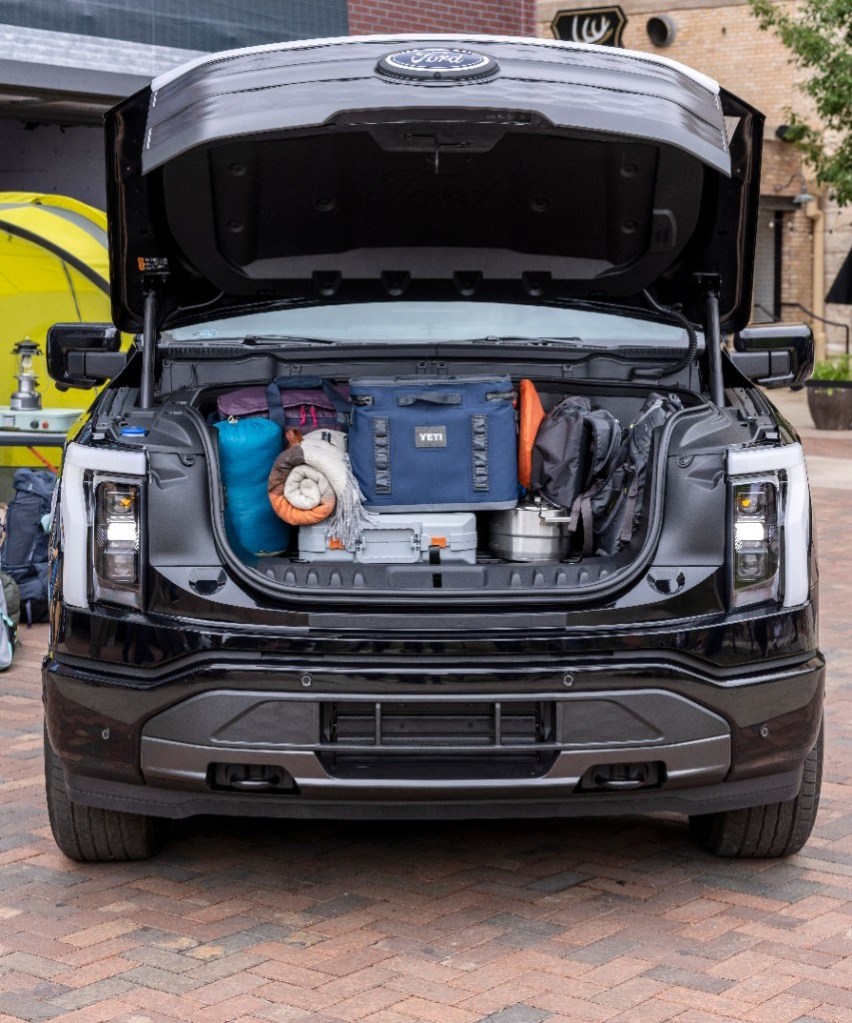
Somehow offering a vastly decreased range predicated on how many miles the average driver actually goes in a day would not be be acceptable, 10.7-cubic-foot frunk notwithstanding.

Speed of Change in the Global Industry: Blink and You May Miss It

By Gary S. Vasilash

The first thing to acknowledge is that the auto industry today is characterized by various forms of partnerships and alliances, whether they are codified like the Renault Nissan Mitsubishi Alliance or looser-but-still actionable work being done on things from entire vehicles to propulsion systems by General Motors and Honda.

Last week Volkswagen brand and XPENG and Audi and SAIC announced that there will be “strategic co-operations” for, initially, products for China that will carry the badges of the German companies, with XPENG supporting VW and SAIC Audi.

The cooperation isn’t particularly surprising. That’s just happening.

What is:

VW will build electric vehicles on an XPENG platform. Yes, there is still the VW MEB platform. But somehow it seems that’s not getting it done in China.

Audi will work with SAIC on developing electric vehicles for the China market in categories that it currently doesn’t have offerings. You’d imagine that the people in Ingolstadt would be up to the challenge, but evidently there is something that needs to be supplemented.

It wasn’t all that long ago that Chinese OEMs had partnerships with Western OEMs with the latter having the engineering and development chops and the former the production resources.

In the current case, it seems that the Chinese companies have the tech and know-how being sought by the German brands. And undoubtedly the production facilities to build the vehicles to be developed, too.

Things are moving far more rapidly than might have been expected even 10 years ago.

GM Making Money—Thanks to Trucks

By Gary S. Vasilash

General Motors reported exceedingly good earnings for Q2: non-adjusted net income attributed to stockholders of $2.57 billion. It was $1.69 billion last year.

The company thinks it will make a lot more this year than it previously expected:

  • $9.3 billion to $10.7 billion is the new target
  • $8.4 billion to $9.9 billion was the previous target

Getting Deluxe for Bucks

A big part of this: full-size truck and SUV sales, especially the high-trim trucks.

  • At GMC 70% of Sierra HD trucks were lux. Some 50% of Sierra light-duty trucks were. And 74% of Canyons were loaded.
  • At Chevy, about 75% were top trim models.

Nine Chevy SUVs—One Economical

Of course, GM points out that the Chevy Trax, an “affordable SUV” (starts at $20,400) had an increase in sales of 115%. (Last year it sold a total of 26,597 Trax models so if the sales were to double this year compared to last, it would still be fewer than Blazer 2022 sales, 67,246.)

Where’s the Money Going?

And regarding trucks, GM noted it is investing to “strengthen our industry-leading full-size truck and SUV business.”

With:

  • $1-billion invested in a plant in Flint, Michigan for next-gen heavy-duty trucks
  • $0.5-billion in Arlington, Texas for next-gen full-size SUVs
  • $0.6-billion for next-gen light-duty trucks

Maybe not the crazy money being thrown at electric vehicles, but clearly there are plans in place for next-gen trucks and SUVs that will continue to haul in the money.

EV Issues

As for EVs, the company built 50,000 in the first half and plans to build 100,000 in the second.

What’s interesting is that in Q2 it sold 15,700 EVs, which is down from the 20,700 it sold in Q1 ’23 and the 16,300 it sold in Q4 2022.

Clearly, not the right direction.

In terms of EV sales, the Chevy Bolt has been making the biggest difference. Through the first half there were 33,659 sold.

The Bolt Will Be Back

However, GM had announced that the Bolt, which doesn’t use the company’s Ultium battery technology, was going out of production. . .until today, when it announced there will be the development of a new Bolt, that will use the battery tech.

GM chair and CEO Mary Barra said, “Our customer’s love today’s Bolt. It has been delivering record sales and some of the highest customer satisfaction and loyalty scores in the industry.”

Starting at $26,500, it is also one of the most cost-competitive EVs in the market, which undoubtedly accounts for more than a slight amount of that popularity.

As long as GM can keep the price low, the Bolt should continue to do well.

If GM ups the price significantly, then its EV sales numbers will grow, but at an anemic pace.

Tesla & Scale

By Gary S. Vasilash

During yesterday’s Telsa Q2 earnings call, there was, not surprisingly, a whole lot of discussion of COGS, or cost-of-goods-sold. (There was seemingly an equal amount of time talking about the Dojo supercomputer that the company has built and is using in its pursuit of full self-driving vehicles, including its, in Elon Musk’s words, “our sort of future robotaxi products,” which essentially got no attention.)

Anyway, the issue for the investors is to make sure that costs are at the least kept under control, if not cut, so that there will be more goods sold.

(And on the subject of “more,” Musk, understandably proudly, noted at the top of his comments “Model Y because the bestselling vehicle of any kind globally in Q1, surpassing the likes of Corolla and Golf. So, it was the number one vehicle of any kind, including vehicles that are sold at a far lower price.”)

Karn Budhiraj, vp of Supply Chain at Tesla, made an interesting comment that was essentially overwhelmed by the other observations made by Musk and his colleagues:

“And there’s also the unit economics improve as volumes grow. That’s the other thing we’re seeing. As we’re becoming a bigger and better part of a lot of suppliers, the economies of scale come into play.”

Yes, the size of Tesla’s marketshare will decrease as other OEMs’ EVs begin to populate showrooms, but given its massive scale predicated on sales, those others still have a steep challenge ahead of them.

Ford F-150 Lightning & the Potential of Scale

By Gary S. Vasilash

As is widely known, there is a pricing benefit when lots of something is made.

The technical term is “economies of scale.”

Companies get to buy components in bulk and, like a giant pack of paper towel or a vat of peanut butter from Costco, the prices are consequently reduced.

That said, Ford announced today that it is cutting the prices for F-150 Lightning models. The Pro model on Saturday had an MSRP of $59,974. Now it is $49,995. A reduction of $9,979. Some 16% off.

And probably figuring those who would buy a Platinum Extended Range wouldn’t need to have as great a reduction, today the MSRP is $91,995, or $6,079 less than it was Saturday.

In announcing the price reductions, Marin Gjaja, chief customer officer, Ford Model e (the electric vehicle part of the company), said, “Shortly after launching the F-150 Lightning, rapidly rising material costs, supply constraints and other factors drove up the cost of the EV truck for Ford and our customers.”

That was a situation where economies of scale were not working.

Gjaja continued, “We’ve continued to work in the background to improve accessibility and affordability to help to lower prices for our customers and shorten the wait times for their new F-150 Lightning.”

Arguably they are getting better scale.

But there could be something else at play here.

Through the first half, Ford delivered 8,757 Lightnings.

As of this fall it will have the ability at the Rouge Electric Vehicle Center to produce 150,000 per year.

At the current rate, it would take a long time to get to 150,000.

VW EV Globally

By Gary S. Vasilash

Volkswagen Group—as in the whole thing, globally (everything from Audi to VW, with Lambo, Porsche and others in between—is taking the electrification of its portfolio quite seriously and so was rather pleased with its sales of battery electric vehicles during the first half of 2023.

It delivered 321,600 EVs—a 48% year-on-year improvement.

In Europe its EV deliveries were up 68%, to 217,100 EVs.

Which means 104,500 for the rest of the world.

In the U.S., there were 29,800 EVs delivered by the Group. That was a 76% improvement.

Meanwhile, over in China in the first half, things actually fell by about 2%, to 62,400 EVs.

These numbers provide a good sense of how EVs are playing out in various markets: the Europeans are buying a lot, as are the Chinese. While the numbers are growing in the U.S., compare the 76% improvement with the 2% decline in China: The Chinese bought 32,600 more EVs than U.S. customers, yet that’s a decline.

A Word About Mercedes-Benz USA Q2 Sales

By Gary S. Vasilash

Although there is increasing rhetoric about the U.S. economy being bad, you really couldn’t come to that conclusion based on the Q2 2023 sales of Mercedes-Benz in the U.S.

It achieved some impressive figures, such as sales in its “Top-End” segment of 26,927 units, or a 40% increase compared to Q2 2022.

A standout for the brand in that segment is the G-Class, that seriously geometric vehicle that seems as though it could bash through brick walls without a scratch while driving up hill in sand towing a full-size Airstream trailer.

G-Class sales were up 553%.

There were 3,088 of them sold in Q2.

It starts at ~$140,000.

And over on the electric vehicle side of things, the EQS, which starts at $104,400, was delivered 2,456 times, for a 25% rise compared with Q2 ’22.

It is worth knowing that the non-electric S-Class had sales of 3,164, a comparative decrease of 19.3% from Q2 ’22, which could be interpreted as those who have some serious money to spend on vehicles are going electric.

An Unusual Audi

Odds are that when you think of Audi–electric or otherwise–you don’t think of somthing that looks, well, like this:

(Image: Audi)

That is the Audi S1 e-tron quattro Hoonitron.

While it had been developed for the rally driver extraordinaire Ken Block, who died earlier this year, the car, which was built at Audi Sport HQ in Neckarsulm, it will be driven at the Goodwood hillclimb by Tom Kristensen. Kristensen is an “Audi ambassador.” He also happens to be a six-time Le Mans winner, so he knows more than a bit about performance driving.

The vehicle has electric motors on each axle that produce about 2,212 lb-ft of torque each, which will cetainly propel it up the hill.