“Manufacturing is Tesla’s core competency.”—Tesla Q4 and 2021 Update
It is interesting to note that in its Fremont plant it has the capacity to produce 100,000 Model S/Model X and 500,000 Model 3/Model Y. In Shanghai, >450,000 Model 3/Model Y.
And it has Berlin and Texas on tap.
Yes, there is a lot of manufacturing capability at Tesla that sometimes gets overlooked by, well, everything else.
If you were to draw an inverted triangle between Liverpool, Manchester and Crewe, with Crewe being the point at the bottom, that gives you a sense of the location in northern England where some 4,000 people work building Bentleys.
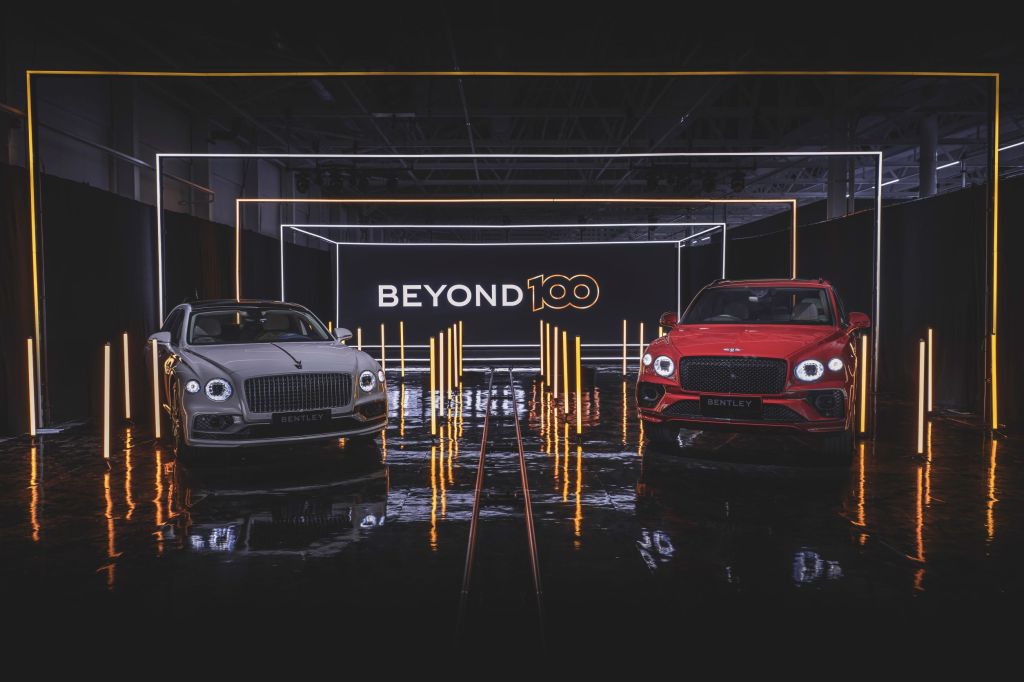
Bentley is 102 now. It clearly plans to be in the game for many more years to come. (Image: Bentley)
Today it was announced that Bentley is making a £2.5-billion investment in sustainability, which includes building at Crewe what is being called a “Dream Factory” for the production of electric vehicles.
Bentley’s first EV will be built at Crewe in 2025, and by 2030, when the brand is fully electric, there will be four more vehicles.
As Adrian Hallmark, chairman and CEO of Bentley, put it:
“Our aim is to become the benchmark not just for luxury cars or sustainable credentials but the entire scope of our operations. Securing production of our first BEV in Crewe is a milestone moment for Bentley, and the UK, as we plan for a long-term sustainable future in Crewe.”
Automotive manufacturing in the UK needs all the help it can get, and clearly the Volkswagen Group, of which Bentley is a part, is giving it some.
Owl Autonomous Imaging has developed and patented “monocular 3D thermal imaging and ranging solutions.”
The company’s tech is applicable to automotive advanced driver assistance systems (ADAS).
According to Owl, current ADAS systems generally use “mutually dependent visible-light cameras and radar” that can be negatively affected under certain conditions. Like night and/or rain.
So the Owl system is meant to overcome those limitations by using HD thermal imaging and the appropriate computer vision algorithms that are capable of creating “ultra-dense point clouds and highly refined object classification.”
In other words, objects like people and other animals generate heat and this system is able of detecting it.
Here’s the curious thing: the tech that Owl is developing for automotive use is predicated on “a thermal ranging solution developed under a challenge grant from the US Air Force to track missiles in flight traveling at over 1,000 mph.”
“Let’s determine what must be true to make it happen—and then let’s make it happen.”
Although it sounds rather simple, what Nicole Kraatz is referring to is the approach that she and her team took to product development under the restrictions that were presented to them because of COVID-19.
Business wasn’t as usual.
And what they were, and are, developing is something that is unlike what had been done before and absolutely important in the offerings of GM:
Kraatz is chief engineer of the Chevrolet Silverado EV.
Imagine: they had to develop a new vehicle while, in many cases, working at their kitchen tables, not the engineering center where there is immediate access to people and tech, not situations where you have to ask the kids to stop streaming because the Internet connection is wonky.
Determine what needs to be done. Then do it.
///
Pickup trucks are essential to the offerings of Chevy in particular and GM in, well, general.
In 2021 Chevrolet delivered a total 1,437,671 vehicles, of which 529,765 were Silverados.
GM sold a total of 2,218,228, vehicles, so Silverado is nearly a quarter of all of its sales.
2024 Silverado EV RST, style meets capability and electricity. (Image: Chevrolet)
In addition to which, GM is committed to transforming its vehicle portfolio to all-electric in the years to come, and is in the process of spending some $35-billion in transforming from combustion, including $2.2-billion at the Detroit-Hamtramck Assembly Center, which has been transformed to Factory ZERO, where the Siliverado EV will be built.
The 2024 model is interesting compared with the cross-town rival’s F-150 Lightning in that the Chevy is a new vehicle from the tires up, with nothing being brought over from the conventional truck, while the Ford is largely the combustion-based truck that is electrified.
(In the case of the Chevy, the Ultium platform is being used, an all-new EV battery-based architecture that provides a range of modularity such that pickup trucks and midsize SUVs—as in the Cadillac Lyriq—and other vehicles can be based on it.)
The Silverado EV will come in two versions at the start: the WT and the RST. The former is the work truck version, the sort of thing that contractors would be interested in as it will offer 8,000 pounds of towing and 1,200 pounds of payload.
The RST is the truck that someone will boast to their neighbors about was it offers everything from four-wheel steering to automatic adaptive air suspension, and when the Wide Open Watts mode is activated, it will have a 0 to 60 mph time of less than 4.5 seconds. (Remember: this is a full-size pickup truck.)
Both will have an estimated range of 400 miles on a charge and be capable of handling DC fast charging (up to 350 kW).
The Silverado EV represents an opportunity to Kraatz and her team to take the learnings of more than 100 years of GM trucks and make it something new.
Kraatz talks all about the Silverado EV on this edition of “Autoline After Hours” with John McElroy, Joann Muller of Axios What’s Next, and me.
Although it is unlikely to make any difference to you, just so you know: On December 20, 2021 the Royal Dutch Shell board of directors decided to change the name of the company to Shell plc.
And today it officially happened.
You will still be able to get your V-Power at your local Shell station.
Did you actually know that the same place you buy your beef jerky and other assorted snacks once had “Royal” in its moniker?
At present, Stellantis has 33 electrified vehicles on offer to consumers. In the next 18 months it will be rolling out eight full battery electric vehicles.
By 2024 Abarth and DS will be all electric. Then Maserati in 25, Lancia in 26 and Alfa in 27. Opel and Chrysler go all electric in 28. Fiat and Peugeot in 2030.
Yet CEO Carlos Tavares was recently quoted as saying related to the European Union, “What is clear is that electrification is a technology chosen by politicians, not by industry.”
On the one hand, politicians are pretty much the last ones who ought to be making technical decisions.
On the other hand, given a choice between keeping the status quo and making a change, industry would opt for the former.
Were it not for the massive success of Tesla, what is the likelihood that either politicians or industry would be talking about electric vehicles?
The number of electric vehicles being offered–or announced that they’re on their way–by traditional OEMs is increasing with a beat that it reminiscent of that person in the apartment above yours tapping his or her giant foot: BAM! BAM! BAM!
And in addition, there is the influx of new manufacturers, which are seeing the opportunity to get into automotive manufacturing, something that, say, 10 years ago, was about as appealing as a session at an endodontist who had just run out of Novocain.
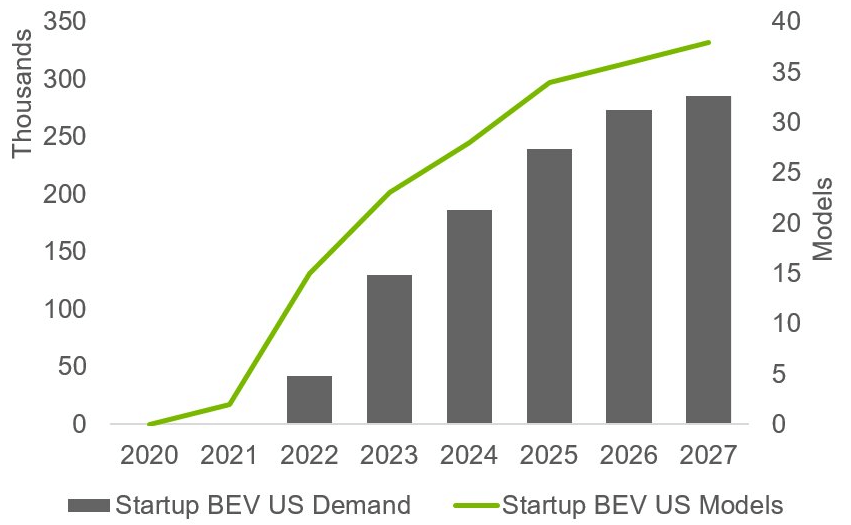
According to LMC Automotive, the startup EV brands in the U.S. are going to have nearly 40 models on offer in the U.S.
(Image: LMC)
However, LMC reckons that few of the new brands are likely to have sales of more than 50,000 units per year.
That said, a sufficient number of 50K-selling OEMs means that the sales are likely to be taken from the traditional OEMs.
However, LMC thinks that it is going to be costly for the upstarts that build factories. The firm calculates that the capacity utilization of a given plant is going to be on the order of 30%, which is about 60% less than it really ought to be. (I.e., 30% capacity utilization means that 70% of the personnel and equipment are not making vehicles, which is the whole point of their being there.)
“2022, in a lot of ways, is going to look like 2021”—Stephanie Brinley, senior analyst, IHS Markit, in a presentation to the Automotive Press Association.
Among the ways are chip shortages, low inventories and high prices.
Everything you didn’t want to see if you’re in the market for a new vehicle.
In 2019 some 148,000 went to a facility in Wolfsburg, Germany. Not surprisingly, COVID 19 reduced the numbers (97,570 in 2020).
The reason those people went to Autostadt was to pick up their new Volkswagen.
And while there they could visit a museum, walk through vehicle pavilions, eat everything from light fair to fine dining, and even stay at a Ritz-Carlton. They could even attend concerts.
Autostadt is the world’s largest auto delivery center.
Volkswagen has turned getting a vehicle into an amazing experience.
People don’t have to pick up their VWs at the Autostadt. It is a choice.
(While I’ve never personally picked up a car at Autostadt, I’ve been there on more than one visit to Wolfsburg and it is remarkable.)
There is nothing like it in the United States.
One of the towers at Autostadt where vehicles are located before delivery. (Photo: Landmann, Lars)
There are factory-owned dealerships in Germany. Meaning, for example, VW-owned.
There are no factory-owned dealerships in the U.S.
Why? Why isn’t there a Ford Factory Store in Dearborn where you could go pick up an F-150 that has been built for you, a facility that is affiliated with the Henry Ford so that there would be the opportunity to have a complete experience beyond the vehicle delivery alone?
Simply because of dealer franchise laws in all 50 states.
Did you ever wonder why you can’t but a vehicle from Amazon?
The same reason. The franchise laws.
What’s the rationale?
According to the National Auto Dealers Association:
“automobiles are sold through franchised dealers because that business model is a good deal for everyone. Consumers are given extra protection in the marketplace, local communities benefit when local businesses compete to sell and service great products, and manufacturers get to invest their capital into designing, engineering and marketing great products in lieu of low-margin retailing. For these and other reasons, state legislatures have passed laws that promote the buying, selling and servicing of cars through local franchised dealers.”
Tim Jackson, the president and CEO of the Colorado Automobile Dealers Association, simplifies that as “Win, win, win.” A win for the OEM. A win for the consumer. A win for the community.
And, as anyone who has bought a vehicle within the past several months from a dealer knows, a win for the dealership, as they have racked up record profits.
On this edition of “Autoline After Hours” Jackson explains why dealers are a good deal for consumers to “Autoline’s” John McElroy, Alexa St. John of Business Insider, and me.
Although there are surveys indicating that people do want to purchase on line and to get vehicles delivered where and when they want them rather than having to go through a dealership, Jackson, not surprisingly, argues that dealerships will continue to play a role in the transaction.
Of course, perhaps trying to emulate Tesla, which doesn’t have franchise dealers, it seems that more and more startup companies (e.g., Lucid, Rivian) are foregoing the franchise model.
Here’s a thought: Aren’t all traditional OEMs doing their damnedest to compete with Tesla on product?
Might they not rethink their model of getting products to consumers?
Well, there are all of those laws that makes that difficult to achieve, to say the least.
But I’m willing to bet that the Germans who have had the Autostadt experience think far more of VW than anyone who has picked up a car from their local dealer, cappuccino machine notwithstanding.
“In 2020, 48% of all EVs on the road could be found in China — more than the combined figure for the US and Europe. China’s EV fleet will be 60% of the world’s total by 2030. Xi Jinping has extended both the sales tax exemption on EVs and subsidies for domestically built EVs to the end of 2022.
“China’s large domestic market, raw materials access, and favorable government policies mean it will continue to dominate the EV landscape and won’t be as disadvantaged by the lithium shortage. Xi Jinping has facilitated the growth of the domestic EV market, causing Tesla to lose market share in China to BYD. This is not only to cement China’s dominance in EVs but also to help meet the net zero target year of 2060.”–Amrit Dhami, Thematic Analyst at GlobalData



 shinymetalboxes