Although the bullishness of Hyundai is something that yesterday’s piece on the XCIENT big-rig noted, we didn’t realize the magnitude of that commitment until we saw this pie chart from a research firm, Information Trends :
(Image: Information Trends)
Yes, that’s right, Hyundai has about 75% of the entire pie.
However, the pie needs to be put into some context:
According to the firm, approximately 8,500 passenger fuel cell vehicles (not big-rigs) were sold in 2020.
To put that into some context: Toyota sells more Camrys in a week in the U.S. than that total number of global fuel cell sales, so there is a way to go. Quite a way.
“With 2021 XCIENT Fuel Cell, Hyundai will contribute to the widespread adoption of commercial vehicles powered by hydrogen.”– Jaehoon (Jay) Chang, CEO and President of Commercial Vehicle Division at Hyundai Motor Company
By Gary S. Vasilash
When people think about “electric vehicles” it tends to be in the context of a car like a Tesla Model 3 or if it is a truck it is the Rivian R1T. These are electric vehicles that are powered by electricity that is stored in a battery.
Fuel cell-powered vehicles are electric vehicles, too. The difference is essentially that instead of batteries there are high-pressure cylinders full of hydrogen that is then transformed on board—through the fuel cell—into electricity.
Using hydrogen to propel big rigs. (Image: Hyundai)
Both the traditional EV and the fuel cell vehicle then have electric motors that are used to propel the vehicle.
While most people, naturally, think of something that they might drive, a big impact both technologically and ecologically is going to be trucks—not F-150 Lightnings, but big rigs.
Batteries are heavy for sedans. They are even more massively heavy to move Class 7 and 8 trucks.
So hydrogen becomes a good alternative, especially as the amount of fuel that can be stored on board provides sufficient range, and the hydrogen tanks can be refilled within minutes, not hours as can be the case for battery recharging.
Hyundai has announced that it will begin production of its 2021 XCIENT Fuel Cell heavy-duty truck in August.
The vehicle has a 180-kW hydrogen fuel cell system and two 90-kW fuel cell stacks. There are seven hydrogen storage tanks that hold about 31 kg of fuel. That goes to power a 350-kW e-motor. The range is estimated to be about 400 km. Refueling time is from 8 to 20 minutes.
At present there are 46 XCIENTs rolling around Switzerland right now and Hyundai plans to ship an additional 140 to the country by the end of the year. It intends to have some 1,600 heavy-duty fuel cell electric trucks in Europe by 2025.
Yes, Hyundai is going to bring the model to the U.S. this year.
Ford is transforming what it going on in what was once a traditional transmission plant
By Gary S. Vasilash
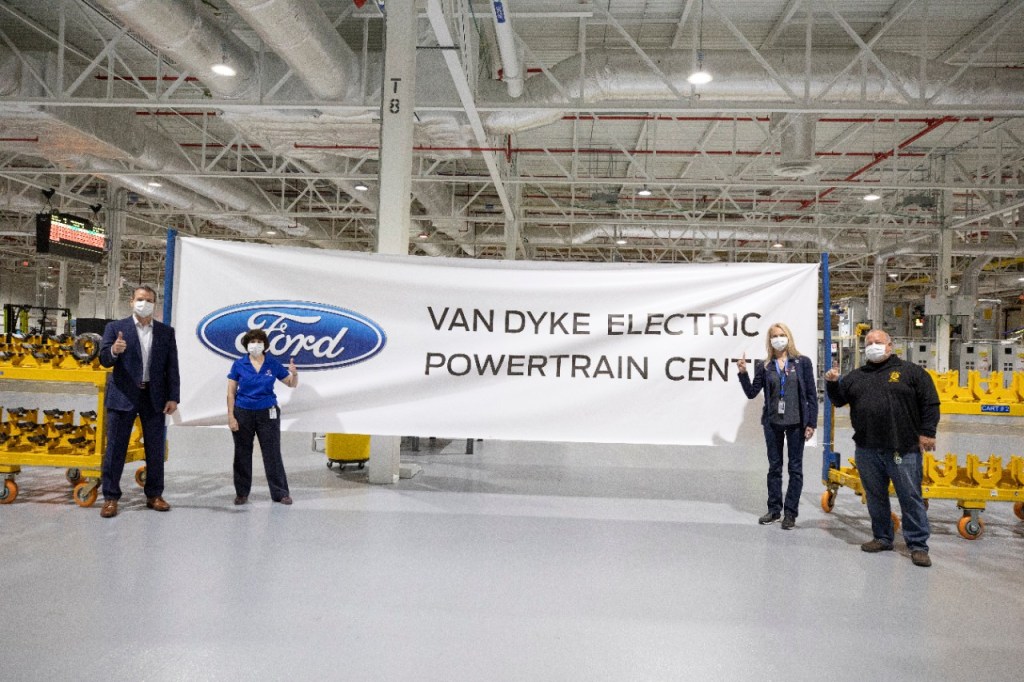
While what has long been known as the “Ford Van Dyke Transmission Plant,” a 2-million square-foot factory in suburban Detroit, didn’t make a transmission until 1993, even though it had been established in 1968 (when it was a suspension components plant), the sign visible on Van Dyke Avenue, after a generation is undergoing a change.
Now it is the “Van Dyke Electric Powertrain Center.”
Sign of change. (Image: Ford)
Inside they are going from just making the classic step-gear (a.k.a., “automatic”) transmission to electric motors and electric transaxles for full electric and hybrid vehicles.
Production of the Ford eMotor will begin at the plant this summer. Early next year the electric transmission (“eTrans”) manufacture will commence.
Ford spent $150-million in the plant to prepare it for its new role.
A lively discussion of things from why Americans don’t buy small, cheap cars and why OEMs aren’t likely to get a big revenue stream from sending data to vehicle head-units
By Gary S. Vasilash
Although there is a whole lot of development going on in the electric vehicle (EV) space, as OEMs announce products and plans with what seems to border on giddiness, maybe things aren’t what they seem.
Consider, for one example, the F-150 Lightning reveal. While it might seem as though every person on your street is likely to replace their gasoline-powered F-150 with an electric one as soon as is practical (even though there is a starting MSRP of $40,000, and even though $40,000 is pretty much the average cost of a vehicle, it is still $40,000), even though people are touting the frunk that will allow them to fill it up with ice and beverages and the power outlets that will permit the audio equipment to be plugged in for parties and picnics, when you listen to Eric Noble, founder and president of The Car Lab, what seems to be the case may not be the case.
The F-150 Lightning in what is a natural environment: a work site. (Image: Ford)
That is, Noble points out that largely because of EV batteries—“They are expensive, huge, very heavy and don’t store very much energy”—especially the cost part, OEMs don’t make money on EVs unless these EVs are priced so highly that the cost of the battery can be buried in the MSRP.
Noble argues that because of the zero-emissions mandate of California and the other states that follow California’s lead in emissions regulations, OEMs that want to sell vehicles in those states—including vehicles with a 5.0-liter V8 under the hood—need to sell zero-emissions vehicles: EVs.
What is the number on the sales forecasts that OEMs have for EVs, he rhetorically asks.
Pretty much what the number of EVs required by the ZEV states are for that particular OEM.
However, he points out that there could be some real business for OEMs when it comes to selling to fleets. (“Ford is good at fleets,” Noble says.)
In other words, Teslas and Mustang Mach Es notwithstanding (and I don’t know whether the champagne need be busted out for the Mach E quite yet because in April Ford sold 1,951 Mach Es and 8,000 regular Mustangs), things like the Lightning are likely to be more oriented toward places where they can do the OEM the most good, which very well may be in fleet applications.
Noble talks about this on this edition of “Autoline After Hours.” And many of his arguments are bolstered by observations by Sam Fiorani, vice president of Global Vehicle Forecasting, AutoForecast Solutions.
Also on the table are other subjects of the moment, like over-the-air updates (not likely to be a revenue stream for OEMs because customers don’t want to have a monthly charge to their credit cards, why tech companies won’t become auto companies and vice versa, and a whole lot more.
Per usual, “Autoline’s” John McElroy and I are engaged in the conversation with these guests, and it is one of the livelier discussions you are like to see about the state of the industry—the reality versus the proclamations.
Toyota leads in SUV sales in the U.S.–by a non-trivial amount
By Gary S. Vasilash
Although it might seem that when it comes to trucks and SUVs, “trucky” things, that Ford, General Motors and the company formerly known as FCA which was formerly known as Chrysler, would be dominant.
When it comes to pickups, yes. The numbers of F-150s, Silverados and Rams is truly extraordinary. Who knew that so many people were in need of boxes on the back of their vehicles? (Yes, people who actually do work with their trucks, do, but somehow that guy down the street who uses the bed to carry mulch once a year. . . .)
According to analysis firm Inovev, SUVs represented 53.5% of the U.S. market during the first quarter.
Toyota RAV4: best selling SUV in the U.S. (Image: Toyota)
And of them, most carried the Toyota “T.”
Inovev notes that Toyota has outsold both Chevy and Ford by about 50,000 units, with Toyota sales being just shy of 250,000 units and the other two slightly below 200,000 for Q1.
Inovev points out that Toyota also leads the Big Three in the sedan category (Camry, Corolla).
So if there are three big categories–trucks, SUVs and cars–the Big Three is now only dominant in one.
Turns out that EVs are significantly less expensive to power
By Gary S. Vasilash
Although electric vehicles tend to be more costly than comparable gasoline-powered vehicles, when it comes to “refueling,” EVs can save a whole lot of money compared with gasoline-powered vehicles, according to the U.S. Department of Energy.
As much as about 60%.
The agency developed what it calls an “eGallon.”
That is a comparison of what it would cost to buy equivalent energy to power an EV the same amount as it would cost a gasoline powered vehicle to travel on one gallon of gas.
So, based on the national average of $2.85 for a gallon of gas (as of March 31) and the equivalent price of electricity at a national average of $1.16 for an eGallon, this means the average fuel savings of approximately 60%.
In Washington state the difference was much larger: the cost of a gallon of regular was $3.13 and the cost of an eGallon was $0.89, so the fuel cost savings was about 72%.
So for those who pay attention to what they’re paying for their miles per gallon, it appears that EVs may be advantageous.
Of course, it takes longer to recharge an EV than it does to fill up a tank with liquid fuel.
Yes, they are selling in the U.S. and Canada in great numbers, but the Mexican market still likes cars, LMC finds
By Gary S. Vasilash
Although SUVs (yes, including crossovers under that omnibus name) continue to proliferate in the U.S. and Canadian markets, turns out that things aren’t quite the same in the other USMCA country, Mexico.
According to LMC Automotive, while SUV sales surpassed those of cars in Canada in 2015 and in the U.S. in 2016, in 2020 cars outsold SUVs in Mexico. And not just by a little.
Nissan still sells cars in Mexico. (Image: Nissan)
The LMC data show that cars outsold SUVs by more than 2:1.
That said, there is growth in SUV sales in Mexico notes LMC Americas Vehicle Sales Forecasts analyst David Oakley, but there is an issue: “The overarching obstacle is cost, with SUVs still carrying a larger price tag than many high volume cars.”
Complicating matters for Mexican consumers is the fact that Ford and Chevrolet have pretty much given up on cars, about which Oakley says, “these brands seem to have jumped the gun with regard to Mexico’s readiness for such a shift.”
Although it is estimated that cars and SUVs will reach parity in sales by 2030 in Mexico, there are still several years of sales between now and then, sales that will probably go to brands like Hyundai and Nissan.
Seems like vehicle buyers are buying—costs be damned
By Gary S. Vasilash
“Importantly, consumer spending will still advance despite higher prices due to pent-up demand and record savings balances.” That’s Richard Curtin, chief economist for the Surveys of Consumers, University of Michigan.
In the survey for May it was discovered that consumer confidence fell compared to the data for April. A concern is with inflation.
According to the U.S. Bureau of Labor Statistics (BLS), the Consumer Price Index was up by 4.2% for the 12-month period ending in the cruelest month. That was the highest rise since September 2008, when it hit 4.9%.
What was a big contributing factor to both the fall in consumer confidence and the increase in consumer prices? Vehicle prices.
In the case of used cars and trucks, the BLS measured a 10% increase in prices—the largest one-month increase since they started measuring back in 1953.
But it seems that shoppers aren’t all that concerned.
“Four out of ten consumers are willing to pay above the manufacturer’s suggested retail price (MSRP), and those willing to pay over MSRP are willing to accept a 12% premium.”
Cox calculates that based on the average MSRP for new vehicles in April being $41,950, according to Kelley Blue Book, “many consumers are willing to pay $5,000 over sticker price.”
Somehow politicians are blamed for inflation.
Seems like consumers might have more than a cameo role in this scenario.
There are lots of new vehicles that have been or will be introduced this year. So on this edition of “Autoline After Hours” we dedicate the show to talking about some of them.
Acura MDX: Fourth generation of the utility. Three rows. Edgier styling. Solid suspension. What’s not to like? Apparently the True Touchpad Interface.
Buick Envision: A crossover with meticulous attention to detail, inside and out. Does the fact that it is made in China have anything to do with that?
Cadillac CT5-V Blackwing and CT4-V Blackwing: A lesser bat-out-of-hell (the 4 has a 472-hp engine) and a full-blown one (the 5 has a 668-hp engine).
Chevy Bolt EUV: The second electric vehicle (EV) in the lineup that looks more like an SUV, presumably to appeal to those who can’t get enough of that body style.
Ford Bronco: A hard-core off-road vehicle, coming soon to a driveway near you. Get the Sasquatch Package and get extra ground clearance and the approach and departure angles that make climbing rocks not an issue. Get the optional Honda
GMC HUMMER EV Pickup. 1,000 hp 11,500 lb-ft of torque. 0 to 60 mph in 3 seconds. 350+ miles of driving range. Fast charge up to 100 miles in 10 minutes. You can’t get a reservation for Edition 1, which is coming out this fall and has an MSRP of $112,595. In the fall of 22 there will be more available with a reduced price: $99,995.
Honda Civic Sedan: The 11th generation appears to be what will bring Honda back to being Honda. Which should make sedan enthusiasts every enthusiastic.
Hyundai Santa Cruz and Tucson and IONIQ 5: whether it is a little truck-like vehicle, a compact sport ute that comes with two flavors of hybrid as well as a conventional ICE powertrain, or a fully electric crossover, seems that Hyundai is the Overachiever of the Year.
Kia Carnival: Don’t call this a “minivan.” Don’t.
Nissan Frontier: It has been a while since Nissan has brought out a new version of its pickup (e.g., the one that is out now appeared in. . . 1998), so they’ve clearly had time to get this one right.
Rivian R1T: Will this electric pickup from a startup be a success in the market?
Nearly a quarter of this year’s field consists of previous winners
By Gary S. Vasilash
(Image: IMS)
On May 30 the 105th running of the Indianapolis 500 is scheduled to be held.
While things can change between now and then, here’s something of at least moderate interest:
In the field of 35 cars (18 will have Chevy engines, 17 Hondas; all are Dallara chassis (a.k.a., cars) running on Firestone tires), there will be nine people who have won “The Greatest Spectacle in Racing.”*
They are:
Helio Castroneves (2001, 2002, 2009)
Juan Pablo Montoya (2000, 2015)
Takuma Sato (2017, 2020)
Scott Dixon (2008)
Tony Kanaan (2013)
Ryan Hunter-Reay (2014)
Alexander Rossi (2016)
Will Power (2018)
Simon Pagenaud (2019)
If Castroneves manages to win, he will be the fourth driver to have won the race four times, with the current three being A.J. Foyt, Al Unser Sr., and Rick Mears.
*The phrase “The Greatest Spectacle in Racing” was written by Alice Greene, a copywriter working for WIBC radio. Some sources have it in 1954 and others in 1955.







 shinymetalboxes