When it comes to discussions of electric vehicles, the topics seem to be, in order of frequency:
Tesla. Anything. Mileage recalculations. Musk’s recreational habits. Labor issues. Massive number of vehicles being sold (which actually doesn’t get the attention that it should: when you subtract Tesla vehicle sales from electric vehicle sales, things don’t look quite as bullish as one might think).
GM. Mainly its failure to produce notable volumes. For 2023 it delivered 9,154 Cadillac LYRIQs, 483 Chevy Blazer EVs, 461 Silverado EVs, 3,244 HUMMER EVs, 14 Zevo 400s, and 483 Zevo 600s (the last two are commercial vehicles). That is a total 13,838 vehicles. Out of 2,594,698 sold.
Ford. One thing is the refocus on hybrids. The other thing is the changing prices for the F-150 Lightning, with the recent notable rise in MSRP. You might have imagined that when the vehicle launched the perceived demand was such that they would have quickly hit economies of scale that would cause prices to, well, not rise. For 2023 it sold 24,165 Lightnings, which is excellent in the context of GM. But when you take into account the total 750,789 F-Series trucks sold, that’s about 3%.
A company that gets little attention is BMW when it comes to EVs.
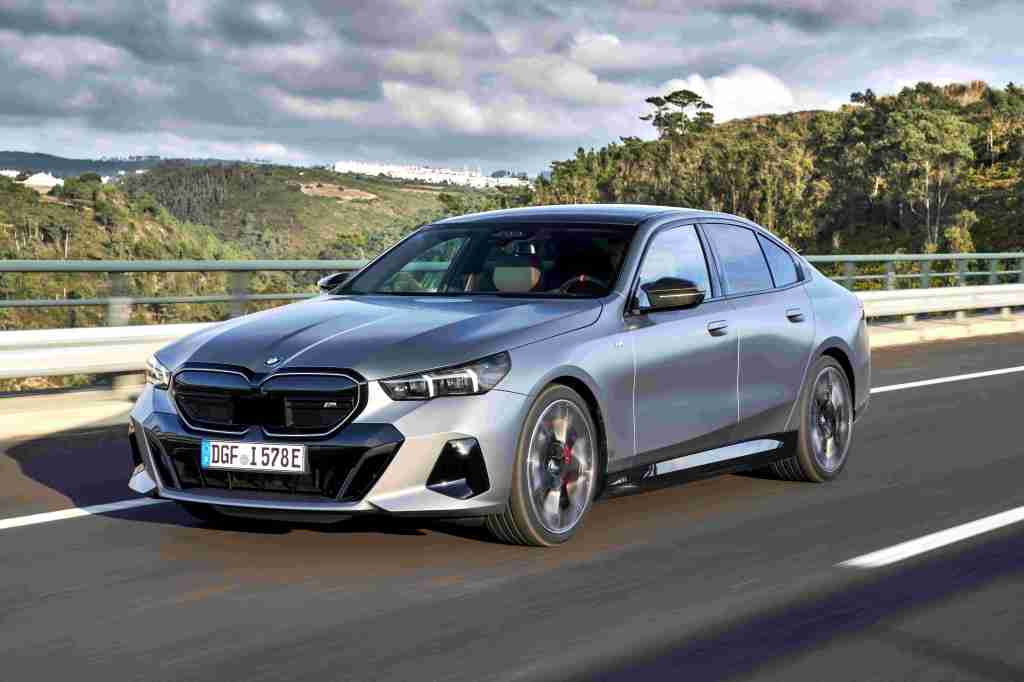
BMW i5: one of the electric vehicles in the company’s offerings–there are also the i4, i7 and iX. (Image: BMW)
Which is surprising given that in 2023 it delivered 45,417 EVs into the U.S. market.
That’s more than the GM EV sales and the Ford Lightning sales combined (38,003).
BMW 2023 EV sales account for 12.5% of its total sales.
If the number of plug-in hybrids BMW sold in 2023 (25,318) are added in to the EV number (so the number of “electrified vehicles”), it is 70,735 or 19.5% of BMW’s total sales in the U.S.
Those are some big numbers for BMW.
Seems like the lack of discussion isn’t keeping people from buying the company’s EVs.
“With the Crystal Center Display as a key component, we want to turn the world of interior design on its head and create an innovative focal point for premium vehicles of the future – one that grabs attention and stirs emotions. We are moving away from the straightforward display of information and elevating it to a highly personalized user experience,”–Dr. Boris Mergell, head of the User Experience (UX) business area, Continental.
Conti’s collaboration with Swarovski. (Image: Continental)
Dr. Mergell is talking about an infotainment display that Continental has developed with crystal company extraordinaire Swarovski. Turns out that in addition to producing necklaces, rings, bracelets, and the like, there is another part of the company, Swarovski Mobility.
Continental developed a microLED display that is integrated into the crystal panel. The microLEDs provide the brightness and contrast for the 10-inch infotainment display. The information displayed seems to float in the slim crystal slab.
Seems like Conti is going for something of a Steampunk aesthetic for its displays: classic decorative crystal meets the cloud.
The “Consumer Attitude’s Around Autonomous Vehicle Technology Survey” indicates that there is a solid base of consumers who are ready to spend money to buy self-driving capability for their next vehicle.
Perhaps.
That is, there is a blur between advanced driver assistance systems (ADAS) and autonomous driving, even though the survey conducted for Ghost Autonomy, a developer of autonomous driving software, provides definitions of both, with ADAS including “automatic emergency braking, blind spot and pedestrian detection, lane keeping assist, surround view, parking assist, driver drowsiness detection and gaze detection” and autonomous driving technologies based on the SAE five levels, but claiming “L3-L5 is considered fully autonomous driving that does not require human backup,” which is not the case, because L3, while it lets the driver do other things, also requires that the driver be capable of reassuming, well, driving.
BMW Pesrsonal Pilot L3: yes, a driver is still required to regain control when needed. (Image: BMW)
For example, BMW has launched “BMW Personal Pilot L3,” which will be available to purchasers (adding 6,000 euros to the sticker) of the BMW 7 Series—in Germany only.
According to BMW this system provides “Level 3 capability as defined by the Society of Automotive Engineers,” and it “allows drivers to redirect their focus to other in-vehicle activities when travelling at up to 60 km/h (37 mph) on motorways with structurally separated carriageways.”
However, the driver “still has to be ready to reassume the task of driving at any time – i.e. as soon as the situation on the road requires them to or the stretch of road suitable for using the BMW Personal Pilot L3 comes to an end.”
In other words, “human backup.”
According to the Ghost Autonomy survey, 52% of those who have experienced self-driving (which arguably would be those who have ridden in a Cruise or Waymo vehicle, as FSD’s name notwithstanding, Tesla’s product isn’t self-driving, at least not within the existing classification, and it actually requires that the driver keep hands on the wheel) would “consider buying a car with full autonomy sooner if the technology was available today,” which is sort of a moot point because (a) it isn’t and (b) its not likely to be anytime soon.
What’s more, those “drivers who’ve experienced self-driving,” 78% of them, are willing to pay $5,000 or more upfront. Arguably this will be a lot more than $5,000 because the aforementioned BMW system would be about $6,600, and the Tesla FSD package (“Your car will be able to drive itself almost anywhere with minimal driver intervention and will continuously improve”) adds $12,000 to the sticker.
One finding in the survey that is certainly laudable is that when asked to rank the factors considered when they purchase their next vehicle they are:
ADAS
Keyless or phone-based entry and start
Premium infotainment screen and sound
Premium interior/exterior trim
EV/battery powertrain
Yes, safety systems rank first.
But one wonders whether that answer isn’t analogous to what people say at the dentist office when asked about their brushing and flossing habits.
Who is going to say even on a survey that awesome audio is more important to them than safety?
This morning the 2024 North American Car, Truck and Utility Vehicle of the Year (NACTOY) awards were announced.
And with no further ado. . .
North American Car of the Year: Toyota Prius & Prius Prime
North American Truck of the Year: Ford Super Duty
North American Utility Vehicle of the Year: Kia EV9
Kia EV9: 2024 NACTOY Utility of the Year. In 2023 Kia also took that NACTOY category with the EV6. Seems that company really has it going on with electric utes. (Image: Kia)
To look at this a more closely:
The Car category also included the Hyundai IONIQ 6 EV and the Honda Accord. Several people whom I’ve talked with (full disclosure: I am one of the 50 jurors for the awards) thought it would more likely be the Accord than the Prius.
While all three are excellent cars, the transformation of the Prius from something that was somewhat awkward to an object of desire (with really good gas mileage) undoubtedly pushed it over the top.
In trucks, the Ford Super Duty was up against the Chevrolet Colorado midsize pickup and the Chevrolet Silverado EV. The NACTOY awards are consumer-centric, not commercial-centric. Which led me to wonder about the Super Duty being a finalist. Then two things happened:
I talked with Detroit Free Press car reviewer Mark Phelan (also a juror) who pointed out that plenty of people buy Super Duty trucks as daily drivers
I spent time behind the wheel of a Super Duty and discovered that in terms of the tech and the amenities it gave nothing up compared with cars or utilities
That the Silverado EV didn’t take the trophy probably surprised some people at GM HQ because this is their Ultium-based offering in the full-size truck segment and it betters the specs of the Ford F-150 Lightning, the EV pickup that won the NACTOY award in 2023. Perhaps the $74,800 price for a work truck kept Chevy from winning.
And in utilities, the finalists that the Kia EV9 faced were the Genesis Electrified GV70 and the Hyundai Kona/Kona EV. In mid-November when the finalists were announced the Kona wasn’t on the list and the Volvo EX30, a small electric crossover, was. But Volvo had to pull the vehicle from consideration because it wasn’t going to have vehicles in-market before the end of 2023.
Two things about the utility situation:
Kia also won the category last year with the EV6
As Genesis is a sibling company with Hyundai and Kia, it is clear that the three companies have remarkable capabilities in the utility space—including the electric utility space
And that second point raises another consideration:
The traditional domestics had the Truck category. But nothing in the other two categories.
In reporting its 2023 Q4 production numbers, Rivian stated it produced 17,541 vehicles at its factory in Normal, Illinois, and delivered 13,972 during the same period.
Manufacturing Rivians in Normal. (Image: Rivian)
In Q3 it built 16,304 vehicles and delivered 15,564.
In Q2 the numbers are 13,992 made and 12,640 delivered.
And first and numerically least, in Q1 it produced 9,395 vehicles and delivered 7,946.
So for the full year it built 57,232 vehicles and delivered 50,122.
In Q3 Rivian management’s guidance was that it would build 54,000 vehicles during 2023, so there is a 3,232 bonus, apparently.
But doesn’t the ~12% of vehicles that were built in 2023 and not delivered seem like a lot sitting in lots?
According to box office receipts, Ferrarididn’t exactly blow the doors off of theaters in its opening weekend, taking in $6.8 million domestically at the box office according to Deadline.
For a bit of context: Car and Driver notes a 2024 Ferrari Daytona SP3 starts at $2.2-million.
Which means that a three-car garage could have within it somethings that cumulatively have a price tag almost equivalent to what the movie took in across the country in wide release.
So in the event that you’re interested in seeing a racing-related movie that doesn’t star Adam Driver wearing his belt well above his waist, here are some alternatives that are, for various reasons, worth a watch:
Winning (1969). Paul Newman raced cars in real life. What’s more, he was respected in the racing community, not some sort of ne’er-do-well who went slumming in the pits when he wasn’t in front of a camera. This movie is about a driver who wants to win “The Greatest Spectacle in Racing,” a.k.a., the Indianapolis 500. Winning, which includes Joanne Woodward (who plays Newman’s character’s wife, which means this is not exactly a stretch roll) and Robert Wagner (whose street cred could come from his being born in Detroit), is not the Greatest Spectacle in Cinema. But it has Paul Newman.
Days of Thunder (1990). Although Tom Cruise and Nicole Kidman (unlike Newman and Woodward when they made the above), weren’t married when they made Days of Thunder, they were wed after meeting on the set.* Apparently the smell of exhaust and burnt rubber has some aphrodisiac qualities. This is a movie that deals with a racing series that is rife with opportunity, a racing series that is quintessentially American in a way that no other racing series is: NASCAR. This film was directed by Tony Scott, who worked with Cruise in 1985 for the Simpson-Bruckheimer production Top Gun. While cars do fly—accidentally, of course—this is no Top Gun. But Robert Duvall as the chaw-chewin’ crew chief is worth watching.
Driven (2001). Sylvester Stallone, of course, wrote Rocky. He also wrote Driven. Singular-word titles notwithstanding, Driven is no Rocky. Driven reunites director Renny Harlin with Stallone: the two worked on Cliffhanger, which Stallone co-wrote, and which is his ken, also starred in. (And again, a one-word title.) Driven, about a young driver played by Kip Pardue (who? Exactly), who is taken under the wing of veteran driver, played by Stallone (who can’t help himself), is, well, predictable but with some good racing footage.
Grand Prix (1966). This is the car racing movie of all car racing movies. Directed by John Frankenheimer, this film shows the challenges of winning a sufficient number of races to achieve the overall Formula One trophy. What’s interesting is that even back in the mid-‘60s the whole commercial aspect of motor racing is revealed (James Garner loses his sponsor and must join a Japanese team—remember, this is 1966!). And while we take an international cast for granted now, this movie brings in a French driver (Yves Montand), a British driver (Brian Bedford), and a Japanese driver (Toshiro Mifune). When it opened, the film was shown at Cinerama-capable theaters, which made it even more astonishing. It also gave rise to the cameos of real drivers. Days of Thunder may have Richard Petty and Rusty Wallace, but Grand Prix has Jimmy Clark and Juan Manuel Fangio.
*On the subject of pairings: in 1986 Newman and Cruise were together in The Color of Money, which focused on shooting pool, a somewhat less frenetic but no less cutthroat sport than motor racing.
“The two times Autosteer allowed my car to roll right through intersections with stop signs were especially nerve wracking. I could tell from icons on the car’s screen that it could see the sign, yet it did not disengage Autosteer or stop. After digging around Tesla’s website, I discovered that Tesla says obeying stop signs and stop lights is a function included for those who pay for Full Self-Driving. Should you really have to pay extra to keep the software your car comes with by default from doing reckless things?”—Geoffrey A. Fowler, Washington Post columnist, on his experience in his Tesla Model Y after the over-the-air update that was a response to the National Highway Traffic Safety Administration’s investigation, a recall that is meant to make Autopilot safer. As Fowler chronicles, he didn’t feel as though there is an improvement.
Or, as he put it, “I found we have every reason to be skeptical this recall does much of anything.”
Although Fisker describes its mission as creating “the world’s most emotional and sustainable vehicles,” chairman and CEO Henrik Fisker announced, “I’m excited to give our loyal members the opportunity to elevate their ownership experience.”
By doing something of an emotional or sustainable nature?
Nope.
But by earning points in the Fisker Loyalty Program.
That’s right: Fisker has a scheme wherein owners (or those holding reservations for the Fisker Ocean: enrollment for both groups is automatic) can get points that they can redeem for things like beanies and thermos bottles.
Fisker: “We are constantly looking to improve our Loyalty Program in ways that respond to our customers’ needs and that help us stand out from the competition.”
Which makes one wonder what it thinks it is competing with.
For those of you still humming Mariah Carey’s “All I Want For Christmas Is You,” here’s a bit of context for an announcement Ford made this morning:
The year that the Ford F-Series started making its consecutive run as the best-selling truck in the U.S., Ms. Carey was seven.
The F-Series has taken the lead for 47 years in a row.* They’re looking at more than 700,000 of them driven off of dealer lots in 2023.
2024 Ford F-150 Platinum. So nice that you probably wouldn’t want to use it as. . .a truck (Image: Ford)
And underscoring the curious popularity of trucks in suburban driveways as well as on work sites (curious because I rarely see my pickup truck-owning neighbors doing anything with the boxes on the back of those vehicles that they couldn’t manage with a trunk), the F-Series has been the best-selling vehicle in the U.S. for 42 years running.*
There is, of course, the question of whether “the most” means “the best.”
After all, McDonald’s has sold more hamburgers than any other company in the world and there is probably no one who doesn’t know whether they can get a better burger.
But one thing it certainly means is that the F-Series provides an unparalleled level of value for more people than any other pickup.
While there may be specific attributes of trucks from other OEMs that are more appealing or necessary for some purchasers, which means those trucks are more valuable for those people, on an overall basis Ford is consistently delivering.
Credit where credit is due. (And you’ll probably need good credit to get a full-size pickup: according to Kelley Blue Book, the average transaction price (ATP) for one in November 2023 was $66,590. You could get an entry-level luxury car for an ATP of $57,889.)
(On a related-unrelated subject, the tremendous number of trucks sold by Ford—closely followed by GM and Ram—in the context of vocational or functional (i.e., towing, hauling) uses of the vehicles might indicate that people are less environmentally keen than might be expected. After all, light-duty pickups aren’t exactly fuel-economy leaders, so were people concerned about carbon, they’d be buying more efficient vehicles for their daily drives. Yes, there are an electric F-150 and Chevy Silverado and one coming from Ram, but from the point of view of resource utilization, as in the massive batteries that have to be constructed, if those trucks aren’t being used as, well, trucks, then that isn’t exactly the most-environmental choice.)
*As the announcement was made a couple days before the actual end of the year, it is a bit of estimation on behalf of Ford. A small bit.
The Chinese Belt and Road Initiative was launched in 2013 by Xi Jinping. BRI is a means by which China, though investments and development projects around the world, aims to have increased global influence. According to the Council on Foreign Relations (certainly not something you’d imagine would be cited on a site like this):
“China’s overall ambition for the BRI is staggering. To date, 147 countries—accounting for two-thirds of the world’s population and 40 percent of global GDP—have signed on to projects or indicated an interest in doing so.”
What’s more, CFR points out:
“Beijing could seek geopolitical leverage over BRI countries. A 2021 study analyzed over one hundred debt financing contracts China signed with foreign governments and found that the contracts often contain clauses that restrict restructuring with the group of twenty-two major creditor nations known as the ‘Paris Club.’ China also frequently retains the right to demand repayment at any time, giving Beijing the ability to use funding as a tool to enforce Chinese hot button issues such as Taiwan or the treatment of Uyghurs.”
All of which is to say that the Belt and Road Initiative is somewhat controversial in places other than Beijing.
CFR quotes French president Emmanuel Macron saying during a 2018 trip to China that BRI could result in the countries that have signed up for the loans and/or development programs becoming “vassal states.”
Which makes it odd to see this headline on a recent news release:
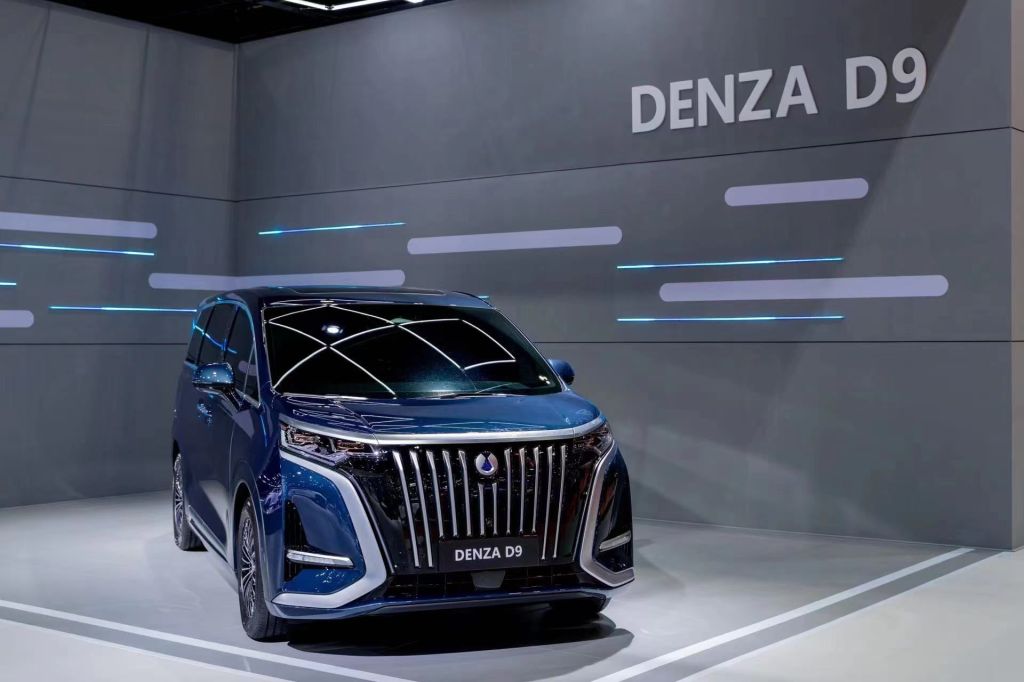
Deepening “Belt and Road” Initiatives: Remarkable Global Expansion for DENZA in 2023
DENZA is a car brand that was established in 2010 by Chinese company BYD and Mercedes-Benz. While it started out as a 50:50 joint venture, last year Mercedes sold all but 10% of its share to BYD.
(Image: DENZA/BusinessWire)
The original announcement about the company noted it would combine BYD’s capabilities in vehicle electrification (BYD is a world leader in that space) and Mercedes’ capabilities in providing luxury and quality. A sensible approach for a startup: the best of both worlds.
While DENZA has been somewhat quiet over the past several years, the company describes 2023 as its “inaugural year on the international stage.”
And then there’s this from the news release:
“With a steady and orderly international expansion, DENZA has not only won the hearts of global media and customers but has also laid a solid foundation for becoming a leading international high-end brand, poised to be the ‘business card’ of Chinese new energy luxury cars, redefining China’s automotive industry and introducing DENZA to a global audience.”
Which, going back to the Belt and Road Initiative, really sounds rather, um, ominous, given the methodical approach that is being taken, especially in contrast to the less-consistent execution by some Western OEMs (i.e., from being all-in on EVs to being sort-of-in to. . .). DENZA has a plan and they’re working it.
And seeing more business cards being passed out by several other Chinese EV companies goes to explain, in part, why the European Union launched an investigation this past Fall into whether Chinese EV OEMs, which are gaining considerable traction in the European market, are benefitting from what could be considered “unfair” government subsidies.
This could cause a considerable concern for European OEMs given the importance of the Chinese domestic market to them and the possibility that the Chinese government could retalitate to things like the imposition of tariffs on Chinese EVs coming into the EU by making it more difficult for EU-based OEMs in the China market.
For example, through Q3 2023 Mercedes-Benz Cars sold the following number of vehicles:
Germany: 172,900
U.S.: 216,700
China: 570,600
Presumably the folks in Stuttgart aren’t going to want to agitate any issues with their biggest market by volume, and they aren’t the only ones.
Somehow the auto industry is becoming as much political as it is technical.



 shinymetalboxes