Robotaxis are what companies from Cruise to Zoox are assiduously working on, the mode of transport that will take the driver out of the equation.
According to market intelligence firm Guidehouse Insights, which has released a report titled Robotaxi Services Overview, this is why: “Removing drivers from ride-hailing operations is widely seen as an opportunity for the industry to reduce operating costs and ensure profitability.”
However, the firm also notes, “major players including Waymo, DiDi, Cruise and Uber have placed multibillion-dollar bets on developing automated driving technology and piloting robotaxi services.”
Seems like it is going to take a whole lot of rides to make an ROI of “multibillion-dollar” investments.
One of the assessments made by Guidehouse Insights is that more than 90% of all passenger miles traveled by robotaxis between 2020 and 2030 will occur in China, North America and Europe.
One thing: According to Sagie Evbenata, sensor research analyst with the firm, “Few commercial deployments are likely to be seen until 2028-2029, but this is likely to be followed by a period of extreme growth where robotaxis mainly replace human-driven ride-hailing services.”
If you have any doubt that EVs have a future in an arena mainly populated by things with pistons, watch this show
Rob Mantinan was a self-described “gearhead” growing up in metro Detroit. He had a Camaro when he was in high school. His dad was a UAW worker at a GM facility in Warren. He went to Kettering University. And started right out of school at GM. He has a mechanical engineering degree from the school with a specialization in automotive powertrain. Which is arguably what a gearhead would get.
But then, while working at GM, he pursued a graduate degree and obtained a master’s in energy systems engineering. He was working on things like the Chevy Volt and his focus began to shift.
The Bolt is quick. But probably not faster than an X-Wing. (Image: Chevrolet)
Which makes a whole lot of sense for what he is doing now: Mantinan is the program engineering manager for the Chevrolet Bolt EV and the Bolt EUV.
On the subject of going from one propulsion system to another, he admits, “I got converted pretty quickly,” adding, “I’ve turned from a piston guy to an EV guy. And I can’t see going back—other than as a toy.”
It is certainly good to be a strong believer in what you are doing. It makes doing it all the better and satisfying. And arguably results in a better outcome.
On this edition of “Autoline After Hours” Mantinan talks about the development and characteristics of the Bolt EUV, which is based on the Bolt EV platform, but stretched in terms of overall length (it is 169.5 inches long vs. 163.2 inches) and wheelbase (105.3 inches vs. 102.4 inches), with most of the addition space being used for rear passenger legroom (39.1 inches vs. 36 inches).
From a styling point of view, Mantinan says that the Bolt EUV is moving the Bolt “to the mainstream”: it resembles more of a crossover than a five-door hatch.
And the Bolt EUV is being offered with tech that is only otherwise available on. . .Cadillacs.
That’s right. On a vehicle that starts under $40,000 Super Cruise Level 2+ tech can be obtained.
One of the topics—which seems to come up whenever EVs are discussed—is the range. The Bolt EUV range is an estimated 250 miles. When asked whether they considered providing enough battery to allow a greater range, Mantinan notes (1) for existing Bolt customers, the range has not been a problem and (2) they wanted to assure that the Bolt EUV was accessibly priced for the buyer who isn’t interested in making the hefty payments that are associated with some other brands: This is a Chevy. (In addition to which, GM will be bringing out an array of EVs—including some with the bowtie on the front—that will be using its Ultium battery technology, but that’s in the future and the Bolts are now.)
Mantinan talks with “Autoline’s” John McElroy, Jeff Gilbert of WWJ-950, and me.
Then the three of us discuss a variety of subjects, including VW’s Power Day, Cruise Automation buying Voyage, Foxconn’s reported EV plant plans, and a whole lot more.
If you have to ask how much it costs, you probably can’t afford it
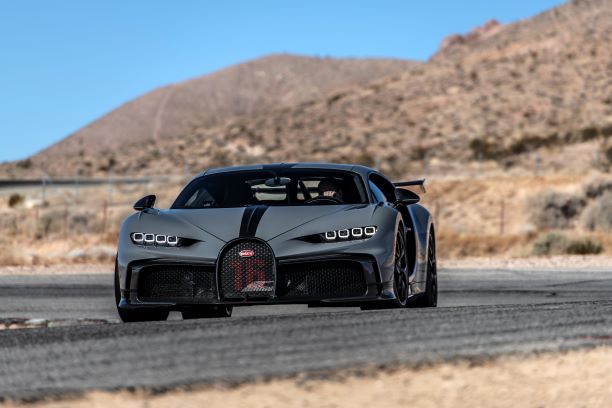
(Image: Bugatti)
This is the Chiron Pur Sport. It has a W16 engine (sort of think of what you get when you put two V8s together, which makes one wonder why a letter that looks like VV is pronounced “double U”).
The engine produces 1,500 horsepower and 1,180 lb-ft of torque.
Because sometimes you just need a little R&R in the limo
It generally occurs in a movie when the passenger of the limo raises the screen with the driver and the driver suddenly pushes a button that causes the passenger doors to lock with an audible “thunk” and from the air vents comes billowing clouds of knockout gas. . . .
Rolls-Royce has developed what it calls the “Phantom Privacy Suite” for its Phantom Extended motor car (a.k.a., “limo”).
Privacy screen in place. (Image: Rolls-Royce)
According to the company there is an electrochromatic glass screen that is either clear or opaque, depending on the passenger’s desire. In addition, there is a “frequency-specific compound [that] inhibits the transmission of conversations in the rear cabin to the front.”
This is a must for “Rolls-Royce Phantom clients—powerbrokers, titans of business and entrepreneurs.”
Should communication with the driver be necessary, there is a built-in intercom system. Should the driver need to speak with the passenger, “they are able to ‘call’ occupants in the Privacy Suite, who can choose to answer or reject the communication.” (Clearly the sort of feature that sometimes one wishes for in an Uber.)
In addition there is a slot that the rear passenger controls through which documents can be passed to forward and back.
Seems like the sort of thing that a knockout gas capsule might be dropped. . . .
Todd Lassa remembers the times he ran the second- and third-gear snake up and down the California coast, and realizes that it may need to change–significantly
Highway 1, the north-south highway in California that runs from Mendocino County in the north to Dana Point in the south, is crumbling into the sea. The road I have traveled countless times over the past three-and-a-half decades just to drive it is a victim of its own popularity, an irony worthy of a Twilight Zone episode.
To quote the February 28 front page of The Washington Post; “California’s shifting weather patterns are presenting new threats to this exotic road as wildfire reaches into places it has never been, leaving raw landscapes and fresh dangers in its burn path.”
For about five years during the Bush 41 era I drove up from Southern California, where I lived at the time, at least once a year.
MX-5 Miata. Ideal for Highway 1 driving. (Image: Mazda)
I had a 1987 Honda CRX, and I quickly learned that it was best to plan a trip from San Luis Obispo to Monterrey/Carmel on Highway 1 just after New Year’s in order to avoid long, slow lines of gawkers in rental Mustang convertibles, Midwest minivans and VW Microbuses full of Dead Heads. Not that I wasn’t a gawker myself, looking west at the Pacific past the cliffs below, while on one of the short straights. Virtually every such drive included a stop for lunch or dinner on the outdoor deck of Nepenthe, in Big Sur, with its aging hippie wait staff, extensive California wine selection, and perfect view of the highway just to the east and the coast to west.
My fin de siècle Highway 1 drive came long before I would wring out a test car on it for a magazine story, in September 1991. I drove all the way up the coast, past Bodega Bay, past the Oregon and Washington borders, past Vancouver, B.C. inland to Prince George and then east to Jasper, Alberta, and back (along inland freeways to make time during the return, sigh). In roughly 18 days, over 5,700 miles, the coastal road in Oregon and Washington, and the Canadian Rockies of Alberta certainly rivaled Big Sur for natural beauty, though no road was more fun than 1.
And now, it is all over. California’s highway department can keep trying to put it back together again, but for what – more CO2-spewing SUVs? No. The next Tesla sports car, or the Corvette E-ray, maybe.
If you happened to read my piece on how bicycle sales in the U.S. had a big year in 2020 – bigger than auto sales, even with inventory shortages, especially for urban/commuter bikes – and put that together with the headline here, you already know where I’m going with this. Highway 1 is ripe for establishing a roads-to-trails movement, like the 60-year-old rails-to-trails movement, in which bicycling and hiking enthusiasts turned old, abandoned railroad beds into gravel or blacktop trails.
Sure, we still need those mass expanses of multi-lane interstate, wide urban and suburban boulevards and two-lane rural blacktops between small towns just to handle current levels of automotive congestion. It won’t be long before those roads and highways are filled with autonomous electric vehicles. As much as I’d like a few more runs between San Simeon and Big Sur in something like a Porsche 718 or Mazda Miata, we are going to have to ban motor vehicles from Highway 1 in order to save it. Forget trying to return with a Miata, or Porsche Boxster or even a Tesla Roadster. My new goal is to get in shape so that I don’t have to resort to an e-bike to cycle up and down the road.
The first change for the French automaker since 2010
2021 is the year that automakers are changing logos, ostensibly to make them seem more relevant in a world of advancing technologies.
First there was Kia. It had its name spelled out with a font with awkwardly sized letter stems housed in an oval. It truly appeared as though it was something that would be affixed to a product in the Dollar Store rather than on some of the best-designed vehicles on the market. The new one is a digitally driven design with the sort of typographic flow that one would associate with advanced technology.
General Motors was not to be outdone (although arguably it was by Kia’s design), revealing a new badge that went from uppercase letters with a horizontal bar beneath them reversed out of a square blue background to two lowercase letters with the horizontal bar underlining over the “m” in a rounded square box (squircle?). While the previous badge was simply a statement of acryomic identity, the new version is meant to signify the electric future, as the shape of the “m” combined with the bar beneath it resembles an electric plug.
(Image: Peugeot)
Now Peugeot has made a change its logo. It is worth noting that Peugeot, which is 210 years old, first used a lion as part of its logo since 1847, so there is something to be said for consistency. (The original logo was used on steel products the company produced; it didn’t appear on a car until 1948, on a Peugeot 203.)
The new logo, designed by Peugeot Design Lab, a wholly owned operation within what is now part of Stellantis that designs everything from pepper mills to scooters, features a lion’s head within a badge form, with the name “Peugeot” in all caps, slightly curved to echo the curve at the top of the shield.
According to Matthias Hossann, Peugeot Design Director, “With over two centuries of history, Peugeot is a pioneer of mobility and a legendary brand for automobiles and bicycles. This emblem and this new brand identity are a link between our history and our vision for the future. This logo has been conceived, designed and developed in-house with the same stringent requirements that we apply to every detail of our vehicles: the quality of materials, the quality of execution and the quality of the finish.”
Although Peugeot is in the process, like seemingly all automakers, electrifying everything, notably this new logo doesn’t stress that change through some sort of potentially hokey maneuver like making the lion’s mane consist of lightning bolts.
More relevant to the purpose of a logo—to be widely seen and identified with a brand—is that the design team specifically worked on developing the marque such that it is optimized for digital use.
After all, where do you see more logos than in digital spaces nowadays?
Observations about how vehicle are developed and more. . .
Genchi gembutsu is one of the principles of the Toyota Production System. It essentially means, “go and see for yourself.” Don’t depend on a report about something. Get to the source of the matter and discover what’s going on for yourself.
Mike O’Brien, who spent some 14 years at Toyota North America, with his final position there as corporate manager, Product Planning, before moving on to Hyundai Motor America, where he spent over a decade, with his last position there being vice president, Corporate Planning, Product Planning and Digital Business, uses the term genchi gembutsu in the context of how vehicles should be developed.
Mike O’Brien believes there will be a shift in the market to more cars that people want just because rather than need, a shift driven in part by how the pandemic has changed working patterns that are likely to be the norm for some time to come. (Image: Hyundai)
That is, those who are involved in the development program need to go out to where the potential customers live and work and play so as to get an up-close look at what their behaviors are vis-à-vis the vehicle that they are working on. By doing that they can obtain a grounded sense of what is missing or what could positively add to the overall experience.
But genchi gembutsu is also a good term in relation to O’Brien, as he has been there, at the places where it happens, so on this edition of “Autoline After Hours” you can get truly informed insights on the current state of the auto industry.
While you often hear people talking about creating “white space” vehicles, O’Brien says that that is the exception, not the rule, because appropriate addressing customer pain points may be solved by doing a simple thing: He notes, for example, that an issue that some older people have is loading things into the trunk of their cars, so perhaps that can be addressed by modifying the lift-over height.
He says that companies talk about benchmarking, but he suggests that it is a method that will help with the creation of something that is about five years behind the curve by the time it is launched.
One of the points that O’Brien makes in his conversation with “Autoline’s” John McElroy, Jason Fogelson, freelance journalist, and me, is that coming out of the pandemic there is likely to be a decided market shift from “need” to “want.”
That is, he explains, take a typical two-car household. One of the spouses may now be working from home. Which means that the second vehicle may not be as necessary as it once was. Consequently, there may be a decision that the one vehicle that is in the household is something that does what needs to be done, but is something “special.” It could be a Bronco, Wrangler or something that doesn’t necessarily have off-road capabilities but aspects that the customers really don’t need, but want.
O’Brien discusses a number of other topics, ranging from traditional OEMs and EVs and why he thinks that hydrogen is a great solution for vehicle applications.
Remember expensive energy? It may return as a thing. . .
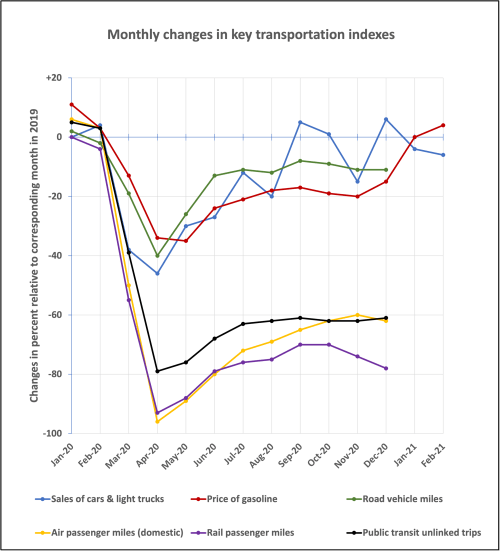
This chart complied by Michael Sivak of Sivak Applied Research clearly shows how bad things were last April—and one takeaway should be to note how quickly things can go south: we may think that major changes take a slow walk, but that’s clearly not the case.
Looks like AMTRAK is going to need a whole lot of help. (Image: Sivak Applied Research)
While there are improvements at the top of the chart, it is clear that modes of mass transportation (or at least transportation that takes more than a few people at a time, as air travel is not necessarily something everyone can afford, even if they’re opting for an airline that charges for every conceivable thing), are still languishing.
One thing that caught my eye is that red line: Gas prices. Note how there is an inexorable increase.
According to the Energy Information Agency, on March 8 the average price of regular in the U.S. was $2.771.
That is up $0.396 from a year ago.
While that is not a huge rise, take that increase, add in the dynamic of Sivak’s chart, and know that last week OPEC+ decided that it would keep a voluntary cut in oil output until at least April, and realize that the ever-rising sales numbers of pickups and full-size SUVs may resemble the left side of Sivak’s chart.
Tesla signifies more than an electric vehicle. . .
“Many consumers perceive Tesla as a leading-edge, high tech, environmentally progressive brand driven by a charismatic leader who not only builds cars and crossovers, but also sends rockets into space and is a global industrial visionary. That combination is hard to beat and has gotten the attention of the entire global auto industry.” –Tom Libby, associate director, automotive industry analysis, IHS Markit
Here’s something to consider: there are about 880 Mercedes dealerships in the U.S.—and just some 130 Tesla outlets (Image: IHS Markit)
The starting price for the Mercedes-Maybach S-Class Sedan has been announced.
It is $184,900.
Starting price.
Other stuff extra. (E.g., heated and cooled cupholders–which is something that Chrysler had on offer years ago–a refrigerated compartment–hello, Ford Flex–and custom champagne flutes and built-in holders–OK, we’ll give that one to Merc.)
Mercedes-Maybach S-Class Sedan. (Image: Mercedes)
We’ll leave it there.
It could be noted that the destination and delivery line item adds $1,050 to the price.
But if you’d even notice that you aren’t in the market for the S-Class.