There’s a lot of weight being hauled by one of those things. And a whole lot of processing for autonomy
Here’s something to think about the next time you’re rolling down the highway in your compact crossover:
One of those big rigs that is on the road with you can weigh 80,000 with a full trailer.
It doesn’t take a physicist to calculate that consequently stopping and maneuvering is going to require more time than the vehicle you’re in.
Plus system (look at the top of the cab) uses lidar, radar and cameras. (Image: Plus)
As drivers of those trucks tend to be on long-distance routes, developing autonomous driving capability for them is a growing area of interest.
One such company in this space is Plus, which is developing self-driving truck tech. According to Hao Zheng, CTO and co-founder of the company, they have more than 10,000 pre-orders for its system.
Here is a number from him that is even more astonishing than the aforementioned 80,000 and 10,000—even more than 80,000 times 10,000: “Enormous computing power is needed to process the trillions of operations that our autonomous driving system runs every fraction of a second.”
Trillions of operations every fraction of a second?
Plus has opted to develop its system using the NVIDIA Orin, which, according to NVIDIA, can deliver 254 trillion operations per second.
Evidently enough.
Still, driver or no, you’ve got to show those vehicles some respect.–gsv
“Dill had rented the big Ford from Budget. It was the biggest Ford they had and he would have rented a Lincoln had one been available. Dill, the VW owner, always rented large Detroit cars with power everything, because he felt it was an opportunity not to be missed—something like renting your own dinosaur.”
Millions of Euros for an up-and-coming EV OEM. . .
Although the classic Silicon Valley origin story has it that someone comes up with something in a garage and the rest is history, that story occurs in other parts of the world, as in Croatia.
There, a 21-year-old Mate Rimac in 2009 thought about the prospect of developing an electric supercar.
In 2011 he started Rimac Automobili.
And today Porsche announced that it was investing an additional 70-million Euro in the company so that it now owns 24% of Rimac Autmobili.
In 2019 Hyundai Group invested 80-million Euro in the company, so it, too, owns a chunk.
It is somewhat surprising to think that a small company could become important to larger OEMs.
Perhaps more surprising are comments from Lutz Meschke, deputy chairman of the executive board and member of the executive board for Finance and IT at Porsche: “Mate Rimac inspires us with his innovative ideas.”
Yes, a finance guy talking inspiration.
Meschke went on to note, however, “Our investment in the company has turned out to be absolutely right. Rimac’s value has increased many times since our initial investment.”
How the flagship of the brand was made even better
The Acura MDX is certainly an important name plate in the company’s lineup. For one thing, the vehicle, which goes back to the turn of this century, has had cumulative sales of more than 1-million units. And there have been sales in excess of 50,000 for 14 of the last 21 years. And, according to Acura, it is the “best-selling three-row luxury SUV of all time.”
The first generation was from 2001 to 2006; second from 2007 to 2013; third from 2014 to 2020; and the all-new fourth generation, model year 2022, has just been launched.
Tom Nguyen, chief engineer and 2022 MDX Global Development Leader, Honda R&D Americas, said that when he was given the assignment to develop the new MDX, his mandate was easy to understand but not necessarily easy to execute: “Don’t screw it up.”
2022 MDX A-Spec: sporty, but a three-row people and cargo-hauler. (Image: Acura)
(Who hasn’t heard something like that from their boss at some point in time?)
So Nguyen and his team went at not merely improving what came before, but creating a vehicle that they hope will not only resonate with MDX loyalists, but bring in new buyers.
One of the advantages that Nguyen says he and his colleagues had during the development was that there was a concerted effort at Acura to create vehicles that are athletic and dynamic. This is evident in the RDX and the TLX.
The ‘22 MDX is based on an all-new platform, said to result in the most rigid SUV the company has had. The torsional rigidity of this MDX is 32% greater than that of its predecessor.
Why does this matter? It contributes to safety—a paramount consideration—but also to the ride and handling of the vehicle. And speaking of which, they developed both a double-wishbone front suspension and a multi-link rear suspension for the vehicle.
Nguyen talks about the development of the MDX on this edition of “Autoline After Hours” with “Autoline’s” John McElroy, freelance automotive journalist Nicole Wakelin, and me.
An interesting aspect of the new MDX is that while they were driving for sportiness, they also made the vehicle bigger than its predecessor—2.2 inches longer, 1 inch wider and with a 2.8-inch increase in wheelbase. While you’d think that bigger would mean something that is more wallowing, Nguyen says that through structural design as well as the use of things like structural adhesives—35 meters of adhesives—the vehicle keeps its wheels planted and the vehicle capable of moving where and as it should (with a belt-driven electric power steering system and available Super Handling All-Wheel Drive contributing to that).
There’s a Lincoln TV commercial showing a woman who goes into her house and sees the ruckus that’s occurring in there among members of, presumably, her family, so she slips back out the door and into the calm cabin of her Lincoln SUV.
Turns out that that sort of thing is real. So indicates research done by Peugeot UK (yes, I know I’m mixing brands here).
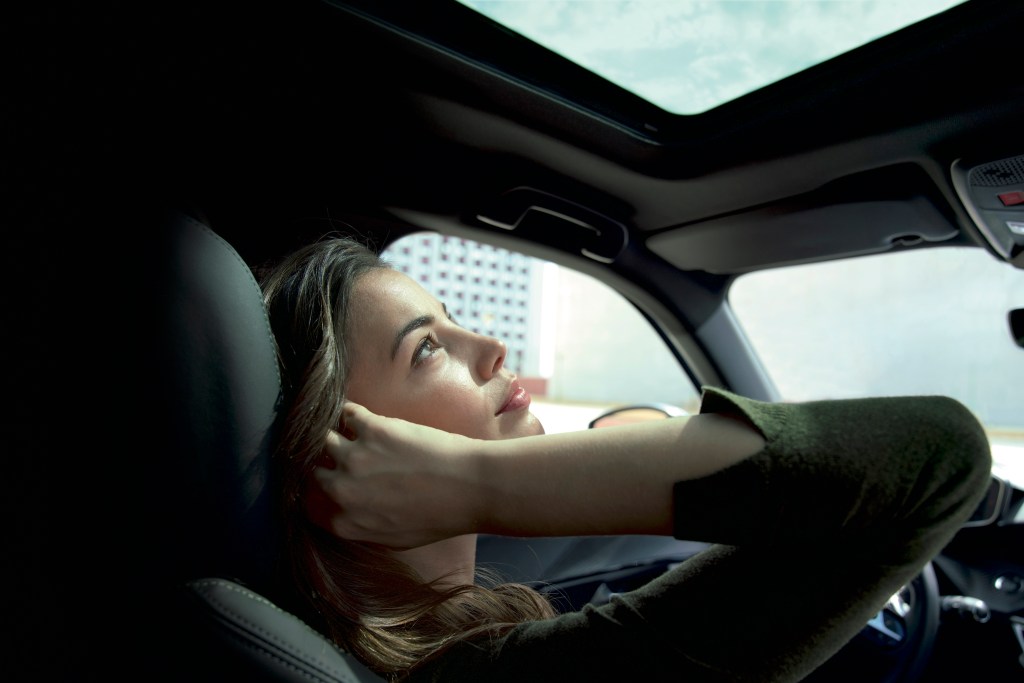
Peugeot UK finds that some people are using their vehicles as spaces for relaxation. (Image: Peugeot)
The company found that 41% of those surveyed said that because of the pandemic-driven lockdown they’ve been using their vehicles for other activities.
58% said it is a place of calm
47% watched TV
43% read books
Although lockdowns and stay-at-home orders will, one hopes, go away in the U.K. (as well as everywhere else) in the not-too-distant future, this use of vehicles for things other than transport may continue.
If they had a zero-emission vehicle (not coincidentally Peugeot has vehicles like the e-2008 electric vehicle), 37% would continue to use their vehicle as an alternative space.
Why? Because the electric motor would allow interior climate control without any exhaust.
The GM Fairfax Assembly & Stamping plant produces the Chevy Malibu and Cadillac XT4. CAMI produces the Chevy Equinox. At the San Luis Potosi plant it’s the Equinox, Chevy Trax and GMC Terrain.
Today all three of these plants, which have been on downtime shifts, have had their downtime extended.
At San Luis Potosi through the end of March. At the other two assembly plants: “to at least mid-April.”
Why?
The shortage of semiconductors.
GM is using its available chips for its “most popular and in-demand products”—like, not surprisingly, full-size trucks and SUVs.
This is completely understandable. Well, the selection of what to build is, at least.
GM has some of the best people in any industry when it comes to dealing with suppliers. While the pandemic certainly caused a shift in priorities not only when it came to vehicle purchases but also the demand for silicon-based products for those suddenly working and learning from home, it seems as though when it comes to traditional sourced components GM (and other OEMs) are masterful.
But it seems that when it come to silicon and having to compete with consumer electronics manufacturers it is an entirely new challenge.–gsv
And it isn’t whether or not there’s free coffee at the dealership
“The future of Volvo Cars is defined by three pillars: electric, online and growth. We want to offer our customers peace of mind and a care-free way of having a Volvo, by taking away complexity while getting and driving the car. Simplification and convenience are key to everything we do.” That’s Lex Kerssemakers, head of global commercial operations, for Volvo Cars.
Volvo announced it will be all-electric by 2030. And that it is launching a line of electric vehicles that will be available online only.
This doesn’t mean that Volvo dealers are going to be looking for something else to do come 2030.
It does mean, however, that there will be some offerings tailored to the ever-increasing number of people who can’t figure why you need to go to a special place to buy something when they have a perfectly good digital device at hand.
“Online and off-line need to be fully and seamlessly integrated. Wherever the customer is in their journey – online, in a showroom, in a Volvo Studio, or driving the car – the customer experience needs to be top-notch,” Kerssemakers added.
Although General Motors is bullish on the whole notion of people driving around in electric vehicles (EVs), for the most part that’s something that is off into the future because there aren’t a whole lot of EVs out there for people to drive—vehicles from GM or any other OEM, for that matter.
GM has had the Bolt EV in dealerships since 2017, a compact car. Compact cars of any type aren’t exactly high on the lists of consumer gotta-haves, and let’s face it: GM’s offering in this space hasn’t been such that people are likely to think when they go out shopping, “Hmm. . . I think I’ll go check out GM compact models.”
Which is to say that the company needs to modify its approach, and with the Bolt EUV it has done that—a bit.
2022 Chevrolet Bolt EUV: Second EV in the Chevy lineup. (Image: Chevrolet)
According to program engineer Rob Manitian, the Bolt EUV shares no sheet metal with the Bolt EV. That said, the Bolt EV has undergone a midcycle refresh so in its new execution, it has a different look, as well.
The rationale for the Bolt EUV is to make the vehicle have more of a “utility” appearance, because if there is something that market wants—and that Chevy has on offer from small to medium to large—its something that seems “utile.”
Seems is pretty much the operative word for the Bolt EUV when it comes to utility vis-à-vis its stable mate.
That is, the Bolt EUV is bigger than the Bolt EV:
The EV has a wheelbase of 102.4 inches; the EUV 105.3.
The EV has an overall length of 163.2 inches; the EUV 169.5.
The height difference is just 0.2 inches.
The size difference is manifest in the rear legroom:
The EV offers 36 inches; the EUV 39.1.
But here is where the seems kicks in: Cargo volume.
The cargo volume behind the rear seat in the EV is 16.6 cubic feet and it is 57 cubic feet with the rear seat folded.
The cargo volume behind the rear seat in the EUV is 16.3 cubic feet and it is 56.9 cubic feet with the rear seat folded.
While those numbers are not significantly different—especially that 0.1 cubic foot difference—one might imagine that the EUV might offer a significant difference when it comes to accommodating stuff, which it clearly doesn’t. (OK. It has standard roof rails. But. . . .)
If you’re not putting someone in that rear seat, then one could say that the choice between the two is pretty much a wash, given that the vehicles have the same platform and propulsion system.
The vehicle is powered by a 150-kW permanent magnet motor. (A.k.a., 200 hp) There is a 65-kWh lithium-ion battery pack that provides an estimated range of 250 miles on a full charge. With a Level 2 charger (240 V) the battery goes to a full charge in 7 hours; with a DC fast charge system, up to 95 miles in 30 minutes.
Because of the increase in the wheelbase, there is a different driving dynamic, one that is appreciated when using. . . Super Cruise.
That’s right: the hands-free driver assistance technology that has been heretofore available only in Cadillac models has moved to the Bolt EUV.
The Super Cruise system makes use of sensors—radar, cameras, on-board—and a LiDAR map. (No, it doesn’t have LiDAR but the mapping of some 200,000 miles of roads—like freeways—that has been done with a LiDAR system. What does that mean? Simply that it is really accurate. In addition to which, GM has a contract with a company that is out there right now, scanning more roadways and updating existing ones, information that goes to Super Cruise via over-the-air updates.)
You activate the system, set speed for adaptive cruise, and assuming you’re on roadway that is good to go, you center the car in the lane, it then gives you a lightbar on the steering wheel indication that it is ready, so you push the button a second time. . .and remove your hands from the steering wheel.
The Bolt EUV then maintains speed—adjusted based on the set spacing via the adaptive cruise—and maintains the lane. The road curves; the steering wheel makes the adjustment.
You are not permitted to take a nap or read a newspaper because there is an unobtrusive “Driver Attention System” that uses infrared lighting and a small camera on top of the steering column that keeps an eye on your eyes (even through sunglasses) so that if you’re paying insufficient attention to what’s going on, the system let’s you know that’s not acceptable behavior.
But to return to the wheelbase for a moment. When driving at freeway speeds in the adjacency to big rigs, unless you’re in a full-size SUV or pickup truck, you’re going to feel buffeting. The addition six inches of wheelbase undoubtedly helps keep things from feeling too unsettling when the Bolt EUV is, essentially, driving itself (I suppose that this point I ought to have in big red letters something that says YOU ARE RESPONSIBLE FOR BEING IN CONTROL OF THE VEHICLE because as modern as it is, you’re still in charge).
The interior of the vehicle is fresh and contemporary without being too overtly “futuristic” in execution. I actually wish it did seem to be a bit more advanced because let’s face it: this is still leading-edge technology compared to about 95% of everything else on the road, so those who are adopting it ought to get a nod that they’re participating in the creation of the future. (It is worth noting that the front end of a white Bolt EUV does resemble a Star Wars stormtrooper, however.)
But perhaps the biggest takeaway of the Bolt EUV is that while it is a technologically sophisticated vehicle, it is a normal vehicle. It is a vehicle that anyone can drive without feeling as though they’re in something that is uncomfortably different (“Uh, how do I ________________”).
Which is what will really matter in order to get more people behind the wheels of EVs.–gsv
Even before COVID this was going to be different. Now it will be really different
When the 2019 North American International Auto Show (NAIAS) closed its doors at what was then still known as “Cobo Center,” Rod Alberts, executive director of the Detroit Auto Dealers Association (DADA), the organization that puts on NAIAS, and his team had a idea for what they would do the following year, something that would be significantly different from the cars-on-carpet approach that had long been characteristic of not only the Detroit Show, but auto shows in general.
For one thing, the date would change to June, which is certainly a much more climatically hospitable time of year.
For another, rather than just staging an event at an expo center, the expo center would be an element of something that would take advantage of a wider footprint in downtown Detroit.
Rod Alberts (Image: DADA)
It wouldn’t just be a matter of people looking at vehicles, but having the opportunity to experience them—including autonomous vehicles.
While a map of NAIAS was historically one with the boundaries being formed by the walls of a single building, the new map was one that stretched far beyond Jefferson and Washington Blvd.
But then there was COVID.
On March 28, 2020, NAIAS put out a statement that included a statement from Rod Alberts: “With the more than 100 convention centers and facilities around the country being considered to potentially serve as temporary hospitals, it became clear to us that TCF Center”—the rebranded Cobo Center—”would be an inevitable option to serve as a care facility to satisfy our community’s urgent health needs.
“One of the hallmarks of NAIAS since the very beginning has been our commitment to being socially responsible. Our thoughts continue to be with those whose lives have been impacted by this devastating virus. And we support the city and state’s mission to help preserve life in the face of this challenging situation.”
The 2020 NAIAS was canceled.
So Alberts and his team flipped the pages of the calendar to June 2020.
January 11, 2021, with COVID-19 getting worse than it had been in March 2020, Rod Alberts and his colleagues canceled the 2021 NAIAS.
But they announce a new event, one that will be held September 21-26, not at TCF Center and its environs, but at the M1 Concourse in Pontiac, Michigan, which is 87 acres dedicated to motorsports, including a 1.5-mile track.
While the reimagined NAIAS that was going to be held in Detroit would have offered some rides, the nature of those rides would have been nothing like what Alberts says is going to happen at what is named “Motor Bella.”
He’s talking fast.
And not only does the M1 allow fast, there is also an off-road facility, so he’s talking dirty, too.
Fast cars, rock-crawlers and a whole bunch of new sheet metal in a whole different venue.
Alberts talks all about Motor Bella on this edition of “Autoline After Hours” with “Autoline’s” John McElroy, Detroit Free Press car critic Mark Phelan, and me.
Alberts, who has probably been to more auto shows in venues around the world than most people have been to auto shows in their home towns, says that the team at NAIAS is completely aware of the what expectations are among especially younger audiences, so they’re going to be staging the Motor Bella event to appeal to not only this younger demographic, but to car enthusiasts of all types.
But while Motor Bella will be an alternative—given that it is outdoors, it can accommodate a COVID environment that, one hopes—will be less onerous—Alberts says the they’ll be back downtown, too.
If you have any interest in the transformation of auto shows, this is something you need to watch.
In light of the kerfuffle between Stellantis, owner of the Jeep brand, and the Cherokee Nation, whose chief, Chuck Hoskin, Jr., told Car and Driver that the Stellantis marque really ought to give up the name “Cherokee” for its Grand Cherokee and Cherokee vehicles as a matter of respect, we thought we would bring you names that poet Marianne Moore came up with for Ford in 1955 when it was searching for a name for what would become the Edsel.
Hurricane Accipter The Impeccable Symmechromatic Thunderblender The Resilient Bullet Intelligent Bullet Bullet Cloisoné Bullet Lavolta The Intelligent Whale The Ford Fabergé The Arc-en-Ciel Arcenciel Mongoose Civique Anticipator Regna Racer Aeroterre Fée Rapide
Moore’s final suggestion: Utopian Turtletop.
If you think about it, “Anticipator” would be a good name for a Level 2+ or higher autonomous vehicle.
Incidentally: Moore was no poetic slouch. Among her many writing awards are the National Book Award and the Pulitzer Prize.–gsv