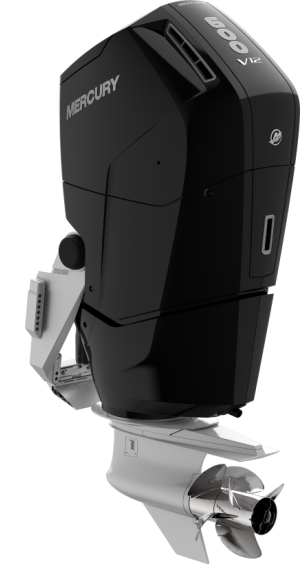
“With boats continuing to grow bigger and performance expectations continuing to rise, boaters have been asking for a better, more capable high‑horsepower solution to meet their needs. The V12 Verado outboard is Mercury’s answer,” said Chris Drees, Mercury Marine president.
Yes, that is “V12” as in a 7.6-liter, 600-hp V12 engine.
While OEMs are seemingly hell-bent on creating an electric transportation future, there is one Everest-sized speedbump between now and then: the lack of a robust charging infrastructure for those vehicles.
Although companies like Shell and bp talk about peak oil and changing their business models to less carbon-intensive approaches, how many of their stations provide electric chargers? Probably far fewer than offer gasoline, beef jerky and lottery tickets.
The European Automobile Manufacturers Association, the European Consumer Organisation and Transport & Environment have jointly written a letter to the commissioners responsible for the European Union’s Green Deal detailing the necessity for specific regulations rather than a nice-to-achieve directive, regulations that will “set binding national targets for all vehicle segments” vis-à-vis charging.
The authors write: “the following minimal targets should be set in stone: one million charging points in 2024 and three million in 2029 for passenger cars and vans, as well as around 1,000 hydrogen stations by 2029.”
And the boldface font is in their letter.
Apparently there are some 225,000 charging points in the EU right now. If they’re going to have one million charge points by January 1, 2024, then this means they need to install 258,000 additional chargers per year. Or 33,000 more per year than currently exist.–gsv
As people spend more and more time indoors because of the pandemic, they are doing all manner of things, from baking sourdough bread to learning how to play musical instruments that they had to pull out of the closet where they abandoned them years earlier.
But then there’s Leh Keen.
He decided to set a Guinness World Record: setting a speed record for a vehicle indoors.
The indoor space he chose was not a rec room that hadn’t been used since the kids were small.
Rather, it was Ernest N. Morial Convention Center in New Orleans, Louisiana, which has the largest contiguous-space exhibit hall, of about 1-million square feet.
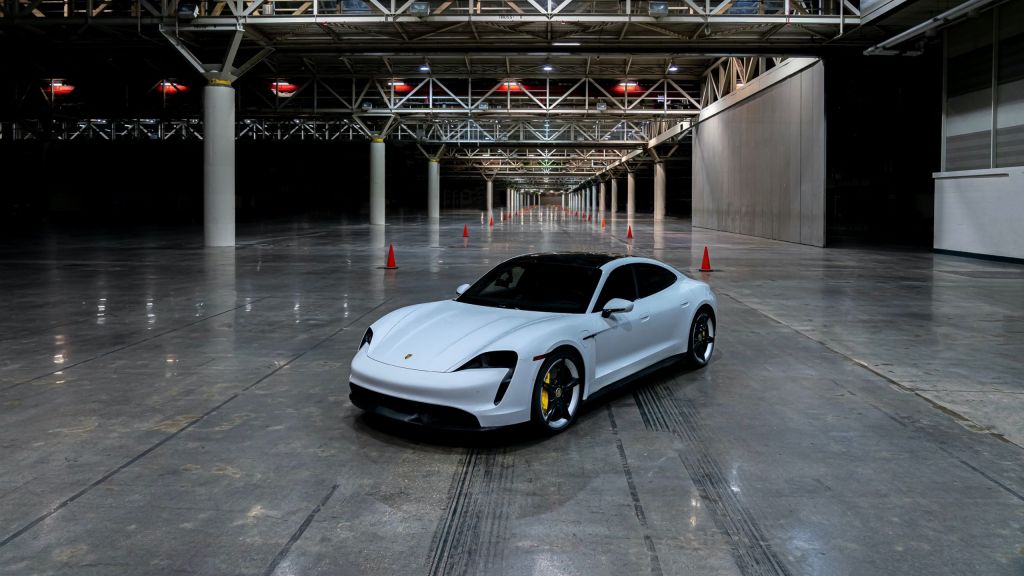
The vehicle in question Keen selected was a Porsche Taycan Turbo S, an all-electric car that provides 750 hp and has four-wheel drive. The car has the ability to accelerate from 0 to 60 in 2.6 seconds.
Porsche Taycan Turbo S driven by Leh Keen to an indoor speed record. (Image: Porsche)
Here’s something you probably didn’t think about because you’ve not driven in a convention center space.
The polished concrete floor is slippery.
Keen: “The surface is so unpredictable, so slick, that you have to have complete trust in your car. It truly was like ice – and you’re accelerating flat out, facing a really hard wall at the end. Suddenly, even in a massive space like the one we had, it seems very small.”
The requirement for the record was to start from a standstill and to come to a complete stop.
There are no safety nets. No open doors to escape through if things go badly.
The record was 86 mph. It stood for seven years.
Keen made the run—and the record—with 102 mph.
He said, “102 mph inside a building. What was I thinking?”–gsv
Americans are big. Really big. Which might explain the absence of small cars (or almost any cars) being offered by the major OEMs
The accepted wisdom seems to have it that one of the primary reasons why vehicle manufacturers are getting out of cars and pouring more resources into crossovers is because they can make better margins on the latter. Which may be true, but is likely only part of the story.
According to the Centers for Disease Control and Prevention, American adults are, well, large. The average male over 20 is 5-foot 9-inches, weighs 199.8 pounds and has a 40.5-inch waist. The average female is 5-foot 3.5-inches, tips the scales at 170.8 pounds, and has a 38.7-inch waist. According to the CDC, 73.6% of adult Americans are overweight.
Seems like a fairly compelling rationale for large vehicles.
So what’s someone who wants to buy a small car to do? Well, the answer to that is “Look for something that is not all that small.”
That is, of the U.S. Big 6 automakers—GM, Ford, Stellantis NA, Nissan, Toyota and Honda—only GM has a car that can be considered “small.”
Chevrolet still offers the Spark. This car has a 93.9-inch wheelbase, is 143.1-inches long, 62.8 inches wide, and 58.4 inches high. It has a passenger volume of 83 cubic feet, and a cargo volume behind the rear seat of 11.1 cubic feet.
2021 Chevy Spark. Small. But big. (Image: Chevrolet)
The next smallest is the Fiat 500X, although the company positions it as being a crossover rather than a car, but for the sake of argument, let’s include it since it has a design that is very much like the now-departed (and tiny) 500. The 500X is gargantuan compared to the Spark, with a 101.2-inch wheelbase and length, width and height dimensions of 167.2, 73.2 and 63.7 inches, respectively. It has a passenger volume of 91.7 cubic feet and cargo area behind the rear seat of 14.1 cubic feet.
Then there’s the Nissan Versa. It has a wheelbase of 103.1 inches—9.2 inches more than the Spark—and an overall length of 177 inches, or almost three feet longer than a Spark. Its other dimensions are 68.5 inches width, 57.3 inches height, a passenger volume of 88.9 cubic feet and a cargo volume of 14.7 cubic feet.
Whereas people might associate “Honda” with “small cars,” with the Fits remaining on dealer lots the only ones left, the smallest car in the lineup is the Civic Hatch. Which isn’t all that small. It has a 106.3-inch wheelbase, is 177.9 inches long, 70.8 inches wide and 56.5 inches high. It has a passenger volume of 97.2 cubic feet and a cargo volume of 25.7 cubic feet.
The smallest Toyota car is now the Prius, which has a wheelbase of 106.3 inches and an overall length of 180 inches—or more than three feet longer than a Spark. It is 69.3 inches wide, 57.9 inches high, and offers 93.1 cubic feet of passenger volume and 27.4 cubic feet of cargo capacity.
Finally, there’s Ford, the company that was the first mass producer of passenger cars, the company that is now shifting its offerings away from, well, passenger cars. It currently has two cars on offer, and production has stopped for the Fusion, so that leaves the Mustang. Which is a completely bizarre thing to have in the context of a Spark. But here it is. The Mustang has a 107.1-inch wheelbase and an overall length of 188.5 inches. It is 81.9 inches wide, 54.3 inches high, and has a passenger and cargo volume of 82.8 and 13.5 cubic feet, respectively.
But consider this: the Spark actually offers more passenger volume than the Mustang. Not much more (0.2 cubic feet, or about the size of a football). But more.
So it might be a reasonable choice for a big American looking for a small car.–gsv
The Lexus CT200h became available in the U.S. market in 2011. It was a global vehicle, one that was a hybrid-only vehicle, albeit not the first Lexus to be such: there was the HS 250h that had gone on sale in 2009 in the U.S. The HS didn’t work out so well in the U.S. market, having been pulled in 2012. Arguably, the issue was that the HS 250h was pretty much just a compact four-door that was Lexus-nice, but not enough. The CT200h had a better run in the U.S. market—going until 2017—and it continues to have a level of appeal as it was a compact hatchback, making it somewhat special (the CT200h wasn’t the first Lexus hatchback: there was the IS hatch, which had a run from 2002 to 2005, but it wasn’t a hybrid).
The Lexus CT 200h hybrid: A charming hybrid circa 10 years ago. (Images: Lexus)
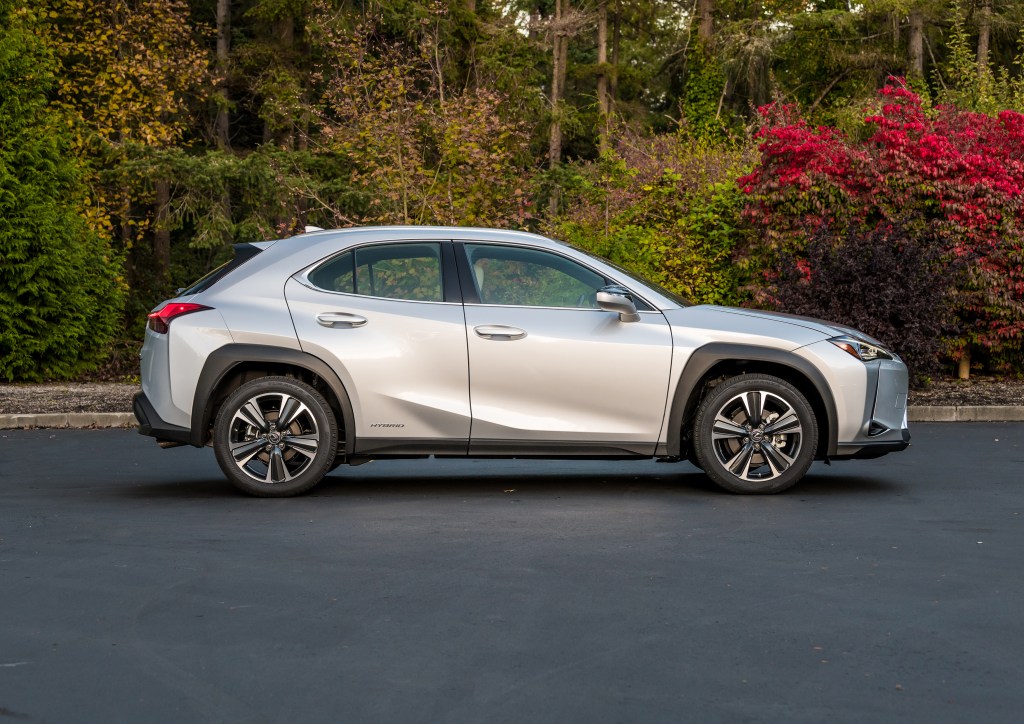
The CT200h came to mind—not the more similarly named HS 250h—when I drove the UX 250h, a compact crossover. The charm of the CT carries over to the UX.
Realize that Lexus offers the RX as a hybrid, as well as the NX. So it is big, smaller and compact with the addition of the UX. The other two are more SUV-like than the UX. It strikes me as a, well, compact hatchback. Yes, it is designed more like a crossover than an SUV, but if you squint. . .there’s the CT200h.
And like the other two, the UX is available as a gasoline-only-powered vehicle. The hybrid version brings AWD with it.
The vehicle is powered by a hybrid system that consists of a 2.0-liter inline four that is supplemented by a two-motor generator hybrid transmission—one motor serves as a generator to provide electricity that goes to the vehicle’s nickel-metal hybrid battery system (yes, NiMH) and to control engine speed while the other motor provides power to the wheels as well as performs regenerative braking. The total system horsepower is 181, which is suitable for an AWD vehicle with a 3,605-pound curb weight: You’re not going to be breaking any speed records and may not even be the first to go when the light turns green, but you’re also going to get an estimated fuel economy of 41 mpg city, 38 mpg highway and 39 mpg combined, which Lexus says makes it the most fuel-efficient crossover without a plug. (Who would have thought that Lexus would be the leader in fuel efficiency while providing a vehicle that is anything but frugal in its interior execution and amenities? This simply speaks to the proficiency that Lexus has in executing vehicles.)
Lexus UX 250h hybrid: Charm circa right now.
The vehicle “seats five.” With a moonroof the passenger volume is 88.5 cubic feet; it is 90.4 cubic feet sans. Trust me: you don’t want to be the fifth person in the vehicle regardless of the roof. The SAE cargo volume is 17.1 cubic feet: remember—this is a compact crossover, so you’re not going to be moving any fridges in it unless it is sized for a dorm room.
But the real thing about the UX is its charm. Which is something that isn’t often characteristic of vehicles nowadays. The 2020 UX 250h Luxury trim has a starting MSRP of $39,900, which makes it the most-affordable Lexus hybrid by a few hundred bucks: the NX 300h AWD starts at $40,160, and while it is a bit bigger, there is something about the UX 250h that makes it special.
If there is any company that really needs its next launch to go off well it is Mitsubishi Motors North America. The vehicle in question is the 2022 Outlander, an SUV.
For 2020 its sales were down in the U.S. by 28%–a big hit to any company—but what makes matters worse, the total number is just 87,387, or about the number of Lincoln SUVs sold in 2020 (87,893)—and let’s face it, Lincoln SUVs have better margins than the Mitsubishi models so the Mitsubishi number is less good than it might be. (Or to be more apples-to-apples, Ford sold 178,496 Escapes in 2020.)
The Outlander has a lot riding on it.
As there seems to be a growing interest in vehicles with off-road cred, Mitsubishi is in good shape given its experience in rally racing, including the Dakar. Kentaro Honda, segment chief vehicle engineer, said of the new Outlander, “We took everything we know about on- and off-road driving from the rally experiences to apply the latest Super All-Wheel Control technology in our newly developed platform. We also specifically developed a new drive mode selector to provide confident driving at all times and in all weather conditions. We hope that many customers will have great experiences with the enhanced driving performance of the all-new Outlander.”
Presumably, this means the vehicle will be off-road worthy—and yet make it simple enough for the likely intended buyer (think someone living in the snowbelt—but in the suburbs, not some mountain top) to be able to dial-in what’s needed without having had a training course at Moab.
2022 Mitsubishi Outlander to be revealed on Amazon Live February 16. But no, they won’t deliver one to your house with Prime. (Image: Mitsubishi Motors North America)
To address that demographic, the global reveal will occur on Amazon Live, Tuesday, February 16 at 6 p.m. EST.
Despite the venue, you cannot get a 2022 Outlander through Amazon Prime.
(Although I’m betting that in the not-too-distant future, Amazon will someone work its way around dealer franchise laws and. . .)
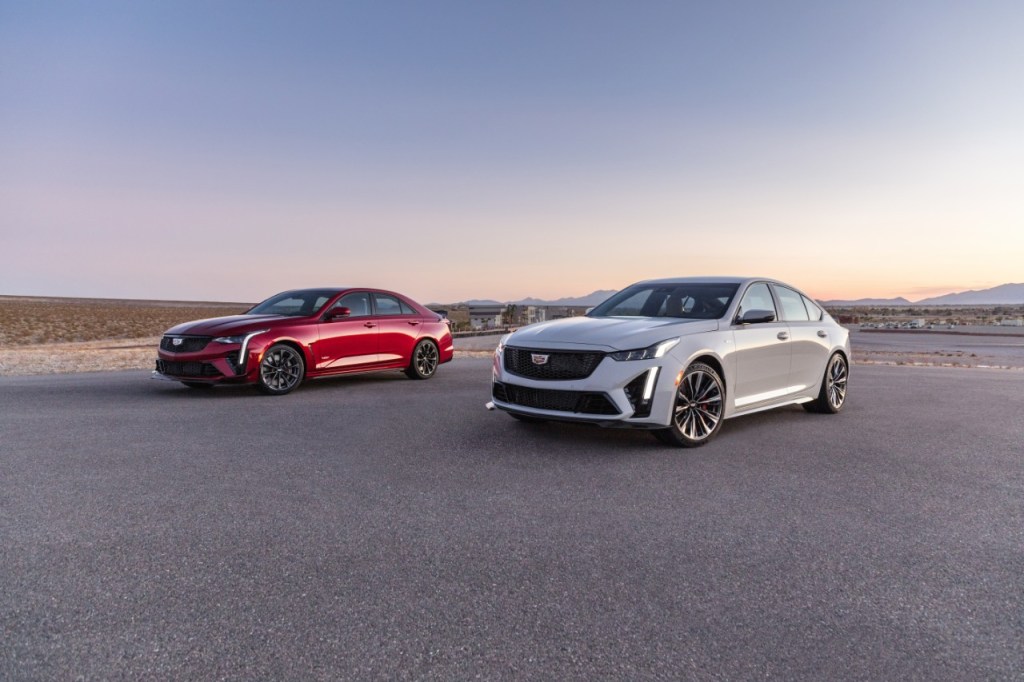
If when you think “Cadillac” you think of something big and lush and lumbering like the Escalade (no offense to the SUV, but it is 211 inches long and weighs up to 6,015 pounds, a.k.a., three tons), then the 2022 V-Series Blackwing vehicles are going to absolutely upend that notion: The CT5-V Blackwing is powered by a hand-built (think about that for a moment) 668-hp. 6.2-liter supercharged V8 mated to a six-speed manual TREMEC transmission; the sedan has a top speed of over 200 mph.
Then there’s the CT4-V Blackwing, which is smaller, a subcompact, and is certainly no slouch, as it is fitted with a 3.6-liter twin-turbo V6 such that it has an estimated top speed of 189 mph. Equipped with the optional 10-speed automatic (which is also available for the other car), it has an estimated 0 to 60 mph in 3.8 seconds.
2022 CT4-V Blackwing (left) and CT5-V Blackwing (right): engineered to perform. (Image: Cadillac)
Of course, when you go fast you also need to, well, stop, so there are serious Brembos deployed, with the CT5-V Blackwing featuring the largest factory-installed brakes in Cadillac history: 15.67 x 1.42-inch front rotors and 14.7 x 1.1-inch rear rotors. (There is also a lightweight carbon-ceramic brake package available, which is helpful in track situations, in particular, as it reduces unsprung mass by 53 pounds and rotating mass by 62 pounds.)
At this point you might be wondering why these vehicles are being named with their full names. That’s because you can go to a Cadillac dealership and buy a CT4 or a CT5. Or you can buy a CT4-V or a CT5-V.
The Blackwing execution is a whole different thing.
And so to that end, on this edition of “Autoline After Hours” Tony Roma, chief engineer of Cadillac V-Series Blackwing, provides a deep dive into the features that they’ve brought to the vehicles in order to make them track-capable vehicles straight out of the dealer’s showroom.
Roma talks with “Autoline’s” John McElroy, Chris Paukert of Roadshow by CNET and me.
Roma says that their objective was to make a vehicle that is “light, nimble and precise.”
Which is arguably what some people might not think about when it comes to Cadillacs.
Then McElroy, Paukert and I discuss a variety of other subjects, including Cadillac’s electric future (Roma is also the chief engineer for the forthcoming, ultra-luxury Celestiq electric vehicle), the agreement between Google and Ford and the whole issue of data monetization, January sales and a whole lot more.
No, this is not predicated on some prognostication wrapped in a Tweet by Elon Musk, nor by the potential that Syd Mead fans may actually get their Cybertruck before the end of 2021.
No, this is not predicated on Joe Biden’s plan recommendation to transform the government’ fleet of ~650,000 vehicles from gasoline and diesel to electric as part of the “Buy American” initiative.
Merchants Fleet has ordered 12,600 BrightDrop EV600s, an all-new, electric light commercial vehicle purpose-built for the delivery of goods and services over long ranges. (Image: GM)
No, this is not even predicated on GM CEO Mary Barra’s statement last week that the vehicle manufacturer intends to become completely (i.e., product and process) carbon-neutral by 2040, including an “aspiration” to eliminate tailpipe emissions by 2035.
No, this is because of three other data points that all came out on the same day this week, all of which indicate that electric vehicles are taking on some significant substance.
1
BrightDrop Gets Second Order
BrightDrop, the company that GM recently established for business deliveries that is predicated on EVs and logistics software, has obtained an order for 12,600 BrightDrop EV600s, from Merchants Fleet, a company that describes itself as “the nation’s fastest growing fleet management company.” Deliveries of the EV600, a light commercial vehicle with some 600 cubic feet of cargo capacity and a range of up to 250 miles, are to start in 2023. The first customer for the trucks is FedEx. The importance of cargo vehicles for EVs can’t be overstated. Not only has Amazon invested a few hundred million in Rivian, but it has ordered 100,000 electric trucks, with deliveries starting later this year.
2
Edmunds Declares “Pivotal Year”
“After years of speculation and empty promises, 2021 is actually shaping up to be a pivotal year for growth in the EV sector. We’re not only about to see a massive leap in the number of EVs available in the market; we’re also going to see a more diverse lineup of electric vehicles that better reflect current consumer preferences.” That’s Jessica Caldwell, Edmunds’ executive director of insights. While the projected growth of EV retail sales is still small—according to Edmunds, they were 1.9% in 2020 and are expected to reach just 2.5% of the market in 2021—the firm anticipates that the greater number of available products in 2021, 30 vehicles including 13 SUVs and six trucks, should start making a big difference.
3
EY Sees “Massive Evolution” in Transport
“Electrifying transport is critical for Europe to meet its tough emissions targets and create a decarbonized future. Transitioning fleet first will pave the way and generate new commercial opportunities, including vehicle-to-grid and electric vehicle charging solutions among others. In order to achieve this, a fleet-centric approach is needed across both government and industry, which aims to remove barriers in areas including common standards and investment,” says Serge Colle, EY Global Power & Utilities Leader. While he is specifically talking about Europe, where the CO2 emissions standards are demanding and becoming more so, the focus on fleets (think things like EV600) is key because as EY research indicates: “the lessons learned from accelerating fleet electrification such as the development of sustainable business models that support charging infrastructure investment and integration of smart charging capability, will enable the wider secondary and passenger vehicle market to transition quicker.” First the fleet. Then the driveway.–gsv
One of the consequences of the pandemic is the increase in the number of commercial vehicles on the roads—as in, for example, all of those FedEx, UPS and Amazon Prime trucks crowding in suburban neighborhoods like a street in New York City pre-pandemic.
Who knew there was such a demand for home deliveries?
So to meet the demands for medium-duty commercial trucks (as well as buses and heavy-duty pickups), ZF has announced that it is investing $200-million in its plant in Gray Court, South Carolina, to produce its ZF PowerLine 8-speed automatic transmission.
This is a new transmission, as it went into production at the ZF HQ production facility in Friedrichshafen, Germany, at the end of 2020; the factory in South Carolina is scheduled to start exclusively supplying the North American market in 2023.
ZF PowerLine 8-speed transmission for truck applications. (Image: ZF)
A couple points about the transmission:
Although it is an 8-speed, Christian Feldhaus, Director Commercial Vehicle Driveline Technology North America, ZF, says, “ZF PowerLine proves equal, but in most cases, higher performance and efficiency than other transmissions with 9 and 10 speeds.” Or more gears are not necessarily better.
In addition to which, although there is increased attention to electric commercial vehicles—such as those Amazon will be getting from Rivian and General Motors’ new BrightDrop—one might wonder about a transmission ostensibly for ICE applications. Feldhaus: “With its modular design, PowerLine is prepared for mild hybrid and plug-in hybrid variants, making it a true technology bridge to future mobility.”
Arguably, post-pandemic there may be a falling off of home-delivery demands. But odds are people who have found it to be a convenient way to get things may stay with it.
So there’s going to be a need for a lot of transmissions.–gsv
In his previous essay looking at the inexorable increase in the cost of vehicles that is putting new ones out of the reach of many, Todd Lassa rhetorically asks, “So what’s the average Joe to do?” So he continues. . .
The answer is bicycles. Before the pandemic, bicycle sales were strong as urban planners re-designed cities to be less auto-centric, and the bike industry innovated with disc brakes and tubeless tires trickling down to $1,000 commuter models, as high-end road bikes adapted electronic shifting. Electric-assisted (e-bikes) and bike-friendly clothing lines formal enough to be worn at office make the commute easier, even in northern cities.
The U.S. market exploded after last March, and severe shortages, especially of those commuter-style bikes were compounded by factories closed to avoid pandemic spread and tariffs against Asian manufacturers by the Trump administration. More than 90 percent of bicycles sold worldwide come from Taiwan and China, with the Giant Manufacturing Company building frames for most the world’s mainstream brands.
Cars and light trucks aren’t going to disappear en masse as urban planners design more, wider bike lanes onto the streets, but more balance between the two types of conveyances is not a bad thing, even for auto enthusiasts.
Pinarello Dogma F1. (Image: Pinarello)
Annual U.S. bike sales numbers are not as reliable as auto sales by registration. The industry is split between cheap commodity bikes sold at big box stores like Walmart, and more “serious” higher quality bikes sold at bicycle shops. The U.S. Commerce Department does count bike and bike frame import numbers (serious enthusiasts can build their own bikes at home by ordering a high-quality aluminum or carbon-fiber frame and adding components from Shimano, SRAM and other suppliers), says Stephen Frothingham, Bicycle Retailer and Industry News’ editor-in-chief. By last October, Frothingham told me, 13.6 million bikes and bike frames were imported into the U.S. for the year, up 19% over the same period in 2019. He estimates the full-year number of bike imports will come to “well over 14.5-million sold in 2020.” Does that number sound familiar?
If you haven’t purchased a new bike in a few years, you might be a bit surprised to walk into a reputable bike shop and find most models priced between roughly $1,000 and $5,000. A new Pinarello Dogma F12, probably the Ferrari SF90 of bikes, will set you back $6,500, frame only, or $12,000 fully built. But consider that the cheapest model you can buy in the U.S. from Ford, the company that put America on wheels, is the wonderfully mediocre EcoSport subcompact crossover, at $21,240. –Todd Lassa