Gas Guzzled

Nowadays it seems as though no one really cares much about the fuel efficiency of their vehicles (unless, of course, the people in question work at an OEM and need to meet regulations that may, in the U.S., at least, be becoming less of an issue, so these people may not care much either).

After all, the price at the pump isn’t all that high, at least so far as memory serves.

But it seems as though prices are ratcheting up, but perhaps in a way that doesn’t seem all that onerous. Yet.

According to GasBuddy, during the week preceding March 19, 2018, gas prices in Detroit rose 7.8 cents per gallon compared to the previous week to an average $2.63 per gallon.

While less than a dime isn’t much, it should be pointed out that they’ve found that the price is 14.6 cents higher than a month ago.

And 31.1 cents per gallon compared with a year ago.

Looked at nationally, things are going north, as well.

According to Patrick DeHann, head of petroleum analysis for GasBuddy, “The national average now stands at its highest level in over a month and is likely to continue moving higher in the weeks ahead as demand continues to recover from the winter blues and the transition to summer gasoline kicks into high gear.”

And here’s the real kicker: DeHann continued, “Overall, gas prices this spring will come in some 10-25% higher than a year ago, removing billions of dollars from other areas of the economy that will instead be funneled to the pump.”

Billions of dollars.

Honda Launches 2018 Accord Hybrid

Honda has been stalwart in its attempts to appeal to auto buyers with a hybrid version of the Accord, going back to 2004 for the 2005 model year, which was then described as the “world’s first V-6 powered hybrid vehicle,” a car that then-American Honda executive vice president Tom Elliott described as “the first hybrid vehicle that combines superb fuel economy with truly exhilarating performance.”

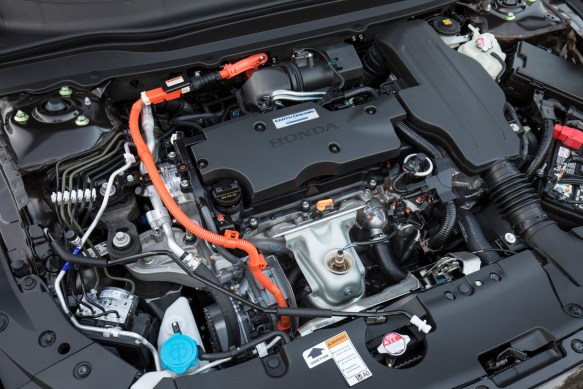
2018 Honda Accord Hybrid
It is almost quaint to look back at the EPA estimated fuel economy numbers for that model: 29 mpg city and 37 mpg highway. You can buy a 2018 Accord with a 1.5-liter turbo that will return 30 mpg city and 38 miles highway—no hybridization involved.
Be that as it may, Honda has launched a new Accord Hybrid, which uses a 2.0-liter four that’s mated to an electric motor, for a total system output of 212 horsepower. This contemporary take on what may be thought of as “exhilarating performance” must be at the basis of the Honda claim that it is the “New Benchmark Among Midsize Hybrids,” because the 2018 Toyota Camry Hybrid, which is certainly the arch-rival in this segment, as both the Accord and Camry are all-new for the model year (unlike the midsize hybrids available for the likes of Hyundai, Ford and Chevy aren’t), has 208 hp.

2018 Honda Accord Hybrid
But the Camry Hybrid has an estimated fuel economy of 51/53/52 mpg (city/highway/combined) and the Accord Hybrid returns an estimate 47/47/47 mpg.
So the question is, what’s more important to the midsize hybrid sedan buyer: 4 horsepower or 5 mpg? Both are fairly minor all things considered, but chances are someone who is going to buy a mainstream hybrid wants the miles per gallon more.
A word about the Accord-Camry competition. Although the Accord won the 2018 North American International Car of the Year award and a trophy case full of other honors, in the 2018 sales race, it is lagging well behind Camry.
According to Autodata, through February there have been 37,430 Accords sold, which is down 12.9 percent compared to the same period in 2017. Meanwhile, Toyota has delivered 55,503 Camrys, up 16.1 percent.
Yes, there are differences in the amount of fleet sales and incentives involved, but at the end of the spreadsheet, there is that minus 12.9 and that plus 16.1.
And another word about hybrids.
Certainly, Toyota has come define the word vis-à-vis cars and crossovers. Given comparatively low gas prices—to say nothing of improved fuel efficiency of conventional cars, as noted in the second paragraph above—hybrid car sales aren’t doing well. For example, Prius sedan sales through February, 7,900 units, is down 22.4 percent compared to the same period in 2017.
However, the Toyota RAV4 Hybrid sales of 7,159 units are up 17.3 percent.
It may simply be the situation that people are interested in hybrid crossovers just as they’re evidently increasingly interested in crossovers of all types compared with cars.
This may not be the ideal time for Honda to be launching the Accord Hybrid. But credit to it for trying.

Is Exterior Faux Wood an Option?

In the era of crossovers and SUVs, station wagons have become about as popular as fax machines.
Be that as it may, the folks at Mercedes would like to point out that for more than five years, its E-Class wagon has been without direct competition from its German competitors.
And as for its U.S. competitors, the last time there was a wagon that could have been considered in this context would be the 2014 Cadillac CTS-V.
The E-Class wagon, apparently, does well for the brand, as it, according to Merc, “attracts one of the brand’s highest median household incomes.” Which probably ought to be the case because through November, it has been delivered just 2,077 times this year, according to Autodata.
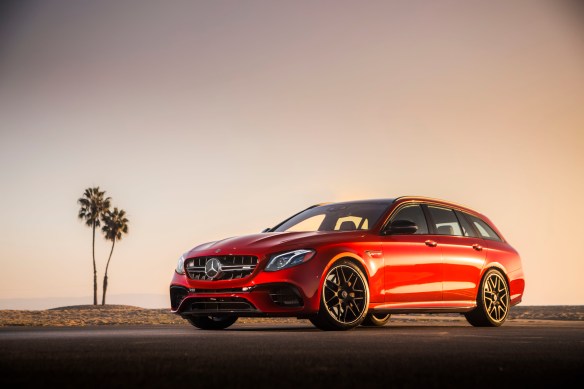
And the AMG version is even more unicorn-like because the company points out that there have never been more than “triple-digit sales” of the vehicle. If the ordinary variant is good for fewer than 3,000 per annum, chances are those trip digits are probably below the horsepower the AMG E63 S Wagon has being generated by its V8 b-turbo engine: 603. And there are 627 lb-ft of torque.
The car—sans delivery charges—is priced at $106,950. The company points out that were someone to want to drive this to the track, they can carry a second set of tires, tools and a jack in the “roomy, family-friendly wagon.”
Of course, given the size of the tires, the kids would have to stay a home should the tires be cargo. And does one really want to put tires in the interior of a Mercedes?
Guess there is something to be said to trying to rationalize a vehicle that has an estimated 0 to 60 mph time of 3.4 seconds.
Strike that.
Trying to rationalize a station wagon that has an estimated 0 to 60 mph time of 3.4 secondsMerc

Dreaming of Stockholm

Image

If you’ve seen the British TV program Wallander staring Kenneth Branagh playing the Swedish detective from the books by Henning Mankell, you know that the man evidently doesn’t get a whole lot of sleep. It is almost painful to watch. You want to shout at the TV: “Stop driving that damn Volvo and go take a nap! The crime has been committed. You can get a little kip and then solve it.”

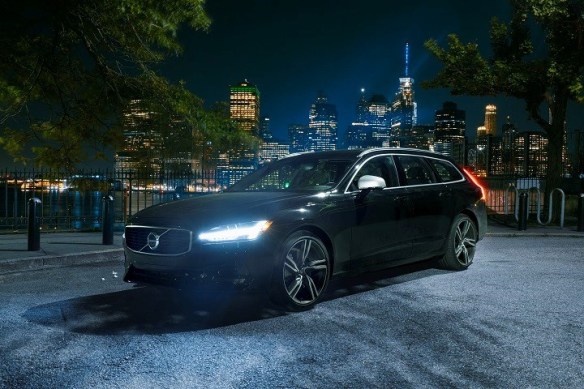
Speaking of the lack of sleep and Volvo, should you be in New York this weekend, you might swing over to Classic Car Club Manhattan, Pier 76, Hudson River Park, specifically to the “Streets Don’t Sleep” Gallery, where Volvo Car USA, Fujifilm USA and the aforementioned car club are sponsoring a photography exhibition titled “Streets Don’t Sleep.”

Work by five photographers—who focused on a Volvo vehicle (V90 Cross Country, S90, XC90, or V90)—are on display. The shooters are: Kosten, Night.Shift, Transmental, Ryan Millier, and Gregory Berg.

Oddly enough, while you can see it today or tomorrow (July 22-23), apparently the people at the gallery do sleep—a lot—because the hours are from 11 am to 4 pm.

(You can learn more at: http://www.volvocars.com/us/shopping-tools/additional-choices/events/streets-dont-sleep )

Streets Don't Sleep - Nightshift - V90

Streets Don’t Sleep – Nightshift – V90

Ram Brings the Stinger Yellow Sport

Generally, people who go for light-duty pickups for primarily recreational purposes tend to be those who want to stand out from the pack.

And those who opt for a 395-hp HEMI engine under the hood of their Ram 1500 tend to be those who don’t want to dawdle when the light turns green.RamStingerYellow

The people at Ram are addressing both of those interests with a limited-edition—as in a total of 2,250 trucks—Stinger Yellow 1500 Sport.

The truck is available in Crew Cab 4×2 and 4×4 configurations. In addition to the yellow paint, there are dual chrome-tipped exhausts, a vented sport hood, and 22-inch wheels on the 4×2, but “just” 20s on the 4x4s.

“Truck buyers are very attached to their vehicles and the Stinger Yellow Sport model adds a custom appearance to the segment’s best-looking truck,” said Mike Manley, head of Ram Truck Brand, FCA Global.

While the “best-looking” part could be debatable, there can be no question that this is the most-visible version of the truck on the market.


Adventures in Automotive Semantics

Robb Report UK* has named the Bentley Bentayga as its SUV of the year. This isn’t entirely surprising as (a) it is an all-new vehicle and (b) it has a starting MSRP in the $230,000 vicinity, and we are talking Robb Report here, not Penny Saver.

Bentayga - Copy

©James Lipman

According to Erin Baker, automotive editor of Robb Report UK, “The Bentayga creates a whole new segment: the ultra-luxury SUV. It far exceeds the nature of other luxury SUVs in every respect.”

Isn’t that pretty much what “ultra-luxury SUV” means, as in exceeding luxury SUVs?  And if it creates a new segment, isn’t it the only entry in that segment?  Let’s bust out the Venn diagrams.

Then there’s Kevin Rose, Bentley Member of the Board for Sales, Marketing and Aftersales: “The Bentayga is the Bentley of SUVs.”

Yes, the Bentley Bentayga is, well, a Bentley and an SUV. So of course it is a Bentley and an SUV.  What are we missing?  (Possibly a sense of humor.)

Well, the air up there where the Bentayga resides is a bit thin for us, so perhaps we just don’t get it.

Congratulations are in order for Bentley.  Hear-hear! or Pip-pip! or whatever the appropriate huzzah may be in this context.

*According to the Robb Report Mission Statement: “Widely regarded as the single most influential journal of living life to the fullest, Robb Report covers the newest in what matters most to its discerning and exceptionally affluent audience. Influencers and opinion leaders look to Robb Report to discover the world’s finest products, services, and experiences through both editorial and advertising,” which is notable inasmuch as it would be hard to imagine less-refined publications being quite so mercenary in its underlining the relevance of why the purveyors of the world’s finest whatever need to spend money with it in the form of advertising.


Writing BMW

While we are certainly fans of writing, nowadays most writing is done, it seems, by tapping on keys, be they physical or digital. Pulling a nib from which ink flows across the surface of a piece of paper seems almost downright cuneiform-like.

BMW is positioned itself, primarily through its innovative i-Brand, but certainly in terms of the amount of technology that it puts into its cars and crossovers, as a technological leader.

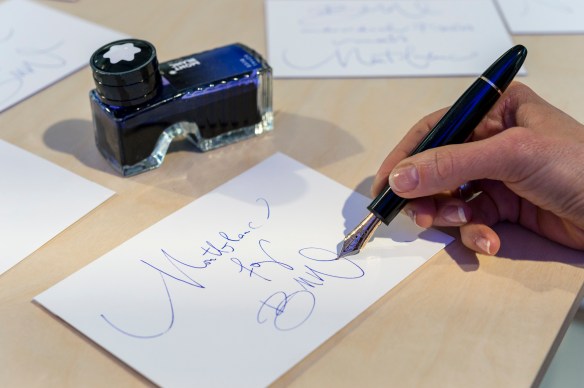
Be that as it may, BMW, in relation to the launch of a limited edition car that may have the longest name in history–The BMW Individual 7 Series THE NEXT 100 YEARS (yes, that is the name)—worked with Montblanc in the creation of hand-writing gear, including a special fountain pen based on the Meisterstuck 149, which features a skeletonized metal cap and barrel that is said to have been inspired by the Merino leather used for the TBI7STN1Y and a “7” engraved into the Au750 rhodium-plated gold nib.

Presumably “The BMW Individual 7 Series THE NEXT 100 YEARS” wouldn’t fit.

While BMW and Montblanc are both luxury brands, it does seem somewhat unusual that BMW didn’t commission something like a special-edition iPad at the very least.

MontBMW

Fun-to-Sit?

While doing laundry, I read on the back of a box of Bounce fabric softener sheets that I was “holding a little box of happy.”

I thought I was holding something that was going to stop fabric cling and make the laundry smell better.

“Happy”?

A favorite metric of auto reviewers is “fun-to-drive.” If that descriptor can be applied to a car or crossover or truck, then it is at some level of acceptable.

If not, then turn the page.

A Google search brings up 18,4-million results for the term.

Admittedly, there are times when it may be fun to drive.

Many people find it exhilarating to be slamming along in a Jeep Wrangler in Poison Spider in Moab. Or driving a Corvette through the twists and turns of Mulholland Highway.

But pretty much, driving is like the fabric softener.

According to the 2015 Urban Mobility Scorecard produced by INRIX and the Texas A&M Transportation Institute (TTI), the average commuter—and let’s be clear here, most of the time you’re driving you are doing so for a purpose that has little to do with “fun”—spends 42 hours per year sitting in rush hour traffic.

Want a reason why Silicon Valley is so keen on autonomous vehicles? How about the findings that the gridlock in San Francisco accounts for 78 hours per annum and it is 67 in San Jose.

“Fun-to-drive.”

Sure.

In the real world, it ought to be “comfortable-to-sit-in.”

Bolt(ed)

At CES this past week, GM chairman and CEO described the production model of the Chevy Bolt, the all-electric vehicle, not to be confused with the Volt, which is a sometimes electric vehicle, by saying:

“We see the Bolt EV as more than just a car. It’s an upgradeable platform for new technologies.”

That whole platform thing makes it sound, well, cooler, doesn’t it? But how many drive cars because they are platforms?

Chevrolet Unveils 2017 Bolt EV at CES

(photo by Steve Fecht for Chevrolet)

Barra went on to say, “Now for the real kicker: this isn’t some science project, or a concept that is years away. The Bolt EV will be in production this year.”

Now certainly at a price of ~$30K after tax rebates, incentives and whatnot, the Bolt is quite a deal.  With a range of some 200 miles, it is dwarfed in distance only by the Tesla Model S, which also has a price tag that isn’t tiny.  (E.g., you might be able to get a two-car garage full of Bolts for the price of one Tesla.)

But we shouldn’t lose sight of the fact that there are other cars–albeit with lesser range–available, including the BMW i3, VW eGolf, Fiat 500e, and Nissan LEAF, so it’s not like General Motors is the only alternative here.

Still, credit must be given to the company that seems to more fully understand that it needs to get faster and different in order to maintain relevance.